
TL;DR
- The Philippine Department of Health directs covered hospitals and healthcare providers to post prices through its Health Facility Price Advisory system.1
- WHO treats medicine price transparency as more than one headline number because factory, retail, and net transaction prices can describe different points in the pricing chain.2
- A systematic review found too little comparative research to promise that price disclosure alone will lower medicine prices or make products affordable.3
- Philippine FDA verification and peso pricing answer separate questions: one checks regulatory information, while the other explains the amount a reader may be asked to pay.4
For Filipino readers, a peso sign can make GLP-1 content look concrete. Yet “₱X only” leaves basic questions unanswered. Is that figure for one unit, one box, or an entire stated period? Does it include added fees? A useful figure is not simply visible. It is labeled well enough to compare without guessing.2
A peso figure needs a job description
Price transparency means showing what kind of price a number represents, not merely printing a currency symbol.2 WHO separates factory, retail, and net transaction prices because each sits at a different point in the chain.2 Philippine health policy adds a local principle: covered providers must make current price information readily accessible to the public.5
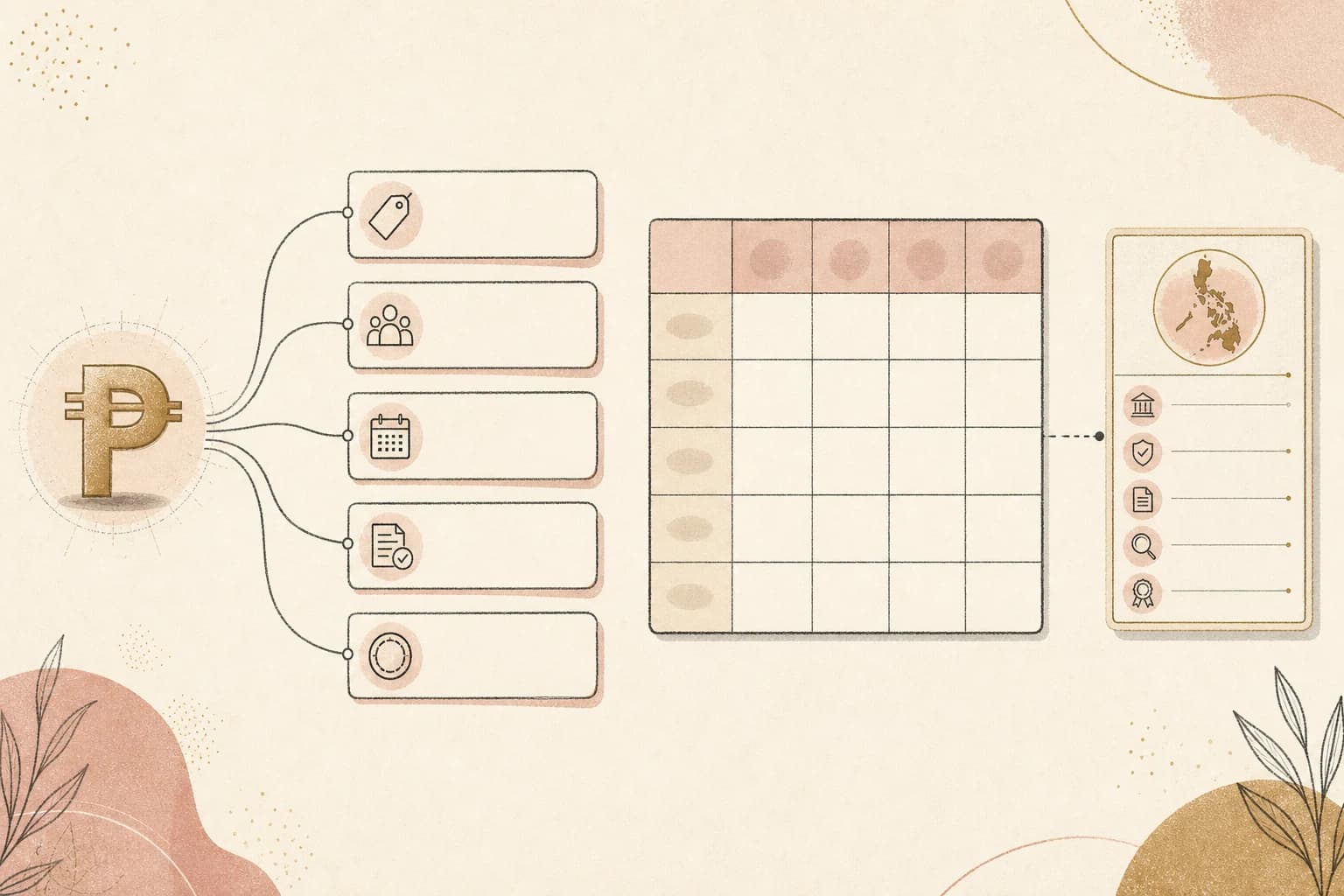
For GLP-1 content, read a price as a labeled measurement. Look for the amount, unit, covered period, included items, excluded fees, and date checked. Without those fields, two identical-looking peso figures may describe different baskets.2 A bold number may still be incomplete even when the arithmetic is correct.2 The aim is not more fine print. It is a price statement whose scope can be understood before anyone tries to compare it.
For a neutral catalog reference, see semaglutide below.
Read the number as a complete sentence
A well-labeled figure answers “how much for what?” in one place. The unit might be an item, pack, service, or another clearly named basis. WHO’s definition covers retail prices and relevant price components, so the denominator matters as much as the peso amount.2 A comparison becomes unreliable when one figure is per item and another covers several items.
Time also needs a label. “Per month” is meaningful only when the content defines what that month includes. The same rule applies to starting figures, recurring figures, and one-time charges. WHO’s broader definition includes relevant price components and pricing methods, not just the visible total.2 Good content should therefore place inclusions, exclusions, source, and check date near the number. Readers should not have to open a message thread to learn what the headline omitted.
The Philippine baseline is public access
The Philippine Universal Health Care framework requires covered providers and facilities to make current prices for offered health services and goods readily accessible to the public.5 A related administrative order covers private and government providers and calls for conspicuous price lists that are updated as prices and services change.6 The Department of Health also directed covered facilities to post prices through its Health Facility Price Advisory system.1
These requirements address healthcare providers and facilities, not every educational story or social post.6 They still offer a useful editorial principle for Philippine-facing content: do not hide the scope of a peso figure. The advisory system aims to standardize price posting, simplify monitoring, and improve public access to price information.7 A magazine article cannot replace that official system. It can make its own figures easier to read by naming the unit, period, inclusions, source, and date.
Transparency does not guarantee affordability
Price visibility and affordability are related ideas, but they are not synonyms. WHO notes that high pharmaceutical prices can create financial hardship and strain broad access to essential medicines.8 That global concern explains why the organization recommends stronger price disclosure.9 It does not prove that publishing one figure will make any product affordable.
The research supports a careful tone. A systematic review screened work on pharmaceutical price-transparency policies and found only two eligible comparative studies.3 One suggested that public disclosure may reduce medicine prices, while cost feedback to prescribers had an inconclusive effect.3 The small evidence base cannot support a broad promise that transparency alone lowers prices or improves access.3 For readers, the immediate value is simpler: a defined figure makes questions and comparisons possible. Whether the amount fits a household budget remains a separate judgment.
For a neutral catalog reference, see tirzepatide below.
List price and take-home price can differ
“The price” can refer to several amounts. The World Health Assembly defines a manufacturer’s net price as the amount left after rebates, discounts, and other incentives are removed.10 That figure may differ from a retail amount or from what one buyer pays.10 A writer should name the layer instead of presenting every number as interchangeable.
Research on advertising shows why context matters. In a randomized experiment, 2,138 US adults viewed prescription-drug ads with no price, a list price, or a list price plus a typical out-of-pocket estimate.11 Responses differed across the three advertised conditions, so one disclosure format did not work the same way everywhere.11 The study used US ads and hypothetical viewing, not Filipino GLP-1 purchases.11 Its useful lesson is narrow: adding a number does not guarantee shared understanding. The label beside the number carries much of the meaning.
Product verification is a separate check
A transparent price cannot verify what a product is. The Philippine FDA Verification Portal gives the public access to lists of licensed establishments, registered health products, product information documents, and approved clinical trials.4 The agency also says the portal is for verification and is not a substitute for regulatory advice.4
This creates two different reading tasks. First, ask whether the peso statement clearly names its unit, scope, inclusions, and date.2 Second, use the appropriate official record for regulatory information rather than treating price, branding, or a polished post as proof.4 One check cannot replace the other. A low, high, or neatly formatted figure says nothing by itself about identity or regulatory standing.4 Keeping those questions apart helps readers avoid giving a price claim more authority than it has.
Useful content makes comparison possible
A healthcare price tool works only when people can understand and use it. A scoping review found weak overall consumer effects for many transparency tools, partly because uptake was low.12 Price-aware patients sometimes chose less costly services and reduced their own spending, but the review was not about the Philippines or GLP-1 products.12
For magazine content, usability starts with a compact price note. It should name the currency, exact unit, covered period, included items, excluded charges, source type, and date checked.2 Any discount should identify the reference figure and the conditions attached to it. Any comparison should keep the same unit and scope on both sides. If those fields are unknown, say that the figure is incomplete rather than smoothing over the gap. Honest limits make a short note more useful than a dramatic but undefined peso headline.
Bottom line
Transparent peso pricing gives GLP-1 content a clearer grammar. Philippine health policy supplies the local principle that covered providers should make current price information publicly accessible.5 WHO adds the wider frame by separating factory, retail, and net transaction prices and their components.2 Research does not justify a promise that disclosure alone will lower prices or improve affordability.3 It does show why a bare number can be a weak tool when people cannot use or interpret it.12 The practical standard is modest: name the amount, unit, period, inclusions, exclusions, source, and date. Then keep price checking separate from official product verification.4
This article is educational research context, not medical advice. Catalog links are neutral references and do not imply a treatment or human-use recommendation.
Frequently asked questions
What counts as transparent peso pricing?
It is a price statement that identifies the amount and what that amount covers. WHO’s definition spans several price types and relevant components.2 For Filipino readers, national health policy adds a local anchor: covered providers should make current price information readily accessible.5
Why is “₱X only” not enough?
The figure may omit its unit, covered period, conditions, or added charges. WHO distinguishes factory, retail, and net transaction prices because they describe different layers.2 Without a label, readers cannot tell whether two numbers measure the same thing, even when both use pesos.
Does a visible price prove affordability?
No. A systematic review found a very small comparative evidence base for pharmaceutical price-transparency policies.3 One disclosure approach suggested lower prices, while another had inconclusive results.3 Affordability still depends on the amount, what it covers, and the buyer’s own circumstances.
Should a price note include a date?
Yes, as an editorial safeguard. WHO recommends disclosure across the pricing and distribution chain and public communication about pricing decisions.9 A check date tells readers when the figure was observed. It does not promise that the same amount applies later or in another setting.
Is a list price the amount a buyer pays?
Not necessarily. The World Health Assembly defines a manufacturer net price after rebates, discounts, and incentives.10 Retail and buyer-paid amounts can sit elsewhere in the chain.10 Content should name the price type instead of assuming that one figure represents every transaction.
Can a clear price replace FDA verification?
No. The Philippine FDA portal provides public regulatory lists, including licensed establishments and registered health products.4 The portal serves verification and is not regulatory advice.4 A price display answers a cost question; it does not establish a product’s identity, quality, or regulatory standing.
Sources
Footnotes
-
Department Circular No. 2021-0454: Utilization of the DOH Health Facility Price Advisory Mobile Application for Public Access to Price Information by Hospitals and Other Health Facility Service Providers. Operational direction in Department Circular No. 2021-0454. The circular concerns facility price information and does not verify a catalog product, establish a nationwide price, or cover every form of GLP-1 content. ↩ ↩2
-
WHO guideline on country pharmaceutical pricing policies; Promoting price transparency: WHO guideline on country pharmaceutical pricing policies, plain-language summary. WHO country pharmaceutical pricing guideline and its plain-language policy summary. This is a policy definition, not evidence that any single displayed figure is a patient's complete cost. ↩ ↩2 ↩3 ↩4 ↩5 ↩6 ↩7 ↩8 ↩9 ↩10 ↩11 ↩12 ↩13
-
Evidence on the effectiveness of policies promoting price transparency - A systematic review. Systematic review of studies published from 2004 through October 2019 on price, expenditure, volume, availability, or affordability outcomes. The small eligible evidence base prevents a broad promise that transparency alone lowers prices or improves affordability. ↩ ↩2 ↩3 ↩4 ↩5 ↩6 ↩7
-
FDA Advisory No. 2023-2238: Utilization of the Food and Drug Administration Verification Portal. Philippine FDA advisory describing the portal and its available regulatory information. The portal is for verification, is not regulatory advice, and does not turn a price statement into proof of product identity or quality. ↩ ↩2 ↩3 ↩4 ↩5 ↩6 ↩7 ↩8
-
Department Circular No. 2021-0454: Utilization of the DOH Health Facility Price Advisory Mobile Application for Public Access to Price Information by Hospitals and Other Health Facility Service Providers. The requirement is quoted in Philippine Department of Health Circular No. 2021-0454. The circular addresses healthcare providers and facilities; it does not establish a current price or access route for any named GLP-1 product. ↩ ↩2 ↩3 ↩4
-
Department Circular No. 2021-0454: Utilization of the DOH Health Facility Price Advisory Mobile Application for Public Access to Price Information by Hospitals and Other Health Facility Service Providers. The administrative order and its operational requirements are summarized in Department Circular No. 2021-0454. The rule applies to healthcare providers and facilities, not automatically to every educational article or social post. ↩ ↩2
-
Department Circular No. 2021-0454: Utilization of the DOH Health Facility Price Advisory Mobile Application for Public Access to Price Information by Hospitals and Other Health Facility Service Providers. Goals listed in Philippine Department of Health Circular No. 2021-0454. A facility information system does not prove that transparency alone makes a health product affordable or verifies a specific catalog listing. ↩
-
WHO guideline on country pharmaceutical pricing policies. Global public-health rationale in the 2020 WHO pharmaceutical pricing guideline. This is a global policy statement and does not quantify hardship, prices, or access for GLP-1 products in the Philippines. ↩
-
WHO guideline on country pharmaceutical pricing policies; Promoting price transparency: WHO guideline on country pharmaceutical pricing policies, plain-language summary. WHO recommendations for national pharmaceutical pricing policy. The recommendations are conditional and require attention to local context, confidentiality arrangements, and data infrastructure. ↩ ↩2
-
Improving the transparency of markets for medicines, vaccines, and other health products. Definition in World Health Assembly Resolution WHA72.8 on health-product market transparency. A manufacturer net price is not necessarily the same as a pharmacy retail price or the amount a particular buyer pays. ↩ ↩2 ↩3 ↩4
-
Does price disclosure in pharmaceutical advertising result in price transparency? Evidence from a randomized experiment. Nine-arm randomized experiment using television-style prescription drug advertisements for three health conditions. The experiment tested US advertising and hypothetical exposure, not Filipino readers, real purchases, or GLP-1 products. ↩ ↩2 ↩3
-
The impact of price transparency on consumers and providers: A scoping review. Scoping review of consumer, provider, and purchaser responses to healthcare price transparency. The review covered healthcare services and insurance settings outside the Philippines and was not specific to GLP-1 medicines. ↩ ↩2 ↩3