
TL;DR
- Retatrutide is described in the published studies as a triple hormone receptor agonist that targets GIP, GLP-1, and glucagon receptors.1
- The phrase “triple agonist” means retatrutide acts on three receptor systems rather than one, when read within its original study context.2
- In the supplied human studies, retatrutide has been studied for type 2 diabetes, obesity, and related metabolic conditions; the studies describe research settings, not a broad clinical claim.3
- A phase 3 trial in adults with type 2 diabetes found that retatrutide lowered HbA1c more than placebo over 40 weeks.4
For readers in the Philippines tracking retatrutide news, the most useful question is simple: what does “triple agonist” mean? The phrase refers to three receptor systems, and the published studies use it to describe retatrutide’s target pattern.12 That makes the nickname easier to understand, but it also keeps the evidence in its research setting.3
Why researchers are studying Retatrutide / Reta
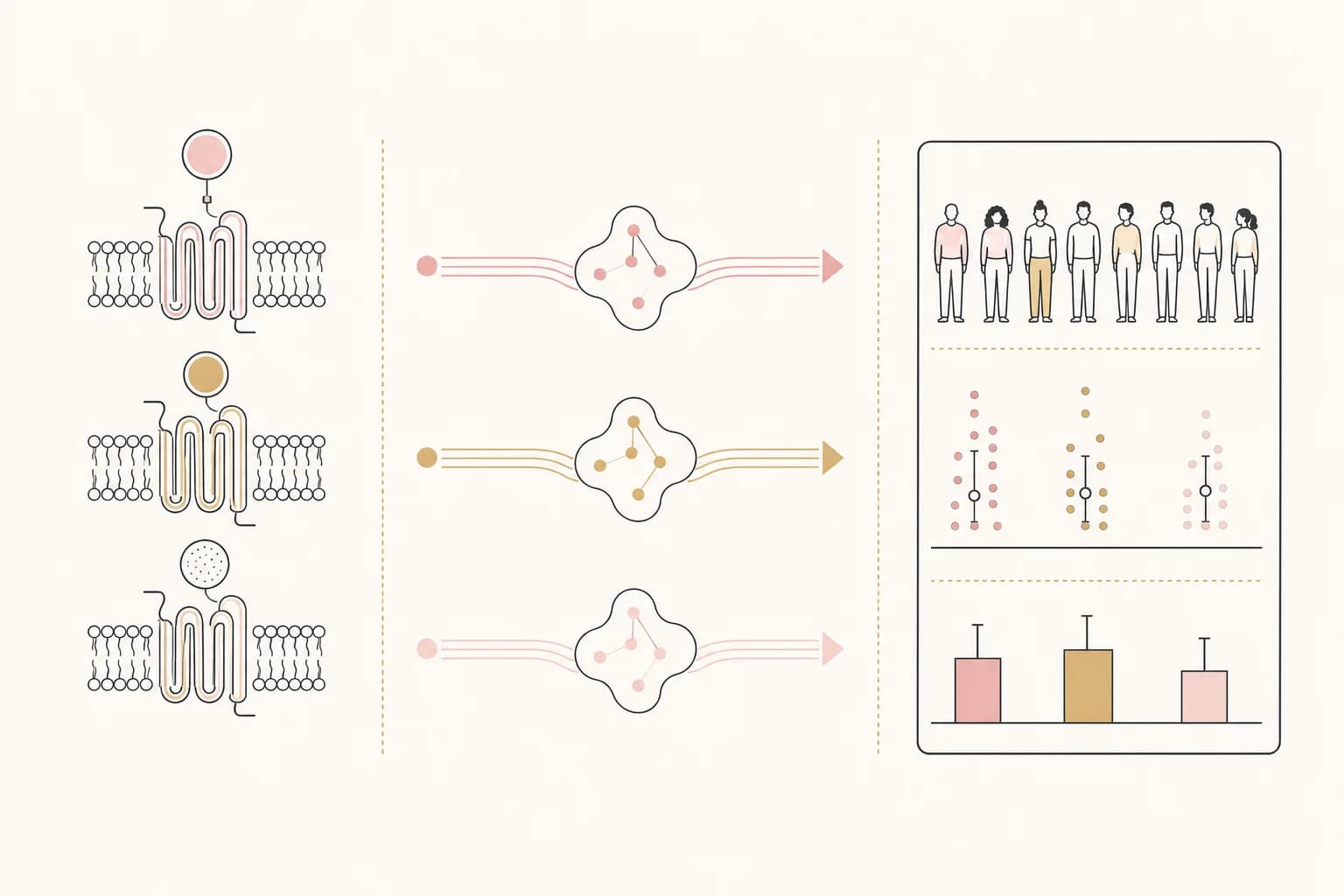
In plain English, “triple agonist” means retatrutide acts on three receptor systems rather than one.2 The published studies describe those receptors as GIP, GLP-1, and glucagon.1
That wording matters because it is a research description, not an everyday treatment label.1 In the supplied human studies, retatrutide has been studied for type 2 diabetes, obesity, and related metabolic conditions.3 Researchers are interested because the receptor pattern is unusual and easy to compare across trials.12 It gives them a structured way to ask different metabolic questions without mixing the endpoints together.3 The nickname comes from that design, not from a finished clinical story.13 It is a shorthand for how the molecule is being studied.12
It is not a claim that one result explains everything.3 It simply names the three targets that appear in the published abstracts.1
For readers looking for the exact topic in the catalog, the Retatrutide card below shows its live details. It is a catalog reference, not research evidence or a recommendation.
Why researchers are interested in retatrutide
The main interest in retatrutide comes from the pattern of human findings.3 Those findings cover type 2 diabetes, obesity, and related metabolic conditions.3
In the phase 3 diabetes trial, retatrutide lowered HbA1c more than placebo over 40 weeks.4 The same trial also measured bodyweight change as a key secondary outcome.5 That matters because glucose control and bodyweight are related, but they are not the same endpoint.45
The phase 2 appetite analyses add another layer.6 Higher retatrutide groups showed greater reductions in appetite-related measures than placebo.6 In that study, reductions in perceived hunger and disinhibition were reported alongside larger bodyweight reductions.7 The association is interesting, but it does not prove one change caused the other.7
The body-composition substudy reported greater body fat reduction with retatrutide.8 This was seen in adults with type 2 diabetes.8 That same study context matters, because body composition is not the same as long-term clinical outcome.8
What human studies have reported so far
The human record is broader than one headline result.4689 It includes phase 3, phase 2, and substudy evidence, each answering a different question.4689
A liver-fat substudy reported large reductions in liver fat with retatrutide versus placebo.9 It studied people with metabolic dysfunction-associated steatotic liver disease.9 That was a subgroup study within a larger obesity trial.9 So the finding is useful, but it should be read in that narrower context.9
Taken together, the reports point in the same general metabolic direction.4689 They do not collapse into one simple outcome, though.4689 Each paper still stands on its own methods and endpoints.4689 That is why readers should separate the diabetes result, the appetite analyses, the body-fat substudy, and the liver-fat substudy.4689
What the mechanism talk is based on
The mechanism discussion starts with the receptor list itself.12 If a study describes retatrutide as acting on GIP, GLP-1, and glucagon receptors, “triple agonist” is the plain-language summary.12
Some post-hoc analyses went a step further.10 They reported that retatrutide-related changes in ANGPTL3/8 paralleled changes in triglycerides and LDL cholesterol.10 That is supportive biologic evidence, but parallel change does not by itself prove a direct clinical mechanism.10
So the receptor story explains the name, while the ANGPTL3/8 findings offer a clue about possible biology.110 Those analyses help explain why the drug keeps drawing research interest.10 They do not settle the mechanism on their own.10 They also should not be read as replacing the human trial outcomes.4689 They sit beside those outcomes as a separate line of evidence.10
For readers comparing nearby catalog topics, the Tirzepatide card below opens its live catalog details. It is a separate reference, not proof of compatibility or a recommendation.
What the CKD study is trying to answer
The kidney research program asks a different question.11 A phase 2b CKD study is underway to examine retatrutide’s effect on measured kidney filtration and kidney imaging markers.11
The paper describing that work says the study is placebo-controlled and double-blind.12 That design detail helps readers place the trial in context.12 It shows how the program is moving from a metabolic story toward a kidney-focused question.1112
At this stage, the CKD paper is a study description and baseline report, not a completed outcome paper.11 That distinction matters because protocol-level information can explain the research plan without answering the clinical question.1112 Readers should treat it as the next chapter of the program, not the final chapter.1112 The point is to see what the researchers are testing now.11
Study context and limits to keep in mind
Retatrutide is called a triple agonist because the published studies describe it as targeting GIP, GLP-1, and glucagon receptors.12 That receptor label is only the starting point, though.12
The reason it keeps attracting attention is the human research record.34689 A phase 3 diabetes trial lowered HbA1c more than placebo.4 A phase 2 study reported appetite-related changes.6 One substudy found more body-fat reduction, and another found large liver-fat reductions.89 Those are encouraging study results, but they remain separate study findings.4689
The CKD program shows how research can move into a new question before final outcomes are ready.1112 Registry records can help confirm that a trial exists or has been completed.13 They do not provide full outcome detail by themselves.13 For that reason, the published papers matter most when readers want to know what was actually found.468913
A careful reading keeps the scope narrow.13
Questions the evidence leaves open
Retatrutide’s triple-agonist label is about receptor targets, not a finished clinical story.12 The human studies so far are the reason researchers keep watching it.4689
What remains open is how to connect the findings into one biological story.1011 The studies point in a similar direction, but they come from different designs and analyses.468910 That is why the label is useful, yet still modest.12 It names the targets first and leaves the rest to the evidence.14689
The kidney study may add another piece later.1112 For now, the safest summary is that “triple” refers to three receptor systems.12 The continuing interest comes from the pattern of human findings, not from a single headline result.34689 Readers can think of retatrutide as a research story that is still being assembled, one study at a time.111213
Bottom line
Retatrutide is called a triple agonist because studies describe three receptor targets.12 That nickname means it works on three receptor systems, not one, in research descriptions.1 Human studies are what keep the term attention-getting.34689 One phase 3 trial reported lower HbA1c than placebo over 40 weeks in adults with type 2 diabetes.4 Separate studies reported appetite-related changes, body-fat reductions, and liver-fat reductions.689 The CKD study shows the research program is still moving into new questions.1112 Registry entries can confirm trial status, but they do not replace published outcomes.13
The plain-English takeaway is simple: the name comes from receptor targets.12
This article is educational research context, not medical advice. Catalog links are neutral references and do not imply a treatment or human-use recommendation.
Frequently asked questions
What does “triple agonist” mean?
It means retatrutide acts on three receptor systems instead of one.2 The published studies name those receptors as GIP, GLP-1, and glucagon.1 In plain English, the label describes the target pattern that researchers are studying.12 It does not, by itself, prove clinical benefit.1
What have human studies shown so far?
The human findings include phase 3 diabetes results and phase 2 appetite findings.46 They also include body-fat and liver-fat substudies.89 The studies report these outcomes separately, so it helps to read them one by one.4689 That is why the overall picture is best seen as a group of related findings, not one single result.3
How should Filipino readers interpret this research?
Filipino readers should see the studies as research context rather than a local treatment guide.3 The key point is the receptor label and the pattern of human findings.124689 It is useful to follow the science carefully, while keeping each study’s setting in view.3 This question is about interpretation, not local access or regulation.3
What is the CKD study adding?
It adds a separate kidney-focused question.11 The phase 2b CKD study is examining measured kidney filtration and kidney imaging markers.11 The paper describes it as placebo-controlled and double-blind.1112 That makes it a protocol-level source for the next stage of research, not final outcome evidence.11
Why mention registry records at all?
Registry records help show that a trial exists or has been completed.13 They do not give the full outcome story on their own.13 Registry status is useful background. Published results still matter most when judging what a study found.13 The record and the paper serve different jobs.13
What remains open about retatrutide?
What remains open is how to connect the human findings into one biological story.710 That is why the triple-agonist label is a starting point, not a final answer.12 More work is needed before the broader picture feels settled.1112
Sources
Footnotes
-
Efficacy and safety of retatrutide, a GIP, GLP-1, and glucagon receptor agonist, in people with type 2 diabetes and inadequate glycaemic control with diet and exercise (TRANSCEND-T2D-1): a double-blind, randomised, phase 3 trial.; Rationale, design and baseline characteristics of the TRANSCEND-CKD trial of retatrutide in patients with chronic kidney disease.; Decreases in circulating ANGPTL3/8 concentrations following retatrutide treatment parallel reductions in serum lipids.; Triple hormone receptor agonist retatrutide for metabolic dysfunction-associated steatotic liver disease: a randomized phase 2a trial.. Multiple supplied human trial papers and related analyses use this same receptor description. This is a research description, not a statement about approval or everyday use. ↩ ↩2 ↩3 ↩4 ↩5 ↩6 ↩7 ↩8 ↩9 ↩10 ↩11 ↩12 ↩13 ↩14 ↩15 ↩16 ↩17 ↩18 ↩19 ↩20 ↩21 ↩22 ↩23 ↩24 ↩25 ↩26
-
Efficacy and safety of retatrutide, a GIP, GLP-1, and glucagon receptor agonist, in people with type 2 diabetes and inadequate glycaemic control with diet and exercise (TRANSCEND-T2D-1): a double-blind, randomised, phase 3 trial.; Rationale, design and baseline characteristics of the TRANSCEND-CKD trial of retatrutide in patients with chronic kidney disease.; Decreases in circulating ANGPTL3/8 concentrations following retatrutide treatment parallel reductions in serum lipids.; Triple hormone receptor agonist retatrutide for metabolic dysfunction-associated steatotic liver disease: a randomized phase 2a trial.. Plain-language definition supported by the receptor list in the supplied abstracts. ↩ ↩2 ↩3 ↩4 ↩5 ↩6 ↩7 ↩8 ↩9 ↩10 ↩11 ↩12 ↩13 ↩14 ↩15 ↩16 ↩17 ↩18
-
Efficacy and safety of retatrutide, a GIP, GLP-1, and glucagon receptor agonist, in people with type 2 diabetes and inadequate glycaemic control with diet and exercise (TRANSCEND-T2D-1): a double-blind, randomised, phase 3 trial.; Rationale, design and baseline characteristics of the TRANSCEND-CKD trial of retatrutide in patients with chronic kidney disease.; Triple hormone receptor agonist retatrutide for metabolic dysfunction-associated steatotic liver disease: a randomized phase 2a trial.. Background and trial descriptions in the abstracts. The studies describe research settings, not a broad clinical claim. ↩ ↩2 ↩3 ↩4 ↩5 ↩6 ↩7 ↩8 ↩9 ↩10 ↩11 ↩12 ↩13 ↩14 ↩15 ↩16
-
Efficacy and safety of retatrutide, a GIP, GLP-1, and glucagon receptor agonist, in people with type 2 diabetes and inadequate glycaemic control with diet and exercise (TRANSCEND-T2D-1): a double-blind, randomised, phase 3 trial.. TRANSCEND-T2D-1 phase 3 randomized controlled trial. The abstract excerpt supplied is truncated, so the full numerical details are not reproduced here. ↩ ↩2 ↩3 ↩4 ↩5 ↩6 ↩7 ↩8 ↩9 ↩10 ↩11 ↩12 ↩13 ↩14 ↩15 ↩16 ↩17 ↩18 ↩19 ↩20 ↩21 ↩22 ↩23
-
Efficacy and safety of retatrutide, a GIP, GLP-1, and glucagon receptor agonist, in people with type 2 diabetes and inadequate glycaemic control with diet and exercise (TRANSCEND-T2D-1): a double-blind, randomised, phase 3 trial.. TRANSCEND-T2D-1 primary and key secondary endpoints. ↩ ↩2
-
Appetite, eating attitudes, and eating behaviours during treatment with retatrutide in adults with type 2 diabetes: Results of a phase 2 study.. Exploratory appetite and eating-behavior analyses from a randomized study. Differences versus dulaglutide were less consistent in the abstract. ↩ ↩2 ↩3 ↩4 ↩5 ↩6 ↩7 ↩8 ↩9 ↩10 ↩11 ↩12 ↩13 ↩14 ↩15 ↩16 ↩17 ↩18 ↩19 ↩20 ↩21 ↩22
-
Appetite, eating attitudes, and eating behaviours during treatment with retatrutide in adults with type 2 diabetes: Results of a phase 2 study.. Pre-specified exploratory analyses with correlation testing. The association does not prove one caused the other. ↩ ↩2 ↩3
-
Effects of retatrutide on body composition in people with type 2 diabetes: a substudy of a phase 2, double-blind, parallel-group, placebo-controlled, randomised trial.. Phase 2 substudy using DXA measurements. The substudy focuses on body composition, not on long-term clinical outcomes. ↩ ↩2 ↩3 ↩4 ↩5 ↩6 ↩7 ↩8 ↩9 ↩10 ↩11 ↩12 ↩13 ↩14 ↩15 ↩16 ↩17 ↩18 ↩19 ↩20 ↩21 ↩22 ↩23
-
Triple hormone receptor agonist retatrutide for metabolic dysfunction-associated steatotic liver disease: a randomized phase 2a trial.. Randomized phase 2a substudy. This is a subgroup study within a larger obesity trial. ↩ ↩2 ↩3 ↩4 ↩5 ↩6 ↩7 ↩8 ↩9 ↩10 ↩11 ↩12 ↩13 ↩14 ↩15 ↩16 ↩17 ↩18 ↩19 ↩20 ↩21 ↩22 ↩23 ↩24
-
Decreases in circulating ANGPTL3/8 concentrations following retatrutide treatment parallel reductions in serum lipids.. Post-hoc human analyses plus supporting hepatocyte experiments. Parallel change does not by itself show a direct clinical mechanism. ↩ ↩2 ↩3 ↩4 ↩5 ↩6 ↩7 ↩8 ↩9 ↩10
-
Rationale, design and baseline characteristics of the TRANSCEND-CKD trial of retatrutide in patients with chronic kidney disease.. TRANSCEND-CKD design and baseline report. This source describes the study plan and baseline characteristics, not completed outcome results. ↩ ↩2 ↩3 ↩4 ↩5 ↩6 ↩7 ↩8 ↩9 ↩10 ↩11 ↩12 ↩13 ↩14 ↩15 ↩16 ↩17
-
Rationale, design and baseline characteristics of the TRANSCEND-CKD trial of retatrutide in patients with chronic kidney disease.. Trial design description. ↩ ↩2 ↩3 ↩4 ↩5 ↩6 ↩7 ↩8 ↩9 ↩10 ↩11
-
Efficacy and safety of retatrutide, a GIP, GLP-1, and glucagon receptor agonist, in people with type 2 diabetes and inadequate glycaemic control with diet and exercise (TRANSCEND-T2D-1): a double-blind, randomised, phase 3 trial.; A Phase 1, Open-label, Single-arm Study to Investigate the Effect of Retatrutide on Metoprolol Pharmacokinetics in Healthy Participants; A Randomized, Placebo-Controlled, Parallel Study to Investigate the Response of Participants With Type 2 Diabetes Mellitus on Once-Weekly Retatrutide to Hypoglycemia; A Randomized, Double-Blind, Phase 3 Study to Investigate the Efficacy and Safety of LY3437943 Once Weekly Compared to Placebo in Participants With Severe Obesity and Established Cardiovascular Disease; A Master Protocol to Investigate the Efficacy and Safety of LY3437943 Once Weekly in Participants Without Type 2 Diabetes Who Have Obesity or Overweight: A Randomized, Double-Blind, Placebo-Controlled Trial (TRIUMPH-1). ClinicalTrials.gov-related registry context supplied in the source set. The article should rely on the published paper for results, not on registry status alone. ↩ ↩2 ↩3 ↩4 ↩5 ↩6 ↩7 ↩8 ↩9