
TL;DR
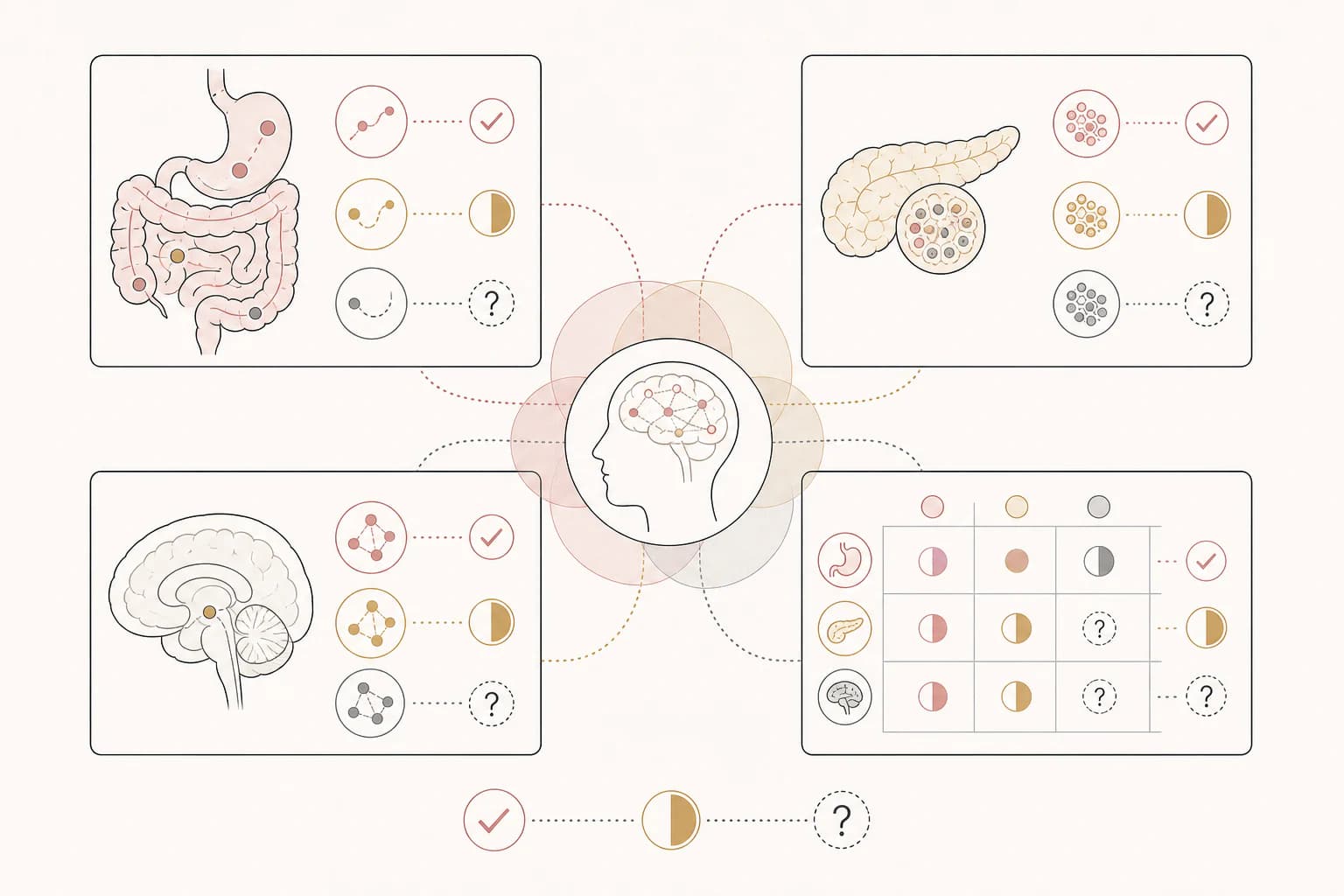
- Appetite control is not one switch. Researchers study combinations because gut, pancreatic, and brain signals form an overlapping network that can shape eating and body weight.1
- Amylin and GLP-1 pathways are separate but related. Studying both may reveal complementary effects that a single pathway cannot fully explain.2
- In a large human phase 3 trial, cagrilintide-semaglutide reduced mean body weight more than placebo, under defined trial conditions.3
- Combination evidence has limits because results belong to specific populations and follow-up periods, while broader outcomes and longer-term safety still need study.4
For Filipino readers, the key question is not whether two signals are automatically “better” than one. It is why scientists test that idea. Appetite biology involves several messages moving between the gut, pancreas, and brain.1 Combination research asks whether reaching different parts of that network can produce a distinct, measurable response.2
Why one appetite target may be too simple
Researchers do not view appetite as a single dial controlled by one hormone.1 Instead, several signals help connect meals, pancreatic activity, brain circuits, and body-weight regulation.1 That complexity gives scientists a clear reason to compare one-pathway and multi-pathway approaches.1 It also explains why a useful result from one target may not settle the whole biological question.5
These signals can overlap without doing the same job.1 A study can therefore ask a focused question: does engaging a second pathway change a measured outcome under the same trial conditions?2 The answer must come from comparison groups, not from the number of pathways alone.4
This logic is a research rationale, not proof that every pairing works better.1 Each combination still needs direct testing against placebo and relevant single-pathway comparators.4 Researchers must also examine adverse events and how long participants were followed.4
For readers who want to identify the research compound discussed here, cagrilintide appears below as a neutral catalog reference.
Amylin and GLP-1 bring different signals
Amylin is released with insulin from pancreatic beta cells.6 Reviews describe its satiety effects across brain regions involved in energy balance and reward.6 GLP-1 receptor activation also affects appetite, but it does not duplicate amylin biology point for point.2
That difference is the scientific appeal of pairing cagrilintide, an amylin analogue, with semaglutide, a GLP-1 receptor agonist.2 Researchers can ask whether two related signals produce complementary effects when tested together.2 The hypothesis is more precise than simply “more hormones means more effect.”2
Mechanistic fit is only a starting point.2 A convincing case also requires randomized human comparisons, safety reporting, and enough follow-up to interpret benefits and harms.4 Biology can suggest a direction, but trials must establish what actually happens in defined groups.4
Human trials test the combination idea
The REDEFINE 1 trial enrolled 3,417 adults without diabetes.3 Participants had obesity, or overweight with at least one related complication.3 All groups also received lifestyle intervention during the 68-week randomized phase 3 study.3
Mean body weight fell more with cagrilintide-semaglutide than with placebo under those trial conditions.3 This finding supports the basic research idea that two pathways can produce a different outcome from an inactive comparison.3 It does not show that every appetite-hormone combination will behave similarly.1
Safety remains part of the same result, not a footnote to it.7 Gastrointestinal adverse events were more common with the combination than placebo.7 They were mainly transient and mild to moderate in the trial report.7 Uncommon or longer-term harms cannot be resolved by one 68-week study.7
A closer regional comparison adds context
REDEFINE 5 offers a more regionally relevant comparison, although it was not a Philippine study.8 The randomized phase 3 trial included 331 adults in Japan and Taiwan.8 Participants met specified Japanese criteria for obesity or overweight with complications.8 Some had type 2 diabetes, while others did not.8
After 68 weeks, mean body-weight reduction was greater with cagrilintide-semaglutide than semaglutide alone.8 That active comparison matters because it asks more than whether the combination beats placebo.8 It directly examines whether adding an amylin pathway changes the result beyond a GLP-1 pathway alone.8
Still, Filipino readers should not treat East Asian enrollment as Philippine evidence.8 Different eligibility rules and participant characteristics limit direct generalization.8 The study strengthens the regional conversation without closing it.4
Diabetes research asks another question
Combination research is not limited to body weight.9 REIMAGINE 2 studied adults with type 2 diabetes and overweight or obesity.9 Participants were receiving metformin, with or without an SGLT2 inhibitor.9 The multinational phase 3 trial compared cagrilintide-semaglutide with semaglutide and other trial groups over 68 weeks.9
The combination lowered HbA1c slightly more than semaglutide alone.9 That difference was statistically significant, but modest in size.9 It answers a narrower question about glycemic control in a defined diabetes population.9
This distinction protects readers from overreading the result.9 A diabetes endpoint is not interchangeable with an appetite mechanism, body-weight outcome, or general wellness claim.9 Different outcomes require their own evidence and context.4
For readers comparing the two research identities discussed above, semaglutide appears below as a neutral catalog reference.
Animal studies reveal separate brain circuits
Human trials show outcomes, while animal and laboratory studies can probe possible mechanisms.10 In mice, researchers altered GIP receptors in selected brain regions.10 They then examined responses to GIP receptor agonists or antagonists, alone and with GLP-1 or amylin receptor agonists.10
The findings linked appetite suppression from GIP receptor agonism to the area postrema.10 They linked added weight effects from GIP receptor antagonism to hypothalamic GIP receptors.10 This helps explain why even opposite actions at one receptor can behave differently within combinations.10
Another laboratory project mapped more than 530,000 brainstem cells across rats, mice, and macaques.11 Functional knockdown experiments in rats implicated one conserved neuron population in cagrilintide effects.11 Semaglutide effects persisted after that same knockdown.11 The causal test was in rats, so it cannot establish the identical mechanism in people.11
Meta-analysis supports caution with comparisons
A systematic review pooled four randomized trials involving 5,023 adults with overweight or obesity.12 Both cagrilintide and cagrilintide-semaglutide reduced body weight versus placebo in the combined analysis.12 These pooled findings support continued research on the amylin pathway and its pairing with GLP-1.12
However, a meta-analysis combines studies with their own designs, populations, and comparisons.12 Four trials remain a limited base for answering every question about who responds, how outcomes compare, or what happens over longer periods.12 Pooled placebo comparisons also cannot replace every direct head-to-head trial.12
That is why researchers keep separating three questions.4 Does the biology look complementary, does the combination improve a chosen outcome, and is the full safety picture acceptable over time?4 One positive answer cannot automatically settle the other two.4
Why “more pathways” does not mean “more certainty”
Responses to GLP-1 receptor agonist monotherapy vary among people.5 That variability is one reason researchers explore additional hormone pathways.5 It does not mean every person needs a combination or will respond in the same way.5
Trial populations also matter.4 Evidence here spans adults without diabetes, adults with type 2 diabetes, and an East Asian trial using specific eligibility rules.389 Animal and laboratory findings answer mechanism questions, not direct human outcome questions.1011
The most responsible reading is therefore conditional.4 Combining appetite signals is a testable strategy supported by biological rationale and several human trial results.23 Its meaning remains tied to each comparator, endpoint, population, and follow-up period.4
Bottom line
Researchers combine appetite hormones because the underlying biology is a network, not a lone target.1 Amylin and GLP-1 pathways offer a concrete example of related signals with potentially complementary actions.2 Randomized human trials show that cagrilintide-semaglutide can outperform placebo or semaglutide alone on selected outcomes in defined populations.389
That evidence is meaningful, but it is not universal.4 Gastrointestinal adverse events were common in a major phase 3 trial, and longer-term questions remain.74 Animal work can clarify circuits, yet it cannot substitute for Filipino human data.1011 The research case is therefore about testing complementary biology carefully, not assuming that targeting more signals must produce a better answer.1
Frequently asked questions
What does “combining appetite hormones” mean in this research?
It means studying compounds that engage more than one hormone pathway, either together or within one multi-receptor design.3 The cagrilintide-semaglutide example pairs amylin and GLP-1 receptor activity.2 Researchers then compare defined outcomes with placebo or single-pathway groups.38 This design tests whether combined biology changes the measured response.2
Why not focus only on GLP-1?
People show varied responses to GLP-1 receptor agonist monotherapy.5 Appetite and body-weight regulation also involve several interacting signals.1 Researchers therefore test whether another pathway adds a distinct effect, while recognizing that results can differ among people.25 Direct comparisons must still answer that question in each population.4
What role does amylin play?
Amylin is released with insulin from pancreatic beta cells.6 Reviews connect it with satiety signaling in homeostatic and reward-related brain regions.6 Its pathway differs from, but relates to, GLP-1 signaling.2 That relationship creates a rationale for controlled combination studies.2 Cagrilintide is the amylin analogue in the example here.2
Have combinations beaten single-pathway comparators?
Yes, in specific human trials and for selected outcomes.89 A Japan and Taiwan trial found greater mean body-weight reduction than semaglutide alone.8 A multinational diabetes trial found a modestly greater HbA1c reduction than semaglutide alone.9 Neither comparison establishes the same result for every group.4
Do animal findings prove how combinations work in people?
No. Mouse experiments can isolate brain regions, and rat experiments can test selected neuron populations.1011 Those designs help identify possible mechanisms.10 They cannot confirm that identical circuits produce identical effects in Filipino people or other human populations.11 Relevant human studies must test human outcomes directly.4
What remains uncertain?
Results remain tied to each trial’s population, endpoint, comparator, and follow-up.4 One major study lasted 68 weeks and cannot settle longer-term harms.7 Reviews identify broader outcomes and long-term safety as continuing research needs.4
This article is educational research context, not medical advice. Catalog links are neutral references and do not imply a treatment or human-use recommendation.
Sources
Footnotes
-
Cagrilintide: A Long-Acting Amylin Analog for the Treatment of Obesity.; Novel GLP-1-based Medications for Type 2 Diabetes and Obesity.. Narrative reviews integrating physiological, preclinical, and clinical research on GLP-1, GIP, glucagon, and amylin pathways. This is a mechanistic research framework, not proof that every combination outperforms a single-pathway approach. ↩ ↩2 ↩3 ↩4 ↩5 ↩6 ↩7 ↩8 ↩9 ↩10 ↩11
-
Cagrilintide: A Long-Acting Amylin Analog for the Treatment of Obesity.; Novel GLP-1-based Medications for Type 2 Diabetes and Obesity.. Mechanistic reviews covering cagrilintide, semaglutide, and emerging multi-pathway approaches. A plausible complementary mechanism does not itself establish clinical superiority or long-term safety. ↩ ↩2 ↩3 ↩4 ↩5 ↩6 ↩7 ↩8 ↩9 ↩10 ↩11 ↩12 ↩13 ↩14 ↩15 ↩16
-
Coadministered Cagrilintide and Semaglutide in Adults with Overweight or Obesity.. Randomized, double-blind, placebo- and active-controlled human phase 3a trial; all groups also received lifestyle intervention. The result applies to the studied population, trial conditions, and follow-up period; it is not a general human-use recommendation. ↩ ↩2 ↩3 ↩4 ↩5 ↩6 ↩7 ↩8 ↩9 ↩10 ↩11
-
Oral glucagon-like peptide-1 receptor agonists and combinations of entero-pancreatic hormones as treatments for adults with type 2 diabetes: where are we now?; Coadministered Cagrilintide and Semaglutide in Adults with Overweight or Obesity.. Synthesis of a clinical-development review and a 68-week randomized phase 3 human trial. This supports caution about generalization but does not establish an unsupported absence of all long-term evidence. ↩ ↩2 ↩3 ↩4 ↩5 ↩6 ↩7 ↩8 ↩9 ↩10 ↩11 ↩12 ↩13 ↩14 ↩15 ↩16 ↩17 ↩18 ↩19 ↩20 ↩21
-
Oral glucagon-like peptide-1 receptor agonists and combinations of entero-pancreatic hormones as treatments for adults with type 2 diabetes: where are we now?. Review of clinical research on oral GLP-1 receptor agonists and dual or triple entero-pancreatic hormone approaches in adults with type 2 diabetes or obesity. The review describes heterogeneity but does not show that a combination is preferable for every individual. ↩ ↩2 ↩3 ↩4 ↩5 ↩6
-
Cagrilintide: A Long-Acting Amylin Analog for the Treatment of Obesity.. Narrative review of amylin physiology and cagrilintide development. The source summarizes a broad evidence base and does not quantify each pathway's contribution in humans. ↩ ↩2 ↩3 ↩4
-
Coadministered Cagrilintide and Semaglutide in Adults with Overweight or Obesity.. Safety findings from the 68-week randomized human REDEFINE 1 trial. Trial summaries do not resolve uncommon or longer-term harms. ↩ ↩2 ↩3 ↩4 ↩5 ↩6
-
Efficacy and safety of co-administered cagrilintide and semaglutide versus semaglutide alone in adults with overweight or obesity with or without type 2 diabetes in Japan and Taiwan (REDEFINE 5): a multicentre, randomised, active-controlled, phase 3a trial.. Double-blind human trial in 331 East Asian adults with obesity or overweight and specified complications, with or without type 2 diabetes. The subgroup was defined by Japanese obesity criteria and largely enrolled in Japan, so it does not directly represent Filipino populations. ↩ ↩2 ↩3 ↩4 ↩5 ↩6 ↩7 ↩8 ↩9 ↩10 ↩11 ↩12 ↩13 ↩14
-
Cagrilintide-semaglutide (CagriSema) versus semaglutide or cagrilintide in people with type 2 diabetes (REIMAGINE 2): a double-blind, randomised, controlled, phase 3 study.. Randomized, double-blind, multinational human REIMAGINE 2 trial in participants receiving metformin with or without an SGLT2 inhibitor. The between-group HbA1c difference was modest, and the finding applies to the studied diabetes population. ↩ ↩2 ↩3 ↩4 ↩5 ↩6 ↩7 ↩8 ↩9 ↩10 ↩11 ↩12 ↩13
-
Distinct brain regions mediate regulation of food intake in response to GIPR agonism or antagonism.. Preclinical mouse knockout and peptide-administration experiments involving the area postrema, hypothalamus, liraglutide, and cagrilintide. Animal mechanisms cannot be assumed to operate identically or produce the same outcomes in humans. ↩ ↩2 ↩3 ↩4 ↩5 ↩6 ↩7 ↩8 ↩9 ↩10
-
A cross-species atlas of the dorsal vagal complex reveals neural mediators of the effects of cagrilintide on energy balance.. Laboratory transcriptomic mapping across rat, mouse, and macaque tissue, with conservation analysis involving humans and functional knockdown experiments in rats. The functional causal test was performed in rats, not people. ↩ ↩2 ↩3 ↩4 ↩5 ↩6 ↩7 ↩8
-
Cagrilintide and CagriSema for weight reduction and metabolic risk modification in overweight or obesity: a systematic review and meta-analysis.. Systematic review and random-effects meta-analysis of randomized controlled trials in adults with overweight or obesity. Only four trials were pooled, and combined estimates do not replace direct head-to-head evidence for every comparison. ↩ ↩2 ↩3 ↩4 ↩5 ↩6