
Quick answer
Growth-hormone peptides fit gym content because a simple biological story—more hormone, more muscle, faster recovery—sounds intuitive. The studies are much less direct.
Ipamorelin has produced a temporary growth-hormone pulse in healthy male volunteers, but a controlled postoperative trial did not show a significant recovery benefit. A CJC-1295 and ipamorelin combination has a positive mouse finding, not a bodybuilding trial in people. This article does not measure how common these posts are in the Philippines. It explains why the message travels easily and where the evidence stops.123
Why does the story sound persuasive?
The pitch compresses a long pathway into one sentence. Growth hormone and IGF-1 are involved in metabolism, tissue growth, and body composition, so changing the pathway can sound like direct proof of better gym results.
But pathway activity is not the same as a clinical outcome. A hormone spike does not automatically establish more strength, larger muscles, quicker injury recovery, or improved performance.
Ipamorelin is a growth-hormone secretagogue, meaning it can stimulate growth-hormone release. That description explains a mechanism; it does not supply the missing performance trial.1
Readers researching Ipamorelin can view its live catalog details below. The listing identifies the catalog item and is separate from the evidence discussed here.
What happened in healthy volunteers?
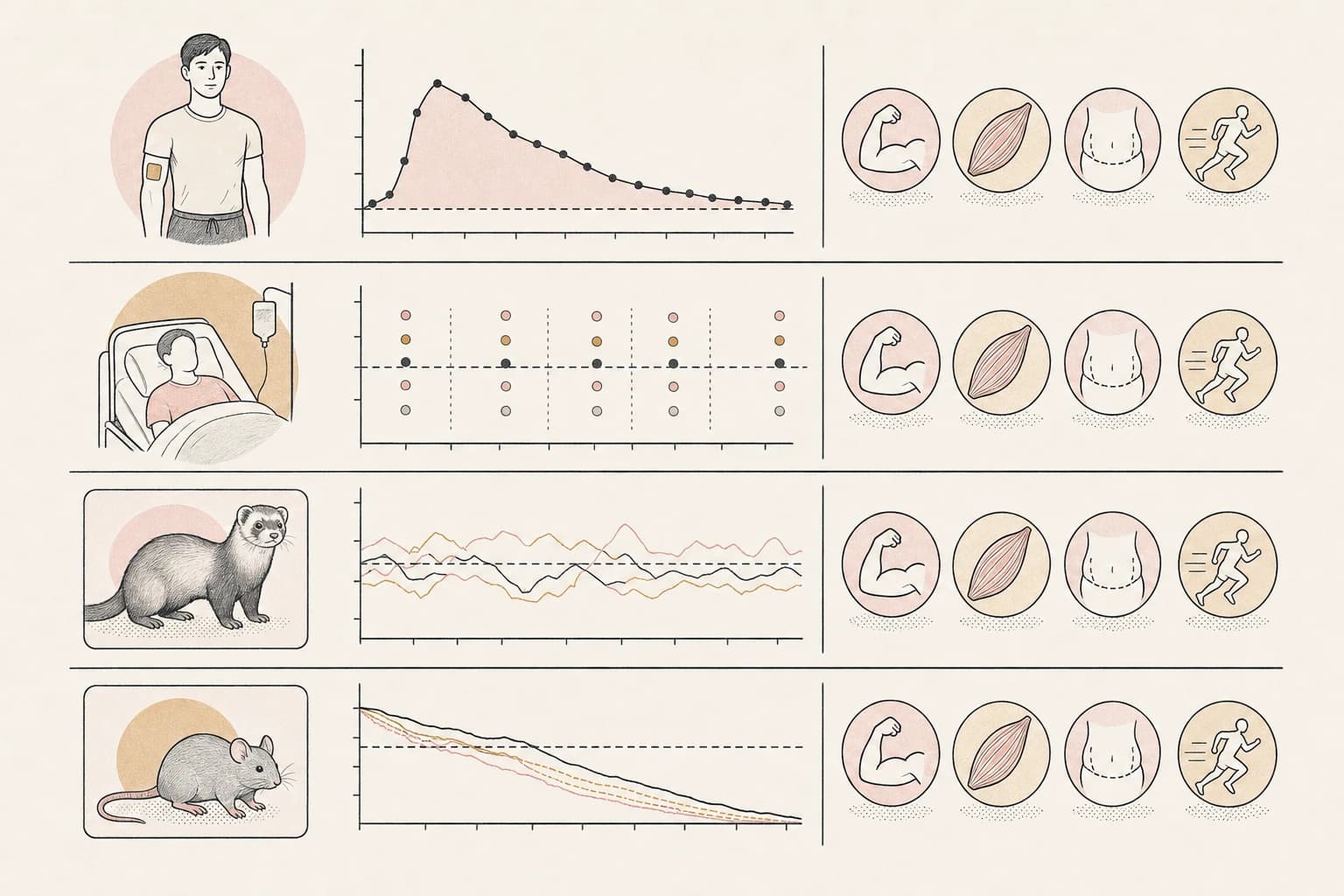
Researchers provided ipamorelin to healthy male volunteers and modeled its pharmacokinetic and pharmacodynamic effects. The study observed a single episode of growth-hormone release followed by a decline.1
The model also found more between-person variability in the hormone-response measurements than in drug exposure. In plain language, people with similar exposure did not necessarily show identical biological responses.1
That result confirms a temporary hormone effect. It does not report resistance-training progress, muscle thickness, maximum strength, body-fat change, injury recovery, or competitive performance.
The distinction matters in gym content. “Raises growth hormone” is a narrower statement than “builds muscle,” even when the two phrases appear next to the same transformation photo.
Three wording changes reveal the leap. “Causes a hormone response” becomes “optimizes hormones.” “Studied after surgery” becomes “accelerates recovery.” “Changed muscle tension in mice” becomes “builds human strength.” Each rewrite removes the population and endpoint that made the original result accurate.
Did ipamorelin improve recovery in a controlled human trial?
Not in the phase 2 bowel-resection study. Adults received ipamorelin or placebo after surgery, and the trial assessed recovery of gastrointestinal function. The key and secondary efficacy analyses did not differ significantly between groups.2
This was a small proof-of-concept trial involving people with varied underlying conditions. It was not designed around weight training, sports injuries, or physique goals.2
Still, the negative result is useful. It shows that a measurable hormone pathway does not guarantee a meaningful recovery outcome, even when researchers test a specific clinical setting.
It also shows why “human trial” should never end the conversation. Readers still need to know what problem the trial addressed, what comparison was used, and whether the main endpoint improved. A real human study can be irrelevant to the performance claim beside it.
What do the animal studies really show?
In ferrets exposed to cisplatin, ipamorelin and anamorelin reduced associated weight loss later in the observation period. Ipamorelin did not change acute or delayed vomiting under the tested conditions.4
That study concerns an animal model of treatment-related illness. Preventing weight loss in sick ferrets is not evidence of lean-mass gain, fat loss, or improved gym recovery in healthy adults.
A sports-medicine review described a mouse model of glucocorticoid-induced muscle loss in which CJC-1295 plus ipamorelin improved maximum tetanic tension. The authors also identified the finding as animal evidence.3
Readers comparing this topic with CJC-1295 with DAC can view its live catalog details below. It is a separate catalog reference, not a suggested combination.
Why can a “stack” claim outrun the evidence?
Combination claims can borrow credibility from each component’s mechanism. If one compound releases growth hormone and another extends signaling, a post may present the pair as an established performance system.
The evidence cited here does not support that leap. The combination finding comes from mice with induced muscle loss, while the human ipamorelin studies examined a hormone pulse and postoperative gastrointestinal recovery.123
A critical review of peptides in sport and bodybuilding concluded that clinical support is limited. Much of the published work concerns therapeutic settings rather than the patterns promoted in bodybuilding communities.5
That mismatch is the central problem: a hospital endpoint, an animal disease model, and a healthy-volunteer biomarker can all be real without proving a gym outcome.
Another warning sign is citation stacking. A post may list several papers after one broad sentence, even though each paper supports only a different fragment. More references do not repair a mismatch between molecule, population, and outcome.
What important risks and quality questions get left out?
A review of peptides that affect the GH–IGF-1 axis described uncertainty around product composition and unregulated combinations. It also listed reported endocrine, metabolic, fluid-retention, musculoskeletal, and application-site effects.6
Those concerns should not be converted into a personalized risk prediction. They show why benefit-only posts are incomplete and why a research label cannot substitute for verified identity or clinical oversight.
Filipino readers should also separate a catalog record from a medical claim. Live product cards identify exact handles and current catalog information; they do not establish approval, suitability, amount guidance, or human-use instructions.
The same caution applies to product identity. A nickname, blend name, or copied label does not prove what a container holds. Research findings belong to the verified compound used in the study, not automatically to every item sold under a similar name.
For athletes, evidence and rules are separate questions. A compound could have a biological effect yet still be restricted by a sports organization. This article does not provide clearance for competition; athletes need the current rules that apply to their event.
Bottom line
Growth-hormone peptide content spreads easily because the mechanism can be turned into a short, attractive story. The evidence remains more limited: ipamorelin produced a temporary hormone pulse in healthy men, failed to improve efficacy outcomes in a small postoperative trial, and has animal findings that do not establish bodybuilding benefits.124
The CJC-1295 combination result cited here is from mice, not athletes. For Filipino readers, the useful question is not whether a pathway sounds anabolic. It is whether a controlled human study measured the exact strength, muscle, recovery, or performance claim being promoted.
Frequently asked questions
Does ipamorelin raise growth hormone in people?
It produced a single growth-hormone release episode in a healthy-male volunteer study. That does not prove a muscle, strength, fat-loss, or recovery benefit.1
Did the postoperative human trial succeed?
No significant difference appeared in the key or secondary efficacy analyses versus placebo. The study concerned gastrointestinal recovery after bowel surgery.2
Is there human evidence for the CJC-1295 and ipamorelin combination?
The combination finding cited here comes from a mouse model of glucocorticoid-induced muscle loss, not a human bodybuilding or athletic trial.3
Why are animal results included?
They help explain where an idea began and what researchers observed. Their context must remain visible so they are not mistaken for human performance evidence.
Do the product cards suggest a stack?
No. They are two separate catalog references. Their placement does not recommend combining products, using them in people, or following a schedule.
Sources
Footnotes
-
Pharmacokinetic-pharmacodynamic modeling of ipamorelin, a growth hormone releasing peptide, in human volunteers.. Healthy male volunteers in a pharmacokinetic-pharmacodynamic study of ipamorelin and growth hormone responses. The study measured hormone responses and pharmacology, not training, body composition, recovery, or athletic performance. ↩ ↩2 ↩3 ↩4 ↩5 ↩6 ↩7
-
Prospective, randomized, controlled, proof-of-concept study of the Ghrelin mimetic ipamorelin for the management of postoperative ileus in bowel resection patients.. Hospital inpatients recovering from bowel resection; the key endpoint was time from the first study dose to tolerance of a standard solid meal. This postoperative gastrointestinal setting does not test exercise, physique, recovery from training, or athletic performance. ↩ ↩2 ↩3 ↩4 ↩5 ↩6
-
Injectable Peptide Therapy: A Primer for Orthopaedic and Sports Medicine Physicians.. A review summarizing a CJC-1295-plus-ipamorelin combination result in mice with glucocorticoid-induced muscle loss. A combination result in mice cannot establish a monotherapy effect of ipamorelin or a human gym-performance benefit. ↩ ↩2 ↩3 ↩4
-
The growth hormone secretagogue receptor 1a agonists, anamorelin and ipamorelin, inhibit cisplatin-induced weight loss in ferrets: Anamorelin also exhibits anti-emetic effects via a central mechanism.. Ferrets exposed to cisplatin in an animal model of emesis, feeding effects, and illness-associated weight loss. This is an animal chemotherapy model, not a study of people, exercise training, body recomposition, or sports performance. ↩ ↩2
-
A new era of doping? Use of peptide and peptide-analog drugs in recreational and professional sport and bodybuilding: a critical review.. Critical review of peptide and peptide-analogue use in recreational and professional sport and bodybuilding. A review can summarize the research landscape but does not turn laboratory, animal, or therapeutic findings into proof of performance benefit. ↩
-
The emerging landscape of performance-enhancing peptides modulating GH-IGF1 axis: bridging the gap between clinical evidence and patient self-administration.. Narrative review of growth-hormone-insulin-like growth factor 1 axis peptides encountered in clinical practice and online self-administration discussions. Reported effects in a review are not a prediction of what will happen to any individual. ↩