
TL;DR
- In a 49-person HIV cohort, participants regained an average 2.9 kg during 24 weeks off semaglutide after losing 7.8 kg during the preceding 24 weeks.1
- A health-network preprint found a different short-term pattern: roughly two-thirds of 4,182 people had stable weight or continued loss during six months after their last known GLP-1 prescription.2
- In a 28-woman prospective study, 71.4% met the study’s regain definition during 12 weeks after semaglutide, with a 5.1 kg average increase among those participants.3
- A preprint reported greater rebound after a 12-week semaglutide period than after a high-fibre dietary arm, measured 14 weeks after both interventions ended.4
For many Filipino readers, the emotionally loaded word is “regain.” It can sound like failure, inevitability, or complete erasure. Follow-up research gives a more varied picture. The answer changes with the population, the way researchers confirmed stopping, and the follow-up clock. Those details matter more than a dramatic all-or-nothing headline.
Weight regain is a timeline, not a yes-or-no label
The studies did not use one post-semaglutide measure. ACTG A5371 reported weight in kilograms, plus waist and fasting-glucose changes.15 The network preprint divided people into regain and no-regain trajectories after a last prescription.6 The 28-woman study paired weight change with a defined appetite measure.37
Time matters just as much. Follow-up lasted 12 weeks in the women’s study and 24 weeks in ACTG A5371.89 The network paper examined six-month and one-year windows after a last known prescription.26 A useful question includes the amount, timing, baseline, and study definition. Regain is a measured trajectory, not a yes-or-no label floating free of time.
For readers looking for the exact topic, the Semaglutide card below shows its live catalog details. It is a catalog reference, not research evidence or a recommendation.
A monitored HIV cohort found partial return, not full erasure
ACTG A5371 followed 49 adults with HIV on stable antiretroviral therapy who also had metabolic dysfunction-associated steatotic liver disease.8 Participants received semaglutide for 24 weeks and were then observed for another 24 weeks without it.8
The group lost an average 7.8 kg during the first period and regained 2.9 kg during the second.1 On average, that was a partial return rather than a return to the original group weight.1 Waist circumference increased by 2.0 cm and fasting glucose by 5.1 mg/dL during the off-semaglutide period.5 Blood pressure, total and LDL cholesterol, triglycerides, and metabolic-syndrome status did not change significantly over that interval.5
This cohort was small and clinically specific.8 Its strength is a clearly defined before-and-after timeline. Its limit is equally clear: 49 adults with HIV and liver disease cannot represent every semaglutide population.8
A large health network saw more than one trajectory
A federated-record preprint examined 4,182 people during the six months after their last known tirzepatide or semaglutide prescription.2 Approximately two-thirds had stable weight or continued loss during that period, while a minority showed regain.2
The researchers also created one-year groups with no later prescription. The semaglutide group included 1,755 people.6 In that analysis, 39.3% had weight regain and 60.7% did not.6 The split shows more than one trajectory within that record.6
Those proportions do not prove durable biological protection.6 The paper was a preprint. A last prescription cannot perfectly show remaining medicine, outside-system care, or the exact day exposure ended.26
The network study checked a 300-person subset with clinician-documented discontinuation near the last prescription. It found a similarly mixed distribution.2 Even so, the main exposure marker remained the last known prescription.2
For readers comparing nearby catalog topics, the Tirzepatide card below opens its live catalog details. It is a separate reference, not proof of compatibility or a recommendation.
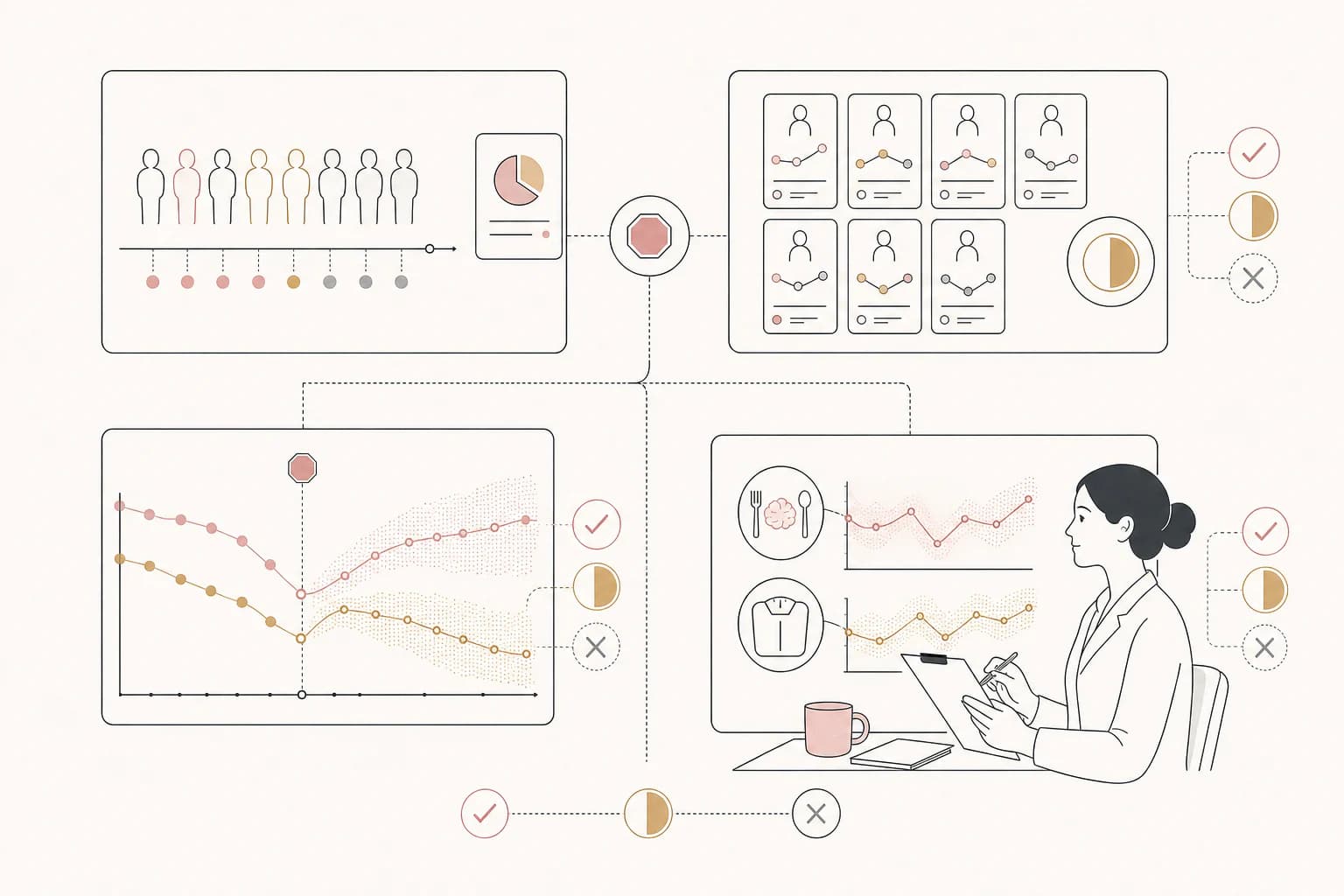
A small prospective study put appetite into the picture
A single-arm study followed 28 women with obesity through 36 weeks of semaglutide and 12 weeks after withdrawal.9 During the first period, the group lost an average 16.9 kg.3 During follow-up, 71.4% met the study’s weight-regain definition, with an average 5.1 kg increase among those participants.3
The same study reported appetite rebound in 78.5% of participants.7 Its definition combined a visual-analogue appetite-score increase with higher daily energy intake.7 Because there was no parallel control group and the sample included only women, the rate is not universal.97
Still, this design adds repeated appetite measures around a planned withdrawal.97
Gut and brain findings remain mechanistic clues
The 28-woman study paired its human observations with a female-rat experiment.10 After semaglutide withdrawal, the animal work found changes in gut microbes, bile acids, and hypothalamic appetite-signaling markers.10 Those changes occurred alongside weight return.10 They do not prove the same mechanism drove the human outcomes.10
A separate preprint compared a 12-week semaglutide period with a high-fibre dietary arm. It reported greater rebound in the semaglutide arm 14 weeks after both interventions ended.4 Linked mouse and microbiota-transfer experiments proposed inflammatory and gut-barrier pathways.4 Those mechanisms remain provisional.4
Mechanistic detail can make a story sound settled. Here, animal experiments and a preprint generate hypotheses rather than one established human explanation.104
Male-mouse work shows that the path changes by stage
One experiment tracked obese male mice through prolonged semaglutide exposure and recovery at two environmental temperatures.11 Researchers described three phases: rapid early loss, slower continued loss, and weight maintenance.11
Food intake gradually returned toward pre-study levels through more frequent meals.11 Meal size remained lower during the exposure period.11 After semaglutide ended, the mice rapidly regained weight. Food intake, meal size, meal frequency, fuel use, energy expenditure, and activity also changed.11
This is detailed physiology in a mouse model, not a forecast for people.11 Its useful lesson is narrower: a single snapshot can miss a stage-dependent pattern.11 The human question remains separate.
The studies differ because the questions differ
The monitored HIV cohort measured a defined 24-week off period and found partial average regain.81 The prescription-network preprint used real-world records and found stable weight or continued loss for many people.26 The 28-woman study used planned withdrawal and frequent appetite measures, finding a high short-term regain proportion.93
ACTG A5371 defined 24 weeks with semaglutide and 24 weeks after it ended.8 The women’s study scheduled 12 weeks of withdrawal after 36 weeks with semaglutide.9 The network preprint used a last known prescription.2 Those definitions help explain why the percentages look different.
The network paper also recorded more exercise counseling among people with durable loss than among those with regain.12 That association cannot show whether counseling caused the trajectory.12 The honest synthesis is variability, with rebound documented in closely observed settings.13
Reading regain evidence from the Philippines
For Filipino readers, the useful first question is how stopping was defined. ACTG A5371 and the women’s study used planned withdrawal periods.89 The network study started from a last known prescription.2
Next, check the population. One cohort involved adults with HIV and liver disease.8 Another included only women with obesity.9 The network record covered a broader prescription population.2 These groups are not interchangeable.
Finally, check the clock. Twelve weeks, 24 weeks, six months, and one year can capture different stages.8269 Distinguish group averages from individual paths too. An average increase can coexist with stable weight, continued loss, or greater regain.12
Bottom line
Weight regain appears in both the monitored HIV cohort and the 28-woman withdrawal study.13 Yet the health-network preprint found stable weight or continued loss for many people.26 Population, follow-up, and the definition of stopping help explain that contrast.829 Animal work offers possible mechanisms, not a settled human explanation.1011 For Filipino readers, the reliable question is not simply whether regain happened. Ask how it was measured, over what period, and in whom. Check whether stopping was planned or inferred from a prescription record.82 One percentage cannot carry all three studies. Study design sets the limit.
Frequently asked questions
Does everyone regain weight after semaglutide?
The health-network preprint found no regain in 60.7% of its one-year semaglutide group.6 The 28-woman withdrawal study found regain in 71.4% over 12 weeks.3 Their definitions and observation methods differed.29 Neither percentage is universal.
Did participants regain all the weight they had lost?
Not on average in the HIV cohort. Participants lost 7.8 kg during 24 weeks with semaglutide and regained 2.9 kg during the following 24 weeks.1 That was partial average return in a small, clinically specific group, not a forecast for every individual.81
Why does the prescription study look less dramatic?
It used the last known prescription in a federated record as its main marker.2 A missing later prescription cannot perfectly reveal remaining medicine, outside-system care, or the exact stopping date.26 Planned withdrawal studies define their timelines more tightly.89
What happened to appetite after withdrawal?
In the 28-woman study, 78.5% met the paper’s appetite-rebound definition during 12 weeks of withdrawal.7 The definition combined an appetite-score increase with higher daily energy intake.7 The small, single-arm, female-only sample means the rate should not be generalized.97
Do gut-microbe findings explain regain?
They offer possible pathways, not a complete explanation. Linked animal work found gut, bile-acid, and hypothalamic changes.10 Another preprint proposed inflammatory and gut-barrier mechanisms.4 Animal experiments and preprints cannot establish a dominant mechanism in people.104
How should Filipino readers assess this evidence?
Check whether stopping was planned or inferred from a last prescription.829 Then note the population and timeframe. The HIV cohort, women’s study, and federated network represent different settings.829 Keep those differences visible in the Philippines.
This article is educational research context, not medical advice. Catalog links are neutral references and do not imply a treatment or human-use recommendation.
Sources
Footnotes
-
The Bounce-back Effect: What Happens After Cessation of Low-dose Semaglutide in People With HIV.. Mean changes in 49 adults with HIV during a planned with-semaglutide period and a defined off-semaglutide period. The average shows partial group-level return and does not describe every participant's path. ↩ ↩2 ↩3 ↩4 ↩5 ↩6 ↩7 ↩8 ↩9 ↩10
-
Weight trajectories after last Tirzepatide or Semaglutide prescription across a federated health network. Real-world prescription-record analysis of tirzepatide and semaglutide users, with a 300-person subset having clinician-documented discontinuation near the last prescription. A last known prescription does not perfectly establish the exact day exposure ended, remaining medicine, or care outside the network. ↩ ↩2 ↩3 ↩4 ↩5 ↩6 ↩7 ↩8 ↩9 ↩10 ↩11 ↩12 ↩13 ↩14 ↩15 ↩16 ↩17 ↩18 ↩19 ↩20 ↩21
-
Post-semaglutide weight regain in females with obesity: Associations with gut microbiota, bile acid metabolism, and central nervous system.. Weight outcomes across 36 weeks with semaglutide and 12 weeks after withdrawal. The study-specific proportion and averages should not be generalized to all populations. ↩ ↩2 ↩3 ↩4 ↩5 ↩6 ↩7 ↩8
-
GLP-1 RA-Exacerbated Gut Microbiome Dysbiosis in Obesity Mediates Post-Cessation Weight Regain. Human trial observations paired with metagenomic, microbiota-transfer, and diet-induced-obesity mouse experiments. The proposed inflammatory and gut-barrier mechanisms are provisional because the report is a preprint and relies partly on animal evidence. ↩ ↩2 ↩3 ↩4 ↩5 ↩6 ↩7
-
The Bounce-back Effect: What Happens After Cessation of Low-dose Semaglutide in People With HIV.. Cardiometabolic follow-up from week 24 to week 48 in the 49-person HIV cohort. Blood pressure, several lipid measures, and metabolic-syndrome status did not change significantly during that interval. ↩ ↩2 ↩3
-
Weight trajectories after last Tirzepatide or Semaglutide prescription across a federated health network. Federated health-network preprint using no subsequent GLP-1 prescription for one year after the last prescription. Prescription records are an imperfect proxy for confirmed exposure and the paper was a preprint. ↩ ↩2 ↩3 ↩4 ↩5 ↩6 ↩7 ↩8 ↩9 ↩10 ↩11 ↩12
-
Post-semaglutide weight regain in females with obesity: Associations with gut microbiota, bile acid metabolism, and central nervous system.. Appetite rebound required both at least a 30% increase in visual-analogue appetite score and a sustained increase of at least 300 kcal per day. This was a study-defined outcome in a small, single-arm, female-only sample. ↩ ↩2 ↩3 ↩4 ↩5 ↩6 ↩7 ↩8
-
The Bounce-back Effect: What Happens After Cessation of Low-dose Semaglutide in People With HIV.. Participants were adults on suppressive antiretroviral therapy in a structured follow-up study. The cohort was small and clinically specific, so its trajectory is not a universal forecast. ↩ ↩2 ↩3 ↩4 ↩5 ↩6 ↩7 ↩8 ↩9 ↩10 ↩11 ↩12 ↩13 ↩14 ↩15 ↩16
-
Post-semaglutide weight regain in females with obesity: Associations with gut microbiota, bile acid metabolism, and central nervous system.. Human study paired with separate female-rat experiments and metabolic measurements. The human sample was small, included only women, and had no parallel control group. ↩ ↩2 ↩3 ↩4 ↩5 ↩6 ↩7 ↩8 ↩9 ↩10 ↩11 ↩12 ↩13 ↩14 ↩15
-
Post-semaglutide weight regain in females with obesity: Associations with gut microbiota, bile acid metabolism, and central nervous system.. Parallel animal component of the prospective human withdrawal study. The animal findings suggest a hypothesis and do not prove that the same mechanism drove the human outcomes. ↩ ↩2 ↩3 ↩4 ↩5 ↩6 ↩7 ↩8
-
Prolonged Semaglutide Treatment Reveals Stage-Dependent Changes to Feeding Behavior and Metabolic Adaptations in Male Mice.. Prolonged semaglutide experiment with recovery periods at room and thermoneutral temperatures. This is detailed mouse physiology, not a forecast of human weight trajectories. ↩ ↩2 ↩3 ↩4 ↩5 ↩6 ↩7 ↩8
-
Weight trajectories after last Tirzepatide or Semaglutide prescription across a federated health network. Documented counseling association within the post-prescription trajectory analysis. The association cannot show whether counseling caused the weight trajectory or marked other differences in care and documentation. ↩ ↩2