
Quick answer
CagriSema is the name used for a research program that coadministers cagrilintide and semaglutide. Cagrilintide engages amylin- and calcitonin-related receptors, while semaglutide acts through the GLP-1 pathway. A large phase 3 trial found greater average body-weight reduction with the combination than placebo over 68 weeks in adults without diabetes. That result belongs to both components together. Animal brainstem experiments and laboratory receptor studies help explain cagrilintide biology, but they do not prove the human combination result’s exact mechanism.1234
What exactly is CagriSema?
CagriSema is not a new single molecule. It refers to cagrilintide and semaglutide provided in the same research program.
Cagrilintide is a long-acting agonist with activity at amylin and calcitonin receptors.3 Semaglutide is a GLP-1 receptor agonist.
The combination brings two signaling strategies into one intervention. That may create effects that differ from either component alone.
It also makes attribution harder. A result from the combined arm cannot be credited entirely to cagrilintide or semaglutide.
The name should therefore remain attached to both components whenever a study outcome is reported. Shortening it to the more familiar ingredient changes the evidence.
That distinction matters every time.
Readers researching Cagrilintide can view its live catalog details below. The listing identifies the catalog item and is separate from the evidence discussed here.
What did the phase 3 human trial find?
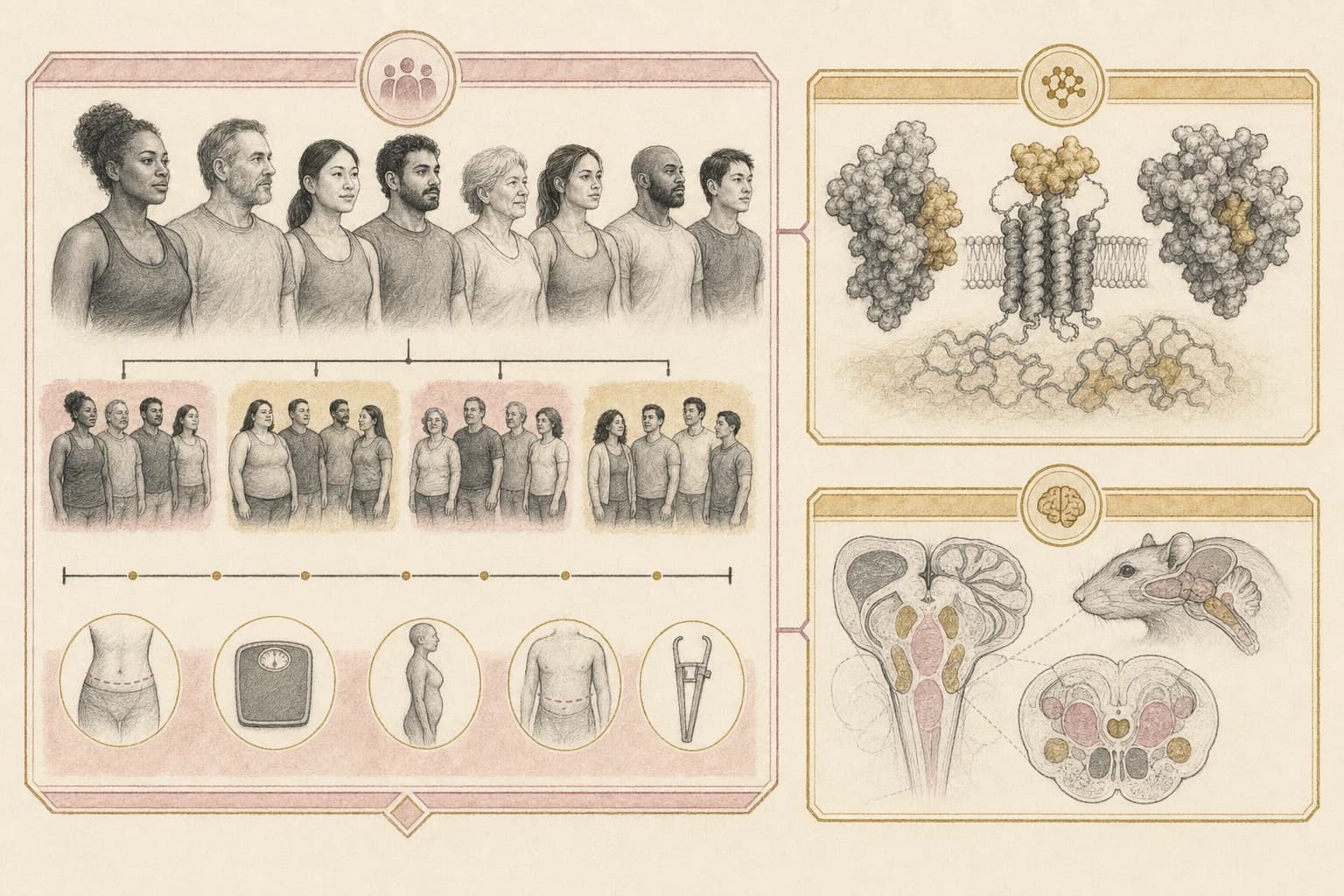
A randomized, double-blind, multicenter phase 3 trial enrolled 3,417 adults with overweight or obesity who did not have diabetes.2
At 68 weeks, the cagrilintide-semaglutide combination produced a greater mean body-weight reduction than placebo.2
That is a human clinical outcome from a large controlled study. It is stronger evidence for the combination than receptor diagrams or animal experiments.
The population matters. The result does not automatically describe adults with diabetes, children, or Filipino readers outside the study setting.
Mean change is also a group average. It does not show every participant’s response, tolerability, or whether they completed treatment.
Responder tables can show how many people crossed defined thresholds, while distribution plots reveal variation. Neither replaces the mean; they answer different questions. A transparent report lets readers see several views rather than choosing the most dramatic one.
Balanced reporting includes the comparator, duration, withdrawals, adverse events, and the analysis used for missing data.
What does cagrilintide’s receptor research show?
Structural work found that cagrilintide binds in an amylin-like way and produces distinct receptor dynamics.4
This kind of laboratory research examines the shape and movement of receptor-bound molecules. It can explain how a compound interacts with its target.
The authors proposed that those dynamics might contribute to clinical effects.4 The structural study does not prove that link.4
A receptor picture cannot tell us the size of weight change, the frequency of adverse events, or who benefits.
Mechanism and outcome are complementary evidence tiers. The mechanism suggests how; the trial measures what happened.
Confusing the two creates a familiar exaggeration: because a binding pattern looks distinctive, the clinical result must be certain.
What did the brainstem experiments add?
A cross-species atlas identified two conserved brainstem neuron populations regulated by cagrilintide.5
Most functional experiments were performed in rats. Researchers reduced prolactin-releasing hormone activity in the dorsal vagal complex and blocked cagrilintide effects, but not semaglutide effects.1
That difference supports the idea that the two components can use distinct neural routes in the experimental model.
It does not prove that the same pathway has the same importance in people. Cross-species conservation and human causation are different claims.
The work is useful because it separates biological questions. It should not be advertised as a human appetite switch.
Readers comparing this topic with Semaglutide can view its live catalog details below. It is a separate catalog reference, not a suggested combination.
Why must combination evidence stay combined?
When two active components are given together, the observed outcome reflects the entire intervention.
One component may add to another, change its tolerability, or alter how participants remain in the trial. The total cannot be divided by assumption.
An interaction is also possible. The joint effect may differ from simply adding two separate averages. Demonstrating that requires suitable comparison arms and a statistical plan; it cannot be inferred because the mechanisms sound complementary.
Separate monotherapy arms can help, but they still need a prespecified comparison and adequate statistical power.
The same caution applies to safety. An event in the combination arm cannot automatically be labeled a semaglutide-only or cagrilintide-only event.
Exposure matters when interpreting both benefit and safety. experimental amount changes, missed scheduled exposures, pauses, and early discontinuation can affect the final estimate. Trial summaries should show what participants actually received over time.
The analysis population needs a label too. An intention-to-treat estimate and an on-treatment estimate answer different questions when people discontinue. Reporting both can show how assumptions about continued exposure influence the apparent result.
This is why precise naming is a safety practice, not editorial fussiness. It prevents readers from borrowing evidence for a different product.
What should Filipino readers verify?
The Philippine FDA Verification Portal separates licensed establishments from registered or notified health products.6
Search the exact intervention or product, then compare its name, manufacturer, form, and current authorization details. A research-program name is not proof of a local record.
WHO notes that some falsified medical products closely resemble genuine ones and may require quality-control analysis.7
An online item claiming one or both ingredients cannot be authenticated by a published trial. The study product and seller item may not be equivalent.
The most useful conclusion keeps the source, study context, combination identity, and local record visible together.8
How can a CagriSema headline be audited?
Check that both components appear in the headline or first paragraph. If only one is named, attribution may already be wrong.
Find the study population and comparator. The cited phase 3 result involved adults without diabetes and compared the combination with placebo.2
Separate clinical results from mechanism. Rat brainstem experiments and receptor structures do not replace the human trial.14
Look for average versus responder results, discontinuation, and follow-up time. A single percentage rarely tells the full story.
Finally, confirm that regulatory language applies to the exact current product and country rather than being copied from another market.
Bottom line
CagriSema combines cagrilintide and semaglutide in one research intervention. A large phase 3 trial found greater average weight reduction than placebo over 68 weeks in adults without diabetes. That finding belongs to the combination, not either ingredient alone.
Laboratory receptor studies and mostly animal brainstem experiments explain why the components may act through different routes, but they do not prove a human mechanism or personal outcome. Filipino readers should also verify exact local product records and identity. Precise naming keeps early-stage human results, early mechanism work, and regulatory facts in their correct places.
Frequently asked questions
Is CagriSema one molecule?
No. It combines cagrilintide and semaglutide in one research program.
Did the phase 3 trial involve people?
Yes. It enrolled 3,417 adults without diabetes.2
Can the combination result be credited to cagrilintide alone?
No. Both components were part of the intervention.
Did the brainstem mechanism study involve humans?
Most functional experiments were conducted in rats.15
Do the catalog cards recommend combining products?
No. They are separate neutral references and provide no amount guidance or treatment advice.
Sources
Footnotes
-
A cross-species atlas of the dorsal vagal complex reveals neural mediators of the effects of cagrilintide on energy balance.. Animal mechanistic experiment in rats. The result cannot be assumed to operate identically in people. ↩ ↩2 ↩3 ↩4
-
Coadministered Cagrilintide and Semaglutide in Adults with Overweight or Obesity.. Randomized, double-blind, multicenter phase 3 human trial with 3,417 adults. The result applies to the studied combination and population, not cagrilintide alone or Filipino adults specifically. ↩ ↩2 ↩3 ↩4 ↩5
-
Structural and dynamic features of cagrilintide binding to calcitonin and amylin receptors.. Laboratory structural study of receptor-bound cagrilintide. Receptor structure does not establish clinical outcomes. ↩ ↩2
-
Structural and dynamic features of cagrilintide binding to calcitonin and amylin receptors.. Laboratory structural and dynamic receptor analysis. The authors state these dynamics could contribute to clinical effects; the study does not prove that link. ↩ ↩2 ↩3 ↩4 ↩5
-
A cross-species atlas of the dorsal vagal complex reveals neural mediators of the effects of cagrilintide on energy balance.. Transcriptomic and spatial research across rats, mice, and macaques, with conservation assessed in human data. Most functional experiments were conducted in rats. ↩ ↩2
-
Philippine FDA Verification Portal; FDA Advisory No. 2023-2238: Utilization of the FDA Verification Portal. Official Philippine regulatory verification service. A portal record applies to the exact product or establishment named in that record. ↩
-
WHO laboratory analysis of suspected falsified medical products; WHO laboratory testing for health-product regulation. WHO guidance on suspected falsified medical products and regulatory laboratory testing. Appearance alone cannot authenticate a product or establish a research outcome. ↩
-
A cross-species atlas of the dorsal vagal complex reveals neural mediators of the effects of cagrilintide on energy balance.; Coadministered Cagrilintide and Semaglutide in Adults with Overweight or Obesity.; Structural and dynamic features of cagrilintide binding to calcitonin and amylin receptors.; Philippine FDA Verification Portal; FDA Advisory No. 2023-2238: Utilization of the FDA Verification Portal. Editorial synthesis of the canonical research records and Philippine verification sources. This synthesis is educational and is not personal medical advice or a product recommendation. ↩