
TL;DR
- CagriSema pairs two researched compounds: cagrilintide, an amylin receptor agonist, and semaglutide, a GLP-1 receptor agonist.1
- A large phase 3 trial found a sizable group-average weight change: adults without diabetes averaged -20.4% at 68 weeks, versus -3.0% with placebo.2
- Blood-sugar findings come from defined diabetes trials: one comparison found a modest HbA1c advantage over semaglutide in participants already receiving specified medicines.3
- Tolerability remains central to the evidence: gastrointestinal events were common in the main obesity trial and occurred more often than with placebo.4
For Filipino readers, the name CagriSema may appear online before the research design behind it becomes clear. The useful question is not whether the name sounds new. It is what scientists combined, whom they studied, and which outcomes they measured. Current evidence comes from controlled human trials, pooled reviews, and limited laboratory work.5
This article is educational research context, not medical advice. Catalog links are neutral references and do not imply a treatment or human-use recommendation.
What CagriSema means
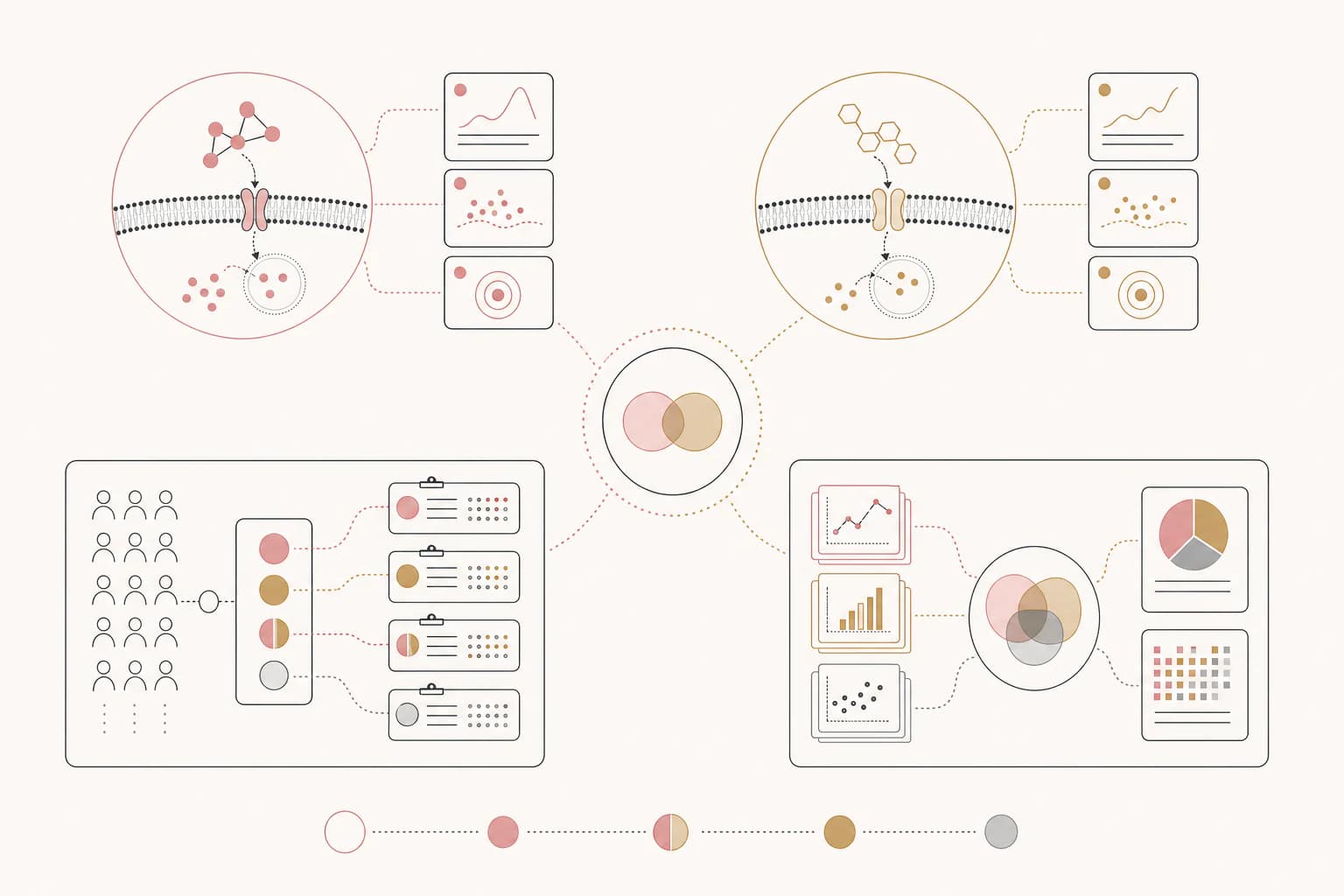
CagriSema is a research combination of cagrilintide and semaglutide.1 Cagrilintide is described as an amylin receptor agonist, while semaglutide is a GLP-1 receptor agonist.1 The program therefore tests two biological pathways together rather than treating the name as a new single molecule.1 Researchers have studied the combination in adults with obesity and in several defined type 2 diabetes groups.6 Those populations are not interchangeable, because their baseline health and trial comparisons differ.3 Results should always be read beside the participant criteria, comparator, duration, and outcome.5
The name is shorthand for a study strategy, not one new molecule.1 Some trials compare the combination with placebo, while others compare it directly with semaglutide or cagrilintide.6 A placebo comparison tests whether groups differed under controlled conditions. An active comparison asks whether the combination differed from one component.3
For a neutral catalog reference, see cagrilintide below.
What the largest obesity trial found
REDEFINE 1 enrolled 3,417 adults without diabetes.6 Participants had obesity, or overweight with at least one related complication.6 Researchers randomly assigned them to CagriSema, semaglutide, cagrilintide, or placebo, with lifestyle intervention across groups.6 This design allowed both placebo and active comparisons within one 68-week human study.6
At week 68, estimated mean body-weight change was -20.4% with CagriSema and -3.0% with placebo.2 The difference was a trial average, not a personal forecast.2 Participants receiving the combination also reached several prespecified weight-change thresholds more often than placebo recipients.2 These findings describe an effect under the study’s conditions, not a promised outcome for readers.2
The study design helps explain why the headline number needs context. Random assignment and the two active-component groups support clearer comparisons within the trial.6 Yet the estimate still belongs to the enrolled group, the 68-week schedule, and the trial’s lifestyle program.6 It does not tell us what every participant experienced.2 The mean summarizes varied individual changes as one group result.2 Threshold results add another view, but they also remain group-level measures from the same controlled study.2
What comparisons with semaglutide add
Direct comparison matters because placebo alone cannot show whether combining compounds adds to an active component.5 REIMAGINE 2 studied adults with inadequately controlled type 2 diabetes who received metformin, sometimes with an SGLT2 inhibitor.3 At week 68, mean HbA1c fell 1.91 percentage points with CagriSema and 1.75 points with semaglutide.3 The estimated difference was 0.16 percentage points in favor of the combination.3
That result is statistically significant, yet its scale and context both matter.3 It concerns glycemic control in a specific treated diabetes population, not all adults interested in weight research.3 A pooled review also favored CagriSema for weight outcomes over semaglutide.5 However, that review contained only three randomized trials and combined varied comparisons.5
The HbA1c result shows why “better” needs a stated endpoint. This comparison measured the average change in a blood-sugar marker, not a universal health outcome.3 The groups differed by 0.16 percentage points on that endpoint.3 Body-weight percentages answer a different question in populations chosen for different trial goals.2
What other diabetes trials show
REIMAGINE 1 focused on 189 adults with early-stage type 2 diabetes inadequately controlled through diet and exercise.7 After 40 weeks, both studied combination groups had larger HbA1c reductions than placebo.7 They also had larger average body-weight reductions than placebo.7 Because this was an early-stage group, it answers a narrower question than REIMAGINE 2.7
REIMAGINE 3 asked another question in 274 adults already receiving basal insulin.8 Adding CagriSema reduced HbA1c more than placebo at week 40.8 No severe hypoglycaemia was reported during that controlled trial.8 This finding should remain tied to monitored participants and the study protocol.8 Together, the trials show why “diabetes evidence” is not one uniform category.3
Even with a shared compound and endpoint, trial answers cannot simply be merged. REIMAGINE 1 began with diet and exercise as the background approach, while REIMAGINE 3 enrolled people using basal insulin.7 Their starting profiles and follow-up conditions shape the meaning of each result.8 Controlled trials tested the same combination in distinct settings and reported each setting separately.7
What an East Asian trial can—and cannot—tell Filipinos
REDEFINE 5 enrolled 331 adults at sites in Japan and Taiwan.9 Participants had overweight or obesity under the study’s criteria, and some had type 2 diabetes.9 At week 68, estimated mean weight change was -18.4% with CagriSema and -11.9% with semaglutide.9 Gastrointestinal disorders were the most common adverse events in both groups.9
This regional evidence may feel more locally relevant than studies dominated by Western populations.9 Still, Japanese and Taiwanese participants are not a substitute for Filipino-specific data.9 Genetics, food patterns, care settings, and enrollment rules can shape how transferable findings are.9 The careful conclusion is limited: the active comparison favored CagriSema in that East Asian trial.9
Geographic proximity should not be treated as proof of equal outcomes. The trial offers evidence from two East Asian settings, which broadens the human data beyond a single region.9 It does not report a Philippine subgroup.9 For a Filipino reader, the most accurate use of REDEFINE 5 is to understand its direct comparison and its limits. Any stronger local conclusion would go beyond the participants described in the source.9
Safety and tolerability in context
In REDEFINE 1, gastrointestinal adverse events affected 79.6% of CagriSema participants and 39.9% of placebo participants.4 Reported examples included nausea, vomiting, diarrhea, constipation, and abdominal pain.4 Most were described as transient and mild to moderate.4 “Mostly mild” does not mean that tolerability is unimportant for every participant.4
A systematic review of four randomized trials also found more gastrointestinal events with CagriSema than comparators.10 Pooled evidence can improve the overview, but it inherits differences among included trials.10 It also cannot settle uncommon or longer-term safety questions by itself.10 Safety interpretation therefore needs both event frequency and study duration, not one reassuring phrase.4
Event counts and event severity answer different questions. In REDEFINE 1, gastrointestinal events were frequent, although most were mild to moderate.4 Uncommon events and longer-term patterns need more evidence than one trial can provide.10 REDEFINE 1 supplies a 68-week comparison, while the systematic review looks across several trials.4 Reading both gives a fuller picture than relying on either a percentage or a broad summary alone.10
For a neutral catalog reference to the second researched component, see semaglutide below.
What researchers are still learning
Blood pressure was examined through secondary and post hoc REDEFINE 1 analyses.11 Those analyses found larger reductions with CagriSema than placebo at week 68.11 Because these were not the main weight endpoints, they deserve qualified interpretation.11 They can inform future questions without becoming a broad cardiovascular claim.11
Mechanism research is earlier still.12 A cross-species laboratory project mapped brainstem cell populations across rodents, macaques, and human tissue.12 Its causal cagrilintide experiments were conducted in rats, not people.12 The study linked specific rat neurons to cagrilintide’s effects on energy balance.12 That work helps form biological hypotheses, but animal findings cannot establish human clinical outcomes.12
Bottom line
CagriSema is best understood as a clinical research program combining cagrilintide with semaglutide.1 Large randomized human trials report meaningful average weight changes and blood-sugar effects in carefully defined groups.2 The clearest active comparisons suggest added effects over semaglutide for selected outcomes.3 Gastrointestinal events are also a consistent part of the evidence.10
For Filipino readers, the East Asian trial adds useful regional context without providing Filipino-specific proof.9 The responsible reading separates obesity trials, diabetes trials, pooled reviews, and animal mechanism studies.12 It also treats group averages as study findings rather than individual predictions.2
Frequently asked questions
Is CagriSema one compound?
No. CagriSema is the research name for combining cagrilintide and semaglutide.1 The first is an amylin receptor agonist, while the second is a GLP-1 receptor agonist.1 Trials evaluate their combined effects within specific participant groups and protocols.6
What did the main obesity trial measure?
REDEFINE 1 measured relative body-weight change over 68 weeks in adults without diabetes.6 It compared the combination with placebo and each component, alongside lifestyle intervention.6 The combination group’s estimated average change was -20.4%, versus -3.0% with placebo.2
Has CagriSema been compared directly with semaglutide?
Yes, in defined human trials.3 REIMAGINE 2 compared their HbA1c effects in adults with type 2 diabetes receiving metformin, with or without another specified medicine.3 REDEFINE 5 compared their weight effects in participants from Japan and Taiwan.9
What side effects appeared most often?
Gastrointestinal events were prominent across the human evidence.10 In REDEFINE 1, reported events included nausea, vomiting, diarrhea, constipation, and abdominal pain.4 Most were transient and mild to moderate, but uncommon and longer-term questions need more evidence.4
Frequency, severity, study length, and discontinuations provide different views of tolerability, so readers should consider them together.10
Do the findings apply specifically to Filipinos?
The collected trials do not establish Filipino-specific outcomes.9 REDEFINE 5 studied adults in Japan and Taiwan, which offers East Asian context but not a direct Filipino population.9 Its findings should remain linked to its enrollment criteria, sites, and controlled design.9
Does laboratory research explain how cagrilintide works in people?
Not fully. One cross-species project mapped relevant brainstem cells, but its causal intervention experiments were in rats.12 Such research can suggest mechanisms and guide human questions.12 It cannot prove that the same causal pathway determines clinical outcomes in people.12
Sources
Footnotes
-
Efficacy and safety of once-weekly cagrilintide-semaglutide (CagriSema) in adults with type 2 diabetes inadequately controlled on diet and exercise (REIMAGINE 1): a randomised, double-blind, placebo-controlled, phase 3a study.. Definition in a published randomized phase 3a human trial. A compound description does not establish suitability for any person. ↩ ↩2 ↩3 ↩4 ↩5 ↩6 ↩7 ↩8
-
Coadministered Cagrilintide and Semaglutide in Adults with Overweight or Obesity.. Prespecified outcome in a phase 3a randomized human trial of adults without diabetes. This is a group average under trial conditions, not a forecast for an individual. ↩ ↩2 ↩3 ↩4 ↩5 ↩6 ↩7 ↩8 ↩9 ↩10 ↩11 ↩12
-
Cagrilintide-semaglutide (CagriSema) versus semaglutide or cagrilintide in people with type 2 diabetes (REIMAGINE 2): a double-blind, randomised, controlled, phase 3 study.. Randomized phase 3 human trial in adults with type 2 diabetes on metformin with or without an SGLT2 inhibitor. The 0.16-point between-group difference applies to this specific trial population. ↩ ↩2 ↩3 ↩4 ↩5 ↩6 ↩7 ↩8 ↩9 ↩10 ↩11 ↩12 ↩13 ↩14
-
Coadministered Cagrilintide and Semaglutide in Adults with Overweight or Obesity.. Safety assessment in a 68-week randomized human trial. Trial summaries do not resolve all uncommon or longer-term harms. ↩ ↩2 ↩3 ↩4 ↩5 ↩6 ↩7 ↩8 ↩9 ↩10
-
Efficacy and Safety of Cagrilintide and Cagrisema Versus Semaglutide as Anti-Obesity Medications: A Systematic Review, Meta-Analysis and Meta-Regression.. Systematic review and random-effects meta-analysis of three randomized human trials totaling 3,545 participants. Pooled results do not replace direct comparisons or establish individual outcomes. ↩ ↩2 ↩3 ↩4 ↩5
-
Coadministered Cagrilintide and Semaglutide in Adults with Overweight or Obesity.. 68-week, multicenter, double-blind, phase 3a human trial with lifestyle intervention in every group. The trial population and structured protocol limit generalization beyond participants. ↩ ↩2 ↩3 ↩4 ↩5 ↩6 ↩7 ↩8 ↩9 ↩10 ↩11
-
Efficacy and safety of once-weekly cagrilintide-semaglutide (CagriSema) in adults with type 2 diabetes inadequately controlled on diet and exercise (REIMAGINE 1): a randomised, double-blind, placebo-controlled, phase 3a study.. Randomized, double-blind, phase 3a human trial in 189 adults inadequately controlled with diet and exercise. The study was limited to a defined early-stage diabetes population and 40 weeks. ↩ ↩2 ↩3 ↩4 ↩5 ↩6
-
Cagrilintide-semaglutide (CagriSema) as an add-on to basal insulin in adults with type 2 diabetes (REIMAGINE 3): a randomised, double-blind, placebo-controlled, multicentre, phase 3 study.. Randomized, double-blind, phase 3a human trial in 274 adults with type 2 diabetes receiving basal insulin. Findings concern monitored trial participants and do not establish risk outside that setting. ↩ ↩2 ↩3 ↩4 ↩5
-
Efficacy and safety of co-administered cagrilintide and semaglutide versus semaglutide alone in adults with overweight or obesity with or without type 2 diabetes in Japan and Taiwan (REDEFINE 5): a multicentre, randomised, active-controlled, phase 3a trial.. Randomized, double-blind, phase 3a human trial in 331 East Asian adults with overweight or obesity, with or without type 2 diabetes. This regional trial does not directly establish outcomes for Filipino populations. ↩ ↩2 ↩3 ↩4 ↩5 ↩6 ↩7 ↩8 ↩9 ↩10 ↩11 ↩12 ↩13 ↩14 ↩15 ↩16
-
CagriSema Versus Semaglutide Monotherapy or Placebo for Obesity: A Systematic Review and Meta-Analysis of Randomized Controlled Trials with GRADE Assessment.. Systematic review and meta-analysis of four randomized human trials involving 4,419 participants with obesity. Pooled estimates combine studies with different comparators and showed high heterogeneity for weight outcomes. ↩ ↩2 ↩3 ↩4 ↩5 ↩6 ↩7 ↩8
-
CagriSema Reduces Blood Pressure in Adults With Overweight or Obesity: REDEFINE 1.. Secondary and post hoc human analyses from a randomized phase 3a trial. These analyses were not the trial's primary body-weight endpoints and should be interpreted accordingly. ↩ ↩2 ↩3 ↩4
-
A cross-species atlas of the dorsal vagal complex reveals neural mediators of the effects of cagrilintide on energy balance.. Transcriptomic and spatial laboratory research across rat, mouse, macaque, and human tissue, with intervention experiments in rats. Animal mechanisms cannot be assumed to describe clinical effects in humans. ↩ ↩2 ↩3 ↩4 ↩5 ↩6 ↩7 ↩8 ↩9