Quick answer
Visceral fat and subcutaneous fat are different body compartments, and tesamorelin trials did not show the same result for both. In adults with HIV-associated lipodystrophy, pooled randomized evidence found lower visceral fat versus placebo while subcutaneous fat and BMI did not significantly decline.
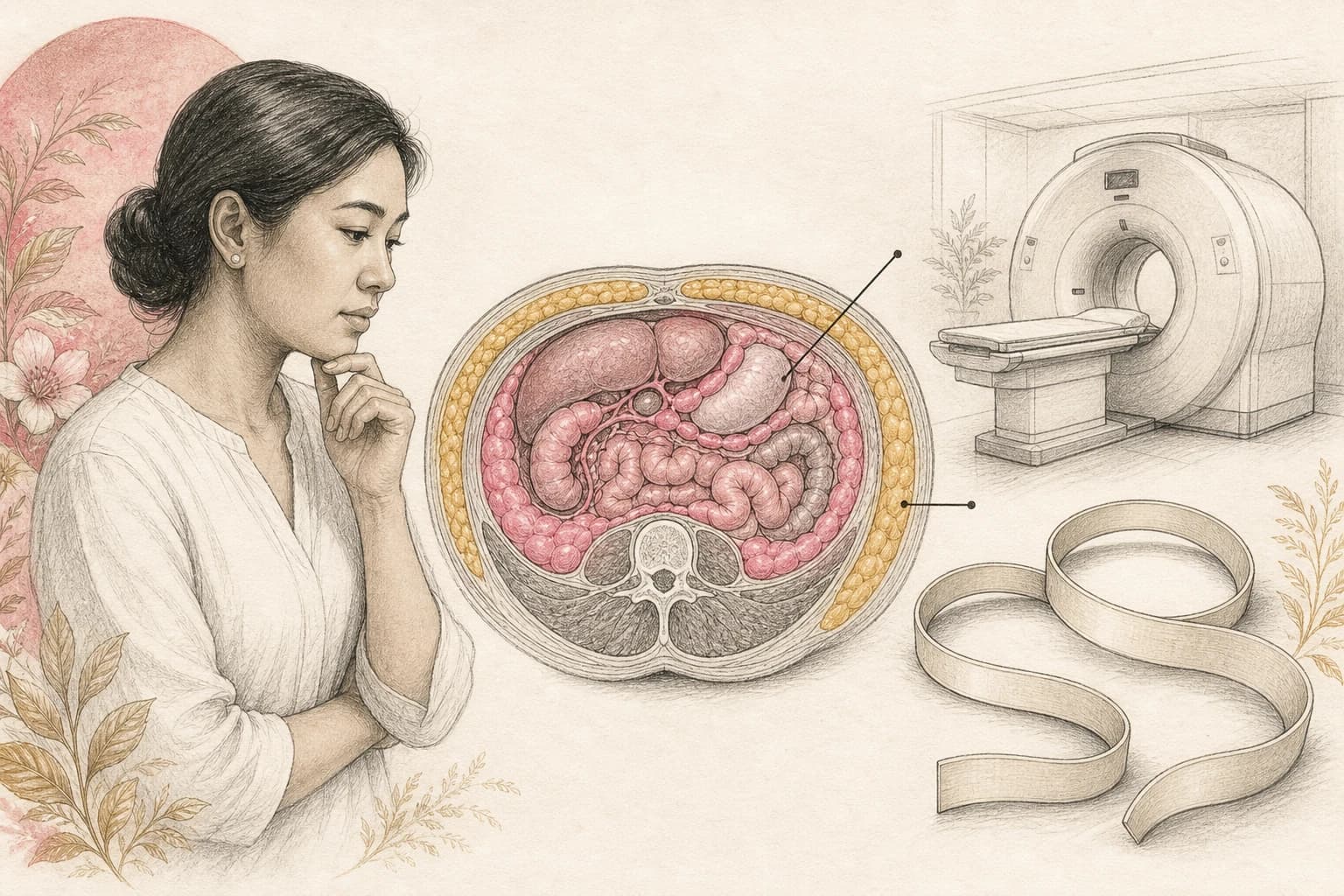
Visceral fat lies around abdominal organs; subcutaneous fat sits beneath the skin. Waist size, scale weight, and appearance overlap with these measures but cannot replace them. Filipino readers should check which compartment a study scanned before accepting a broad claim about belly fat or weight loss.123
Where are visceral and subcutaneous fat stored?
Subcutaneous fat is the layer beneath the skin. It contributes to the tissue a person can pinch and strongly affects visible body shape.
Visceral fat sits deeper inside the abdomen around organs. Imaging can estimate it separately from the outer subcutaneous layer.
The two compartments can move differently. A person may have a smaller measured visceral-fat area without a matching change in the fat directly under the skin.
Waist circumference cannot perfectly separate them. It is a useful external measurement influenced by both fat compartments, body structure, bloating, and measurement technique.
This anatomy explains why “belly fat” is too vague for a research claim. Readers need to know whether the study used a scan, tape measure, scale, or visual assessment.
Readers researching Tesamorelin can view its live catalog details below. The listing identifies the catalog item and is separate from the evidence discussed here.
What did the pooled tesamorelin trials find?
A meta-analysis combined five randomized controlled trials in adults with HIV-associated lipodystrophy. Visceral fat was lower with tesamorelin than with placebo.3
Subcutaneous adipose tissue did not show a significant reduction. BMI also did not significantly fall.3
That contrast is the article’s most important result. It shows why one favorable body-compartment endpoint cannot support every version of a weight-loss claim.
Tesamorelin is a growth hormone-releasing hormone analogue studied for abdominal fat accumulation in people living with HIV. This population should remain visible whenever the result is summarized.1
The FDA record lists EGRIFTA WR as a named tesamorelin medicine under a US application originally approved in 2010. The record does not establish identity or approval for a separate catalog item.4
How did the studies measure the compartments?
A randomized-trial analysis used imaging to assess visceral fat alongside liver fat and other measures. MRI, proton magnetic resonance spectroscopy, and DEXA served different parts of the measurement plan.2
These tools are more specific than scale weight. A scan can show internal distribution even when the total number on the scale barely changes.
Researchers must also decide whether they are reporting an area from one image slice, a calculated volume, or a regional estimate. These technical choices can produce values with different units and should not be merged casually.
Changes in liver fat add another compartment. Liver fat is stored within that organ and does not equal either visceral or subcutaneous adipose tissue, even though metabolic studies may measure all three.
Readers should also distinguish an absolute change from a percentage change. The same percentage can represent different amounts depending on the starting value, and averages can hide wide variation between participants.
A small subgroup of participants with HIV using integrase inhibitors completed 12 months. Visceral and liver fat declined more with tesamorelin than with placebo.5
Only 31 people completed that subgroup analysis, and all had HIV plus metabolic liver disease. The result is informative but should not be generalized to everyone seeking fat loss.5
Measurements also have limits. Imaging estimates rely on equipment, protocols, and analysis. The strength comes from standardized comparison between trial groups, not from treating the scan as infallible.
Do waist, muscle, and cognition tell the same story?
No. A six-month open-label randomized study found a larger waist-circumference reduction with tesamorelin, but the between-group cognitive result was not significant.6
This shows that one anthropometric change does not establish a brain or functional benefit. Each outcome needs its own test.
An exploratory muscle analysis reported changes in area and density among tesamorelin responders. Those participants had already reached a visceral-fat response threshold, which limits how broadly the finding applies.7
A separate placebo-controlled pilot of 22 adults found no direct significant change in measured clinical outcomes after ten weeks of a lower experimental amount of tesamorelin. Exploratory brain-imaging signals were not clinical confirmation.8
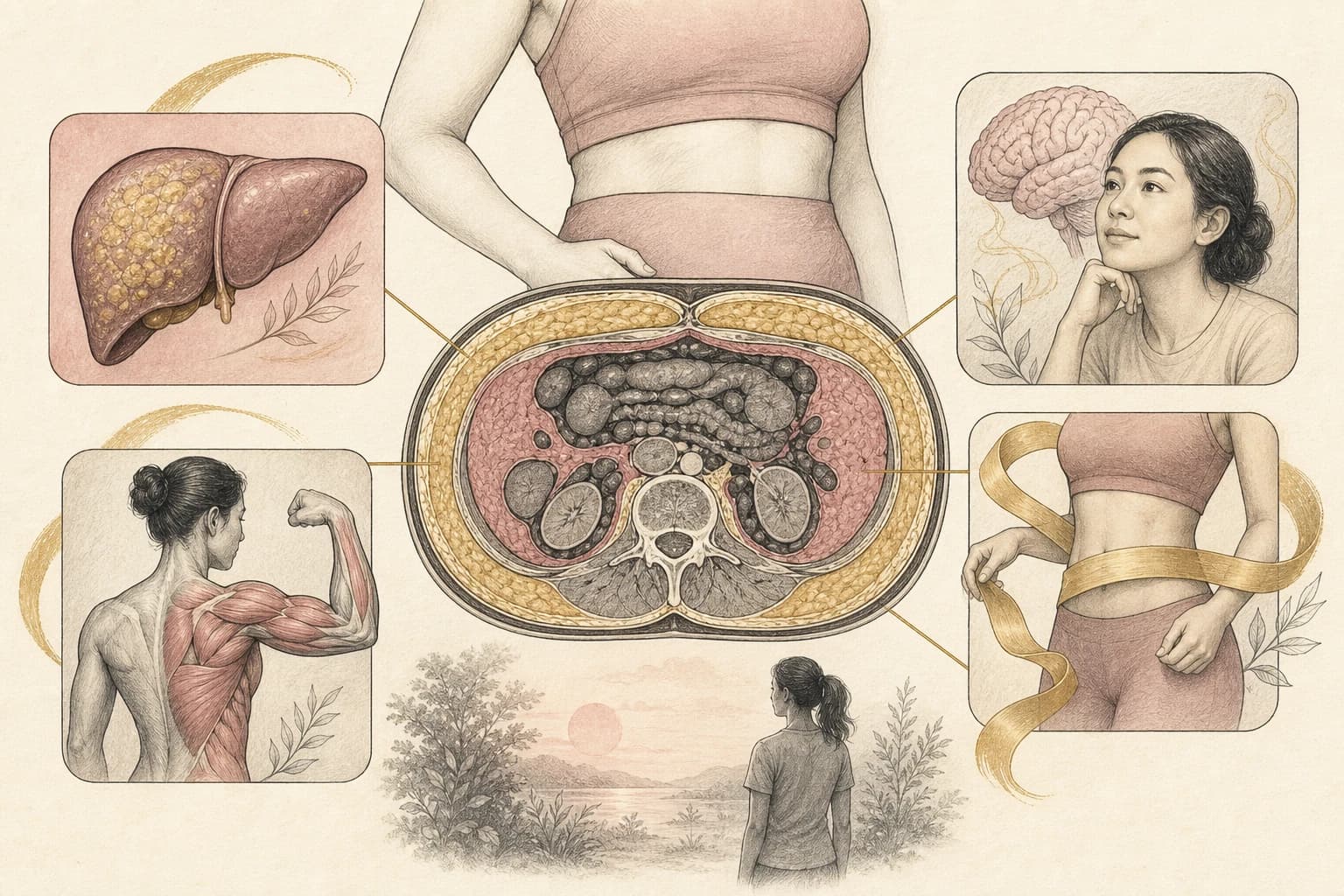
The lesson is not that only fat matters. It is that waist, muscle imaging, cognition, and visceral fat belong in separate result columns.
Readers comparing this topic with Semaglutide can view its live catalog details below. It is a separate catalog reference, not a suggested combination.
Can future studies broaden the evidence?
Yes, but plans should not be mistaken for findings. The TRIUMPH publication describes a planned tesamorelin-plus-exercise trial in older adults living with HIV.9
Researchers intend to examine physical function and muscle quality. Those outcomes could add practical meaning beyond a fat scan.
The protocol does not report completed efficacy results. It cannot currently support claims about strength, mobility, or recovery.9
When future results appear, readers should compare the enrolled population, intervention, adherence, comparator, and endpoints with the protocol. A press release or registry update may not provide the full analysis.
They should also check whether the analysis was predefined and whether every randomized participant was included. Subgroups and responder analyses can be useful, but selection after treatment can make a result appear more general than it is.
How should Filipino readers translate a fat-loss headline?
Replace “fat” with the exact measured compartment. If the paper says visceral adipose tissue, keep that phrase or explain it plainly.
Name the population. Evidence from HIV-associated lipodystrophy is human evidence, but it is not automatically evidence for a general Filipino weight-management population.13
Check whether body weight or BMI changed. A positive scan result alongside neutral BMI is not contradictory; the tests describe different things.3
Separate the regulated medicine from the catalog listing. EGRIFTA WR’s FDA record cannot verify another product or create Philippine approval.4
Finally, avoid visual shortcuts. A before-and-after torso photo cannot show which internal fat compartment changed. Only the appropriate validated measurement can answer that question.
Bottom line
Visceral fat surrounds organs, while subcutaneous fat lies beneath the skin. Tesamorelin trials in adults with HIV-associated lipodystrophy found a favorable visceral-fat result, but subcutaneous fat and BMI did not significantly decline in the pooled evidence.
Smaller studies added liver-fat, waist, responder-only muscle, and cognitive findings, each with different limits. Filipino readers should insist that articles name the compartment, population, measurement method, and exact product. “Belly fat” and “weight loss” are too broad when the research result belongs to a specific scan-based endpoint.
Frequently asked questions
Is visceral fat the fat beneath the skin?
No. Visceral fat is stored deeper around abdominal organs; subcutaneous fat sits under the skin.
Did pooled tesamorelin trials reduce both compartments?
No. Visceral fat fell, while subcutaneous fat did not significantly decline.3
Did BMI significantly fall in the meta-analysis?
No. The pooled BMI result was not significant.3
Can a progress photo show visceral-fat change?
No. A photo shows outward appearance and cannot isolate internal abdominal fat.
Do the product cards recommend using Tesamorelin with Semaglutide?
No. They are separate catalog references and do not recommend combining products, amount guidance, treatment, or human use.
Sources
Footnotes
-
Efficacy and safety of tesamorelin in people with HIV on integrase inhibitors.; Body composition, hepatic fat, metabolic, and safety outcomes of Tesamorelin, a GHRH analogue, in HIV-associated lipodystrophy: A meta-analysis of randomized controlled trials.. Randomized evidence and pooled randomized evidence in adults living with HIV. This is a defined clinical population, not a general weight-loss population. ↩ ↩2 ↩3
-
Efficacy and safety of tesamorelin in people with HIV on integrase inhibitors.. MRI, proton magnetic resonance spectroscopy, and DXA measurements in adults with HIV and metabolic liver disease. A compartment-specific outcome is not interchangeable with total body weight. ↩ ↩2
-
Body composition, hepatic fat, metabolic, and safety outcomes of Tesamorelin, a GHRH analogue, in HIV-associated lipodystrophy: A meta-analysis of randomized controlled trials.. Meta-analysis of randomized controlled trials searched through July 2025. The pooled result does not establish the same effect in people without HIV-associated lipodystrophy. ↩ ↩2 ↩3 ↩4 ↩5 ↩6 ↩7
-
FDA Drugs@FDA record for EGRIFTA WR (TESAMORELIN). Official United States regulatory record for the named medicine. The record applies to EGRIFTA WR and does not establish approval or equivalence for a catalog listing. ↩ ↩2
-
Efficacy and safety of tesamorelin in people with HIV on integrase inhibitors.. Thirty-one participants in the subgroup completed 12 months; all had HIV and metabolic dysfunction-associated steatotic liver disease. The subgroup was small and its results should remain tied to that setting. ↩ ↩2
-
Effects of Tesamorelin on Neurocognitive Impairment in Persons With HIV and Abdominal Obesity.. Phase 2 study in virally suppressed adults with HIV, abdominal obesity, and neurocognitive impairment. The study lacked a placebo arm and does not establish a cognitive benefit. ↩
-
The Growth Hormone Releasing Hormone Analogue, Tesamorelin, Decreases Muscle Fat and Increases Muscle Area in Adults with HIV.. Secondary analysis of earlier randomized trials in adults with HIV and abdominal obesity. Selecting responders limits how broadly the finding can be applied. ↩
-
The effect of growth hormone-releasing hormone on cognition and brain connectivity in adults with cognition ranging from normal to mild cognitive impairment.. Pilot study of 22 adults outside the main HIV fat-accumulation setting. Exploratory brain-imaging signals are not confirmed clinical benefits. ↩
-
Tesamorelin as an Adjunct to Exercise for Improving Physical Function in HIV (TRIUMPH): a clinical trial protocol.. Protocol for a randomized trial in older adults living with HIV. A protocol describes what researchers plan to measure rather than a completed result. ↩ ↩2