Quick answer
Tesamorelin trials use visceral fat, body weight, BMI, waist circumference, and liver fat because each endpoint measures something different. A 2026 meta-analysis in adults with HIV found less visceral adipose tissue with tesamorelin than placebo, but no significant reduction in BMI or subcutaneous fat.1
Those findings can coexist. Visceral fat is the tissue around internal organs, while subcutaneous fat lies beneath the skin. BMI is a ratio of weight to height and cannot show where tissue changed. The evidence supports narrow body-composition statements in defined HIV populations, not a generic weight-loss or cognition claim.2
What is visceral fat?
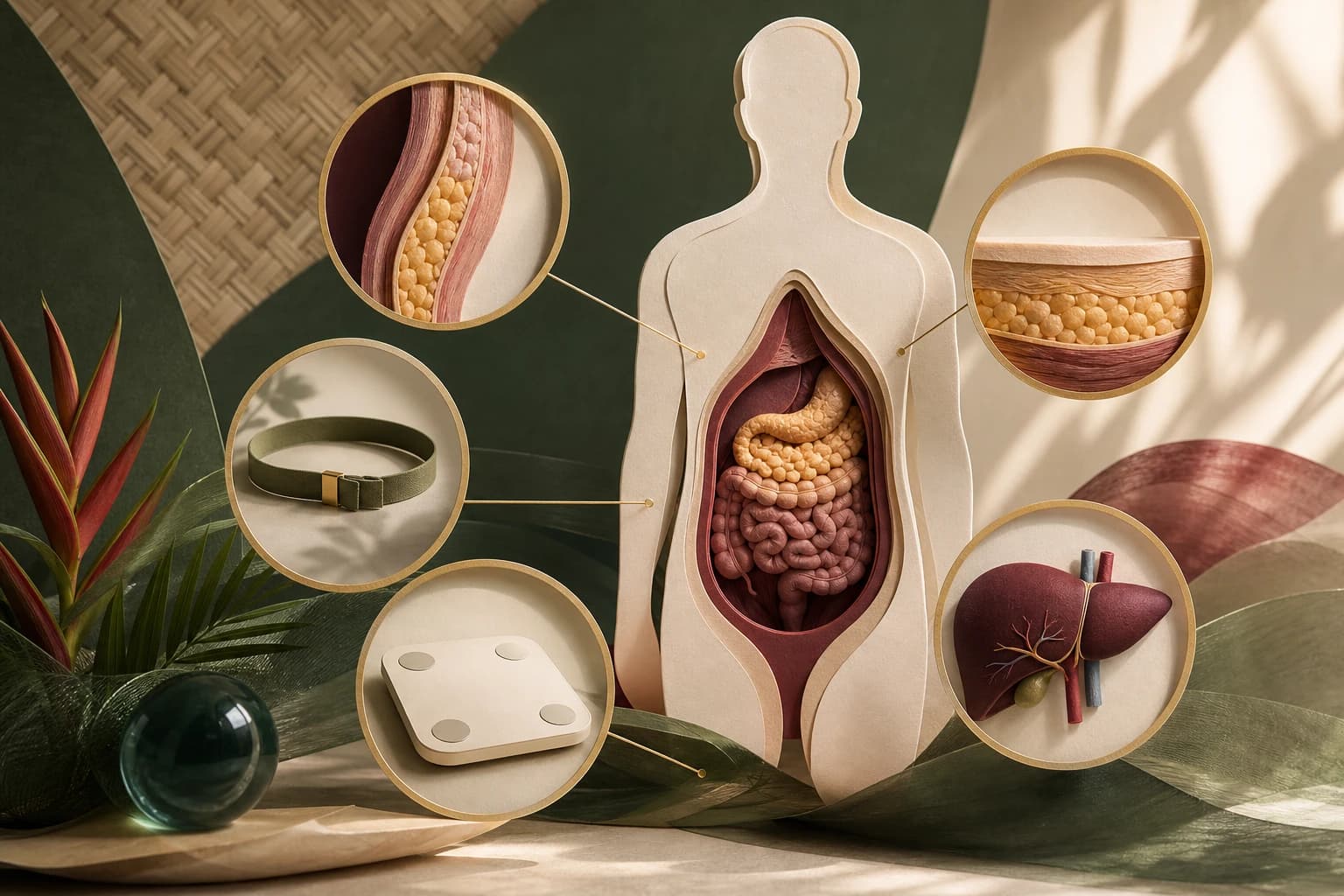
Visceral adipose tissue sits inside the abdominal cavity around internal organs.
Researchers often estimate it with imaging rather than a household scale. The result may be reported as area, volume, or change from baseline.
Subcutaneous abdominal fat lies beneath the skin. It occupies a different compartment and may respond differently within the same study.
Body weight combines fat, lean tissue, fluid, bone, and other components. BMI divides weight by height squared, offering a broad size measure without showing composition.
This is why one endpoint cannot substitute for another. A study can find a compartment change while total scale weight or BMI changes little.
The unit matters too. A kilogram change, percentage change, square-centimeter area, and standardized effect size cannot be compared without conversion and context.
Readers should also distinguish a baseline value from change over time. Two groups may begin with different distributions even when randomization was properly performed in a small trial.
Readers researching Tesamorelin can view its live catalog details below. The listing identifies the catalog item and is separate from the evidence discussed here.
What did the meta-analysis find?
A 2026 meta-analysis combined five randomized placebo-controlled trials in adults with HIV.
It found that tesamorelin reduced visceral adipose tissue compared with placebo. It did not find a significant reduction in BMI or subcutaneous adipose tissue.1
This is not a contradiction. The analysis measured distinct compartments and a broad body-size ratio.
Pooling several trials can improve precision, but the estimate still belongs to the included HIV populations, intervention periods, and measurement methods.
A meta-analysis weights studies according to its statistical method rather than giving each paper one equal vote. Larger or more precise trials may influence the pooled result more strongly.
Between-study variation should be inspected alongside the summary estimate. A clean average can conceal differences in scan protocols, participant criteria, and follow-up.
The responsible headline is specific: visceral fat declined in the studied context. “Weight-loss treatment” would broaden both the endpoint and population beyond the source.
Why can waist and imaging tell different stories?
Waist circumference is practical but indirect.
A tape measurement reflects the total shape around the abdomen. It cannot separate visceral fat from subcutaneous fat, muscle, organs, or temporary abdominal changes.
Imaging can estimate internal compartments more directly, though its interpretation depends on the scan method, selected body region, and analysis procedure.
In a six-month open-label trial of 73 adults with HIV, abdominal obesity, and neurocognitive impairment, waist circumference fell more with tesamorelin than standard care.3
The cognitive comparison in that trial was not statistically significant. A positive waist result cannot be converted into proof of improved cognition.3
What does the liver-fat subgroup add?
A small double-blind analysis examined people with HIV using integrase-inhibitor regimens.
Among those who completed the analysis, the tesamorelin group had larger declines in visceral and liver fat than placebo over 12 months.4
Only 15 tesamorelin and 16 placebo participants completed this subgroup analysis. Its narrow population and small size limit how broadly it can be applied.4
Liver fat is another distinct endpoint. A visceral-fat result cannot be assumed to establish liver-fat change unless both were measured.
Subgroup research can show whether a pattern deserves more focused study. It should not be presented as the same certainty as a large primary analysis.

Why do trials choose more than one endpoint?
Different endpoints answer different clinical and biological questions.
A primary endpoint is chosen in advance as the central test. Secondary endpoints add information, while exploratory outcomes often generate future hypotheses.
Imaging may reveal a targeted tissue change that a scale misses. Weight and waist are easier to collect but less specific. Functional or symptom outcomes ask whether a tissue change translated into how people feel or perform.
Statistical testing also becomes more complicated when many outcomes are examined. Finding one positive result among several does not automatically make the whole trial positive.
Trial registries and protocols can show which endpoints were planned before results were known. That record helps readers distinguish confirmation from exploration.
An endpoint can also be clinically relevant without being the primary one. The label describes its role in the analysis, not whether patients care about it.
Readers should locate the endpoint hierarchy before reading the conclusion. The study title alone may not show which measure carried the prespecified test.
What is a responder-only analysis?
A responder analysis selects participants who already met a defined outcome threshold.
One exploratory tesamorelin analysis examined muscle area and density among selected adults with HIV who had achieved a visceral-fat response.5
Because the group was chosen based on response, the findings cannot establish the same muscle pattern for every randomized participant.
Responder analyses can describe what accompanied a particular response. They are vulnerable to selection effects if presented as a universal treatment result.
The selection rule belongs in the first sentence, not buried in a limitation paragraph. That small wording choice keeps the evidence honest.
What should Filipino readers verify?
Ask exactly what changed: visceral fat, subcutaneous fat, liver fat, waist, BMI, weight, muscle measure, cognition, or function.
Then check whether it was a primary, secondary, subgroup, or responder-only result and whether the population matches the claim.
The Philippine FDA Verification Portal separates licensed establishments from registered or notified products. Search the exact item and company record.6
WHO notes that falsified products can closely resemble genuine ones and may require laboratory analysis. A trial figure cannot authenticate a catalog item.7
Keep every endpoint attached to its study design, population, measurement method, and exact product identity.8
Readers comparing this topic with Sermorelin can view its live catalog details below. It is a separate catalog reference, not a suggested combination.
Bottom line
Visceral fat, subcutaneous fat, liver fat, waist, weight, and BMI are related but distinct endpoints. Tesamorelin trials in adults with HIV found a specific visceral-fat signal even when BMI and subcutaneous-fat changes were not significant. Smaller subgroup and responder analyses add narrower observations, not universal conclusions.
Filipino readers should ask which compartment was measured, how it was measured, and where the result sat in the trial hierarchy. A targeted body-composition finding should not be rewritten as generic weight loss, cognitive improvement, or an identity claim for a product.
Frequently asked questions
Can visceral fat fall without a significant BMI change?
Yes. BMI does not show which body compartment changed.1
Is waist circumference a direct visceral-fat measurement?
No. It is an external measure that cannot separate internal compartments.
Did the cognitive trial prove a cognitive benefit?
No. The between-group cognitive result was not significant.3
Can responder-only findings apply to everyone?
No. The analysis begins with a selected subgroup.5
Do the cards promise fat loss?
No. They are neutral catalog references.
Sources
Footnotes
-
Body composition, hepatic fat, metabolic, and safety outcomes of Tesamorelin, a GHRH analogue, in HIV-associated lipodystrophy: A meta-analysis of randomized controlled trials. Adults with HIV in placebo-controlled trials. The finding is about measured compartments in the studied population, not general weight loss. ↩ ↩2 ↩3
-
Body composition, hepatic fat, metabolic, and safety outcomes of Tesamorelin, a GHRH analogue, in HIV-associated lipodystrophy: A meta-analysis of randomized controlled trials; Efficacy and safety of tesamorelin in people with HIV on integrase inhibitors; Effects of Tesamorelin on Neurocognitive Impairment in Persons With HIV and Abdominal Obesity; The Growth Hormone Releasing Hormone Analogue, Tesamorelin, Decreases Muscle Fat and Increases Muscle Area in Adults with HIV. Human trials and analyses in defined HIV-related contexts. This is a scope inference from the populations and outcomes in the cited studies. ↩
-
Effects of Tesamorelin on Neurocognitive Impairment in Persons With HIV and Abdominal Obesity. Adults with HIV who were virally suppressed and had abdominal obesity and neurocognitive impairment. The study had limited power and no placebo arm. ↩ ↩2 ↩3
-
Efficacy and safety of tesamorelin in people with HIV on integrase inhibitors. People with HIV and metabolic dysfunction-associated steatotic liver disease; 15 tesamorelin and 16 placebo participants completed the subgroup analysis. The analysis was small and specific to its clinical group. ↩ ↩2
-
The Growth Hormone Releasing Hormone Analogue, Tesamorelin, Decreases Muscle Fat and Increases Muscle Area in Adults with HIV. Secondary analysis of prior trials in adults with HIV and abdominal obesity. The responder selection narrows how broadly the result can be read. ↩ ↩2
-
Philippine FDA Verification Portal; FDA Advisory No. 2023-2238: Utilization of the FDA Verification Portal. Official Philippine regulatory verification service. A portal record applies to the exact product or establishment named in that record. ↩
-
WHO laboratory analysis of suspected falsified medical products; WHO laboratory testing for health-product regulation. WHO guidance on suspected falsified medical products and regulatory laboratory testing. Appearance alone cannot authenticate a product or establish a research outcome. ↩
-
Body composition, hepatic fat, metabolic, and safety outcomes of Tesamorelin, a GHRH analogue, in HIV-associated lipodystrophy: A meta-analysis of randomized controlled trials; Efficacy and safety of tesamorelin in people with HIV on integrase inhibitors; Effects of Tesamorelin on Neurocognitive Impairment in Persons With HIV and Abdominal Obesity; Philippine FDA Verification Portal; FDA Advisory No. 2023-2238: Utilization of the FDA Verification Portal. Editorial synthesis of the canonical research records and Philippine verification sources. This synthesis is educational and is not personal medical advice or a product recommendation. ↩