TL;DR
- “Cold chain” should mean documented control within the exact product limits, not merely a cold parcel or a seller’s assurance.1
- A credible delivery record connects the shipment to monitored temperatures, qualified transport, and a review when the goods arrive.2
- In the Philippines, buyers can check establishment and health-product records through the official FDA Verification Portal, using exact names and details.3
- Temperature control and authenticity are separate checks because WHO has documented falsified semaglutide-branded goods, including one carrying a genuine batch number.4
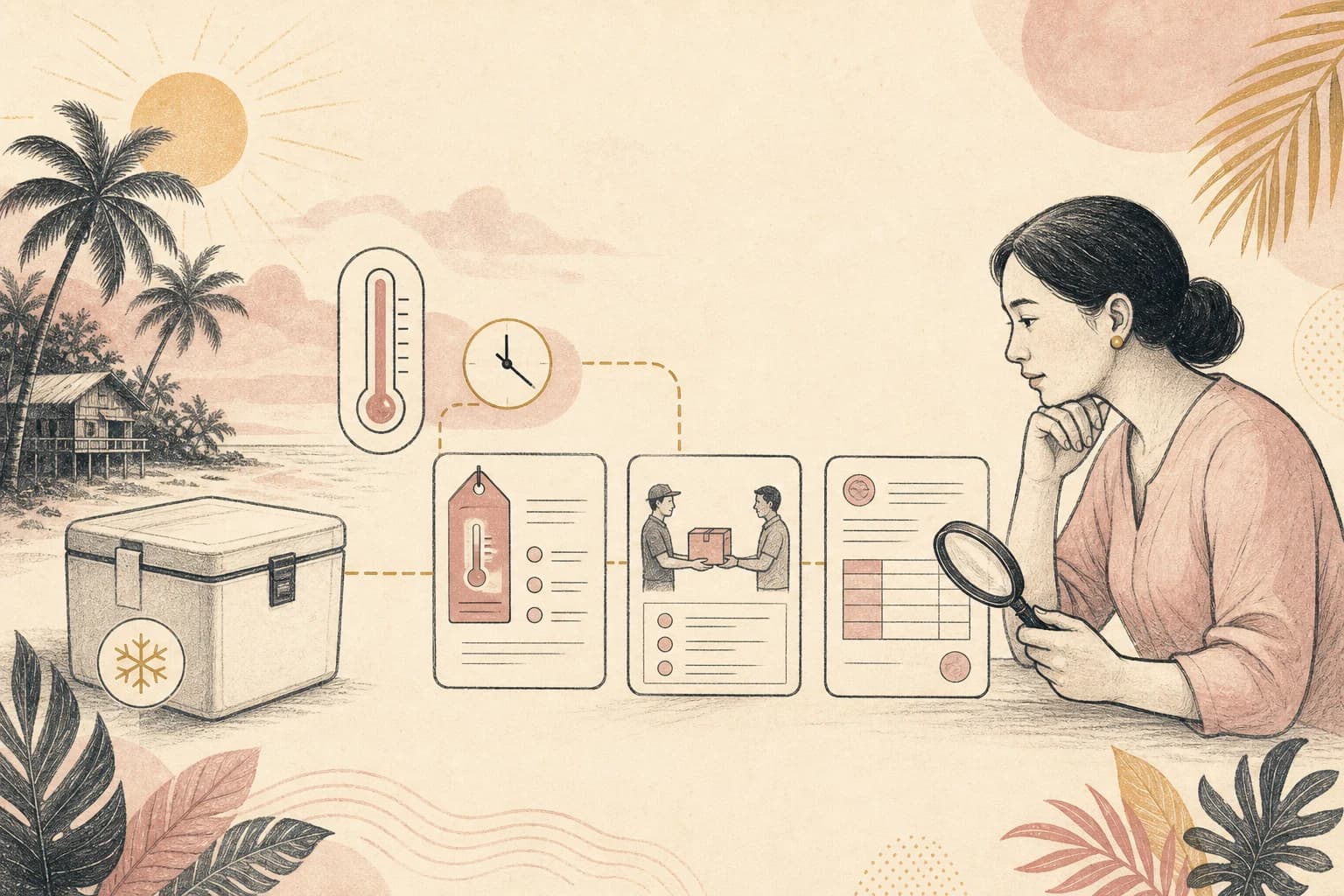
Philippine heat makes “kept cold” sound reassuring, especially after a parcel has crossed roads, warehouses, ferry points, or a condominium lobby. Yet cold-chain quality is not something a buyer can confirm by touching a box. It rests on product-specific limits, a traceable seller, and records that cover the journey.5 Filipino readers need to know which questions turn a smooth sales claim into checkable evidence.2
Cold chain is a documented condition
WHO calls a medicine time-and-temperature-sensitive when it can degrade beyond intended performance outside set environmental or time limits.6 A temperature excursion means exposure beyond the prescribed range during storage or transport.6 Those definitions make “still cool” an incomplete answer.6
The correct limits come from authorized product information and stability data, not from a universal rule for every cold item.1 A proper chain therefore links the exact product, the allowed conditions, monitored storage, transport, and a response to any deviation.5 The tropical setting raises the practical stakes, but it does not rewrite the rulebook.1
That is why the evidence must stay tied to one identified product.1
For readers looking for the exact topic, the semaglutide card below opens its live catalog details.
The exact label sets the limits
“Refrigerated” is a category, not the whole instruction.1 Current US FDA labels show why the exact name and presentation matter.7 One named Wegovy presentation allows up to 28 days between 8°C and 30°C before cap removal.7 Current Zepbound labeling includes different unrefrigerated windows, including 21 or 30 days at up to 30°C, depending on presentation.7
These are examples from named regulated medicines in one jurisdiction, not facts about the catalog cards on this page.7 They also show why a borrowed screenshot or a rule for a nearby product is weak evidence.1 A seller should be able to identify the applicable authorized information and connect it to the exact goods offered.1
In a Philippine summer, “room temperature” should never be translated into “any temperature indoors.”7 The printed upper limit and elapsed time still matter.7
An ice pack is not a temperature record
Cold packs, foam, and insulated bags may be parts of a shipping system, but their presence does not reveal the full temperature history.8 WHO guidance calls for routes and shipping systems to be qualified against expected transport conditions.8 It also calls for suitable monitoring when temperature control matters.8
The stronger question is not “Was there ice?” but “What measured the trip?”5 Useful evidence identifies the relevant shipment, monitoring period, and device.5 WHO guidance also calls for monitoring equipment to be suitable and calibrated, with records reviewed and retained.5
A photo taken before dispatch proves only what the camera captured at that moment.8 It does not cover a delayed van, a warehouse hand-off, a missed ferry, or hours at a collection point.8 The record must follow the journey, not merely decorate the listing.5
The hand-offs deserve attention
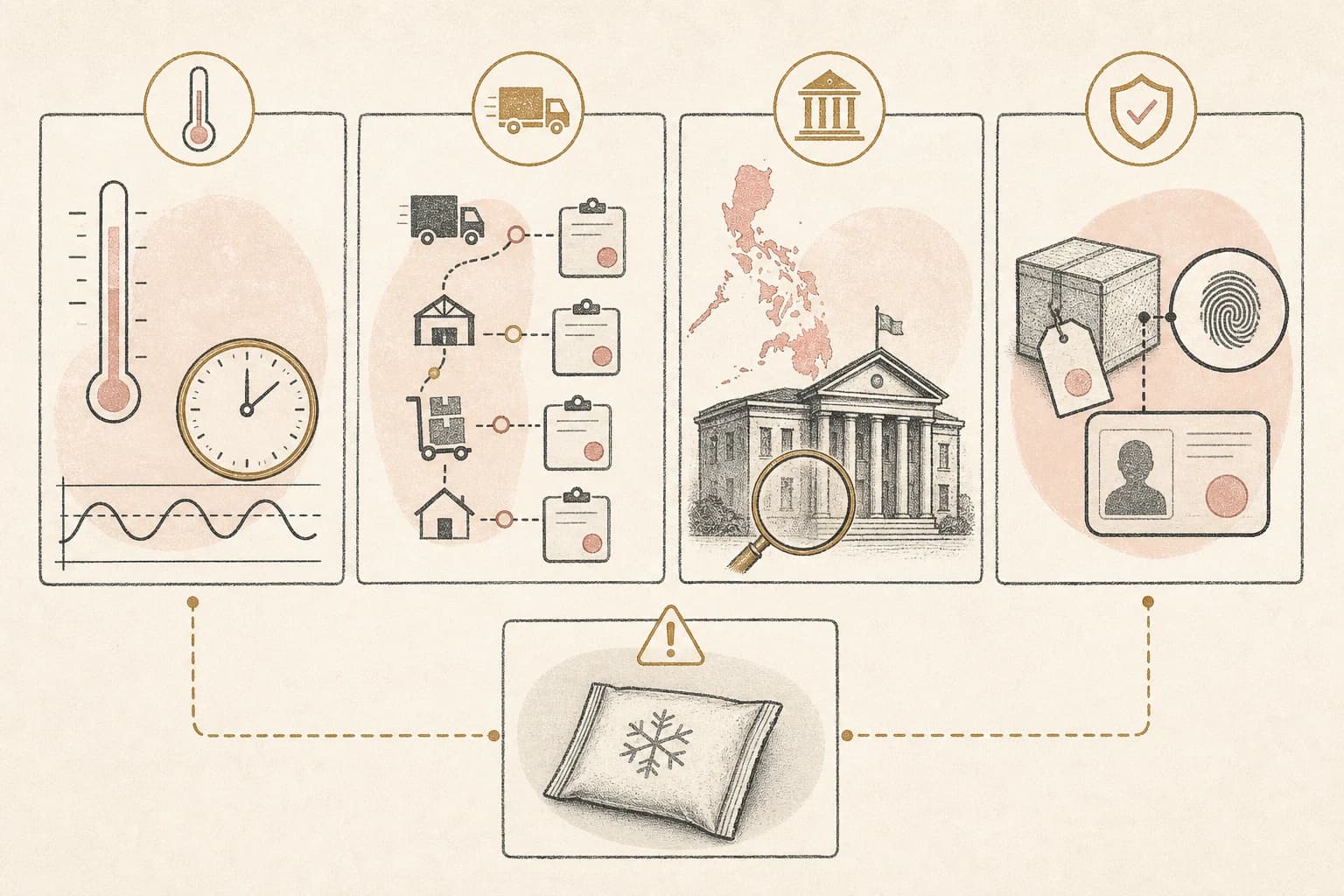
Every transfer can separate the product from its claimed conditions.8 WHO guidance says controlled-temperature deliveries should receive priority at receipt.2 Where appropriate, the transport temperature data should be reviewed when the delivery arrives.2 This moves the cold-chain question from appearance to continuity.2
A Filipino buyer can ask who accepted the shipment, when it arrived, and whether the temperature record was checked before release.2 The seller should also connect the delivery to its supplier and identifying records.9 WHO receiving guidance includes checks for the correct product, supplier, batch, expiry date, tampering, contamination, and damage.9
These checks serve different purposes.9 Matching names and dates help trace the goods, while temperature data addresses storage history.5 Neither cancels the other.9 A neat label does not prove a cold journey, and a cold parcel does not prove identity.9
An excursion needs a real assessment
A temperature reading outside the stated range is not answered by “probably fine.”10 WHO guidance calls for deviations to be reported and investigated.10 The decision should draw on product stability information and the responsible manufacturer or authorization holder.10
Several details shape that review: the highest and lowest readings, total time outside range, the exact presentation, and earlier shipment history.10 A single temperature without duration leaves the event incomplete.10 So does a claim that the parcel was “cold again” at delivery.10
The practical request is a written, shipment-specific explanation.10 It should state what happened, which record was reviewed, and who accepted the conclusion.10 Seller confidence is not a substitute for a documented disposition.10 Nor should a buyer improvise one from a different product’s limits.1
Philippine verification is a separate layer
The Philippine FDA Verification Portal provides public lists for two distinct checks.3 It lists establishments with Licenses to Operate and health products with Certificates of Product Registration or Notification.3 The portal also advises exact spelling when searching names.3
That means buyers should check both the seller’s establishment identity and the specific health-product record claimed.3 Names, registration details, and dates should match what is being presented.3 A portal result supports the listed regulatory record, but it does not prove the journey of one delivered item.3
Philippine heat is not ignored in the regulatory framework.11 For covered new-drug applications using specified review pathways, FDA Circular No. 2022-004 requires stability reports for Zone IVB, described as hot and very humid, unless otherwise justified.11 That requirement concerns application evidence; it is not a temperature log for a later parcel.11
For readers comparing nearby catalog topics, the tirzepatide card below opens its live catalog details.
Authenticity is not the same as coldness
A product can arrive cold and still raise identity concerns.9 WHO’s 2024 alert described three falsified Ozempic batches detected in Brazil, the United Kingdom, and the United States.4 The alert did not report a Philippine case.4 One falsified item carried a genuine batch number, showing why a lot number alone is not decisive.4
WHO advises obtaining medical products from authorized or licensed suppliers.12 For the specified alert, it also highlighted lot-and-serial combinations, label quality, and spelling as checks.12 These signals can reveal a problem, but none authenticates every item alone.12
This is where the Philippine portal, delivery documents, and physical inspection fit together.3 The portal checks listed records.3 Receiving documents support traceability.9 Visual details may reveal tampering or damage.9 Temperature records answer another question entirely.5
Turn the claim into six questions
Start with the exact identity: what authorized product information supplies the storage limits?1 Then ask for the allowed range, maximum time outside refrigeration, and any light or freezing restrictions shown there.7 Those details must belong to the named presentation, not a similar item.7
Next, ask how the route was qualified and what device monitored the shipment.8 Request the record covering dispatch through receipt, plus evidence that it was reviewed.2 If a deviation occurred, ask for the written assessment and responsible decision-maker.10
Finally, check the establishment and health-product entries in the Philippine FDA portal.3 Compare supplier, product, batch, expiry date, and delivery documents.9 Look for tampering, damage, poor label quality, or spelling problems.9 This sequence cannot guarantee authenticity, but it replaces vague reassurance with records tied to specific questions.12
Bottom line
For Filipino buyers, tropical heat is a reason to ask for stronger evidence, not a reason to invent a special temperature rule.1 The applicable authorized information defines the limits.1 Qualified transport and monitored records show how the shipment was handled.5 Receipt checks connect those records to the supplier, batch, dates, and physical condition.9 A deviation needs a documented, product-specific assessment rather than a casual promise.10
Philippine FDA records add an essential local verification layer for establishments and health products.3 They do not replace shipment evidence.3 Authenticity also stays separate: WHO’s alert shows that even a genuine batch number can appear on falsified goods.4 The sound approach is to verify identity, authority, temperature history, and exception handling together.12
This article is educational research context, not medical advice. Catalog links are neutral references and do not imply a treatment or human-use recommendation.
Frequently asked questions
What does “cold chain” actually mean?
It means controlled storage and transport within the exact conditions assigned to a time-and-temperature-sensitive medicine.6 The chain includes more than refrigeration.5 It also involves monitoring, records, qualified systems, and action when readings leave the allowed range.10 A cold parcel at one moment cannot establish that history.8
Is an ice pack enough proof?
No. An ice pack may be one part of a transport system, but it does not measure the complete trip.8 WHO guidance emphasizes qualified routes, suitable monitoring, and reviewed records.5 Ask for evidence linked to the shipment and its travel period, not only a packing photo.8
What should a temperature record show?
It should connect a suitable, calibrated monitor to the relevant shipment and period.5 For a controlled-temperature delivery, the data should be reviewed at receipt where appropriate.2 The useful record covers the journey and makes any reading outside the stated limits visible.10
Does one warm reading prove the goods are unusable?
Not by itself.10 WHO guidance treats a deviation as an event to report and investigate.10 The assessment depends on duration, temperature, exact presentation, shipment history, and product stability information.10 The responsible manufacturer or authorization holder should inform the disposition rather than a generic internet rule.10
What can I verify through Philippine FDA records?
The FDA Verification Portal lists establishments with Licenses to Operate and health products with Certificates of Product Registration or Notification.3 Search exact names and compare the displayed details with the seller’s claim.3 A matching entry supports that listed record, not the temperature history of a particular delivery.3
Can a correct batch number prove authenticity?
No. WHO’s falsified Ozempic alert included an item carrying a genuine batch number.4 WHO also highlighted serial combinations, label quality, spelling, and licensed suppliers.12 These are useful warning-sign checks, but they work best with traceable sourcing and delivery records.9
Sources
Footnotes
-
TRS 961 - Annex 9: Model guidance for the storage and transport of time and temperature sensitive pharmaceutical products; TRS 1025 - Annex 7: Good storage and distribution practices for medical products. International technical guidance on controlled storage and transport. Local law and the applicable authorized labeling take precedence. ↩ ↩2 ↩3 ↩4 ↩5 ↩6 ↩7 ↩8 ↩9 ↩10 ↩11
-
TRS 1025 - Annex 7: Good storage and distribution practices for medical products. WHO requirements for receiving controlled-temperature medical products. The guidance addresses professional distribution practice; a buyer may need the responsible supplier or distributor to interpret the record. ↩ ↩2 ↩3 ↩4 ↩5 ↩6 ↩7 ↩8
-
FDA Verification Portal. Official Philippine FDA public verification service. A portal match verifies the listed record and details shown; it does not by itself prove the history or authenticity of a particular delivered item. ↩ ↩2 ↩3 ↩4 ↩5 ↩6 ↩7 ↩8 ↩9 ↩10 ↩11 ↩12 ↩13 ↩14 ↩15
-
Medical Product Alert N°2/2024: Falsified OZEMPIC (semaglutide). WHO Medical Product Alert No. 2/2024 for specified falsified products. The alert concerns the named batches and countries; it does not establish prevalence or identify a Philippine case. ↩ ↩2 ↩3 ↩4 ↩5 ↩6
-
TRS 1025 - Annex 7: Good storage and distribution practices for medical products. WHO good storage and distribution practices for medical-product supply chains. A record is useful only when it belongs to the relevant shipment, period, and calibrated device. ↩ ↩2 ↩3 ↩4 ↩5 ↩6 ↩7 ↩8 ↩9 ↩10 ↩11 ↩12
-
TRS 961 - Annex 9: Model guidance for the storage and transport of time and temperature sensitive pharmaceutical products. WHO technical guidance for pharmaceutical storage and distribution systems. The definition does not determine whether any particular excursion is acceptable for a specific product. ↩ ↩2 ↩3 ↩4
-
WEGOVY (semaglutide) Highlights of Prescribing Information; ZEPBOUND (tirzepatide) Highlights of Prescribing Information. Current US FDA labeling for two named regulated medicines and their specified presentations. These US labels do not define the identity, quality, status, or storage rules of any Majiko catalog reference or a differently labeled product. ↩ ↩2 ↩3 ↩4 ↩5 ↩6 ↩7 ↩8
-
TRS 961 - Annex 9: Model guidance for the storage and transport of time and temperature sensitive pharmaceutical products. WHO model guidance for time- and temperature-sensitive pharmaceutical logistics. A cooler, ice pack, or photograph alone does not establish route qualification or the shipment's complete temperature history. ↩ ↩2 ↩3 ↩4 ↩5 ↩6 ↩7 ↩8 ↩9 ↩10
-
TRS 1025 - Annex 7: Good storage and distribution practices for medical products. WHO receiving and traceability procedures for medical products. Visible checks and matching documents do not replace temperature records or a formal authenticity investigation when concerns arise. ↩ ↩2 ↩3 ↩4 ↩5 ↩6 ↩7 ↩8 ↩9 ↩10 ↩11 ↩12
-
TRS 961 - Annex 9: Model guidance for the storage and transport of time and temperature sensitive pharmaceutical products; TRS 1025 - Annex 7: Good storage and distribution practices for medical products. WHO excursion-management and distribution procedures. Temperature alone does not settle disposition; duration, presentation, shipment history, and product-specific stability limits matter. ↩ ↩2 ↩3 ↩4 ↩5 ↩6 ↩7 ↩8 ↩9 ↩10 ↩11 ↩12 ↩13 ↩14 ↩15 ↩16 ↩17
-
FDA Circular No. 2022-004: Implementing Guidelines on the Abridged and Verification Review Pathways for New Drug Registration Applications. Philippine regulatory documentary requirements for specified new-drug review pathways. The circular is an application requirement, not proof that every shipment remained within its labeled limits. ↩ ↩2 ↩3
-
Medical Product Alert N°2/2024: Falsified OZEMPIC (semaglutide). Public and professional advice in WHO Medical Product Alert No. 2/2024. These checks can reveal warning signs but cannot authenticate every item on their own. ↩ ↩2 ↩3 ↩4 ↩5 ↩6