
TL;DR
- In pooled weight-management trials, nausea affected 25% to 29% of tirzepatide groups, compared with 8% on placebo; these are group rates, not personal forecasts.1
- Diarrhea, vomiting, and constipation were also common, but their percentages differed across assigned trial groups, so one number cannot summarize every event.2
- A real-world comparison recorded fewer gastrointestinal reports with tirzepatide than semaglutide, but its observational design limits causal conclusions.3
- Dramatic liver, platelet, and metabolic events appear in individual reports, which identify signals but cannot establish population frequency.4
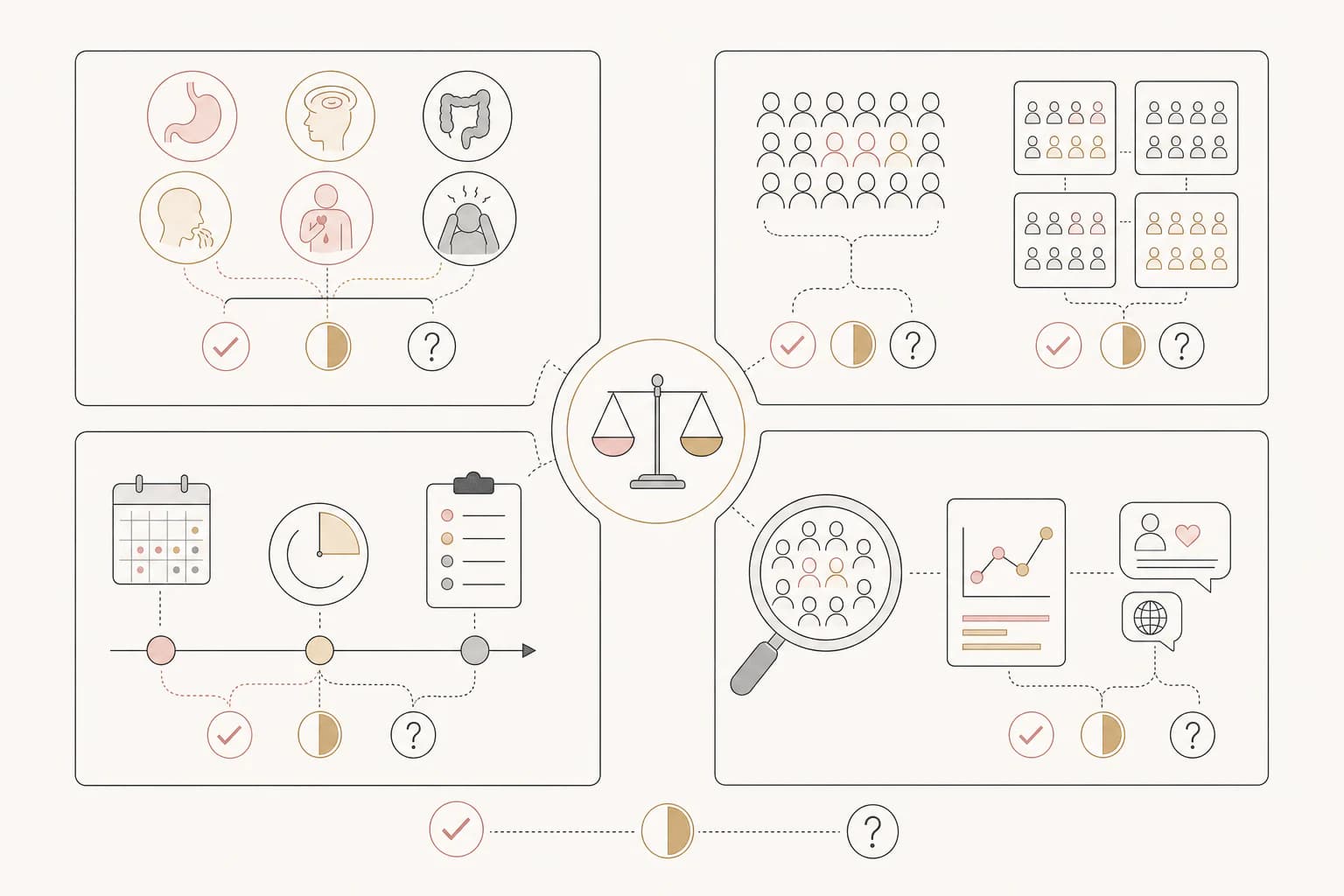
For Filipino readers, a frightening clip can feel more immediate than a trial table. Yet the two tell different kinds of truth. Tirzepatide research includes controlled trials, routine-care records, and individual case reports.1 Reading them together requires close attention to denominators, study design, comparison groups, and the exact population observed.3
First, understand what a side-effect rate means
A trial rate is the share of participants reporting an event under a defined research protocol.1 It describes a group, not one person's future.1 In pooled placebo-controlled weight-management trials, nausea appeared in 25% to 29% of tirzepatide groups.1 The placebo figure was 8%.1 That comparison helps separate events reported during treatment from background symptoms.1 It also gives the percentage a clear denominator and comparator.1 However, it does not prove tirzepatide caused every episode.1
Regulatory records identify Zepbound and Mounjaro as named tirzepatide products.5 Those records apply to specific regulated products and indications.5 They do not establish that a catalog item is equivalent to either named product.5
For a neutral catalog reference, the exact product is tirzepatide.
The common pattern is gastrointestinal
The pooled trial pattern is less mysterious than many online accounts suggest.2 Diarrhea affected 19% to 23% of tirzepatide groups.2 Vomiting affected 8% to 13%, while constipation affected 11% to 17%.2 These ranges reflect separate assigned groups, not one combined probability.2 Adding them together would also be misleading because one participant could report several events.2
A longer phase 3b trial adds information about timing and severity.6 Its most common tirzepatide adverse events were gastrointestinal.6 They were mostly mild to moderate and mostly appeared during escalation.6 That wording matters: “most common” does not mean universal, and “mostly mild” does not mean trivial for everyone.6 The study also included an open-label lead-in before its randomized maintenance period.6 Its results therefore belong to that particular trial structure.6
Stopping rates add a different measure
Symptom percentages do not fully describe tolerability.7 Another useful endpoint is whether participants stopped because of adverse reactions.7 In pooled Zepbound trials, 4.8% to 6.7% of tirzepatide participants stopped for that reason.7 The comparable placebo figure was 3.4%.7
These figures answer a narrower question than “How bad were the side effects?”7 Stopping can reflect severity, persistence, personal tolerance, or study procedures.7 Meanwhile, a participant may remain in a trial despite an unpleasant event.7 A discontinuation rate should therefore sit beside symptom rates, not replace them.7
A randomized phase 3 trial in 206 Chinese adults offers another population.8 Gastrointestinal events were the most common treatment-emergent events in its tirzepatide groups.8 The abstract did not provide percentages for each gastrointestinal event.8 That missing detail should remain missing, rather than being guessed.8
Real-world numbers answer another question
Trials actively define visits, outcomes, and follow-up.1 Routine-care research instead observes what gets recorded in ordinary clinical settings.3 A retrospective US multicenter study compared 207 tirzepatide users with 304 semaglutide users.3 It recorded gastrointestinal side effects in 28.5% and 50.7%, respectively.3
That result should not be treated as a head-to-head randomized verdict.3 The cohort was 91.8% White and 74.8% female.3 Differences in who received each medicine, what clinicians documented, and who remained under observation may shape the result.3 The study still offers useful routine-care context, but it cannot erase trial findings.3
Another retrospective cohort followed adults with type 1 diabetes and obesity.9 Side effects were described as common, while 89.4% continued tirzepatide at one year.9 Severe hypoglycaemia, ketoacidosis, and hospitalisation rates did not differ from matched controls.9 The abstract did not list individual side-effect counts.9
Why rare stories travel farther
Case reports often begin with one unusual clinical event.4 One report described acute liver injury in a woman in her twenties after tirzepatide exposure.4 Investigators reported no alternative cause, followed by recovery after cessation.4 This sequence supports a possible association, but one person provides no denominator.4
A second report described severe immune thrombocytopenia in a 47-year-old man.10 Other secondary causes were reportedly excluded, and platelet counts recovered after several interventions.10 Because treatment changes occurred together, the report cannot isolate one decisive factor.10
A third report described hyperglycemic ketoacidosis in a 38-year-old woman without diabetes.11 She also had congenital heart disease and had five months of exposure.11 Again, the report can alert researchers to a possible signal.11 This single report does not measure how often that event occurs or predict another person's outcome.11
Viral reach is not statistical weight
A vivid account can be accurate about one person's experience yet weak evidence about frequency.4 Trial tables have denominators, comparison groups, and prespecified collection methods.1 Case reports provide clinical detail but usually lack a comparison group and rate estimate.10 Observational cohorts sit between them, with larger groups but less control over confounding.3
The right comparison is therefore not “real story versus research.”4 A case report is research, but it answers a different question.4 It can suggest what deserves investigation.10 A controlled trial is better suited to estimating common-event rates within its enrolled population.1 A routine-care cohort can test whether patterns appear outside trial conditions.3
Combination studies need an extra label
Context also changes attribution.12 In a 102-person phase 2 study, every participant received tirzepatide with another assigned intervention.12 Any adverse event occurred in 76% with apitegromab and 71% with placebo added.12 Serious events occurred in 2% of each arm.12
Those percentages describe the complete study arms.12 They do not isolate which component was linked to each event.12 They also cannot be compared casually with pooled monotherapy tables from another trial program.12 The participants, research question, and event collection came from a different protocol.12 Combination evidence remains useful when its full context stays attached.12 Removing that context can make a precise percentage support the wrong conclusion.12
Comparing tirzepatide with semaglutide carefully
The available real-world comparison found different reporting percentages for gastrointestinal effects.3 However, it was retrospective, not randomized.3 It also involved a US cohort with limited demographic diversity.3 Filipino readers should not assume those exact percentages transfer unchanged to the Philippines.3
The comparison still illustrates a broader lesson.3 Side-effect figures depend on population, study design, event collection, and comparator.3 Two percentages may look directly comparable while measuring differently.3 Trial tables and routine-care records should therefore keep their original labels and settings.3
That discipline matters when a short post removes the study label.3 A percentage from routine-care records should not be presented as though it came from a controlled trial.3 Likewise, one group's result should not be treated as a personal forecast for every reader.1 The useful comparison is specific: what was recorded, in whom, under which design, and against what comparator.3
For a neutral related catalog reference, the exact product is semaglutide.
Bottom line
The strongest recurring signal in the cited tirzepatide trials is gastrointestinal.2 Nausea, diarrhea, vomiting, and constipation appeared often enough to quantify in pooled trial groups.1 Most gastrointestinal events in one long phase 3b study were mild to moderate and clustered during escalation.6 A smaller share stopped because of adverse reactions.7
Rare viral stories should neither be dismissed nor converted into rates.4 Individual liver injury, thrombocytopenia, and ketoacidosis reports can flag possible signals.10 They cannot reveal population frequency or prove what another reader will experience.11 The clearest reading keeps trial rates, observational findings, and single-person reports in their proper lanes.3
This article is educational research context, not medical advice. Catalog links are neutral references and do not imply a treatment or human-use recommendation.
Frequently asked questions
What were the most common tirzepatide side effects in the pooled trials?
Gastrointestinal events led the pattern.2 Nausea affected 25% to 29% of tirzepatide groups.1 Diarrhea affected 19% to 23%, vomiting 8% to 13%, and constipation 11% to 17%.2 Each range represents separate assigned groups in pooled placebo-controlled weight-management trials.2
Does a 29% nausea rate mean I have a 29% personal chance?
A trial percentage cannot predict one person exactly.1 The 29% figure describes one assigned group under defined trial conditions.1 Individual experience may differ from that group result.1 The 8% placebo rate also shows that nausea occurred without active tirzepatide exposure in the comparison group.1
Were most gastrointestinal events severe?
In SURMOUNT-MAINTAIN, gastrointestinal events were the most common tirzepatide adverse events.6 They were mostly mild to moderate and mostly occurred during escalation.6 That finding belongs to a phase 3b trial with an open-label lead-in and randomized maintenance period.6 It does not describe every participant's experience.6
How often did trial participants stop because of adverse reactions?
Across pooled Zepbound trials, 4.8% to 6.7% of tirzepatide participants stopped because of adverse reactions.7 The placebo figure was 3.4%.7 These discontinuation percentages measure a specific trial outcome.7 They do not capture every symptom or explain each participant's reason beyond the recorded adverse reaction.7
Do rare case reports prove tirzepatide caused those events?
No.4 Reports described liver injury, severe immune thrombocytopenia, and hyperglycemic ketoacidosis after tirzepatide exposure.10 Their timelines and investigations can support possible associations.11 However, single cases cannot establish frequency, eliminate every alternative explanation, or prove the same outcome would occur in other people.4
Why did one real-world study show different results from trials?
The retrospective study relied on gastrointestinal effects reported in routine care.3 Trials use defined protocols and enrolled populations.1 The real-world cohort was also predominantly White and female.3 Different populations, documentation, follow-up, and treatment selection can all shape observed percentages, so the numbers answer related but distinct questions.3
Sources
Footnotes
-
FDA Drugs@FDA record for ZEPBOUND (TIRZEPATIDE). Pooled placebo-controlled adult trials in the official Zepbound label. These are group rates from defined trials, not an individual's predicted experience. ↩ ↩2 ↩3 ↩4 ↩5 ↩6 ↩7 ↩8 ↩9 ↩10 ↩11 ↩12 ↩13 ↩14 ↩15 ↩16 ↩17 ↩18 ↩19 ↩20
-
FDA Drugs@FDA record for ZEPBOUND (TIRZEPATIDE). Pooled placebo-controlled adult trials in the official Zepbound label. Rates varied across assigned trial groups and should not be merged into one overall probability. ↩ ↩2 ↩3 ↩4 ↩5 ↩6 ↩7 ↩8 ↩9 ↩10
-
Real-World Comparative Effectiveness of Tirzepatide and Semaglutide for Obesity: A Multicentered Study.. Retrospective observational study of 511 adults treated for obesity. The cohort was predominantly White and female, and reported events may differ from actively collected trial events. ↩ ↩2 ↩3 ↩4 ↩5 ↩6 ↩7 ↩8 ↩9 ↩10 ↩11 ↩12 ↩13 ↩14 ↩15 ↩16 ↩17 ↩18 ↩19 ↩20 ↩21 ↩22 ↩23 ↩24 ↩25 ↩26
-
Drug-induced liver injury secondary to tirzepatide.. Single human case report involving a woman in her twenties. A case report can signal a possible association but cannot estimate frequency or prove causation. ↩ ↩2 ↩3 ↩4 ↩5 ↩6 ↩7 ↩8 ↩9 ↩10 ↩11
-
FDA Drugs@FDA record for ZEPBOUND (TIRZEPATIDE); FDA Drugs@FDA record for MOUNJARO (TIRZEPATIDE). Authoritative US regulatory records for the named products. The records apply only to the named FDA-regulated products and indications. ↩ ↩2 ↩3
-
Tirzepatide for maintenance of bodyweight reduction in people with obesity in the USA (SURMOUNT-MAINTAIN): a multicentre, double-blind, randomised, placebo-controlled trial.. Completed multicenter, randomized, placebo-controlled phase 3b obesity trial. The trial included an open-label lead-in and a later randomized maintenance period. ↩ ↩2 ↩3 ↩4 ↩5 ↩6 ↩7 ↩8 ↩9 ↩10 ↩11
-
FDA Drugs@FDA record for ZEPBOUND (TIRZEPATIDE). Pooled placebo-controlled adult trials in the official Zepbound label. Discontinuation is a trial outcome and does not measure every event's intensity. ↩ ↩2 ↩3 ↩4 ↩5 ↩6 ↩7 ↩8 ↩9 ↩10 ↩11 ↩12 ↩13
-
Tirzepatide monotherapy in Chinese patients with early type 2 diabetes: A randomized, double-blind, placebo-controlled phase 3 trial (SURPASS-CN-MONO).. Randomized, double-blind, placebo-controlled phase 3 monotherapy trial at 29 Chinese centers. The abstract does not provide individual gastrointestinal event percentages. ↩ ↩2 ↩3 ↩4
-
Real-World Effectiveness and Safety of Tirzepatide in Type 1 Diabetes and Obesity: Impact on Glycaemia, Weight, and Cardiometabolic Risk Markers.. Retrospective real-world cohort of 142 exposed adults and 50 matched controls. The abstract does not enumerate side-effect types or counts, and observational comparisons can retain confounding. ↩ ↩2 ↩3 ↩4
-
A Rare Case of Tirzepatide-Associated Immune Thrombocytopenia.. Single human case report with other secondary causes reportedly excluded. A single report cannot establish a population rate or certain causation. ↩ ↩2 ↩3 ↩4 ↩5 ↩6 ↩7
-
Tirzepatide-induced ketoacidosis with hyperglycemia in a patient without diabetes.. Single human case report involving congenital heart disease and five months of exposure. The report cannot determine frequency or show what would happen in other populations. ↩ ↩2 ↩3 ↩4 ↩5 ↩6
-
Apitegromab for lean mass preservation during tirzepatide-induced weight loss: a randomized, double-blind, placebo-controlled phase 2 trial.. Randomized, double-blind phase 2 combination trial in adults with overweight or obesity. The study evaluates a combination and cannot attribute every event to tirzepatide. ↩ ↩2 ↩3 ↩4 ↩5 ↩6 ↩7 ↩8 ↩9 ↩10