Quick answer
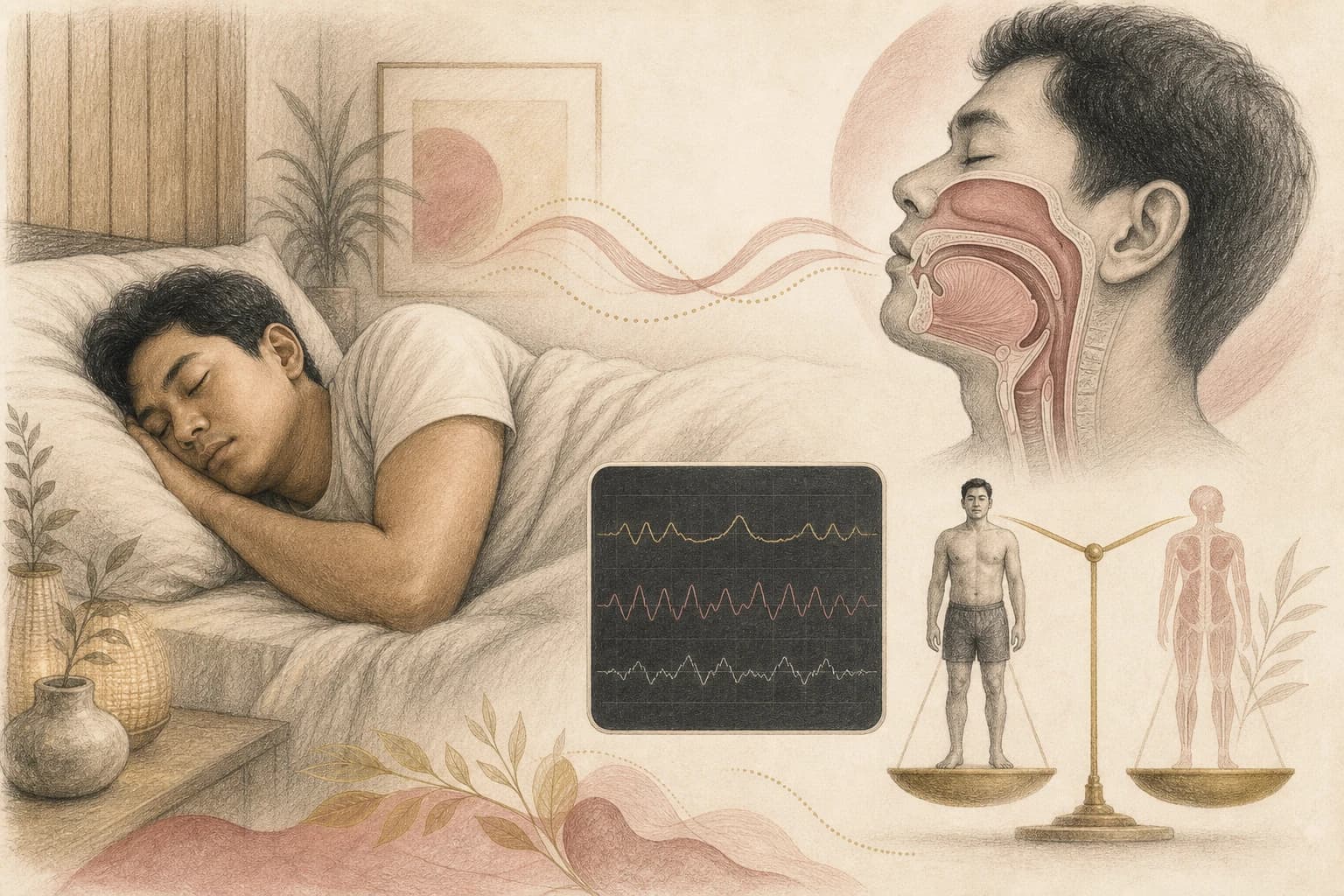
Researchers became interested in tirzepatide for obstructive sleep apnea because obesity and metabolic dysfunction are closely linked with many cases of the condition. Reviews report reductions in body weight and the apnea-hypopnea index, a count of breathing interruptions during sleep.
The difficult question is how much change comes from weight loss and whether any separate pathway contributes. Current evidence cannot fully separate those effects, and long-term outcomes still need study. Sleep apnea remains a condition requiring proper assessment, not a symptom to self-diagnose.123
What is obstructive sleep apnea?
Obstructive sleep apnea involves repeated partial or complete blockage of the upper airway during sleep. The interruptions disturb sleep and can lower blood oxygen.4
A person may snore loudly, wake with headaches, feel unrefreshed, or become sleepy during the day. These signs are not specific enough to confirm the condition by themselves.
Researchers often summarize severity with the apnea-hypopnea index, or AHI. It counts apnea and hypopnea events per hour of sleep.
An apnea is a major pause in airflow. A hypopnea is a meaningful reduction. Formal definitions and thresholds depend on the sleep-test standard being used.
AHI is important, but it is not the whole lived experience. Oxygen levels, sleep quality, symptoms, heart health, and adherence to established care can also matter.
Readers researching Tirzepatide can view its live catalog details below. The listing identifies the catalog item and is separate from the evidence discussed here.
Why does body weight enter the discussion?
Obesity and metabolic dysfunction are strongly associated with obstructive sleep apnea.1 Fat around the neck and abdomen can influence airway mechanics and breathing during sleep.
That does not mean body weight explains every case. Jaw structure, airway anatomy, age, alcohol, sedating medicines, neuromuscular factors, and other conditions may contribute.
Weight change can reduce some mechanical pressure and alter metabolic signals. This made a medicine associated with substantial weight loss an obvious subject for sleep-apnea research.
The logic is plausible, but plausibility is not the result. Trials must still show what happened to breathing events, symptoms, and safety.
It is also possible for two people with similar weight to have very different apnea severity. That is one reason a scale cannot replace a sleep study.
For Filipino readers, access to diagnostic testing may vary by city and health system. The evidence does not support guessing the diagnosis from a social-media checklist.
What changes have reviews reported?
Reviews of tirzepatide and sleep apnea report reductions in body weight and AHI while emphasizing the need for longer-term trials.3
An AHI reduction means fewer scored breathing events during the tested sleep period. It does not automatically mean the condition disappeared or that every symptom resolved.
Study averages also conceal individual variation. Some participants may have large changes, others smaller changes, and some may stop treatment or lack follow-up data.
The most useful reading pairs the breathing result with the population, baseline severity, comparison group, and duration. A percentage without that context is easy to oversell.
Longer follow-up matters because body weight, adherence, sleep habits, and airway physiology can change. A study endpoint does not guarantee that an effect persists indefinitely.
Safety and tolerability belong in the same review. A benefit-only summary cannot explain how many participants experienced problems or discontinued.
Is the effect only about weight loss?
The honest answer is that researchers have not completely separated weight-dependent and possible weight-independent effects.2
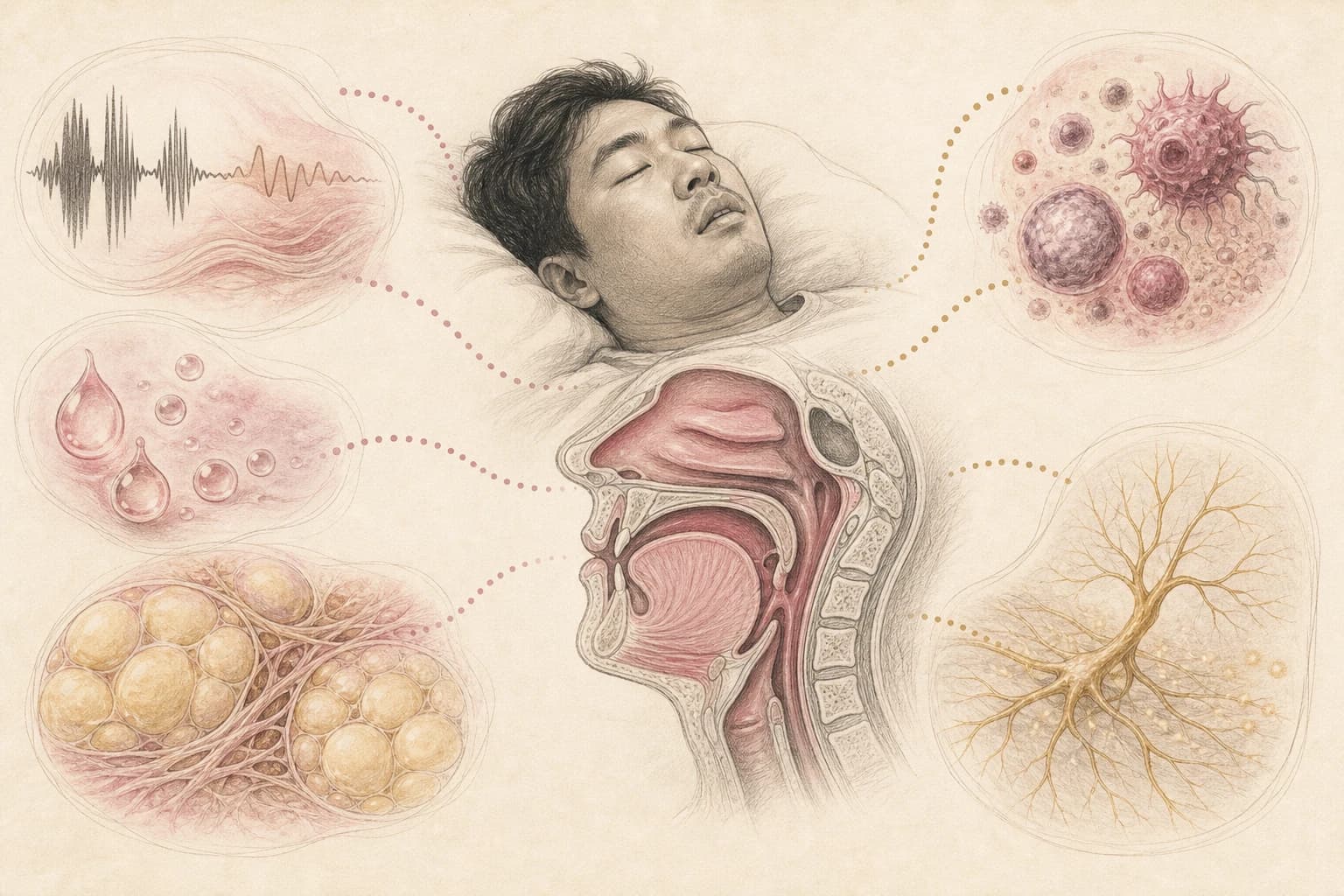
Proposed pathways include changes in adiposity, inflammation, insulin sensitivity, autonomic regulation, ventilatory control, and neuromuscular function.52
These ideas are not equally proven. A review can organize mechanisms without confirming that each one caused the clinical result.
To test a weight-independent effect, researchers need analyses designed for that question. Simply observing weight loss and better AHI at the same time cannot reveal the full causal path.
The same caution applies in undo. It would be too strong to claim that only weight matters when other pathways have not been excluded.
Readers comparing this topic with Semaglutide can view its live catalog details below. It is a separate catalog reference, not a suggested combination.
What does the research not replace?
It does not replace a sleep assessment. Snoring alone cannot show how often breathing stops or how oxygen changes.
It does not prove that established sleep-apnea equipment or other clinician-directed care can be stopped. That question requires individual evaluation.
It does not show that tirzepatide is appropriate for every person with apnea. The causes, severity, medical history, and treatment goals differ.
It also does not turn a study result into a product-authentication tool. A paper about a named medicine cannot verify an online item.
Finally, the research does not erase uncertainty about long-term outcomes. Reviews explicitly call for continued study.3
How should Philippine product claims be checked?
The Philippine FDA Verification Portal separates licensed establishments from registered or notified products.6 Verify the exact item rather than stopping at a seller’s business record.
Compare the product name, manufacturer, form, and authorization information shown in the current official entry. Similar packaging is not proof of the same product.
WHO explains that falsified medical products may closely resemble genuine products and can require quality-control analysis.7
That warning matters when demand rises faster than public understanding. A convincing box, receipt, or social account cannot prove identity.
The scientific and regulatory questions are separate. A positive study does not authorize every item, while a product record does not guarantee an individual outcome.
How can readers judge a sleep-apnea headline?
Look first for AHI, oxygen, symptoms, and the duration of follow-up. These reveal whether the headline matches the measured outcome.
Check whether the article distinguishes association from mechanism. Obesity is linked with apnea, but it does not explain every case.1
Notice whether weight-dependent and weight-independent effects are presented as settled. Current reviews say that separation remains uncertain.2
Ask whether the article tells readers what the study cannot replace. Sleep testing and individualized clinical care should not disappear behind a dramatic result.
Keep each conclusion attached to its exact source, population, and product identity.8 That makes the evidence easier to trust and harder to misuse.
Bottom line
Tirzepatide attracted sleep-apnea research because body weight and metabolic dysfunction are closely connected with many cases of obstructive sleep apnea. Reviews report reductions in weight and breathing-event frequency, yet the exact role of weight loss versus other proposed pathways remains uncertain.
AHI is a useful endpoint, not a complete description of symptoms or long-term health. Filipino readers should not use online signs to diagnose themselves or use a study to authenticate a product. The evidence is early-stage enough to explain scientific interest, but still specific enough to require careful wording, proper sleep assessment, and current official verification.
Frequently asked questions
What does AHI mean?
It is the average number of apnea and hypopnea breathing events recorded per hour of sleep.
Does lower AHI mean sleep apnea is cured?
Not necessarily. Severity, symptoms, oxygen levels, and follow-up still matter.
Is every case of obstructive sleep apnea caused by obesity?
No. Obesity is closely linked, but anatomy and other factors also contribute.1
Has a weight-independent effect been proven?
No. Current evidence cannot fully separate it from weight-dependent change.2
Can a study confirm that an online tirzepatide product is genuine?
No. Product identity requires current official records and, in some cases, quality analysis.67
Sources
Footnotes
-
GLP-1/GIP dual agonist tirzepatide in obstructive sleep apnea syndrome: mechanisms, evidence, and clinical perspectives.; Tirzepatide in Obesity-Related Obstructive Sleep Apnea: Beyond Weight Loss Toward Disease Modification?. Two narrative reviews synthesizing clinical and mechanistic literature. Association does not mean obesity explains every case of obstructive sleep apnea. ↩ ↩2 ↩3 ↩4
-
Tirzepatide in Obesity-Related Obstructive Sleep Apnea: Beyond Weight Loss Toward Disease Modification?. Critical narrative review of randomized trials, meta-analyses, and mechanistic studies. Proposed effects involving inflammation, insulin sensitivity, autonomic regulation, or ventilatory control remain hypotheses requiring targeted study. ↩ ↩2 ↩3 ↩4 ↩5
-
GLP-1/GIP dual agonist tirzepatide in obstructive sleep apnea syndrome: mechanisms, evidence, and clinical perspectives.. Review synthesis of preliminary and clinical findings. A review summary cannot replace appraisal of individual trials or establish long-term outcomes. ↩ ↩2 ↩3
-
Tirzepatide: A Breakthrough Therapy for Obstructive Sleep Apnea and Metabolic Dysfunction.. Narrative review of obstructive sleep apnea and tirzepatide research. This is a general description from a review, not a diagnostic rule for an individual. ↩
-
GLP-1/GIP dual agonist tirzepatide in obstructive sleep apnea syndrome: mechanisms, evidence, and clinical perspectives.. Mechanistic hypotheses summarized in a narrative review. These proposed pathways are not all confirmed in humans. ↩
-
Philippine FDA Verification Portal; FDA Advisory No. 2023-2238: Utilization of the FDA Verification Portal. Official Philippine regulatory verification service. A portal record applies to the exact product or establishment named in that record. ↩ ↩2
-
WHO laboratory analysis of suspected falsified medical products; WHO laboratory testing for health-product regulation. WHO guidance on suspected falsified medical products and regulatory laboratory testing. Appearance alone cannot authenticate a product or establish a research outcome. ↩ ↩2
-
GLP-1/GIP dual agonist tirzepatide in obstructive sleep apnea syndrome: mechanisms, evidence, and clinical perspectives.; Tirzepatide: A Breakthrough Therapy for Obstructive Sleep Apnea and Metabolic Dysfunction.; Tirzepatide in Obesity-Related Obstructive Sleep Apnea: Beyond Weight Loss Toward Disease Modification?; Philippine FDA Verification Portal; FDA Advisory No. 2023-2238: Utilization of the FDA Verification Portal. Editorial synthesis of the canonical research records and Philippine verification sources. This synthesis is educational and is not personal medical advice or a product recommendation. ↩