
TL;DR
- Because obesity often overlaps with obstructive sleep apnea, researchers began studying links among body weight, metabolism, and nighttime breathing.1
- Tirzepatide drew interest because it acts through GIP and GLP-1 receptors. Researchers asked whether its metabolic effects might also change the nightly breathing disruptions measured in obesity-related sleep apnea.2
- Reviews describe improvements in body weight and the apnea-hypopnea index. However, they also call for longer research and more precise explanations of how those changes happen.3
- The central uncertainty remains important: researchers cannot yet cleanly separate effects related to weight reduction from other proposed biological pathways. Those pathways remain scientific questions, not settled explanations.4
For Filipino families, loud snoring may sound ordinary until pauses in breathing make sleep feel alarming. Obstructive sleep apnea can break up sleep and lower blood oxygen during repeated airway blockages.5 Because obesity often overlaps with the condition, researchers began looking beyond the airway alone.1 Tirzepatide entered that research through questions about metabolism, body weight, and nighttime breathing.3
This article is educational research context, not medical advice. Catalog links are neutral references and do not imply a treatment or human-use recommendation.
First, what obstructive sleep apnea does
Obstructive sleep apnea involves repeated complete or partial blockage of the upper airway during sleep.5 These events can disturb sleep and produce periods of low blood oxygen.5 Researchers often count them with the apnea-hypopnea index, or AHI.3 AHI summarizes breathing interruptions across each hour of sleep.3
The condition is not simply “bad snoring.”5 Researchers study airway anatomy, body composition, metabolism, and breathing control.4 Obesity is a major part of that picture, but it does not explain every case.1 This overlap led to a basic question: if a compound changes weight and metabolic health, could sleep-related airway obstruction change too?3 That question shaped later research.3
Tirzepatide appears below as a neutral catalog reference.2
Why the obesity connection mattered
Obesity and metabolic dysfunction are closely associated with obstructive sleep apnea.1 Researchers therefore saw weight change as one plausible route to changing sleep-apnea severity.3 Less tissue around the upper airway could potentially improve its stability during sleep.6 Changes in abdominal fat might also affect breathing mechanics.6
That idea is plausible, but it is not a complete explanation.4 Reviews also discuss inflammation, insulin sensitivity, automatic body regulation, and breathing control.4 These pathways could affect the airway or breathing system overnight.4 Researchers have not shown how much each one contributes in humans.4
The topic therefore became more than a simple weight story.4 Tirzepatide offered a way to study several connected changes in obesity-related sleep apnea.3 It did not reveal which change caused each sleep outcome.4
What made tirzepatide scientifically interesting
Tirzepatide acts at two metabolic signaling targets: GIP and GLP-1 receptors.2 That dual action set it apart within the broader incretin research field.2 Researchers were already studying how GLP-1-based approaches affected weight and metabolic health.3 Sleep-apnea studies extended the question to nighttime breathing.3
Reviews then summarized reductions in both body weight and AHI in tirzepatide research.3 AHI matters because it counts the breathing events central to sleep-apnea severity.3 Some research also examined oxygen-related outcomes and sleep measures.3
Still, changes that happen together do not prove a direct airway effect.4 Weight, fat distribution, inflammation, and breathing control can all change at once.4 A trial may show that outcomes moved without showing the full chain between them.4 That gap is now a key research question.4
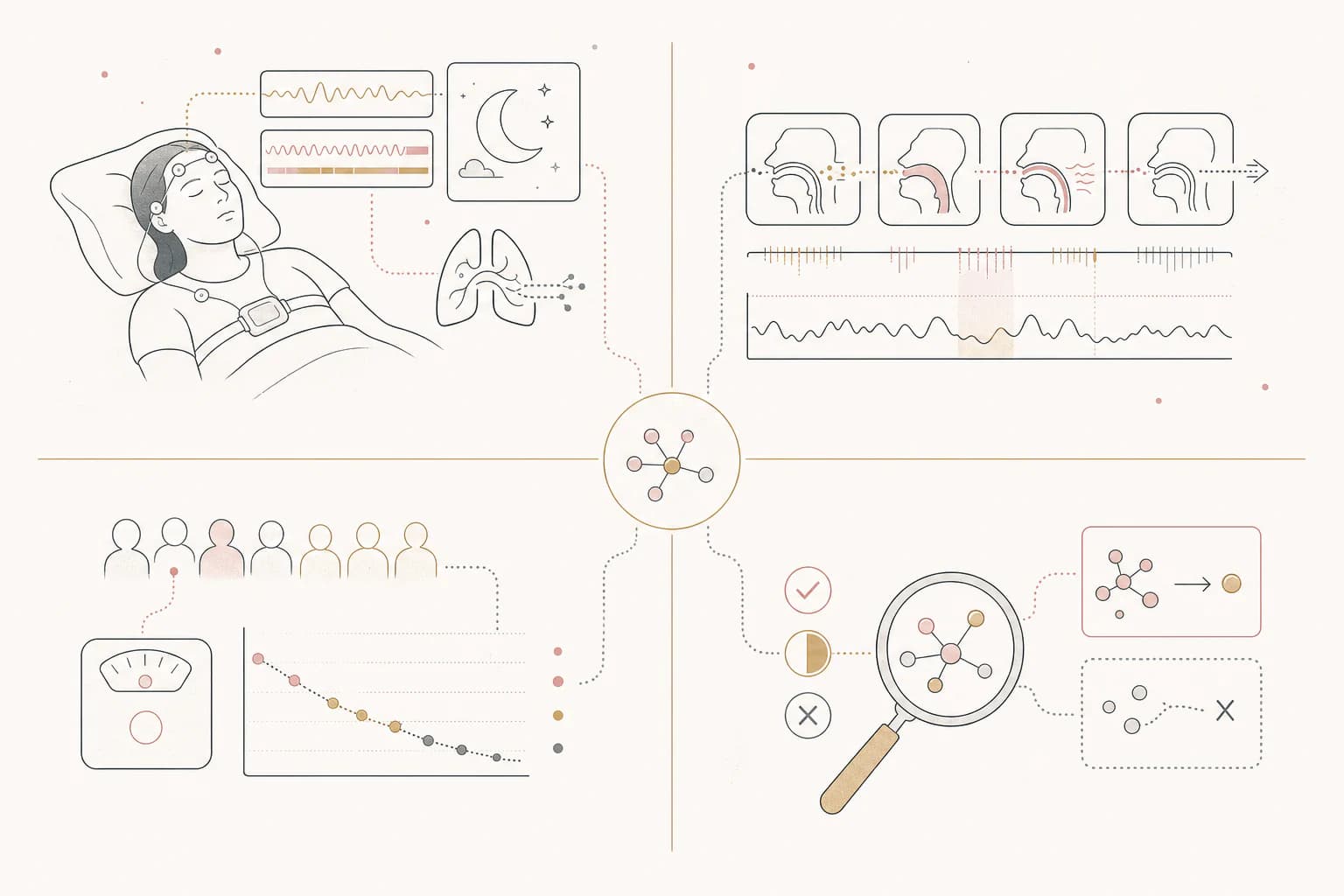
What the broader evidence reports
A 2026 systematic-review preprint gathered 40 studies of GLP-1-based therapies in adults with sleep apnea.7 It reported larger AHI reductions for tirzepatide than for liraglutide.7 Its authors also suggested that weight loss explained much of the observed effect.7 They discussed possible additional mechanisms, but those remain uncertain.7
Those figures require restraint because the report was a preprint.7 It combined studies that could differ in design, participants, and context.7 A pooled result can summarize a field, but the included studies may not be equally strong.7 It also cannot prove that one mechanism explains every result.4
Narrative reviews reached a similarly cautious destination.3 They described encouraging changes while calling for longer trials.3 Interest grew because several outcomes moved together, not because every scientific question had been answered.4
What participants said changed
Sleep-study numbers capture only part of life with obstructive sleep apnea.8 A qualitative study interviewed 82 people leaving the phase 3 SURMOUNT-OSA trials.9 Forty-nine had been assigned tirzepatide and 33 placebo.9 They were based in the United States and Germany.9
More tirzepatide-assigned participants reported meaningful improvements in key symptoms and daily impacts.8 They also reported better sleep quality and daytime functioning more often than placebo-assigned participants.8 These accounts show why researchers considered patient experience alongside sleep-study measures.8
However, the interviews were self-reports from a selected trial group.8 Most interviewees were male, non-Hispanic, and White.9 Their experiences may not represent Filipino patients or everyone with sleep apnea.9 The findings add a human layer, but they do not replace objective measures.8
Semaglutide appears below as a neutral catalog reference for the broader incretin research field.7
Why one striking case is not the whole story
A case report followed one 35-year-old man with obesity and severe obstructive sleep apnea.10 He participated in SURMOUNT-OSA and received tirzepatide for 12 months.10 The report described large reductions in body-mass index and AHI.10 It also recorded changes in airway patency and several breathing-control traits.10
Those details made the report useful for forming new research questions.10 Researchers could examine more than weight and event counts.10 Airway muscle responses and breathing stability might also deserve close study.4
But one person cannot establish a general mechanism.10 The changes may have interacted in ways unique to that participant.10 A case report also cannot separate weight change from other pathways.4 Its best role is to sharpen future questions, not settle them.10
How this research fits beside CPAP
The research interest did not erase the mechanical view of sleep apnea.4 CPAP supports the airway during sleep, while tirzepatide research examines a metabolic route.11 These approaches ask different questions and may be studied alone or together.11
A United States online survey explored how patients and sleep-medicine providers viewed those possibilities.12 It included 461 patients and 114 providers.12 When asked to assume equal effectiveness, the groups expressed different long-term preferences.12 Both groups also showed interest in studying combined approaches.11
The survey was observational and had an approximately 5% response rate.12 It measured attitudes, not comparative clinical outcomes.11 Its authors therefore called for comparative-effectiveness trials involving CPAP, tirzepatide, or both.11 Filipino preferences may differ from those collected in the United States.12
What researchers still need to untangle
The biggest unresolved issue is cause: what produced the sleep-related changes?4 Weight reduction is a strong candidate because obesity drives many cases of obstructive sleep apnea.1 Yet reviews propose other pathways involving inflammation, airway stability, and breathing control.6
Current evidence cannot assign a clear share of the outcome to each pathway.4 Longer studies could test whether improvements persist and track with body composition.3 Focused studies could measure airway behavior and breathing control over time.4 More diverse studies would make findings easier to interpret across populations.9
The distinction matters scientifically.4 A weight-mediated change and a separate direct effect are different claims.4 Until studies isolate them, “beyond weight loss” should remain a research hypothesis.4
Bottom line
Researchers became interested in tirzepatide and obstructive sleep apnea because several lines of evidence converged.3 Obesity is closely tied to the disorder, and tirzepatide changes metabolic signals linked with weight.1 Reviews reported movement in AHI, body weight, oxygen-related measures, and sleep outcomes.3 Participant interviews added reports about sleep quality and daytime functioning.8
The evidence still has boundaries.4 Reviews cannot establish every mechanism, one case cannot predict typical outcomes, and a preprint needs cautious reading.10 The next phase is about explaining cause, not declaring victory.4 Researchers still need longer, more diverse studies that test mechanisms and comparisons.3
Frequently asked questions
What is the apnea-hypopnea index?
The apnea-hypopnea index, or AHI, counts complete and partial breathing interruptions per hour of sleep.3 Researchers use it to describe obstructive sleep-apnea severity and track changes over time.3 It is one important measure, but research also considers oxygen-related outcomes, sleep quality, and daytime functioning.8
Why did body weight become central to this research?
Obesity and metabolic dysfunction are closely linked with obstructive sleep apnea.1 Fat distribution can affect upper-airway stability and breathing mechanics.6 Therefore, researchers asked whether substantial metabolic and weight changes might accompany fewer nighttime breathing events.3 That connection remains important, although it does not explain every case.1
Does the research prove a direct effect on the airway?
No clear direct effect has been separated from weight-related change.4 Reviews propose pathways involving inflammation, autonomic regulation, airway stability, and ventilatory control.4 However, present evidence cannot determine how much each pathway contributes.4 Targeted human mechanistic studies are still needed to distinguish these explanations.4
What did trial participants report?
In an 82-person exit-interview subset, more tirzepatide-assigned participants reported meaningful improvements than placebo-assigned participants.9 Reports covered key symptoms, sleep quality, and daytime functioning.8 These were personal accounts rather than objective sleep measurements.8 The subset’s demographic makeup also limits generalization to Filipino readers.9
Why treat the systematic review cautiously?
The 2026 systematic review was a preprint, so it had not completed journal peer review.7 It brought together 40 studies with different possible designs and populations.7 Its comparison favored tirzepatide over liraglutide for AHI reduction.7 Still, pooled findings do not resolve study differences or prove a specific mechanism.7
What should future studies clarify?
Future work needs to separate weight-linked change from other proposed effects.4 Longer studies can examine persistence and safety over time.3 Focused studies can track airway and breathing-control changes directly.4 Comparative trials can examine CPAP, tirzepatide, and combined approaches rather than relying on preferences alone.11
Sources
Footnotes
-
GLP-1/GIP dual agonist tirzepatide in obstructive sleep apnea syndrome: mechanisms, evidence, and clinical perspectives.; Tirzepatide in Obesity-Related Obstructive Sleep Apnea: Beyond Weight Loss Toward Disease Modification?. Two narrative reviews synthesizing clinical and mechanistic literature. Association does not mean obesity explains every case of obstructive sleep apnea. ↩ ↩2 ↩3 ↩4 ↩5 ↩6 ↩7 ↩8
-
GLP-1/GIP dual agonist tirzepatide in obstructive sleep apnea syndrome: mechanisms, evidence, and clinical perspectives.. Pharmacology description in a narrative review. Receptor activity alone does not establish an effect on obstructive sleep apnea. ↩ ↩2 ↩3 ↩4
-
GLP-1/GIP dual agonist tirzepatide in obstructive sleep apnea syndrome: mechanisms, evidence, and clinical perspectives.. Review synthesis of preliminary and clinical findings. A review summary cannot replace appraisal of individual trials or establish long-term outcomes. ↩ ↩2 ↩3 ↩4 ↩5 ↩6 ↩7 ↩8 ↩9 ↩10 ↩11 ↩12 ↩13 ↩14 ↩15 ↩16 ↩17 ↩18 ↩19 ↩20 ↩21 ↩22 ↩23
-
Tirzepatide in Obesity-Related Obstructive Sleep Apnea: Beyond Weight Loss Toward Disease Modification?. Critical narrative review of randomized trials, meta-analyses, and mechanistic studies. Proposed effects involving inflammation, insulin sensitivity, autonomic regulation, or ventilatory control remain hypotheses requiring targeted study. ↩ ↩2 ↩3 ↩4 ↩5 ↩6 ↩7 ↩8 ↩9 ↩10 ↩11 ↩12 ↩13 ↩14 ↩15 ↩16 ↩17 ↩18 ↩19 ↩20 ↩21 ↩22 ↩23 ↩24 ↩25 ↩26 ↩27 ↩28 ↩29 ↩30 ↩31
-
Tirzepatide: A Breakthrough Therapy for Obstructive Sleep Apnea and Metabolic Dysfunction.. Narrative review of obstructive sleep apnea and tirzepatide research. This is a general description from a review, not a diagnostic rule for an individual. ↩ ↩2 ↩3 ↩4
-
GLP-1/GIP dual agonist tirzepatide in obstructive sleep apnea syndrome: mechanisms, evidence, and clinical perspectives.. Mechanistic hypotheses summarized in a narrative review. These proposed pathways are not all confirmed in humans. ↩ ↩2 ↩3 ↩4
-
Effect of GLP-1 Receptor Agonists and Tirzepatide on Obstructive Sleep Apnea Severity: A Systematic Literature Review. Preprint systematic literature review of adults with obstructive sleep apnea receiving GLP-1-based therapies. The report is a preprint, combines varied studies, and had not completed journal peer review in the supplied metadata. ↩ ↩2 ↩3 ↩4 ↩5 ↩6 ↩7 ↩8 ↩9 ↩10 ↩11 ↩12
-
Patients' Experiences of Obstructive Sleep Apnea and Tirzepatide Treatment: An Exit Interview Study.. Qualitative participant reports collected when participants exited the SURMOUNT-OSA trial. These are self-reported experiences from a selected subset, not objective sleep-study measurements. ↩ ↩2 ↩3 ↩4 ↩5 ↩6 ↩7 ↩8 ↩9 ↩10
-
Patients' Experiences of Obstructive Sleep Apnea and Tirzepatide Treatment: An Exit Interview Study.. Qualitative telephone interviews with a subset of phase 3 trial participants. The interview subset was mostly male, non-Hispanic, and White, limiting broader generalization. ↩ ↩2 ↩3 ↩4 ↩5 ↩6 ↩7 ↩8
-
Endotypic trait responses to 12-month tirzepatide treatment for an obese patient with obstructive sleep apnea: a case report.. Single case report of a 35-year-old man with obesity and severe obstructive sleep apnea. A single case cannot establish causation or predict outcomes for other people. ↩ ↩2 ↩3 ↩4 ↩5 ↩6 ↩7 ↩8 ↩9 ↩10
-
Treatment preferences for comorbid obesity and obstructive sleep apnea (PRO-CON OSA) survey: Patient and provider preferences for CPAP and/or tirzepatide.. Authors' conclusion from an observational patient-and-provider preference survey. A preference survey does not test clinical effectiveness or determine the best approach for an individual. ↩ ↩2 ↩3 ↩4 ↩5 ↩6
-
Treatment preferences for comorbid obesity and obstructive sleep apnea (PRO-CON OSA) survey: Patient and provider preferences for CPAP and/or tirzepatide.. Observational online survey conducted from November 2024 through August 2025. The survey had an approximately 5% response rate, used a hypothetical equal-effectiveness assumption, and may not represent Filipino preferences. ↩ ↩2 ↩3 ↩4 ↩5