
Quick answer
Tirzepatide-related weight loss can include both fat mass and lean mass, so a lower scale number does not tell the whole body-composition story. Human studies generally show fat loss alongside a smaller amount of lean-tissue loss, but the proportions vary with the population, follow-up period, and measurement method. One meta-analysis estimated that lean mass represented about one quarter of weight lost with tirzepatide. That is a pooled average, not a forecast for one Filipino reader.123
Why can weight loss include lean mass?
Body weight is a total, not a tissue label. It includes fat, muscle, organs, bone, water, and other material. When weight changes, several compartments can move at once.
Studies of tirzepatide have reported reductions in fat mass and lean mass during overall weight loss.1 This does not mean that every kilogram outside the fat category is lost muscle.
Lean mass includes water and non-fat tissues as well as skeletal muscle. Hydration, recent meals, glycogen, and the measuring device can change the estimate.
The useful question is therefore not simply, “Did lean mass fall?” It is how much changed, how it was measured, and what happened to function.
A person can lose some measured lean mass while carrying a lower total load and retaining useful strength. Another person can record a similar scale change with a less favorable pattern. The headline number cannot separate those stories.
Readers researching Tirzepatide can view its live catalog details below. The listing identifies the catalog item and is separate from the evidence discussed here.
What have human studies found?
A network meta-analysis covering 41 randomized trials estimated that tirzepatide reduced both fat mass and lean body mass compared with placebo.4
A separate systematic review of 20 randomized trials calculated that lean mass made up 25.4 percent of the weight lost with tirzepatide.3
That figure is easier to understand with an imaginary example. If a group lost 20 kilograms on average, a 25 percent share would equal about five kilograms of measured lean mass. It does not mean every participant followed that ratio.
The review reported moderate variation between studies.3 Different starting weights, health conditions, treatment periods, and scanning methods can move the result.
Routine-care studies add a view outside tightly controlled trials. They also bring more confounding. Food intake, movement, illness, sleep, and other medicines may change without being assigned by researchers.2
This mix of evidence supports a cautious conclusion: fat loss appears to account for the larger share, while lean mass still deserves attention.
Why do measurement methods matter?
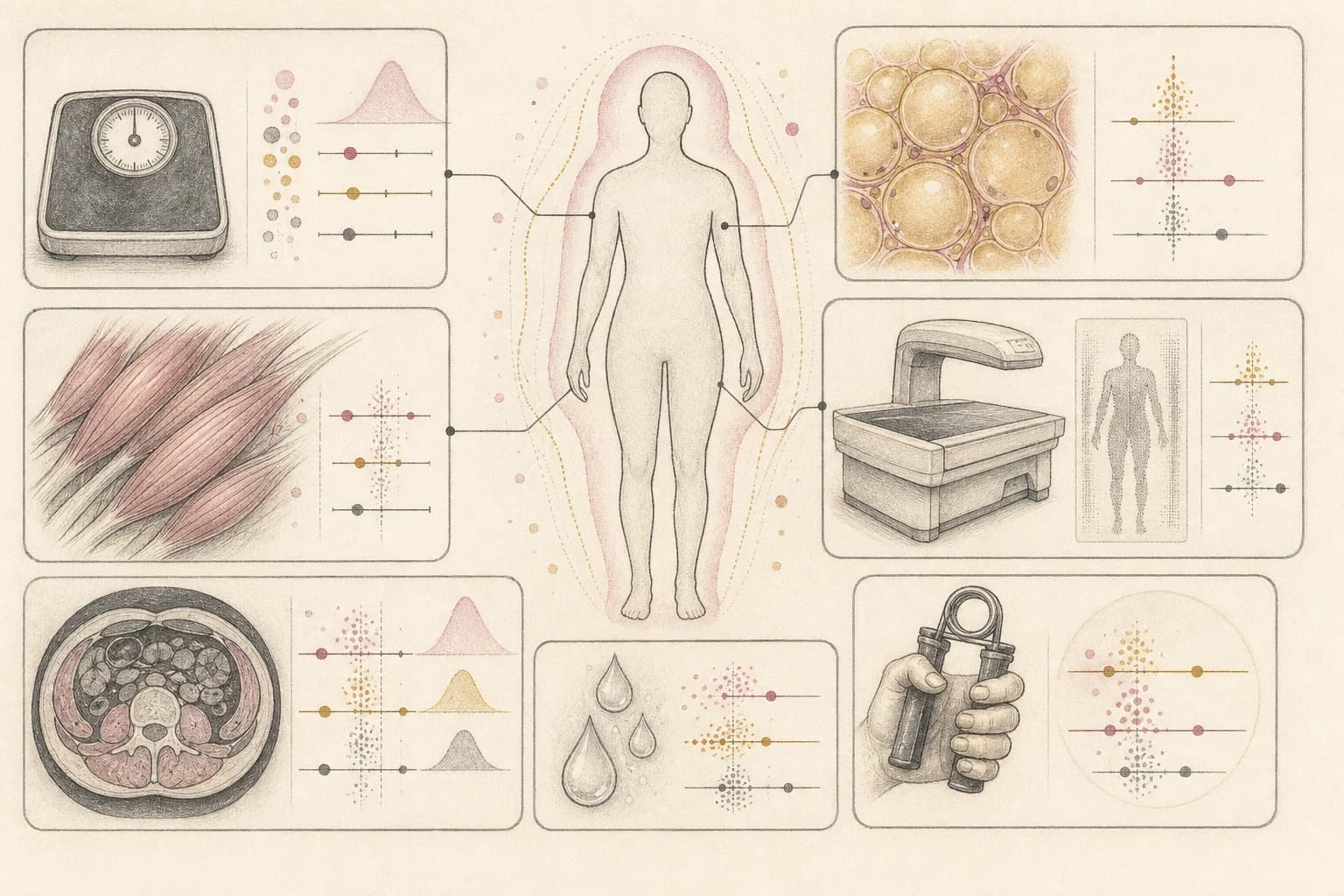
DXA, MRI, and bioelectrical impedance do not measure the body in the same way. DXA estimates bone, fat, and lean soft tissue. MRI can map specific tissues. Bioimpedance estimates composition from electrical resistance.
Across the reviewed studies, interpretation depended on the device, follow-up, population, and whether authors reported kilograms or percentages.2
A percentage can sound alarming without its denominator. A small lean-mass change may look large as a share of a modest total loss. The undo can also happen.
Timing matters as well. Early changes can include water and glycogen shifts, while longer follow-up may capture different tissue patterns.
Measurement error is another reason to avoid false precision. Consumer smart scales are useful for rough trends, but they are not interchangeable with research-grade scans.
For a fair comparison, use the same method under similar conditions. Switching devices midway can create an apparent change that comes from the instrument.
Does a comparison with semaglutide settle the issue?
Not yet. An observational preprint reported a greater relative lean-body-mass decline with tirzepatide than semaglutide in people with paired routine-care measurements.5
The analysis was not randomized or peer reviewed. It relied on electronic health records and digitally extracted body-composition data, which can introduce selection and measurement bias.5
That makes it a research signal, not a final ranking. People prescribed different medicines may differ in weight, diabetes status, treatment history, or reasons for returning for another scan.
A good head-to-head conclusion needs comparable groups, consistent measurements, adequate follow-up, and a plan written before results are known.
Readers comparing this topic with Semaglutide can view its live catalog details below. It is a separate catalog reference, not a suggested combination.
What matters beyond the scan?
Body composition is meaningful because tissues support movement, metabolism, and daily function. The scan is one part of that picture.
Strength, walking capacity, balance, energy, and the ability to do ordinary tasks can add context. They do not replace imaging, but they can show whether a numerical change matters in real life.
Protein intake, resistance exercise, illness, sleep, and age may influence lean tissue. The cited studies do not turn any single routine into a certain safeguard.
The same caution applies to dramatic social-media photos. Lighting, posture, clothing, and timing can make a body look different without measuring tissue.
A useful progress review keeps several signals together: weight trend, waist or imaging data, strength or function, symptoms, and clinical context. One number should not carry the entire interpretation.
What should Filipino readers verify?
The Philippine FDA Verification Portal separates licensed establishments from registered or notified health products.6 Finding a business name is not the same as confirming an exact product record.
Check the exact name, manufacturer, dosage form, and authorization details shown in the current portal. Similar branding does not establish the same identity.
WHO notes that some falsified medical products can closely resemble genuine ones and may require quality-control analysis.7 Appearance, a photo, or a seller’s claim cannot authenticate the contents.
Scientific findings also apply to the studied product and setting. They cannot automatically be transferred to an item with uncertain origin or composition.
This is why evidence and verification belong in the same conversation. A careful study cannot rescue an unidentified product, and a legitimate listing cannot prove a body-composition outcome.
How should a body-composition claim be read?
First, identify whether the claim concerns kilograms, percentages, or a ratio. Those numbers answer different questions.
Second, look for the method. A DXA result should not be described as though it came from a bathroom scale.
Third, check the population and time frame. A group average from adults with obesity or diabetes is not an individual prediction.
Finally, ask whether the article reports both fat and lean changes. Celebrating only one compartment can create a distorted picture.8
The most honest summary keeps the exact result attached to its source, study design, and limitations. That approach is less dramatic, but far more useful.
Bottom line
Tirzepatide body-composition research shows that total weight loss can include both fat and lean mass. Across pooled studies, fat generally represents the larger share, while one meta-analysis estimated lean mass at about 25.4 percent of weight lost. That average varies and cannot predict one person’s result.
Measurement method, timing, hydration, population, and function all affect interpretation. Filipino readers should also verify the exact product through current official records. A scale number is a starting point; a trustworthy assessment connects it with tissue measurements, study context, and real-world function.
Frequently asked questions
Does tirzepatide cause only fat loss?
No. Studies report reductions in both fat mass and lean mass during overall weight loss.1
Does lean mass mean only muscle?
No. It includes body water and other non-fat tissues as well as skeletal muscle.
Is 25.4 percent certain for every person?
No. It is a pooled estimate from randomized trials, with variation between studies.3
Is a smart scale as accurate as DXA or MRI?
No. Consumer bioimpedance devices can track rough trends, but methods are not interchangeable.
Does the semaglutide comparison prove one medicine preserves more lean mass?
No. The cited comparison was observational and reported as a preprint.5
Sources
Footnotes
-
Early changes in body composition with tirzepatide in adults with obesity: a real-world BIA study.; Comparative Effects of Individual Glucagon-Like Peptide-1 Receptor Agonist-Based Medications on Direct Measurement of Body Composition Among Adults With Overweight or Obesity With or Without Type 2 Diabetes: A Systematic Review and Network Meta-Analysis of Randomised Controlled Trials.; Lean Mass Changes With Incretin Therapy Versus Lifestyle Intervention: A Systematic Review and Meta-Analysis of Randomised Controlled Trials.; Comparative Effects of Antidiabetic Drugs on Body Composition: A Systematic Review and Network Meta-Analysis.. Human evidence across a routine-care cohort and systematic reviews of randomized trials. The amount and proportion varied across populations, methods, interventions, and follow-up periods. ↩ ↩2 ↩3
-
Early changes in body composition with tirzepatide in adults with obesity: a real-world BIA study.; [Tirzepatide in real-world clinical practice: changes in body composition and muscle function in patients with obesity].; Effects of Tirzepatide on Body Composition, Metabolic Parameters, and Sleep Outcomes: A Real-World One-Year Prospective Study.; Impact of tirzepatide on systemic arterial stiffness assessed by cardio-ankle vascular index in individuals with obesity complicated by type 2 diabetes: A retrospective cohort study in Japan.; Comparative Effects of Individual Glucagon-Like Peptide-1 Receptor Agonist-Based Medications on Direct Measurement of Body Composition Among Adults With Overweight or Obesity With or Without Type 2 Diabetes: A Systematic Review and Network Meta-Analysis of Randomised Controlled Trials.; Lean Mass Changes With Incretin Therapy Versus Lifestyle Intervention: A Systematic Review and Meta-Analysis of Randomised Controlled Trials.. Synthesis of human observational cohorts and systematic reviews using bioimpedance, DXA, or MRI. This is an interpretive synthesis rather than a single prespecified study outcome. ↩ ↩2 ↩3
-
Lean Mass Changes With Incretin Therapy Versus Lifestyle Intervention: A Systematic Review and Meta-Analysis of Randomised Controlled Trials.. Human systematic review and meta-analysis of randomized trials using DXA or MRI. The pooled analysis reported moderate heterogeneity, so the estimate is not an individual prediction. ↩ ↩2 ↩3 ↩4
-
Comparative Effects of Antidiabetic Drugs on Body Composition: A Systematic Review and Network Meta-Analysis.. Human systematic review and network meta-analysis of randomized controlled trials. The review combined trials of antidiabetic medicines, and results depend on included populations and measurement methods. ↩
-
Greater lean-body-mass decline with tirzepatide than semaglutide in routine care, revealed by body-composition digital phenotyping. Human observational preprint using electronic health records and digitally extracted body-composition measurements. It was not peer reviewed, treatment was not randomized, and digital extraction may introduce measurement or selection bias. ↩ ↩2 ↩3
-
Philippine FDA Verification Portal; FDA Advisory No. 2023-2238: Utilization of the FDA Verification Portal. Official Philippine regulatory verification service. A portal record applies to the exact product or establishment named in that record. ↩
-
WHO laboratory analysis of suspected falsified medical products; WHO laboratory testing for health-product regulation. WHO guidance on suspected falsified medical products and regulatory laboratory testing. Appearance alone cannot authenticate a product or establish a research outcome. ↩
-
Early changes in body composition with tirzepatide in adults with obesity: a real-world BIA study.; Comparative Effects of Individual Glucagon-Like Peptide-1 Receptor Agonist-Based Medications on Direct Measurement of Body Composition Among Adults With Overweight or Obesity With or Without Type 2 Diabetes: A Systematic Review and Network Meta-Analysis of Randomised Controlled Trials.; Lean Mass Changes With Incretin Therapy Versus Lifestyle Intervention: A Systematic Review and Meta-Analysis of Randomised Controlled Trials.; Comparative Effects of Antidiabetic Drugs on Body Composition: A Systematic Review and Network Meta-Analysis.; [Tirzepatide in real-world clinical practice: changes in body composition and muscle function in patients with obesity].; Effects of Tirzepatide on Body Composition, Metabolic Parameters, and Sleep Outcomes: A Real-World One-Year Prospective Study.; Impact of tirzepatide on systemic arterial stiffness assessed by cardio-ankle vascular index in individuals with obesity complicated by type 2 diabetes: A retrospective cohort study in Japan.; Philippine FDA Verification Portal; FDA Advisory No. 2023-2238: Utilization of the FDA Verification Portal. Editorial synthesis of the canonical research records and Philippine verification sources. This synthesis is educational and is not personal medical advice or a product recommendation. ↩