Quick answer
Semax, Selank, DSIP, and Pinealon should not be treated as one proven cognitive-peptide category. In the source set reviewed here, Semax has direct human studies, but they involve stroke, motor neuron disease, and eye conditions—not healthy adults trying to improve focus.
The most encouraging newer findings come from animals or cells. A review groups the four names into broad research families, yet it does not compare them head to head. The practical lesson is simple: check each compound, population, and outcome separately before accepting a shared “brain peptide” claim.12
Are these four peptides really one category?
No. The grouping is convenient for online discussion, but it is not a clinical verdict. One 2026 review described Semax and Selank as neuroactive peptides while placing DSIP and Pinealon in a recovery-oriented group. That classification summarizes ideas; it does not demonstrate that the compounds work alike.1
Semax is a synthetic peptide related to the ACTH(4–10) sequence. Its chemical identity, study history, and measured outcomes belong to Semax alone. Evidence attached to that name cannot automatically support Selank, DSIP, or Pinealon.3
Readers researching Semax can view its live catalog details below. The listing identifies the catalog item and is separate from the evidence discussed here.
What human evidence exists for Semax?
The reported human studies ask narrow clinical questions. They include people recovering after ischemic stroke, people with motor neuron disease, and patients receiving care for optic-nerve or retinal conditions. None is a general trial of concentration, memory, or exam performance in healthy adults.2
A 2018 study followed 110 people during rehabilitation after ischemic stroke. The Semax groups had higher plasma BDNF and better functional scores, but rehabilitation timing also influenced recovery and the relationship between the biomarker and function.4
An earlier comparison involved 30 patients who received Semax with intensive stroke care and 80 controls receiving conventional care. Investigators reported faster neurological improvement in the Semax group. The result concerns add-on hospital care in acute stroke, so it cannot answer whether Semax improves everyday cognition.5
Did every human study report a clear benefit?
No. In an open-label study of 27 people with motor neuron disease, Semax did not change chronic partial denervation or the main clinical measures. Researchers reported a temporary quality-of-life change related to emotion and motivation, but that narrower signal should not replace the negative primary observations.6
An optic-nerve study reported better visual outcomes when Semax was added to broader neurotrophic and anti-inflammatory care. Because Semax was part of a treatment package, the abstract does not isolate how much of the result came from Semax itself.7
A retinal-surgery comparison also changed more than one element. One group received heliox plus Semax electrophoresis, while another received Semax nasal drops. Better recovery measures in the combined program cannot identify which component produced the difference.8
What do animal and laboratory studies add?
They add possible mechanisms and research directions, not proof of a human cognitive benefit. In a transgenic mouse model with Alzheimer-like features, Semax and a derivative improved behavioral-task performance and reduced amyloid deposits. Those are positive mouse findings in an engineered disease model.9
A chronic-stress experiment in male rats produced a mixed pattern. Semax improved a sucrose-preference measure and reduced several stress-linked changes, yet it did not change the forced-swim outcome. Even within one animal model, different tests did not support one sweeping conclusion.10
Another study connected Semax with functional recovery after spinal-cord injury in female mice and with molecular changes in a cell model. Injury recovery, inflammation pathways, and cognition are separate outcomes, so the finding should stay in its original context.11
Readers comparing this topic with Selank can view its live catalog details below. It is a separate catalog reference, not a suggested combination.
Can a mechanism tell us whether people will think more clearly?
Not by itself. In a rat stroke model, Semax and a related peptide partly offset gene-expression changes after experimental ischemia. A separate rat study found hundreds of altered genes in frontal-cortex cells under normal conditions. Gene activity can guide research, but a changed transcript is not the same thing as better attention or memory.1213
Rat brain slices showed another mixed result. Semax increased spontaneous calcium-signal frequency in hippocampal neurons but did not significantly change the tested acid-triggered response in cerebellar cells. The experiment maps cellular behavior rather than a person’s daily function.14
In cultured cells, Semax bound copper and reduced copper-linked oxidative stress around amyloid-beta under the tested conditions. That chemistry is several steps removed from a clinical outcome, because a dish does not reproduce absorption, distribution, illness, behavior, or long-term safety in people.15
Can Semax findings be transferred to Selank, DSIP, or Pinealon?
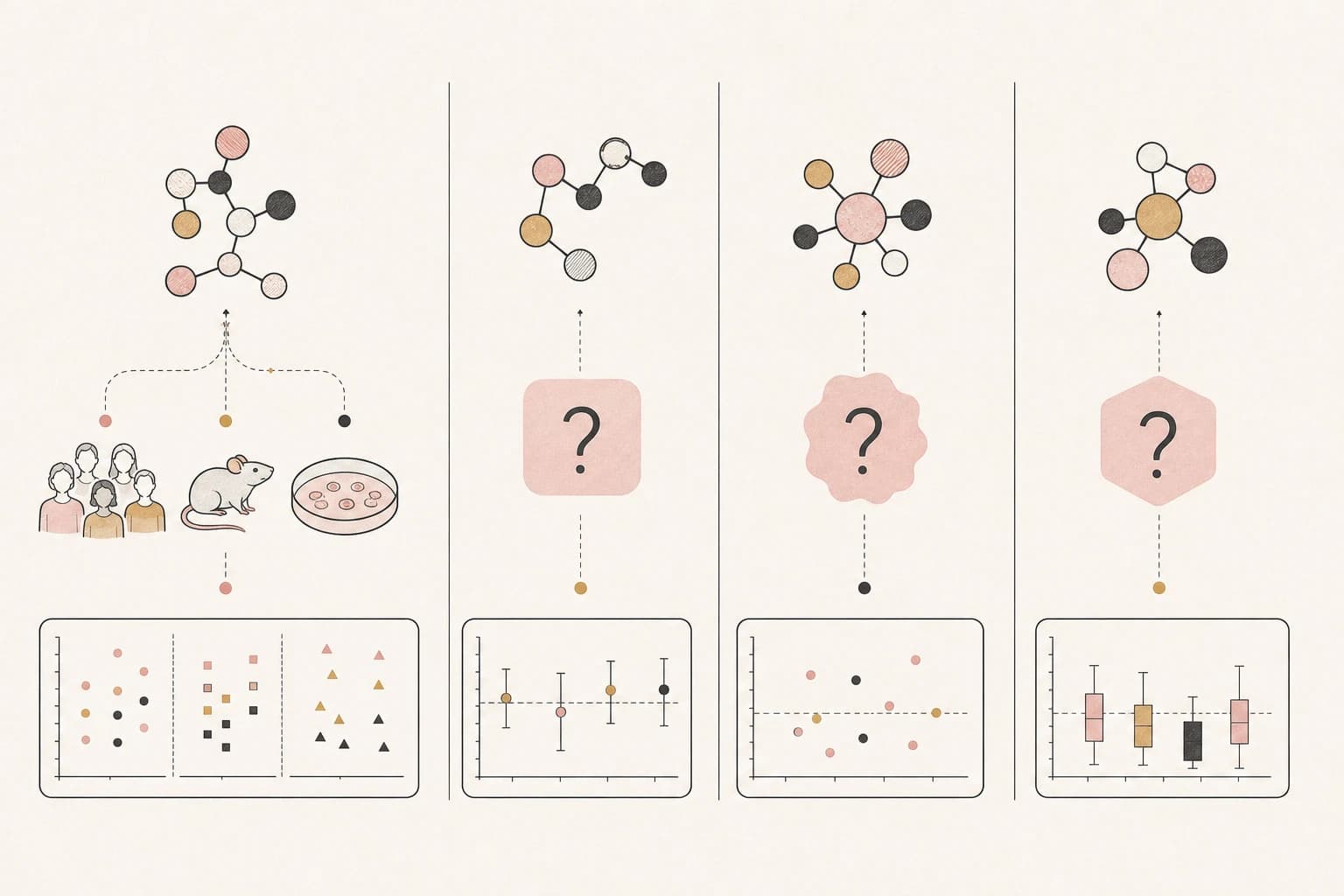
No. Similar marketing language does not create interchangeable evidence. A review can mention several peptides in the same table or paragraph, but each name still needs its own identity check, direct studies, population, comparator, and measured endpoint.1
This matters when a claim changes halfway through a post. A Semax stroke paper cannot prove that Selank improves anxiety, that DSIP fixes insomnia, or that Pinealon slows aging. Each of those statements would need relevant evidence for the exact compound and the exact outcome.
The same rule applies to combinations. Seeing two catalog items beside one another does not mean they were studied together. Product links help readers identify records; they do not create a protocol or recommendation.
How should a Filipino reader check a cognitive-peptide claim?
Start with the study population. A hospital patient after stroke is not equivalent to a healthy student, night-shift worker, gamer, or executive. If the people do not match the claim, the conclusion has already widened beyond the evidence.24
Next, identify the endpoint. BDNF, neurological scales, visual function, gene expression, calcium signaling, and cultured-cell stress are different measurements. Ask whether the article names the real endpoint or quietly converts it into “focus,” “brain health,” or “mental performance.”47121415
Finally, check the design. Open-label studies, add-on treatment, combined programs, animal models, and cell experiments all have legitimate uses. They simply answer different questions, and none should be presented as a universal cognitive result.689
Bottom line
Semax has direct human research, but the studies reviewed here focus on defined neurological and eye conditions rather than cognitive enhancement in healthy adults. Some results were positive, while others were negative, mixed, or difficult to isolate from combined care.1245
Animal and laboratory studies offer early-stage clues without establishing human benefit. Selank, DSIP, and Pinealon remain separate evidence questions; mentioning all four together does not produce a shared conclusion. For Filipino readers, the safest shortcut is to match every claim to the exact compound, study population, endpoint, and research setting before deciding what the evidence means.
Frequently asked questions
Which compound has direct human studies in this article?
Semax. The human papers involve stroke rehabilitation, motor neuron disease, optic-nerve disease, and retinal-surgery recovery. They do not test broad cognitive enhancement in healthy people.2
Do the human studies prove Semax improves memory or focus?
No. Their main outcomes include neurological function, biomarkers, quality of life, and visual measures. Translating those outcomes into everyday memory or attention would go beyond what the studies directly tested.467
Are the animal findings positive?
Some are positive and some are mixed. The Alzheimer-like mouse study reported better task performance, while the rat stress study improved one behavioral measure but not another. Neither establishes a human result.910
Does a shared review category mean the peptides are interchangeable?
No. A review’s categories help organize a discussion. They do not replace direct trials, prove equivalent effects, or allow findings from one peptide to be assigned to another.1
Are the Semax and Selank product cards a suggested combination?
No. They are neutral catalog references using live Medusa data. The cards do not recommend human use, a combination, or any treatment schedule.
Sources
Footnotes
-
Therapeutic Peptides in Orthopaedics: Applications, Challenges, and Future Directions.. Broad narrative review of therapeutic peptides in orthopaedics. The grouping is a review framework, not a head-to-head trial or proof that the four peptides share effects. ↩ ↩2 ↩3 ↩4 ↩5
-
[The efficacy of semax in the tretament of patients at different stages of ischemic stroke].; [The study of chronic partial denervation and quality of life in patients with motor neuron disease treated with semax].; [Evaluation of therapeutic effect of new Russian drug semax in optic nerve disease].; [Effectiveness of semax in acute period of hemispheric ischemic stroke (a clinical and electrophysiological study)].; [Effect of a combined physiotherapeutic approach on changes in functional parameters after endovitreal surgery of rhegmatogenous retinal detachment with a favorable anatomical outcome].. Population comparison across five human clinical papers. Results from these clinical groups do not establish cognitive enhancement in healthy people. ↩ ↩2 ↩3 ↩4 ↩5
-
[Evaluation of therapeutic effect of new Russian drug semax in optic nerve disease].; Semax peptide targets the μ opioid receptor gene Oprm1 to promote deubiquitination and functional recovery after spinal cord injury in female mice.; Semax, a Copper Chelator Peptide, Decreases the Cu(II)-Catalyzed ROS Production and Cytotoxicity of aβ by Metal Ion Stripping and Redox Silencing.. Identity descriptions across a human optic-nerve paper, a mouse spinal-cord study, and an in vitro chemistry study. Chemical identity does not establish a cognitive benefit or a human-use outcome. ↩
-
[The efficacy of semax in the tretament of patients at different stages of ischemic stroke].. Clinical study comparing early and late rehabilitation groups, each divided into Semax and non-Semax subgroups. The abstract does not describe blinded randomization, and rehabilitation timing was an important part of the result. ↩ ↩2 ↩3 ↩4 ↩5
-
[Effectiveness of semax in acute period of hemispheric ischemic stroke (a clinical and electrophysiological study)].. Older controlled clinical study in acute hemispheric ischemic stroke. The study was small, older, and reported an add-on effect in acute stroke care rather than a general cognitive outcome. ↩ ↩2
-
[The study of chronic partial denervation and quality of life in patients with motor neuron disease treated with semax].. Open-label study in sequential groups with repeated electromyography and clinical assessments. The small, open-label design and mixed outcome pattern limit broad interpretation. ↩ ↩2 ↩3
-
[Evaluation of therapeutic effect of new Russian drug semax in optic nerve disease].. Controlled clinical study in vascular, toxic-allergic, inflammatory, and atrophic optic-nerve conditions. Semax was part of combined care, and the abstract does not establish a stand-alone effect or a cognitive benefit. ↩ ↩2 ↩3
-
[Effect of a combined physiotherapeutic approach on changes in functional parameters after endovitreal surgery of rhegmatogenous retinal detachment with a favorable anatomical outcome].. Comparative follow-up study after surgery for retinal detachment. Because the programs differed in several ways, the result cannot isolate the contribution of Semax, heliox, or delivery method. ↩ ↩2
-
The Potential of the Peptide Drug Semax and Its Derivative for Correcting Pathological Impairments in the Animal Model of Alzheimer's Disease.. Behavioral and histological study in APPswe/PS1dE9/Blg mice. A mouse disease model cannot establish memory, prevention, or disease outcomes in people. ↩ ↩2 ↩3
-
Antidepressant-like and antistress effects of the ACTH(4-10) synthetic analogs Semax and Melanotan II on male rats in a model of chronic unpredictable stress.. Chronic unpredictable stress model in adult male Sprague-Dawley rats. The mixed behavioral pattern is specific to a male-rat stress model and is not a human mood or cognition result. ↩ ↩2
-
Semax peptide targets the μ opioid receptor gene Oprm1 to promote deubiquitination and functional recovery after spinal cord injury in female mice.. Mouse spinal-cord injury model combined with cell and molecular analyses. The study concerns injury recovery and mechanism work, not cognitive performance in people. ↩
-
ACTH-like Peptides Compensate Rat Brain Gene Expression Profile Disrupted by Ischemia a Day After Experimental Stroke.. RNA sequencing of rat frontal-cortex tissue after transient middle cerebral artery occlusion. Gene-expression shifts in rat brain tissue are mechanistic findings, not proof of a clinical or cognitive outcome. ↩ ↩2
-
Changes of Transcriptomic Activity in Rat Brain Cells under the Influence of Synthetic Adrenocorticotropic Hormone-Like Peptides.. RNA sequencing in rat frontal cortex without an induced disease condition. Transcriptomic change alone does not show whether an effect is beneficial, harmful, or meaningful in people. ↩
-
The Effect of Peptide Semax, an ACTH(4-10) Analogue, on Intracellular Calcium Dynamics in Rat Brain Neurons.. Ex vivo hippocampal and cerebellar slice experiment. The result is a mixed cellular response in rat tissue, not a memory or learning outcome. ↩ ↩2
-
Semax, a Copper Chelator Peptide, Decreases the Cu(II)-Catalyzed ROS Production and Cytotoxicity of aβ by Metal Ion Stripping and Redox Silencing.. Chemical and cultured-cell experiment involving copper, amyloid-beta, reactive oxygen species, and SH-SY5Y cells. The experiment did not test cognition, daily function, or disease outcomes in humans. ↩ ↩2