Quick answer
Tesamorelin has reduced visceral fat in randomized trials involving adults with HIV-associated body-fat or metabolic conditions. That is meaningful human evidence, but it is not the same as proving general weight loss.
Visceral fat surrounds organs inside the abdomen. It differs from the fat under the skin, total body weight, and BMI. The pooled trials found a benefit for visceral fat while BMI and subcutaneous fat did not significantly fall. Filipino readers should therefore ask which body compartment, population, and endpoint sits behind every tesamorelin claim.123
What exactly did the tesamorelin trials measure?
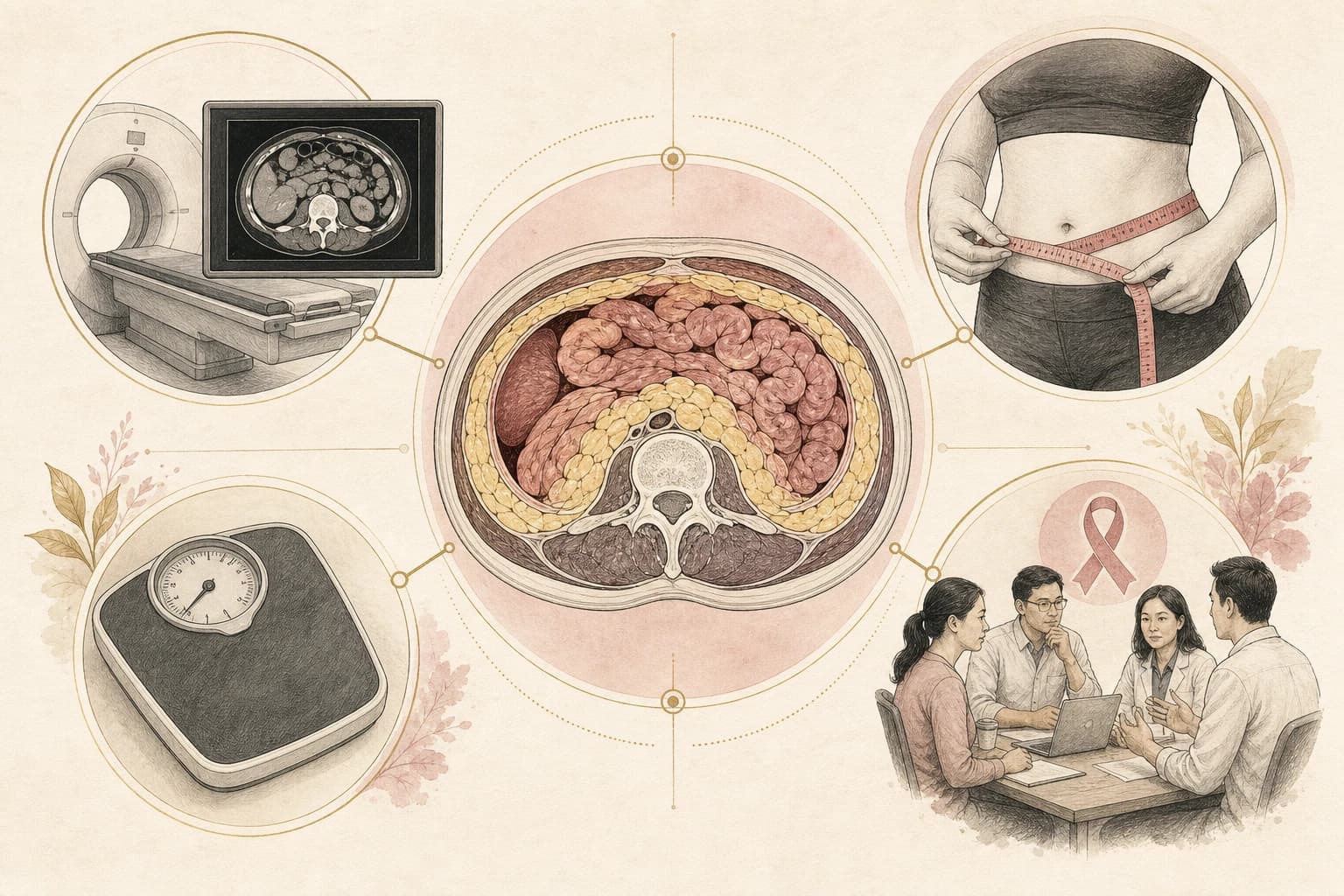
The strongest evidence concerns visceral adipose tissue in adults living with HIV. Visceral fat sits deeper in the abdomen than subcutaneous fat, the layer people can pinch beneath the skin. A scan can measure these compartments separately.12
A meta-analysis pooled five randomized controlled trials in adults with HIV-associated lipodystrophy. Compared with placebo, tesamorelin lowered measured visceral fat. The same analysis also found reductions in trunk fat, liver-fat percentage, and waist circumference.2
Those endpoints overlap, but they are not interchangeable. Waist size is a tape measurement. Visceral fat and liver fat usually require imaging. BMI combines height and weight without showing where tissue sits or whether a change came from fat, muscle, or fluid.
This is why a headline such as “reduces belly fat” needs translation. The trial result refers to a particular internal fat compartment in a defined clinical group. It does not mean every kind of abdominal fat changed, nor that everyone lost substantial scale weight.23
Readers researching Tesamorelin can view its live catalog details below. The listing identifies the catalog item and is separate from the evidence discussed here.
Why is this not a generic weight-loss finding?
The pooled evidence did not find significant reductions in BMI or subcutaneous fat. That contrast is the central point: a treatment can change one body compartment without producing the broad pattern people imagine when they hear “weight loss.”3
The research population also matters. Participants were adults with HIV-associated lipodystrophy or related metabolic conditions. Their health history, medications, and body-fat distribution are not a stand-in for every Filipino reader interested in slimming, gym performance, or cosmetic fat loss.12
An official FDA record identifies EGRIFTA WR as a named tesamorelin medicine and records its original US approval in 2010. That record belongs to the regulated product, not to every item that shares the ingredient name.4
A US approval also does not establish Philippine registration. Regulators approve specific products for specific uses in their own jurisdictions. Ingredient identity, manufacturer, formulation, and indication still have to match the official record.
The careful conclusion is narrower and more useful: tesamorelin has human evidence for reducing measured visceral fat in certain HIV-related settings. The cited research does not turn that result into a general promise about body weight or appearance.
What did newer and smaller studies add?
A randomized-trial subgroup analysis followed adults with HIV, metabolic liver disease, and integrase-inhibitor treatment. Among those who completed 12 months, visceral and liver fat fell more with tesamorelin than with placebo.5
This supports the same general direction, but the subgroup was small. Fifteen tesamorelin participants and sixteen placebo participants completed that analysis. A result from a specific subgroup should stay attached to that subgroup, especially when readers are deciding how widely it applies.5
The study reported similar overall adverse-event frequency between groups, including hyperglycemia. That is useful within the analysis, but it cannot define every safety issue across longer use, different populations, or products of uncertain identity.6
Another six-month study involved 73 virally suppressed adults with HIV, abdominal obesity, and neurocognitive impairment. Waist circumference declined more with tesamorelin, but cognitive performance did not differ significantly between groups.7
That mixed result prevents a common leap. A change in an abdominal measurement does not automatically prove a change in memory, thinking, energy, or daily function. Each outcome requires its own measurement and result.
Do muscle and laboratory findings broaden the claim?
An exploratory analysis reported changes in muscle area and density. However, the tesamorelin group included people selected because they had already reached a defined visceral-fat response. Studying responders can reveal a pattern, but it cannot show that every participant would experience it.8
Researchers have also examined paired liver biopsies from a human trial. The analysis described changes in gene-expression pathways inside liver tissue. That is valuable biological information, yet a molecular signal is not a new clinical outcome such as improved symptoms or function.9
These examples show how evidence can become overstated online. A responder analysis may be retold as a universal muscle benefit. A tissue-level finding may be advertised as a whole-body health result. Neither retelling preserves the study design.
Readers comparing this topic with Semaglutide can view its live catalog details below. It is a separate catalog reference, not a suggested combination.
What do negative findings and unfinished studies tell us?
Negative findings help define the boundary of a claim. In a small placebo-controlled pilot involving 22 adults with cognition ranging from normal to mild impairment, a lower experimental amount of tesamorelin produced no direct significant change in the measured clinical outcomes after ten weeks.10
Exploratory brain signals in that pilot were not clinical confirmation. Early analytical patterns can guide later research, but they should not be presented as proof that a person will think, feel, or function better.
The TRIUMPH paper is even easier to misread because it describes an interesting research question. Investigators planned to test tesamorelin or placebo alongside exercise in older adults living with HIV, including measures of physical function and muscle quality.11
But a protocol is a plan, not a result. Until completed findings are reported, it cannot prove that the intervention improved strength, mobility, recovery, or muscle quality. Future-tense language belongs with study protocols.
How should Filipino readers check a visceral-fat claim?
Start with the population. Ask whether the evidence came from adults with HIV-associated lipodystrophy, another defined condition, or a broader group. A match in ingredient name does not erase a mismatch in health context.
Next, identify the endpoint. “Visceral fat,” “waist circumference,” “body weight,” “BMI,” and “subcutaneous fat” answer different questions. If a post swaps one term for another, return to the study’s exact measurement.
Then check the product. The FDA record concerns EGRIFTA WR under a named application. A separate catalog listing is not automatically that medicine, and a US record does not answer Philippine regulatory or supply-chain questions.4
Finally, look for the comparison group and study status. Randomized placebo-controlled findings carry more meaning than anecdotes. Subgroup and responder analyses need clear labels, while protocols should never be written as completed results.
This approach does not dismiss the research. It protects the result that is actually there: a measurable visceral-fat effect in defined human settings, alongside limits that keep the claim honest.
Bottom line
Tesamorelin has credible human evidence for reducing visceral fat in adults with specific HIV-associated body-fat and metabolic conditions. The pooled trials did not show the same result for BMI or subcutaneous fat, and smaller studies produced mixed findings for cognition, muscle measures, and laboratory signals.1710
That makes tesamorelin a clear example of why one positive endpoint should not become a generic weight-loss promise. Filipino readers should match every claim to the exact population, body compartment, product, and study status. A scan result, a scale result, and a marketing headline are not the same thing.
Frequently asked questions
Does tesamorelin reduce visceral fat?
Randomized evidence found lower visceral fat versus placebo in adults with HIV-associated lipodystrophy. The result should remain tied to that studied population.2
Does that mean tesamorelin causes general weight loss?
No. The meta-analysis did not find significant reductions in BMI or subcutaneous fat, even though visceral-fat outcomes favored tesamorelin.3
Did the studies show a cognitive benefit?
No clear cognitive benefit was established. One six-month study found no significant between-group cognitive difference, and a small pilot found no direct significant clinical change.710
Is a trial protocol evidence that an intervention works?
No. A protocol explains what researchers plan to test. The TRIUMPH protocol does not report completed efficacy results.11
Do the product cards recommend using tesamorelin with semaglutide?
No. They are separate live catalog references, not a combination, amount guidance, treatment, or human-use recommendation.
Sources
Footnotes
-
Efficacy and safety of tesamorelin in people with HIV on integrase inhibitors; Body composition, hepatic fat, metabolic, and safety outcomes of Tesamorelin, a GHRH analogue, in HIV-associated lipodystrophy: A meta-analysis of randomized controlled trials. Randomized-trial analysis and randomized-trial meta-analysis in adults with HIV. These are defined clinical populations, not a general weight-loss population. ↩ ↩2 ↩3 ↩4
-
Body composition, hepatic fat, metabolic, and safety outcomes of Tesamorelin, a GHRH analogue, in HIV-associated lipodystrophy: A meta-analysis of randomized controlled trials. Pooled randomized evidence in adults with HIV-associated lipodystrophy. The pooled finding does not establish the same effect outside that studied population. ↩ ↩2 ↩3 ↩4 ↩5 ↩6
-
Body composition, hepatic fat, metabolic, and safety outcomes of Tesamorelin, a GHRH analogue, in HIV-associated lipodystrophy: A meta-analysis of randomized controlled trials. Pooled randomized evidence in adults with HIV-associated lipodystrophy. A change in one body-composition measure is not interchangeable with every other measure. ↩ ↩2 ↩3 ↩4
-
FDA Drugs@FDA record for EGRIFTA WR (TESAMORELIN). Official United States regulatory record for the named product. The record concerns EGRIFTA WR and does not establish approval or equivalence for a separate catalog item. ↩ ↩2
-
Efficacy and safety of tesamorelin in people with HIV on integrase inhibitors. Small subgroup of a double-blind trial in adults with HIV and metabolic liver disease. The subgroup was small and its result should remain tied to its population and setting. ↩ ↩2
-
Efficacy and safety of tesamorelin in people with HIV on integrase inhibitors. Small subgroup analysis in adults with HIV using integrase inhibitors. A small subgroup cannot define the complete safety profile. ↩
-
Effects of Tesamorelin on Neurocognitive Impairment in Persons With HIV and Abdominal Obesity. 73 virally suppressed adults with HIV, abdominal obesity, and neurocognitive impairment. The study had no placebo arm and limited power. ↩ ↩2 ↩3
-
The Growth Hormone Releasing Hormone Analogue, Tesamorelin, Decreases Muscle Fat and Increases Muscle Area in Adults with HIV. Secondary analysis of earlier randomized trials in adults with HIV and abdominal obesity. Selecting responders limits how broadly the finding can be applied. ↩
-
Effects of tesamorelin on hepatic transcriptomic signatures in HIV-associated NAFLD. Paired biopsy analysis from a randomized placebo-controlled trial in people with HIV-associated fatty liver disease. Gene-expression changes do not by themselves establish a clinical benefit in another population. ↩
-
The effect of growth hormone-releasing hormone on cognition and brain connectivity in adults with cognition ranging from normal to mild cognitive impairment. Pilot study in adults with cognition ranging from normal to mild impairment. Exploratory brain-imaging signals were not confirmation of a clinical benefit. ↩ ↩2 ↩3
-
Tesamorelin as an Adjunct to Exercise for Improving Physical Function in HIV (TRIUMPH): a clinical trial protocol. Protocol for a randomized trial in older adults living with HIV. A protocol describes planned measurements and cannot establish that an outcome occurred. ↩ ↩2