
Quick answer
Human trials show that tesamorelin can reduce visceral abdominal fat in defined groups of adults living with HIV. That is a specific body-composition finding, not proof of general weight loss. A meta-analysis of five randomized trials supports the visceral-fat result, while smaller studies report liver-fat or exploratory muscle changes in similarly specialized populations. Cognitive results were mixed or negative, and the evidence should not be extended to routine slimming, bodybuilding, or anti-aging use.123456
What is visceral fat, and why does the distinction matter?
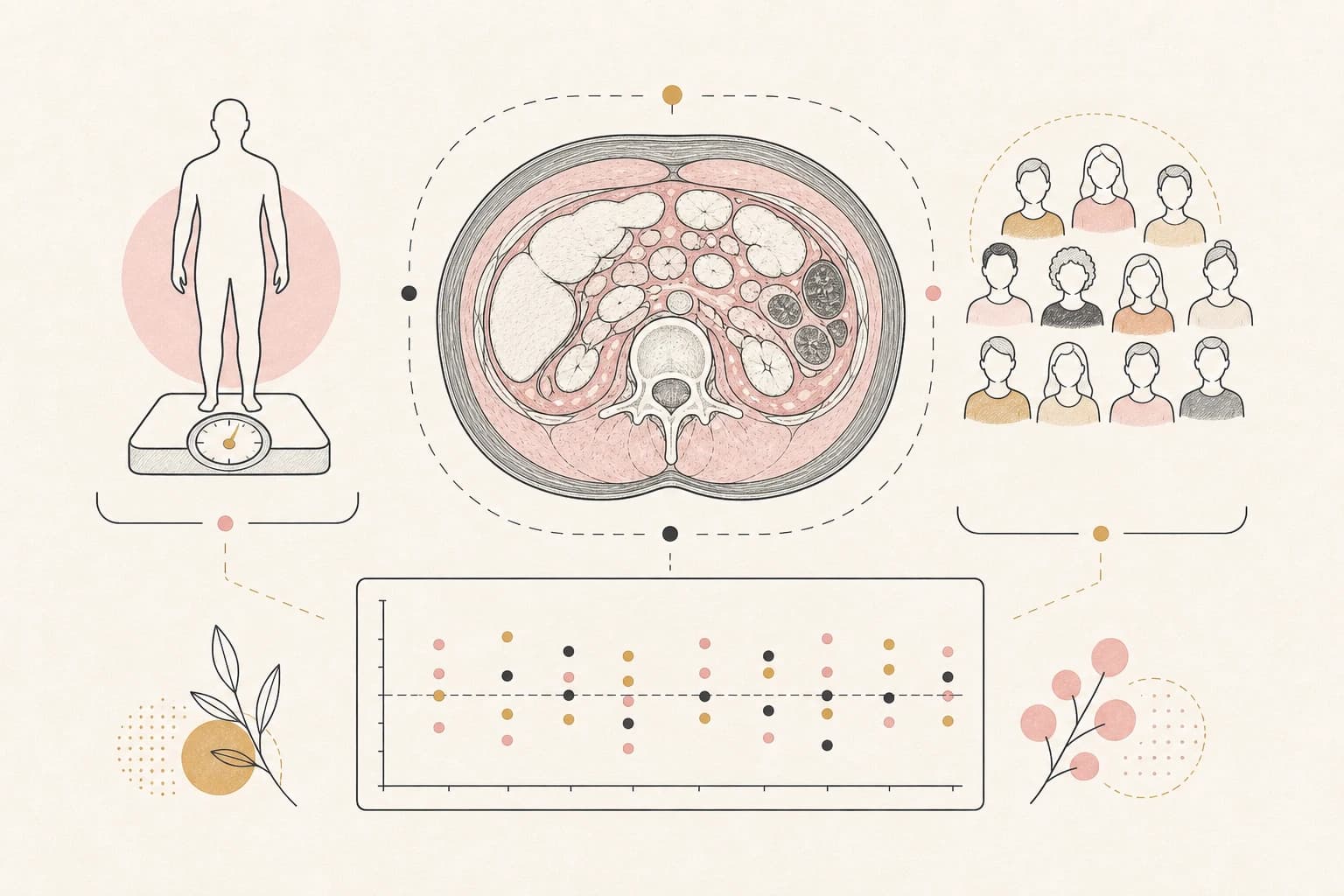
Visceral fat sits around internal organs and is measured separately from total body weight or fat under the skin. Tesamorelin trials used imaging and other body-composition measures to track this specific compartment.7
That makes “tesamorelin reduced visceral fat” a different statement from “tesamorelin caused general weight loss.” A person’s weight can stay similar while one body compartment changes, and a scan result does not automatically describe appearance, waist size, or every kind of fat.
The strongest evidence also comes from a defined clinical population: adults living with HIV who had abdominal fat accumulation or related metabolic conditions. The studies were not broad consumer weight-management trials.16
Readers researching Tesamorelin can view its live catalog details below. The listing identifies the catalog item and is separate from the evidence discussed here.
What does the randomized evidence show?
A meta-analysis combined five randomized controlled trials in adults with HIV-associated lipodystrophy. Across those studies, tesamorelin was associated with lower visceral fat than placebo.3
Pooling trials can provide a more stable estimate than highlighting one small paper. It does not erase differences among the trials, and it does not broaden their population. The result remains about adults with HIV-associated lipodystrophy rather than people seeking routine weight loss.3
The outcome must also remain precise. The analysis supports a change in visceral fat, not a universal reduction in all fat compartments. Rewriting it as “melts belly fat” or “works for obesity” would add claims the trial population and measurements did not establish.76
This is one case where narrow wording is not a weakness. It tells readers exactly what the human evidence can support.
What did the integrase-inhibitor analysis add?
A 2024 randomized-trial analysis focused on participants with HIV using integrase-inhibitor regimens. Thirty-one people in this subgroup completed 12 months. Tesamorelin was associated with larger reductions in visceral fat and liver fat than placebo.2
The study is relevant because treatment patterns and metabolic conditions can vary within the broader HIV population. Its small subgroup, however, limits certainty and makes the result unsuitable for broad extrapolation.2
Adverse events, including hyperglycemia, occurred at similar frequencies in the tesamorelin and placebo groups in this analysis. The sample was too small to define the complete safety profile, so “similar in this subgroup” should not become “proven safe for everyone.”8
The clean summary is that the trial adds a focused liver-fat and visceral-fat signal in a specialized group. It does not establish the same effect for a different population or catalog item.
What did studies of cognition and muscle find?
A six-month open-label randomized study enrolled 73 virally suppressed adults with HIV, abdominal obesity, and neurocognitive impairment. Tesamorelin reduced waist circumference, but the between-group cognitive outcome did not improve significantly.4
An open-label design means participants and researchers knew the assigned treatment, and the study did not include a placebo arm. It was also not powered to prove a cognitive benefit. The waist result and cognitive result therefore need separate sentences rather than one optimistic conclusion.4
Another analysis reported changes in muscle area and density among tesamorelin responders. That sounds encouraging, but the analysis included people selected because they had already reduced visceral fat. This responder-only approach limits how widely the result can be generalized.5
A separate ten-week pilot in 22 adults found no direct significant change in its measured clinical outcomes. Exploratory machine-learning patterns in such a study are hypothesis-generating, not confirmation of cognitive benefit.96
Readers comparing this topic with Semaglutide can view its live catalog details below. It is a separate catalog reference, not a suggested combination.
Which tesamorelin publications do not yet contain results?
The TRIUMPH publication describes a planned trial combining tesamorelin with exercise in older adults living with HIV. It explains the research design and intended physical-function outcomes, but it does not report completed efficacy results.10
A protocol is valuable because it shows what investigators planned before seeing the data. It cannot answer whether the intervention worked. Articles should wait for the completed results rather than treating a registered plan as a positive trial.
This distinction matters in fast-moving research. Search results may place protocols beside completed trials, and both may use confident titles. Publication type tells the reader whether the paper contains an answer or only a question.
What does the FDA record establish?
The US FDA Drugs@FDA database lists EGRIFTA WR, with tesamorelin as its active ingredient, under application BLA 022505 and records an original approval date of November 10, 2010.11
That is an identity-specific regulatory fact. It applies to the named medicine and its official record. It does not make a separate catalog item FDA-approved, clinically equivalent, or supported by the same manufacturing controls.12
For Filipino readers, US approval also does not establish Philippine authorization. The correct local statement requires a current Philippine record for the exact product. Research papers, foreign approval databases, and catalog cards answer different questions.
The product name needs equal care. A study may refer to tesamorelin as a molecule, while an approval record identifies a named medicine with its own application and manufacturing history. A catalog entry performs a third job: it shows current commercial information. Keeping those identities separate prevents a valid trial result or approval date from becoming an unsupported statement about another item.
Bottom line
Tesamorelin has meaningful human evidence for reducing visceral fat in adults with HIV-associated abdominal fat conditions. A five-trial meta-analysis supports that focused result, and a smaller subgroup analysis also found changes in liver fat.23
The evidence does not justify calling tesamorelin a general weight-loss, cognitive, bodybuilding, or anti-aging product. Visceral fat is one compartment, the study populations are specialized, and exploratory findings remain exploratory. Regulatory records apply only to the exact named medicine, not every item carrying the same molecule name.457612
Frequently asked questions
Does tesamorelin cause general weight loss?
The collected trials support a reduction in visceral fat in defined groups living with HIV. Visceral fat is a specific imaging-based compartment and is not interchangeable with total body weight.37
Did tesamorelin reduce liver fat?
A small 2024 subgroup analysis reported larger liver-fat and visceral-fat reductions than placebo. Only 31 participants in that subgroup completed 12 months, so the finding remains population-specific.2
Did the cognitive study show improvement?
No significant between-group improvement appeared in the cognitive outcome. The open-label study reported a waist-circumference change, but it was not powered to establish cognitive benefit.4
Is EGRIFTA WR the same as a catalog item?
No. The FDA record applies to the exact named medicine. It does not establish approval, equivalence, or identical quality controls for a separate catalog product.1112
Why include Semaglutide as a related card?
It is a separate live catalog reference for readers comparing metabolic research topics. It is not evidence for tesamorelin and does not suggest equivalence or combination use.
Sources
Footnotes
-
Efficacy and safety of tesamorelin in people with HIV on integrase inhibitors.; Body composition, hepatic fat, metabolic, and safety outcomes of Tesamorelin, a GHRH analogue, in HIV-associated lipodystrophy: A meta-analysis of randomized controlled trials.. Randomized trial analysis and meta-analysis in adults living with HIV. This is a defined clinical population, not a general weight-loss population. ↩ ↩2
-
Efficacy and safety of tesamorelin in people with HIV on integrase inhibitors.. Subgroup analysis of a randomized double-blind trial; 31 participants in the subgroup completed 12 months. The analysis was small and limited to people living with HIV and metabolic liver disease. ↩ ↩2 ↩3 ↩4 ↩5
-
Body composition, hepatic fat, metabolic, and safety outcomes of Tesamorelin, a GHRH analogue, in HIV-associated lipodystrophy: A meta-analysis of randomized controlled trials.. Meta-analysis of randomized controlled trials searched through July 2025. The pooled result does not establish the same effect in people without HIV-associated lipodystrophy. ↩ ↩2 ↩3 ↩4 ↩5
-
Effects of Tesamorelin on Neurocognitive Impairment in Persons With HIV and Abdominal Obesity.. Phase 2 study in 73 virally suppressed adults with HIV, abdominal obesity, and neurocognitive impairment. The study lacked a placebo arm and was not powered to establish a cognitive benefit. ↩ ↩2 ↩3 ↩4 ↩5
-
The Growth Hormone Releasing Hormone Analogue, Tesamorelin, Decreases Muscle Fat and Increases Muscle Area in Adults with HIV.. Secondary analysis of earlier randomized trials in adults with HIV and abdominal obesity. The tesamorelin group was restricted to participants who had already reduced visceral fat, limiting generalization. ↩ ↩2 ↩3
-
Efficacy and safety of tesamorelin in people with HIV on integrase inhibitors.; Body composition, hepatic fat, metabolic, and safety outcomes of Tesamorelin, a GHRH analogue, in HIV-associated lipodystrophy: A meta-analysis of randomized controlled trials.; The effect of growth hormone-releasing hormone on cognition and brain connectivity in adults with cognition ranging from normal to mild cognitive impairment.. Population comparison across randomized evidence and a small non-HIV pilot. Different populations and outcomes require their own controlled trials. ↩ ↩2 ↩3 ↩4 ↩5
-
Efficacy and safety of tesamorelin in people with HIV on integrase inhibitors.; Body composition, hepatic fat, metabolic, and safety outcomes of Tesamorelin, a GHRH analogue, in HIV-associated lipodystrophy: A meta-analysis of randomized controlled trials.. Trials separately measured visceral fat, hepatic fat, and other body-composition outcomes. Changes in one compartment should not be rewritten as universal fat loss. ↩ ↩2 ↩3 ↩4
-
Efficacy and safety of tesamorelin in people with HIV on integrase inhibitors.. Small subgroup analysis in adults living with HIV using integrase inhibitors. A small study cannot define the complete safety profile. ↩
-
The effect of growth hormone-releasing hormone on cognition and brain connectivity in adults with cognition ranging from normal to mild cognitive impairment.. Pilot study in adults with cognition ranging from normal to mild impairment. Exploratory machine-learning signals are not the same as a confirmed clinical benefit. ↩
-
Tesamorelin as an Adjunct to Exercise for Improving Physical Function in HIV (TRIUMPH): a clinical trial protocol.. Protocol for a randomized trial in older adults living with HIV. A protocol explains what researchers intend to test; it cannot prove an outcome. ↩
-
FDA Drugs@FDA record for EGRIFTA WR (TESAMORELIN). Official United States regulatory record for the named product. The record applies to EGRIFTA WR and does not establish equivalence for a catalog item. ↩ ↩2
-
FDA Drugs@FDA record for EGRIFTA WR (TESAMORELIN). Scope statement attached to the official Drugs@FDA record. Regulatory identity must be preserved exactly. ↩ ↩2 ↩3