
TL;DR
- TB-500 is a seven-amino-acid, N-acetylated fragment, while thymosin beta-4 is a 43-amino-acid peptide; sharing part of a sequence does not make them the same research material.1
- A direct 2024 TB-500 study measured metabolism in laboratory systems and rats, and its fibroblast scratch test found a signal for one metabolite rather than the parent peptide.2
- Human studies often cited near this topic tested full-length thymosin beta-4 in defined clinical settings, so their results should not be reassigned to TB-500.3
- For athletes under anti-doping rules, evidence interpretation and sports eligibility are separate questions because WADA places TB-500 in its prohibited growth-factor category.4
For Filipino readers, begin by slowing down gym conversations, short videos, and research screenshots. One post may call TB-500 thymosin beta-4. Another may borrow a wound-study headline. A third may pair it with another peptide. The useful response is not ridicule. It is a careful check of the molecule, model, measurement, and rulebook behind each sentence.5
Start with the name on the evidence
TB-500 is the N-acetylated sequence Ac-LKKTETQ, a chain of seven amino acids.6 Those letters are a compact code for the order of its amino-acid building blocks.6 The sequence matches positions 17 through 23 inside thymosin beta-4, which is 43 amino acids long.1
That relationship is like quoting seven words from a 43-word sentence.1 The excerpt comes from the larger sentence, but it is not the whole sentence.1 A paper about full-length thymosin beta-4 therefore cannot be renamed as a TB-500 paper.1 The exact form also matters: FDA treats TB-500 free base and TB-500 acetate as different active ingredients.7 Before reading an outcome, look for the precise material named in the methods.7
For readers looking for the exact topic, the TB-500 card below opens its live catalog details.
One short sequence can still have several forms
Online language often drops small chemical details, yet those details can change what was tested.8 The aged-mouse experiment discussed in FDA’s review used non-acetylated LKKTETQ on skin wounds.9 At day seven, the study reported more epidermal closure and collagen content than with the comparison material.9
TB-500 adds an acetyl group to that sequence.6 FDA explains that acetylation can alter charge, water-avoiding behavior, size, lifespan, folding, and binding.8 It therefore said the non-acetylated fragment’s profile cannot be transferred directly to TB-500.8 The study also involved aged female mice and a defined skin-wound model.9 It did not measure gym performance, muscle gain, tendon recovery, or a result in people.9 “Same letters” is not enough; chemical form, model, tissue, and endpoint all travel with the finding.8
A model tells you what the result can mean
A cell scratch assay starts with a gap made across a layer of cultured cells.2 Researchers then measure how the gap changes under selected laboratory conditions.2 That can describe cell movement, but it is not a torn tendon, a training block, or a person’s return to sport.2
Animal work adds a whole organism, yet its species and measurements still define the result.10 The 2024 TB-500 paper used exposed rats to identify fragments produced as the peptide was broken down.10 Ac-LK was the main measured rat metabolite during the first six hours, while Ac-LKK remained detectable through 72 hours.10 These are metabolism findings, not proof of repair.10 When content jumps from “detected in rat urine” to a human recovery claim, it changes the question without supplying the missing experiment.10
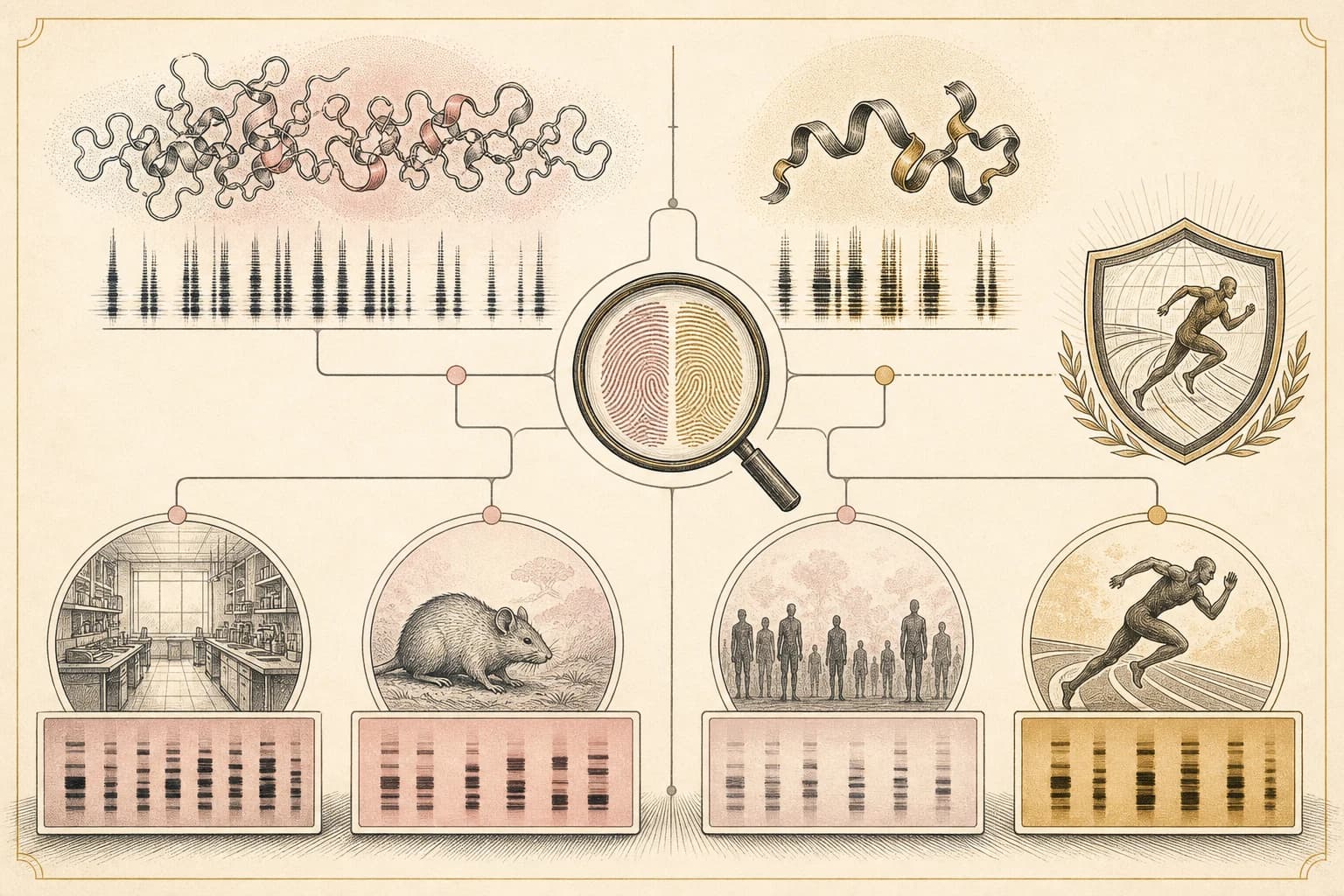
The direct TB-500 experiment was not a simple win
The 2024 study is useful because it tested the named parent peptide and several metabolites side by side.2 In its fibroblast scratch assay, parent TB-500 did not produce a significant closure difference from the control.2 One shorter metabolite, Ac-LKKTE, produced a small significant change under the same conditions.2
That pattern should be reported whole.2 Saying only that “TB-500 research showed closure” would hide which material produced the signal.2 Saying the study proved that TB-500 fails everywhere would also outrun a single laboratory setup.2 The paper used one cell system, a selected concentration, and an eight-hour comparison summarized by FDA.2 Its rat work focused on identifying and measuring metabolites.10 The accurate takeaway is narrower: the parent and its breakdown products did not behave identically in that assay.2
Human thymosin beta-4 research is another lane
Human research does appear around the larger thymosin beta-4 topic, but identity must stay attached.11 A randomized phase 1 study examined full-length recombinant human thymosin beta-4 in healthy volunteers.11 It included 54 people in a single-exposure part and 30 in a repeated-exposure part, focusing on safety, tolerability, movement through the body, and antibody response.11
Another trial randomized 73 patients at eight European sites.3 It compared topical full-length thymosin beta-4 with placebo for venous stasis ulcers and reported a possible signal at one concentration.3 That population, route, molecule, and clinical endpoint were all specific.3 Neither study tested TB-500 as defined by FDA.12 Neither study measured bodybuilding recovery or performance.11 Human data for a related 43-amino-acid peptide cannot fill the identity gap for a seven-amino-acid fragment.1
BPC-157 is named here only as the neutral catalog reference below.
Sports rules answer a different question
Evidence asks what a study measured and how well a sentence matches that design.2 Anti-doping rules ask whether a substance falls within a prohibited class.4 FDA’s 2026 briefing notes that WADA places TB-500 in its prohibited growth-factor category.4
That classification does not prove a recovery effect, and a weak evidence claim does not cancel a sports rule.4 Competitive athletes should therefore keep two columns in mind: “What does the study establish?” and “What does my sport prohibit?”4 The second question depends on the rules that govern the athlete’s competition, not on a seller’s label or a social post.4 The sports classification remains separate from any clinical outcome claim.4
Read bodybuilding content in four passes
First, copy the exact identity from the cited paper: TB-500, non-acetylated LKKTETQ, a metabolite, or full-length thymosin beta-4.8 Second, name the model: cultured cells, rats, healthy volunteers, or patients with a specific condition.11 Third, state the endpoint without upgrading it; metabolite detection is not repair, and scratch closure is not athletic recovery.10
Fourth, check whether the conclusion matches the comparison.2 The direct laboratory paper found different behavior for parent TB-500 and Ac-LKKTE.2 The human trials used full-length thymosin beta-4.11 FDA’s bounded 2026 search did not identify clinical studies or human exposure data for TB-500 free base or acetate.12 These details do not make the topic useless. They make the wording precise. A good post can be interested in early science while keeping the molecule and model visible.2
Bottom line
The central problem with TB-500 content is often identity before it is interpretation.1 TB-500 is a seven-amino-acid acetylated fragment, not the full 43-amino-acid thymosin beta-4 molecule.6 Non-acetylated fragment findings, a rat metabolism study, a cell scratch assay, and human full-length thymosin beta-4 trials belong to separate evidence lanes.8 The direct 2024 assay also distinguished the parent peptide from a shorter metabolite instead of producing one simple positive story.2 For Filipino readers, the practical habit is to keep four labels beside every claim: exact molecule, model, endpoint, and rule context.4 That approach preserves useful research without turning related names into interchangeable proof.
This article is educational research context, not medical advice. Catalog links are neutral references and do not imply a treatment or human-use recommendation.
Frequently asked questions
Is TB-500 the same as thymosin beta-4?
No. FDA defines TB-500 as the N-acetylated seven-amino-acid fragment Ac-LKKTETQ, drawn from positions 17 through 23 of thymosin beta-4.6 Full-length thymosin beta-4 has 43 amino acids.1 The shared sequence explains the relationship, but it does not make the two materials identical.
Why does acetylation matter here?
Acetylation is a chemical change, not a decorative naming detail.8 FDA explains that it can alter a peptide’s charge, size, folding, lifespan, water-avoiding behavior, and binding.8 That is why an experiment using non-acetylated LKKTETQ cannot automatically stand in for TB-500.8
What did the 2024 TB-500 study find?
The study tracked TB-500 and its metabolites in laboratory systems and exposed rats.10 In a fibroblast scratch assay, the parent peptide did not differ significantly from control, while Ac-LKKTE showed a small significant change.2 That laboratory endpoint does not establish recovery or performance in people.2
Do human thymosin beta-4 trials answer the TB-500 question?
They answer questions about the material they tested. One phase 1 study used full-length recombinant thymosin beta-4 in healthy volunteers.11 A phase 2 ulcer study also used full-length thymosin beta-4.3 Their human setting does not erase the molecular difference from TB-500.1
What does the WADA classification tell an athlete?
It tells an athlete that TB-500 falls within WADA’s prohibited growth-factor category, as noted in FDA’s 2026 review.4 It does not tell the athlete that a claimed benefit is proven.4 Sports status and scientific support are different checks, and both need their own evidence.4
Why is BPC-157 shown as a related reference?
The card is navigation, not a claim that the two peptides match or belong together. FDA lists TB-500 and BPC-157 separately in its compounding safety-risk summary, with different identity and information concerns.5 Separate records should stay separate unless a direct study supports a narrower comparison.5
Sources
Footnotes
-
FDA Briefing Document for TB-500-Related Bulk Drug Substances. FDA sequence comparison of TB-500 and thymosin beta-4. Sharing a short sequence does not make the fragment and parent peptide interchangeable. ↩ ↩2 ↩3 ↩4 ↩5 ↩6 ↩7 ↩8 ↩9
-
FDA Briefing Document for TB-500-Related Bulk Drug Substances; Simultaneous quantification of TB-500 and its metabolites in in-vitro experiments and rats by UHPLC-Q-Exactive orbitrap MS/MS and their screening by wound healing activities in-vitro. In-vitro comparison at one reported concentration over eight hours. A scratch assay measures cultured-cell movement under laboratory conditions, not recovery, performance, or clinical wound outcomes. ↩ ↩2 ↩3 ↩4 ↩5 ↩6 ↩7 ↩8 ↩9 ↩10 ↩11 ↩12 ↩13 ↩14 ↩15 ↩16 ↩17 ↩18 ↩19
-
The effect of thymosin treatment of venous ulcers. Double-blind, placebo-controlled, exposure-escalation study in a specific clinical wound population. This finding concerns topical full-length thymosin beta-4 in venous ulcers and cannot be assigned to TB-500 or to sports recovery. ↩ ↩2 ↩3 ↩4 ↩5
-
FDA Briefing Document for TB-500-Related Bulk Drug Substances. Official FDA review citing the World Anti-Doping Agency classification. An anti-doping classification governs sport eligibility and testing; it is not a clinical effectiveness finding or a Philippine approval statement. ↩ ↩2 ↩3 ↩4 ↩5 ↩6 ↩7 ↩8 ↩9 ↩10 ↩11
-
Certain Bulk Drug Substances for Use in Compounding that May Present Significant Safety Risks. Current FDA public compounding safety-risk summary. Separate listing does not establish that the substances work together, are interchangeable, or share a human-use recommendation. ↩ ↩2 ↩3
-
TB-500; FDA Briefing Document for TB-500-Related Bulk Drug Substances. Official FDA substance identity and July 2026 regulatory review. A substance identity record defines the molecule; it does not establish a clinical outcome or product equivalence. ↩ ↩2 ↩3 ↩4 ↩5
-
FDA Briefing Document for TB-500-Related Bulk Drug Substances. July 2026 FDA compounding review. This is a United States compounding-review distinction, not a statement about Philippine regulatory status. ↩ ↩2
-
FDA Briefing Document for TB-500-Related Bulk Drug Substances. FDA pharmacology assessment comparing related peptide forms. The statement limits extrapolation; it does not predict which form will have a particular effect. ↩ ↩2 ↩3 ↩4 ↩5 ↩6 ↩7 ↩8 ↩9
-
FDA Briefing Document for TB-500-Related Bulk Drug Substances. FDA summary of a study in 26-month-old female mice using non-acetylated LKKTETQ. The tested peptide was non-acetylated LKKTETQ, not N-acetylated TB-500, and the model does not establish a human outcome. ↩ ↩2 ↩3 ↩4
-
Simultaneous quantification of TB-500 and its metabolites in in-vitro experiments and rats by UHPLC-Q-Exactive orbitrap MS/MS and their screening by wound healing activities in-vitro. Analytical chemistry study using human serum and enzyme systems, rat urine, and synthesized standards. Metabolite detection establishes analytical and animal context, not a beneficial outcome in people. ↩ ↩2 ↩3 ↩4 ↩5 ↩6 ↩7 ↩8
-
A first-in-human, randomized, double-blind, single- and multiple-dose, phase I study of recombinant human thymosin beta-4 in healthy Chinese volunteers. Healthy-volunteer safety, tolerability, pharmacokinetic, and antibody study of NL005. The intervention was full-length recombinant thymosin beta-4, not TB-500, and the study did not test bodybuilding outcomes. ↩ ↩2 ↩3 ↩4 ↩5 ↩6 ↩7
-
FDA Briefing Document for TB-500-Related Bulk Drug Substances. FDA review across named medical, regulatory, and safety databases through the dates reported in the briefing. This is a bounded statement about FDA's documented search, not proof that a record can never exist. ↩ ↩2