
Quick answer
Sermorelin’s documented medical history does not establish it as a broad anti-aging treatment. FDA records connect the former Geref product to growth-hormone deficiency in children with growth failure, and the product’s approvals were later withdrawn after production stopped.
Small studies in healthy older men found that GHRH(1–29) could change growth hormone or IGF-1 measures. They did not consistently improve body composition, weight, metabolism, sleep, or other outcomes often bundled into anti-aging marketing. Filipino readers should separate historical pediatric use, adult hormone-response research, and modern wellness promises instead of treating them as one story.1234
What was sermorelin’s documented medical role?
FDA orphan-drug records identify Geref as sermorelin acetate. Its historical designation concerned growth-hormone deficiency in children whose condition involved growth failure.1
That context is specific: a defined pediatric disorder and a growth-related medical goal. It is not an approval for reversing normal aging, improving gym performance, changing an adult physique, or increasing general vitality.
Sermorelin is a 29-amino-acid analogue of human growth hormone-releasing hormone. It stimulates the body’s growth-hormone secretion, which explains why adult wellness marketing can attach a wider story to its mechanism.5
Readers researching Sermorelin can view its live catalog details below. The listing identifies the catalog item and is separate from the evidence discussed here.
What happened to the former Geref product?
An FDA medical review records that Geref production ended in 2008. The approvals for the two NDAs containing the product were withdrawn in June 2009.2
Withdrawal after production stopped does not, by itself, prove a new safety finding or validate modern compounded versions. It records the regulatory status of particular approved products.
This distinction matters when marketing says a compound “was FDA-approved.” Historical approval is not a transferable badge for every present-day product, supplier, formulation, indication, or country.
It also does not create Philippine approval. US regulatory history and Philippine product registration are separate questions that require their own current official records.
Dates belong beside regulatory statements. A reader should be able to see when a product was approved, when manufacturing stopped, and when an approval changed. Removing that timeline can make a discontinued historical record look like a current market authorization.2
The exact product matters as much as the ingredient name. A historical NDA covers a particular sponsor, formulation, manufacturing record, and labeled use. It does not certify every modern item that uses “sermorelin” in a listing.
What did the pediatric review actually conclude?
A review described sermorelin’s diagnostic and treatment use in children with idiopathic growth-hormone deficiency. It also noted limited treatment data and unresolved questions about final height and comparisons with other approaches.5
That makes the history more nuanced than either “proven” or “useless.” There was a defined medical rationale and clinical experience, alongside unanswered long-term and comparative questions.
Most importantly, pediatric growth failure is not a model of normal adult aging. A therapy’s history in one population cannot support unrelated promises about wrinkles, energy, recovery, fat loss, muscle, or longevity.
The word “replacement” can also mislead. Sermorelin stimulates a signaling pathway; it is not simply interchangeable with externally supplied growth hormone. Mechanistic differences do not automatically prove that one approach is safer, more natural, or better for an outcome.5
What did studies in healthy older men find?
One six-week study enrolled 11 healthy older men. GHRH(1–29) increased nocturnal growth-hormone measures and produced changes in some strength or endurance measures.3
The same study found no change in DEXA muscle or fat measurements, body weight, glucose, insulin, or lipids. That mixed pattern is important because it separates a hormone response from the broader body-composition and metabolic story.3
A 14-day study in ten healthy older men also increased growth-hormone and IGF-1 measures at the higher study level. Several metabolic and laboratory measures remained unchanged.4
Both studies were small and brief.34 Their value is that they directly measured human hormone responses. Their limitation is that they cannot settle long-term questions about function, disease, lifespan, or broad quality of life.
Marketing often highlights only the rising hormone line. A balanced explanation should place every unchanged body-composition or metabolic measure beside it, because those neutral findings show what the intervention did not demonstrate.34
Readers comparing this topic with Ipamorelin can view its live catalog details below. It is a separate catalog reference, not a suggested combination.
Does longer research prove broad anti-aging effects?
Not from the cited five-month study. It used a different modified GHRH analogue in older men and women, not the exact former Geref product. Researchers reported hormone-axis changes and some sex-specific findings.6
Several body-composition measures, bone density, body weight, and sleep quality did not change. Because the molecule differed, its results should not be silently assigned to sermorelin; because several outcomes were neutral, it also cannot support a universal rejuvenation claim.6
Anti-aging is not one endpoint. It can refer to appearance, strength, body composition, sleep, metabolic markers, physical function, disease risk, or lifespan. A credible claim must identify which outcome changed and in whom.
The term also invites endpoint switching. If weight does not change, a promoter may point to sleep; if sleep does not change, the story may move to energy or “cellular age.” Research cannot be evaluated when the promised outcome changes after the results are known.
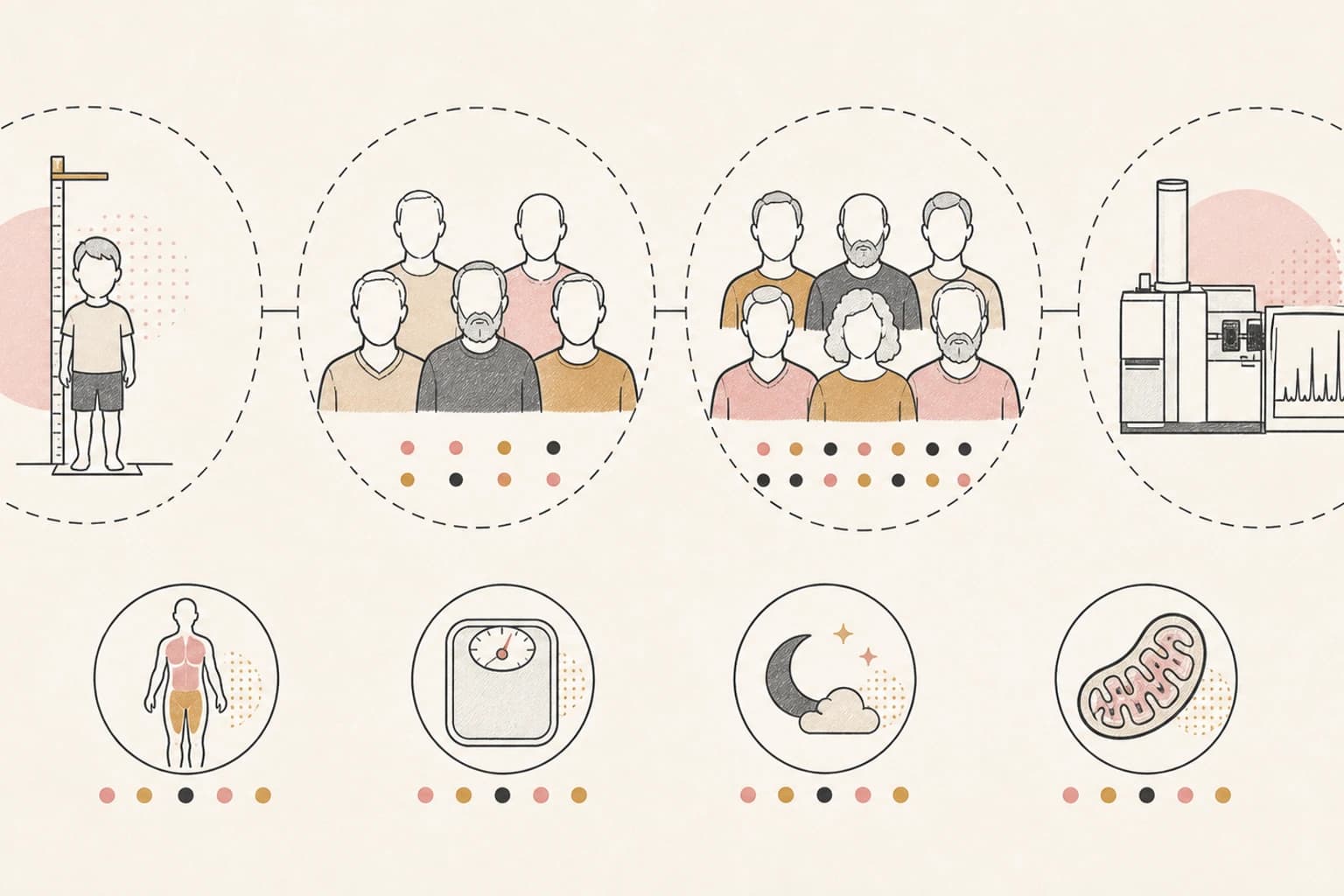
What do laboratory and supply-chain findings add?
A urine mass-spectrometry study developed a validated method to detect sermorelin and a metabolite. That is analytical science used to identify a compound; it is not a benefit or safety trial.7
The distinction is useful for athletes and buyers. Detectability does not prove effectiveness, while a label does not prove identity. Different questions require different tests.
A review of GH–IGF-1-axis peptides describes sermorelin as a GHRH analogue and warns about uncertain composition and combinations in unregulated supply chains. It does not establish performance or body-recomposition benefits.8
For Filipino readers, live catalog information should remain separate from these studies. Product cards can identify current catalog records, but they cannot verify equivalence to a historical medicine or establish an anti-aging indication.
The best evidence hierarchy is simple: exact official product records for regulatory history, exact human studies for clinical outcomes, and analytical methods for identity or detection. No single source type answers every question.
Bottom line
Sermorelin’s medical history concerns a former pediatric product for growth-hormone deficiency, not a general anti-aging approval. Small studies in older adults show that GHRH-related interventions can change hormone measures, but body composition, weight, metabolism, sleep, and other outcomes were often unchanged or mixed.
One longer study used a different analogue, and a detection study measured identity rather than benefit. Filipino readers should ask which exact molecule, population, endpoint, product, and regulator a claim refers to. A historical indication and a modern wellness promise are not the same evidence.
Frequently asked questions
Was sermorelin historically approved in the United States?
FDA records connect Geref, a sermorelin acetate product, to pediatric growth-hormone deficiency with growth failure.1
Why were the Geref approvals withdrawn?
The FDA medical review says production stopped in 2008 and the relevant approvals were withdrawn in June 2009.2
Did older-adult studies improve body composition?
The six-week study increased hormone measures but did not change DEXA muscle or fat measurements or body weight.3
Does hormone release prove anti-aging?
No. Hormone concentrations are biomarkers. Anti-aging claims need direct evidence for the specific health, function, appearance, or lifespan outcome being claimed.
Are the Sermorelin and Ipamorelin cards a combination recommendation?
No. They are separate catalog references and do not recommend combining products, human use, amount guidance, or treatment.
Sources
Footnotes
-
Search Orphan Drug Designations and Approvals: Sermorelin acetate (Geref). Official United States orphan-drug record for Geref. This is a historical record for a named medicine and pediatric condition, not an anti-aging indication. ↩ ↩2 ↩3
-
Macrilen medical review: regulatory history of Geref. Official FDA regulatory-history review. The record describes the named Geref product and does not determine the status or identity of another listing. ↩ ↩2 ↩3 ↩4
-
Effects of single nightly injections of growth hormone-releasing hormone (GHRH 1-29) in healthy elderly men. Six-week human study in healthy men aged 64 to 76 years. This small, short study of GHRH(1-29) had mixed outcomes and does not establish broad anti-aging benefits. ↩ ↩2 ↩3 ↩4 ↩5 ↩6
-
Growth hormone-releasing hormone-(1-29) twice daily reverses the decreased GH and insulin-like growth factor-I levels in old men. Short clinical trial comparing healthy older and younger men. A hormone-signal change over 14 days is not a test of long-term function, appearance, or healthy aging. ↩ ↩2 ↩3 ↩4
-
Sermorelin: a review of its use in the diagnosis and treatment of children with idiopathic growth hormone deficiency. Review of diagnostic and pediatric growth-hormone-deficiency literature. The reviewed population was children with growth hormone deficiency, not healthy adults seeking anti-aging effects. ↩ ↩2 ↩3
-
Endocrine and metabolic effects of long-term administration of [Nle27]growth hormone-releasing hormone-(1-29)-NH2 in age-advanced men and women. Human study of [Nle27]GHRH(1-29)-NH2, a modified analogue rather than sermorelin. Results for a different analogue cannot be treated as a sermorelin result. ↩ ↩2
-
Analysis of growth hormone releasing hormone and its analogs in urine using nano liquid chromatography coupled with quadrupole/orbitrap mass spectrometry. Laboratory methods study using urine analysis. Detection science cannot establish an anti-aging, performance, or clinical outcome. ↩
-
The emerging landscape of performance-enhancing peptides modulating GH-IGF1 axis: bridging the gap between clinical evidence and patient self-administration. Narrative review of clinical evidence and self-administration practices. A review frames the evidence landscape; it does not prove a benefit for a catalog item or a Philippine reader. ↩