
Quick answer
The modern evidence collected for this review does not show that sermorelin improves muscle strength, fat loss, athletic recovery, or healthy aging in general consumers. Reviews classify it as a growth hormone-releasing hormone analogue, so its biological pathway is understandable. The clinical leap is not. Current publications mainly discuss hormone-pathway mechanisms, limited body-composition evidence, online performance claims, and product-quality concerns rather than strong, direct sermorelin outcome trials.1234
What is sermorelin supposed to signal?
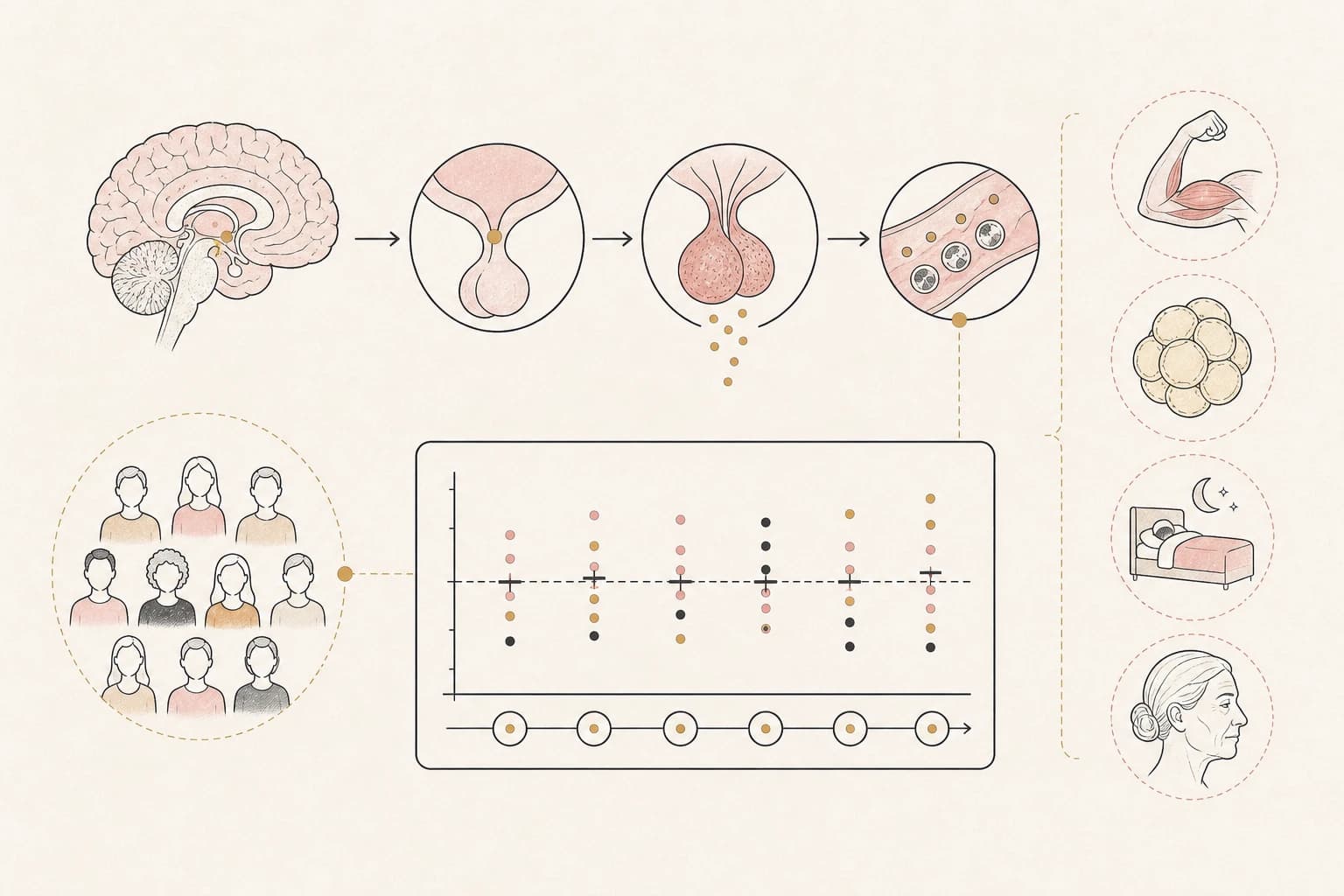
Sermorelin is described in current reviews as an analogue of growth hormone-releasing hormone. That places it upstream in the growth hormone and IGF-1 pathway: it is intended to stimulate a signal rather than act as growth hormone itself.1
That mechanism explains why sermorelin is marketed around body composition, recovery, and aging. It does not establish any of those results. A pathway can be biologically active while a claimed clinical outcome remains untested or uncertain.
This distinction is the most important part of the article. “Affects the growth hormone pathway” is a mechanism statement. “Builds muscle,” “reduces fat,” or “improves recovery” are outcome statements that require direct controlled human trials.12
Readers researching Sermorelin can view its live catalog details below. The listing identifies the catalog item and is separate from the evidence discussed here.
What does the human evidence show about body composition?
The current reviews describe the clinical evidence as limited. One review covering growth hormone secretagogues discussed possible roles in men with metabolic concerns or hypogonadism, but it was not a randomized trial proving sermorelin changes body composition.2
That matters because review articles can summarize a field without settling a specific product claim. If the underlying literature does not directly compare sermorelin with placebo on muscle mass, fat mass, strength, or function, the review cannot manufacture that missing result.
The collected modern sources therefore do not establish that sermorelin improves muscle strength, fat loss, athletic recovery, or healthy aging for general consumers. This is a statement about the evidence reviewed, not a claim that future research could never find an effect.4
For readers, the practical test is simple: find the direct human trial behind the exact promised outcome. A pathway explanation, animal paper, online testimonial, or study involving a different compound cannot substitute for it.
Why are sports and anti-aging claims so common?
Growth hormone and IGF-1 are familiar terms in physique and performance marketing. Once a compound is linked to that pathway, sellers can attach outcomes that sound biologically plausible even when the direct clinical evidence is thin.
A 2026 review described a gap between regulated clinical evidence and online self-delivery claims for peptides affecting the growth hormone–IGF-1 axis. Another critical review found that peptide use in sport is promoted for physique and recovery despite limited clinical evidence and poorly defined long-term risks.35
Neither paper proves that a particular person will benefit or be harmed. Their value is different: they show that online confidence can run ahead of controlled data. Popularity measures attention, while a randomized outcome trial measures whether a claim held up under comparison.35
This is also why anecdotal “stacks” create confusion. If multiple compounds, training changes, diets, and supplements are used together, a personal story cannot isolate what caused the result.
What safety information can and cannot say
Reviews of growth hormone pathway peptides discuss metabolic, fluid-retention, musculoskeletal, and application-site concerns. Those are useful categories to watch, but they should not be presented as sermorelin-specific event rates unless a sermorelin study measured them.6
The same rule applies to reassuring language. A short study or class-level discussion cannot establish long-term safety for unsupervised consumer use. Safety depends on product identity, population, exposure, monitoring, and duration.
A sports-medicine review noted that many peptides outside named approvals have favorable animal findings while rigorous human safety evidence remains scarce. The word “favorable” does not erase the species boundary or the missing long-term human data.7
Readers comparing this topic with CJC-1295 with DAC can view its live catalog details below. It is a separate catalog reference, not a suggested combination.
Did a glioma paper prove sermorelin improves cancer?
No. A recurrent-glioma paper used transcriptomic datasets and computational drug-sensitivity scoring. It analyzed data from 1,018 glioma patients, but it did not provide sermorelin to patients in a randomized treatment trial.8
Computational screening can identify a hypothesis worth testing. It can connect gene-expression patterns with a predicted response and propose possible mechanisms. It cannot show that patients live longer, experience tumor shrinkage, or benefit clinically from the predicted compound.89
The title of such a paper may sound therapeutic, so the methods must carry more weight than the headline. Here, the correct description is “bioinformatics prediction,” not “cancer treatment result.” Turning it into a treatment recommendation would undo the study’s actual evidence level.9
What do product-testing reports add?
A preprint analyzing direct-to-consumer peptide test data reported wide variation in measured quality and detectable endotoxin in some samples. Sermorelin appeared in the broader dataset, but the report had not completed peer review and cannot describe every product on the market.10
The useful lesson is about identity, not a universal verdict. A molecule name on a label does not prove the contents, purity, sterility, or similarity to research material. Those are separate questions requiring appropriate records and testing.
For Filipino readers, a paper from another country also does not establish Philippine authorization or verify a local seller. Research findings, regulatory status, and live catalog details belong to different systems. Keep each statement attached to the source that can actually support it.
Readers should also distinguish a branded or regulated medicine from a molecule name used in research marketing. Similar spelling cannot establish equivalent formulation, quality controls, or intended use. When a listing supplies only a peptide name and a broad promise, the missing identity information is part of the evidence gap, not a minor shopping detail.
Bottom line
Sermorelin has a clear proposed place in the growth hormone–IGF-1 pathway, but the modern evidence reviewed here does not establish the popular muscle, fat-loss, recovery, or healthy-aging outcomes.124
Mechanism is not outcome, prediction is not treatment, and product naming is not authentication. Readers should look for direct controlled human studies measuring the exact promised result. Until those studies exist, the honest description is that the marketing story is more complete than the clinical evidence.38105
That is a limit of the current record, not an invitation to fill the gap with anecdotes.
Frequently asked questions
Is sermorelin the same as growth hormone?
No. Current reviews describe sermorelin as a growth hormone-releasing hormone analogue that acts upstream in the pathway. A related pathway does not make the two substances clinically interchangeable.1
Has sermorelin been proven to build muscle?
Not by the modern evidence collected here. Reviews describe limited clinical efficacy data, and the corpus does not contain a direct controlled trial establishing muscle-strength or body-composition benefits for general consumers.24
Did the glioma study provide sermorelin to patients?
No. It used transcriptomic data and computational drug-sensitivity methods. The findings were hypothesis-generating and did not report randomized patient treatment outcomes.89
Are class-wide side effects sermorelin event rates?
No. Reviews discuss concerns across several growth hormone pathway peptides. Those categories should not be converted into a measured frequency for sermorelin unless a sermorelin-specific study reports it.6
Why show a CJC-1295 product card?
It gives readers a separate catalog reference for comparison. It does not imply equivalent evidence, a suggested combination, or a personal-use recommendation.
Sources
Footnotes
-
The emerging landscape of performance-enhancing peptides modulating GH-IGF1 axis: bridging the gap between clinical evidence and patient self-administration.; Beyond the androgen receptor: the role of growth hormone secretagogues in the modern management of body composition in hypogonadal males.. Narrative reviews of growth hormone secretagogues and performance-related peptide claims. A pathway effect does not establish a clinical benefit. ↩ ↩2 ↩3 ↩4 ↩5
-
Beyond the androgen receptor: the role of growth hormone secretagogues in the modern management of body composition in hypogonadal males.. Review discussing sermorelin and other secretagogues in men with hypogonadism or metabolic concerns. The review is not a randomized sermorelin efficacy trial. ↩ ↩2 ↩3 ↩4 ↩5
-
The emerging landscape of performance-enhancing peptides modulating GH-IGF1 axis: bridging the gap between clinical evidence and patient self-administration.. Clinical narrative review of regulated evidence and online performance use. The paper summarizes available literature and does not prove harm or benefit for an individual. ↩ ↩2 ↩3 ↩4
-
Safety and Efficacy of Approved and Unapproved Peptide Therapies for Musculoskeletal Injuries and Athletic Performance; The emerging landscape of performance-enhancing peptides modulating GH-IGF1 axis: bridging the gap between clinical evidence and patient self-administration.; Beyond the androgen receptor: the role of growth hormone secretagogues in the modern management of body composition in hypogonadal males.; A new era of doping? Use of peptide and peptide-analog drugs in recreational and professional sport and bodybuilding: a critical review.. Cross-review synthesis focused on direct clinical outcomes. This conclusion is limited to the collected evidence and should be updated when direct controlled trials appear. ↩ ↩2 ↩3 ↩4
-
A new era of doping? Use of peptide and peptide-analog drugs in recreational and professional sport and bodybuilding: a critical review.. Critical review of peptide and peptide-analogue use in sport and bodybuilding. Popularity and anecdotal reports are not proof of efficacy. ↩ ↩2 ↩3
-
The emerging landscape of performance-enhancing peptides modulating GH-IGF1 axis: bridging the gap between clinical evidence and patient self-administration.. Narrative review covering several peptide classes, including sermorelin. Class-wide concerns should not be rewritten as a measured rate for sermorelin alone. ↩ ↩2
-
Safety and Efficacy of Approved and Unapproved Peptide Therapies for Musculoskeletal Injuries and Athletic Performance. Narrative review of approved and unapproved peptides marketed for injury and performance. This is a broad review and not sermorelin-specific efficacy evidence. ↩
-
A potentially effective drug for patients with recurrent glioma: sermorelin.. Computational analysis of datasets from 1,018 glioma patients. Predicted sensitivity is hypothesis-generating and does not show patient benefit. ↩ ↩2 ↩3 ↩4
-
A potentially effective drug for patients with recurrent glioma: sermorelin.. Bioinformatics drug-screening study. Mechanistic predictions cannot support a cancer-treatment recommendation. ↩ ↩2 ↩3
-
Evaluation of Research Grade Peptides Marketed Directly to Consumers Reveals Extensive Variability in Purity and Measured Abundance. Preprint analysis of a large public independent-testing dataset that included sermorelin. The findings describe sampled gray-market products and have not completed peer review. ↩ ↩2