Quick answer
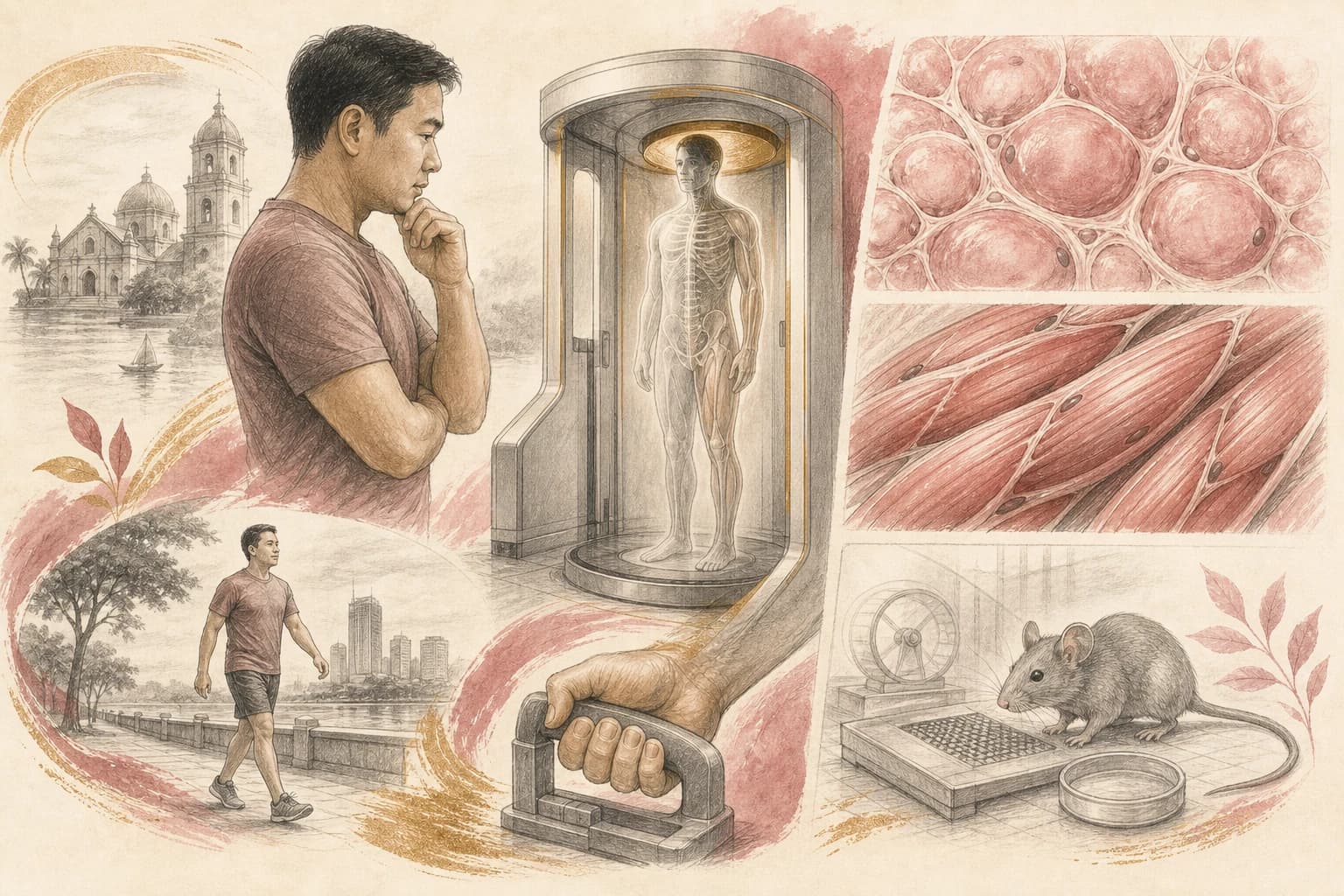
Semaglutide body-composition research shows that weight change can include reductions in both fat mass and lean mass. In a prespecified human trial analysis, both compartments fell over 24 weeks versus placebo.
Mouse studies explore possible biological pathways and report that exercise combined with semaglutide preserved lean mass better than semaglutide alone. Those animal results do not prescribe a human routine or predict an individual outcome. Lean mass is also broader than muscle, so scans, strength, function, and study context should be read together.1234
What does lean mass actually include?
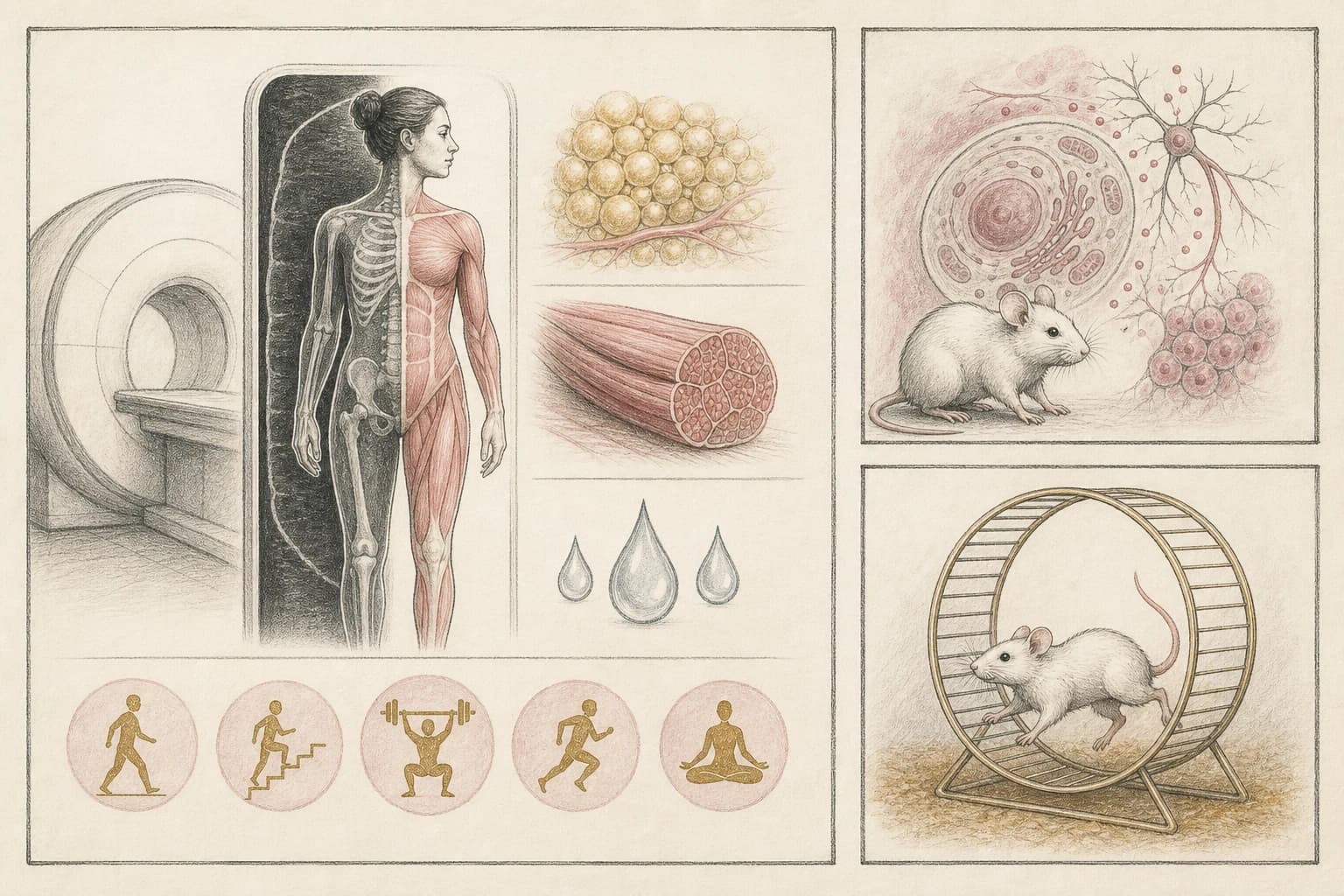
Lean mass is everything in the measured body compartment that is not fat. It includes muscle, organs, body water, connective tissue, and other non-fat material.
That is why “lean mass loss” should not automatically be rewritten as “muscle wasting.” The two phrases do not mean exactly the same thing.
Measurement method matters. DXA estimates fat, bone, and lean soft tissue, while other tools use different assumptions.
Bioelectrical impedance sends a small current through the body and estimates compartments from resistance. Its convenience makes it common, but hydration and device equations can shift the result. It should not be treated as identical to research imaging.
Hydration, glycogen, recent food, and timing can shift the estimate. A small change may reflect more than tissue protein.
Function matters too. Strength, walking, balance, and daily capacity can add information that a composition scan cannot provide.
Regional measures can add another layer. A whole-body lean estimate may change even when a particular muscle group is stable, and a scan cannot reveal how effectively tissue performs. Researchers need outcome choices that match the claim.
The most useful review states what was measured before deciding what the change means.
That discipline also keeps uncertainty visible.
Readers researching Semaglutide can view its live catalog details below. The listing identifies the catalog item and is separate from the evidence discussed here.
What did the human SMART analysis find?
Semaglutide is a GLP-1 receptor agonist studied for changes in body weight and body composition.1
In a prespecified analysis of the randomized, double-blind SMART trial, semaglutide reduced both lean body mass and fat mass versus placebo over 24 weeks.2
The participants were adults with chronic kidney disease and overweight or obesity. That population should remain attached to the finding.
A prespecified analysis is planned before the result is examined, which reduces some opportunities for selective reporting.
The outcome still describes a group average. It cannot predict the proportion for a specific person or explain every change in function.
Starting composition can affect what an absolute change means. The same kilogram difference represents a different proportion in people with different body sizes. Reporting baseline values makes the follow-up result easier to interpret.
It also does not justify the statement that all weight lost was beneficial tissue or that lean change was automatically harmful. The trial measured compartments, not a universal judgment.
What do the mouse mechanism studies add?
In a diet-induced obesity model, semaglutide lowered body weight, fat mass, and lean mass in mice.3
The researchers also explored FGF15, a gut-derived signal involved in communication among the gut, liver, bone, and muscle.
Lean mass declined even when intestinal FGF15 was absent.5 That helps narrow one mechanistic question inside the mouse model.
It does not establish the cause of human lean-mass change. Animal experiments use controlled genetics, diets, environments, and timelines that differ from ordinary life.
Mechanistic evidence is valuable because it can suggest what to test next. It should not be converted into a diagnostic explanation for an individual.
The correct wording keeps the species visible in every claim.35
What did the exercise experiment show?
Another mouse study compared semaglutide with a semaglutide-plus-exercise condition.4
The combination reduced fat mass more than no treatment and preserved lean mass better than semaglutide alone in that model.4
This does not mean exercise certain complete preservation. It also cannot assign the result to semaglutide alone because exercise was part of the tested combination.
The program, intensity, animal health, and 14-week setting belong to the result. A human plan requires human clinical context.
Still, the study illustrates a broader research principle: body composition and function should be examined alongside weight.
Readers comparing this topic with Tirzepatide can view its live catalog details below. It is a separate catalog reference, not a suggested combination.
Why do social-media claims become misleading?
“Semaglutide reduces fat mass, not muscle” ignores the human finding that both fat and lean mass changed.2
“Semaglutide destroys muscle” also goes too far. Lean mass is not identical to muscle, and the cited human analysis did not establish universal functional decline.
“Exercise prevents all lean loss” exaggerates a mouse combination study.4 Better preservation is not the same as complete prevention.
Before-and-after photos cannot measure tissue. Lighting, posture, clothing, and hydration can create apparent differences.
A more accurate sentence is that body composition can shift across several compartments, and the pattern depends on population, method, and accompanying behaviors.
What should Filipino readers verify?
The Philippine FDA Verification Portal separates licensed establishments from registered or notified products.6
Search the exact item and compare name, manufacturer, form, and current authorization details. A business license is not an item-level confirmation.
WHO notes that some falsified medical products closely resemble genuine products and can require quality-control analysis.7
Body-composition evidence applies to the studied product, protocol, and population. It cannot be transferred to an unidentified item because the label looks familiar.
The sound conclusion keeps the source, species, study context, and product identity visible together.8
How should a body-composition result be judged?
Look for the absolute change and the percentage of total weight loss. Each reveals a different part of the result.
Check whether the study measured lean mass, skeletal muscle, strength, or function. These terms should not be swapped.
Find the population and follow-up. The SMART analysis involved a defined chronic-kidney-disease group over 24 weeks.2
Separate human findings from mouse mechanisms. Animal work can explain possibilities without predicting personal outcomes.35
Finally, compare methods consistently. A bathroom scale, bioimpedance device, and DXA scan do not produce interchangeable evidence.
Bottom line
Human semaglutide research shows that weight change can include lower fat mass and lower lean mass. The SMART trial analysis established that pattern over 24 weeks in adults with chronic kidney disease and overweight or obesity. Mouse studies add mechanistic and exercise-combination clues, but they cannot prescribe human care or forecast one person’s tissues.
Lean mass is broader than muscle, and a scan does not replace strength or function. Filipino readers should also verify exact product records. The responsible question is not whether one compartment moved; it is what was measured, in whom, by which method, and what the change meant.
Frequently asked questions
Did the human trial report lower lean mass?
Yes. It reported reductions in both lean body mass and fat mass versus placebo.2
Does lean mass mean only skeletal muscle?
No. It includes water, organs, and other non-fat tissues.
Did the FGF15 study involve people?
No. It was a mechanistic mouse experiment.35
Did exercise fully prevent lean-mass change?
The mouse combination preserved lean mass better than semaglutide alone; it did not create a universal human guarantee.4
Can photos confirm muscle loss?
No. Tissue measurement and functional assessment require more suitable methods.
Sources
Footnotes
-
Effects of Semaglutide on Body Composition and GFR: A Prespecified Analysis of the SMART Trial.. Human randomized placebo-controlled trial in adults with CKD and overweight or obesity. This is a research framing claim, not a statement about clinical use outcomes. ↩ ↩2
-
Effects of Semaglutide on Body Composition and GFR: A Prespecified Analysis of the SMART Trial.. Prespecified analysis of a randomized placebo-controlled double-blind trial. The result describes measured body-composition change, not a broader clinical conclusion. ↩ ↩2 ↩3 ↩4 ↩5
-
Gut-Derived FGF15 Modulates Lean Mass, Bone, and Bile Acid Responses to Weight Loss.. Preclinical study in mice with diet-induced obesity. Animal findings can help explain biology but do not predict human body-composition change on their own. ↩ ↩2 ↩3 ↩4 ↩5
-
Semaglutide and Exercise Synergy in Obesity: Preserving Muscle Mass and Uncovering Organ Crosstalk.. Mouse study of obesity and metabolic disease. Exercise was part of the combination studied, so the result cannot be assigned to semaglutide alone. ↩ ↩2 ↩3 ↩4 ↩5
-
Gut-Derived FGF15 Modulates Lean Mass, Bone, and Bile Acid Responses to Weight Loss.. Same preclinical study exploring gut-liver-muscle signaling. This is mechanistic context, not a human outcome. ↩ ↩2 ↩3 ↩4
-
Philippine FDA Verification Portal; FDA Advisory No. 2023-2238: Utilization of the FDA Verification Portal. Official Philippine regulatory verification service. A portal record applies to the exact product or establishment named in that record. ↩
-
WHO laboratory analysis of suspected falsified medical products; WHO laboratory testing for health-product regulation. WHO guidance on suspected falsified medical products and regulatory laboratory testing. Appearance alone cannot authenticate a product or establish a research outcome. ↩
-
Effects of Semaglutide on Body Composition and GFR: A Prespecified Analysis of the SMART Trial.; Gut-Derived FGF15 Modulates Lean Mass, Bone, and Bile Acid Responses to Weight Loss.; Philippine FDA Verification Portal; FDA Advisory No. 2023-2238: Utilization of the FDA Verification Portal. Editorial synthesis of the canonical research records and Philippine verification sources. This synthesis is educational and is not personal medical advice or a product recommendation. ↩