
TL;DR
- Return to sport is a staged risk-management process that sits beside rehabilitation, not a one-time verdict drawn from a calendar or an online claim.1
- A useful decision combines physical function, tolerance for sport load, psychological readiness, and the demands of the athlete’s actual playing environment.2
- The cited TB-500 experiment used serum, rats, and fibroblast assays, which cannot measure whether an injured person is ready for training or competition.3
- BPC-157 and TB-500 also raise anti-doping questions for covered athletes, but a banned-substance rule and a medical clearance answer different questions.4
In the Philippines, returning may mean a school tournament, a weekend basketball league, a running event, or a professional season. The pressure can feel the same: there is a date, a team, and a strong wish to be back. A peptide blog can explain research language. It cannot examine the injury, test sport demands, or take responsibility for a clearance decision.5
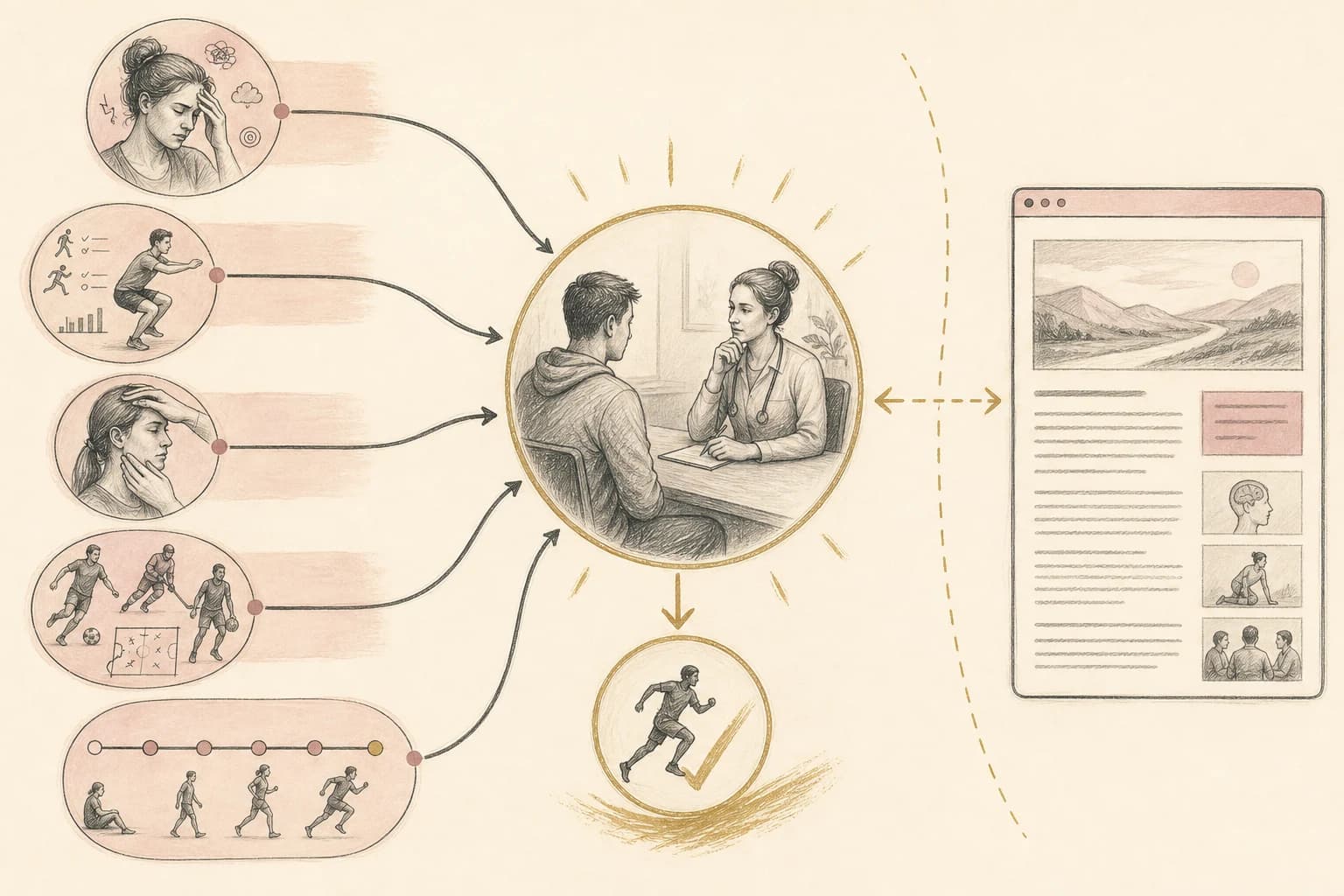
Return is a process, not a date
Return to sport is better understood as a continuum that runs beside recovery and rehabilitation.1 It is not one finish line reached when pain drops or a certain number of days passes.1 The 2016 Bern consensus describes the decision as complex risk management with several moving parts.1
The decision therefore develops throughout rehabilitation instead of appearing only at its final appointment.1 The better question is not simply “When?” but “Ready for which demands?”2
The athlete, clinician, and coach may each hold useful information.5 The athlete can describe symptoms and confidence.5 The clinician can assess health and function.5 The coach can explain the speed, contact, and workload of the role.5 Their discussion should build a staged plan instead of a yes-or-no guess.5
TB-500 is named here only as the neutral catalog reference below.3
Four questions are more useful than one
A 2026 clinical reasoning review groups readiness into four domains: function, load tolerance, psychological readiness, and sport context.2 Function asks what the body can do during relevant movement.2 Load tolerance asks whether that work can be repeated at the needed intensity.2 Psychological readiness includes confidence and the athlete’s response to the return process.2
Context changes the task.2 Straight-line jogging is not the same demand as cutting for volleyball, absorbing contact in basketball, or landing repeatedly in gymnastics.2 A goalkeeper, guard, and distance runner also face different exposures.2 The review therefore describes a readiness profile, shared progression choices, and reassessment over time.6 It presents this framework as a reasoning aid, not a prediction tool that guarantees a safe result.2
Concussion shows why the sequence matters
Concussion needs a specific response because the return decision follows a possible brain injury.7 CDC guidance says a player with suspected concussion should leave play immediately and stay out for that day.7 The athlete should be checked for danger signs and assessed by a healthcare provider.7
The later return uses six steps, moving from regular activities toward light, moderate, heavy non-contact work, controlled practice, and competition.8 Each step typically takes at least 24 hours under provider supervision.8 New or returning symptoms mean stopping the activity and contacting the medical provider.9
This example should not be copied as the exact protocol for every ankle, knee, shoulder, or muscle injury.7 It shows the core logic: progress is observed under rising demands, and setbacks change the plan.9
What the TB-500 experiment actually measured
The cited 2024 TB-500 paper was an analytical and preclinical study, not a return-to-sport trial.3 Researchers examined the peptide’s breakdown in human serum, laboratory enzyme systems, and urine from treated rats.3 They then compared the parent peptide and its metabolites in fibroblast assays.3
In that assay, only a metabolite called Ac-LKKTE showed significant scratch-closure activity against the control.10 That result belongs to cells under laboratory conditions.10 It does not report an athlete’s pain, strength, joint stability, repeated sprint ability, confidence, or response to contact.10
The distinction is practical.3 A molecular or cell signal may help researchers form a later question.10 It cannot perform a physical examination or show that a person can tolerate the next training step.3 The experiment and a clearance visit are different tools built for different jobs.3
BPC-157 sits on another evidence map
A systematic review searched orthopaedic sports-medicine research on BPC-157 through June 2024.11 It included 36 studies: 35 preclinical reports and one retrospective clinical item.11 The preclinical work covered laboratory and animal models rather than supervised return-to-sport programs.11
The clinical item involved 12 people with chronic knee pain and had no control group.11 It did not test readiness for practice, contact, competition, or a named sport demand.11 That narrow design cannot be silently converted into evidence for a return date.11
The review is still useful when read at its real scale.11 It maps which models and outcomes researchers examined.11 It does not replace injury-specific assessment, progressive loading, or the shared decision described in return-to-sport frameworks.5
BPC-157 is named here only as the neutral catalog reference below.11
Anti-doping is a separate checkpoint
Medical readiness and competition eligibility are not synonyms.4 A sports-medicine review states that BPC-157 and TB-500 are banned substances in sport.4 The 2026 World Anti-Doping Agency list places BPC-157 under the non-approved-substances class and TB-500 under growth factors and growth-factor modulators.4
That rule matters to athletes covered by an anti-doping program.4 It does not decide whether a knee can cut safely, whether a shoulder can handle contact, or whether concussion symptoms returned during exertion.2 Those remain clinical and sport-specific questions.2
Product quality is another separate issue.12 The US FDA identifies potential immune-response, peptide-impurity, and ingredient-characterization concerns for compounded drugs containing either substance.12 That assessment is specific to the US compounding context and says nothing about the quality of a catalog card.12
Bring the real sport into the conversation
A useful appointment needs a clear picture of the injury and the task waiting at the other end.2 The clinician’s reasoning can include current symptoms, relevant movement, repeated load, confidence, and the setting of return.2 The athlete can explain the position, training schedule, contact level, playing surface, and upcoming demands.5
Progress should then be reassessed rather than assumed from one good session.6 The four-domain framework starts with minimum clinical readiness, builds a readiness profile, supports a shared progression choice, and returns to reassessment.6 It does not claim to predict every outcome.2
For Filipino readers moving between school, club, community, or elite sport, the transferable lesson is simple.5 Bring the actual activity into the decision.2 A generic recovery story cannot represent a particular injury, athlete, and playing environment.1
Bottom line
A return-to-play decision carries more information than a peptide article can hold.1 It connects the injury with function, repeated load, confidence, sport demands, and reassessment.2 Concussion guidance makes that progression especially visible: removal from play, provider assessment, staged activity, and a response when symptoms return.7 The cited TB-500 work measured metabolism and fibroblast activity, while the BPC-157 review mostly mapped preclinical models.3 Neither source tested a complete return-to-sport decision.11 Anti-doping rules add another checkpoint for covered athletes, but they do not replace medical judgment.4 Read the research for context, then take the clearance question to a qualified healthcare professional who can assess the athlete and the sport.5
This article is educational research context, not medical advice. Catalog links are neutral references and do not imply a treatment or human-use recommendation.
Frequently asked questions
What does return to play actually mean?
It is a progression through recovery, rehabilitation, training, and competition rather than one universal date.1 The Bern consensus treats it as ongoing risk management.1 The exact pathway depends on the injury, the athlete, and the demands waiting in the sport setting.2
Can one pain-free workout provide clearance?
One session shows only what happened under that session’s demands.2 A broader profile considers function, repeated load, psychological readiness, and sport context.2 The proposed framework also calls for reassessment over time, so a single good day does not complete the reasoning process.6
Why is concussion treated differently here?
A suspected concussion may involve a brain injury, so CDC guidance calls for immediate removal, same-day exclusion, danger-sign checks, and provider assessment.7 Its six-step return process then raises activity gradually.8 New or returning symptoms are a reason to stop and contact the provider.9
What did the cited TB-500 study show?
It characterized TB-500 metabolism in serum, laboratory systems, and treated rats, then tested fibroblast activity.3 Only the Ac-LKKTE metabolite produced significant scratch-closure activity against the assay control.10 Those measurements did not test sport function, repeated loading, contact, confidence, or clearance.10
What does the BPC-157 review add?
The review maps 36 orthopaedic sports-medicine studies, including 35 preclinical reports and one small retrospective clinical item.11 That clinical item concerned chronic knee pain and lacked a control group.11 It did not evaluate a staged return to practice or competition.11
Is anti-doping clearance the same as medical clearance?
No. The cited sports-medicine review describes BPC-157 and TB-500 as banned in sport.4 Anti-doping rules address eligibility for athletes covered by those rules.4 Medical readiness instead asks whether the athlete can meet relevant demands with an acceptable, individually assessed risk.1
Sources
Footnotes
-
2016 Consensus statement on return to sport from the First World Congress in Sports Physical Therapy, Bern.. International consensus statement developed by 17 expert clinicians in sports physical therapy. A consensus framework guides reasoning; it does not supply an individual athlete's clearance. ↩ ↩2 ↩3 ↩4 ↩5 ↩6 ↩7 ↩8 ↩9 ↩10
-
Integrating functional performance, load tolerance, psychological readiness, and contextual factors in return-to-sport decision-making: a conceptual and practical framework.. Critical narrative review proposing a four-domain return-to-sport framework. The authors present the framework as a reasoning aid, not a validated prediction model. ↩ ↩2 ↩3 ↩4 ↩5 ↩6 ↩7 ↩8 ↩9 ↩10 ↩11 ↩12 ↩13 ↩14 ↩15 ↩16 ↩17 ↩18 ↩19 ↩20
-
Simultaneous quantification of TB-500 and its metabolites in in-vitro experiments and rats by UHPLC-Q-Exactive orbitrap MS/MS and their screening by wound healing activities in-vitro.. Analytical and preclinical laboratory study focused on metabolism, detection, and fibroblast activity. These models did not measure an injured athlete's function, sport load, psychological readiness, or safe return. ↩ ↩2 ↩3 ↩4 ↩5 ↩6 ↩7 ↩8 ↩9 ↩10
-
Injectable Peptide Therapy: A Primer for Orthopaedic and Sports Medicine Physicians.. Narrative orthopaedic review checked against the World Anti-Doping Agency's 2026 Prohibited List. Anti-doping status governs covered competition and is distinct from medical readiness, general legality, and Philippine regulatory status. ↩ ↩2 ↩3 ↩4 ↩5 ↩6 ↩7 ↩8
-
2016 Consensus statement on return to sport from the First World Congress in Sports Physical Therapy, Bern.. International sports physical therapy consensus on return-to-sport decision-making. The participants contribute different information and authority; collaboration does not replace clinical assessment. ↩ ↩2 ↩3 ↩4 ↩5 ↩6 ↩7 ↩8 ↩9 ↩10
-
Integrating functional performance, load tolerance, psychological readiness, and contextual factors in return-to-sport decision-making: a conceptual and practical framework.. Conceptual return-to-sport framework intended for individualized clinical reasoning. The sequence requires adaptation across injuries, sports, competition levels, and resource settings. ↩ ↩2 ↩3 ↩4
-
Responding to a Sports-related Concussion. Current CDC HEADS UP public-health guidance for sports-related concussion. This concussion-specific action does not define protocols for every other sports injury. ↩ ↩2 ↩3 ↩4 ↩5 ↩6
-
Returning to Sports. Current CDC HEADS UP progression from regular activities through competition. The schedule is a progression framework, not a fixed personal recovery timeline. ↩ ↩2 ↩3
-
Returning to Sports. Symptom-monitoring rule within the six-step CDC return-to-sports progression. Symptom monitoring is one part of supervised concussion care and not a self-clearance test. ↩ ↩2 ↩3
-
Simultaneous quantification of TB-500 and its metabolites in in-vitro experiments and rats by UHPLC-Q-Exactive orbitrap MS/MS and their screening by wound healing activities in-vitro.. In-vitro wound-healing assay comparing TB-500 and identified metabolites. A fibroblast assay result does not establish tissue recovery, medical clearance, or performance readiness in people. ↩ ↩2 ↩3 ↩4 ↩5 ↩6
-
Emerging Use of BPC-157 in Orthopaedic Sports Medicine: A Systematic Review.. Systematic review searching PubMed, Cochrane, and Embase through 3 June 2024. The clinical item concerned knee pain, lacked a control group, and did not test a return-to-sport protocol. ↩ ↩2 ↩3 ↩4 ↩5 ↩6 ↩7 ↩8 ↩9 ↩10 ↩11 ↩12 ↩13
-
Certain Bulk Drug Substances for Use in Compounding that May Present Significant Safety Risks. Current U.S. FDA compounding safety assessment for nominated bulk drug substances. This is a U.S. compounding assessment and does not establish Philippine regulatory status or the quality of a catalog reference. ↩ ↩2 ↩3