TL;DR
- Retatrutide is a triple hormone receptor agonist studied in clinical trials for metabolic conditions, when read within its original study context.1
- In a completed Phase 3 trial in adults with type 2 diabetes, retatrutide was tested against placebo in a 40-week randomized study.2
- Earlier phase 2 research in adults with type 2 diabetes reported greater reductions in appetite, hunger, and prospective food consumption with retatrutide than with placebo.3
- A phase 2a liver-fat trial found large reductions in liver fat with retatrutide compared with placebo in people with metabolic dysfunction-associated steatotic liver disease.4
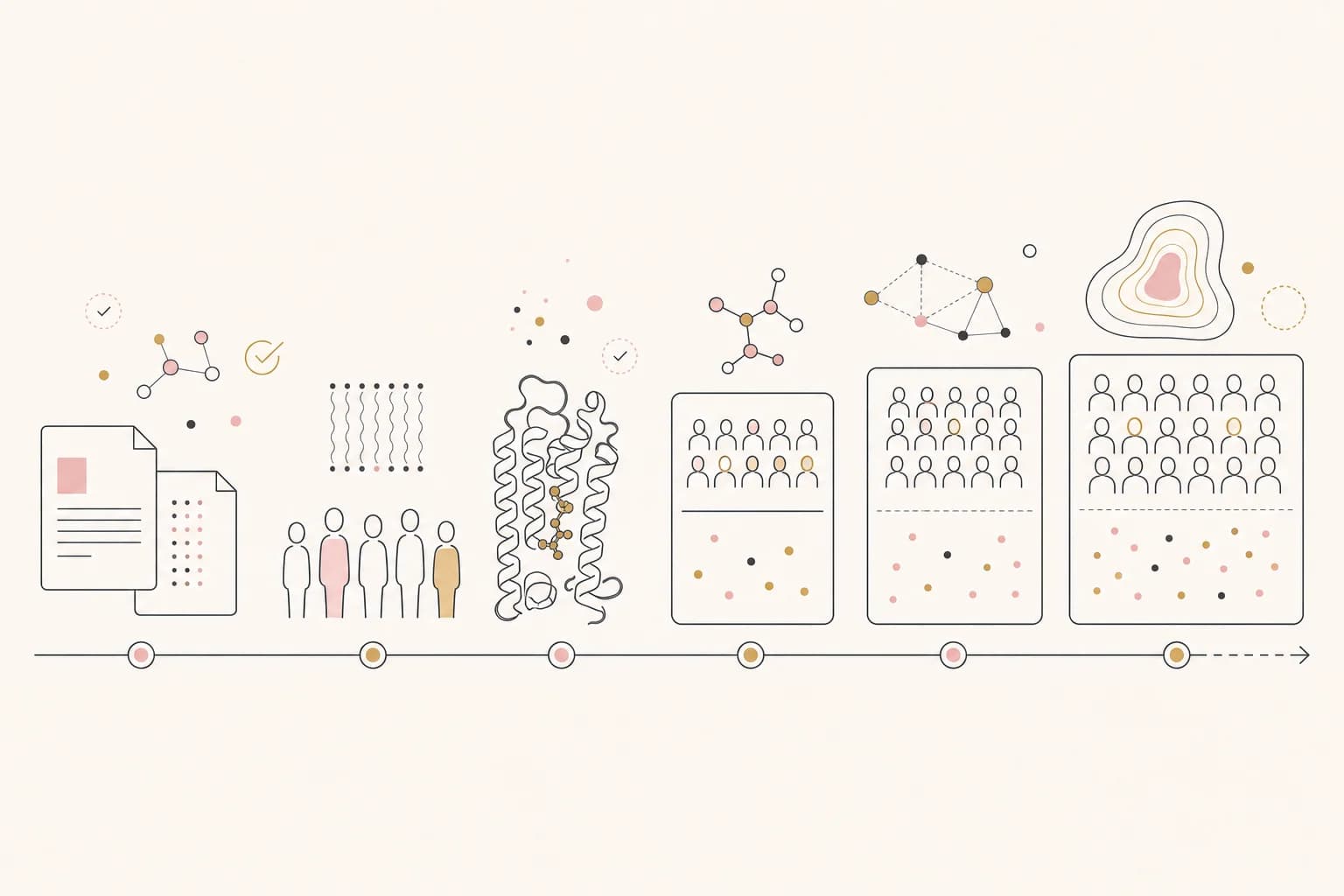
For readers in the Philippines, the key question is simple: what do the published studies actually show? The timeline now spans early human signals, mechanistic work, and a Phase 3 diabetes trial.5 That makes the evidence easier to map, but it still needs careful reading.2 It is a story of research steps, not a single finished conclusion.
Why researchers are studying Retatrutide / Reta
Retatrutide is a triple hormone receptor agonist studied in clinical trials for metabolic conditions.1 Its published research spans papers, abstracts, and trial reports from several development stages.5 Reading those stages separately helps readers follow the development path.5
The published studies place retatrutide in a development timeline that includes Phase 2 studies and Phase 3 trials.5 That timeline matters because each stage answers a different question. Early work looks for signals. Later work tests those signals in larger and more structured trials.5 This is why the article should be read as a sequence of evidence, not a single headline result.5 Retatrutide is now far enough along to have several distinct research layers, but each layer still has its own limits.5
For readers looking for the exact topic in the catalog, the Retatrutide card below shows its live details. It is a catalog reference, not research evidence or a recommendation.
What retatrutide is, and why researchers are studying it
The trial record helps explain why researchers kept following retatrutide. In earlier phase 2 work, exploratory appetite analyses reported greater reductions in appetite and hunger with retatrutide.3 They also found lower prospective food consumption than with placebo.3 The same phase 2 appetite study also found greater reductions in perceived hunger.6 It also showed lower disinhibition in higher retatrutide groups.6
Those findings matter because they connect treatment response with day-to-day eating behavior.36 They do not settle the full clinical question, but they show why later studies needed clearer endpoints.36 A phase 2 body-composition substudy also evaluated total body fat mass by DXA in adults with type 2 diabetes.7 DXA is a body-scanning method used here to measure fat mass.7 It helps researchers describe body composition more precisely.7
Taken together, those early studies show how the research program moved from appetite signals to formal trial planning.367 That is the useful frame for general readers.

The Phase 3 milestone: what the diabetes trial actually tested
The Phase 3 diabetes study is the clearest milestone in the current record.5 In adults with type 2 diabetes, retatrutide was tested against placebo in a 40-week randomized study.2 The trial enrolled adults whose diabetes remained inadequately controlled with diet and exercise alone.8
The primary endpoint was change in HbA1c.9 The study also tracked body-weight change as a key secondary endpoint.10 Those choices show the trial’s main focus: glucose control first, weight change alongside it.910 That structure shows what the researchers wanted to measure.2910 It also shows why the study belonged in Phase 3.2910
What the paper does not do is turn one 40-week result into a lifetime answer.2 It tells us how the comparison was built and what outcomes it was designed to test. It does not, by itself, resolve every later question about durability, sequencing, or broader clinical use.2 In a fast-moving field, that distinction matters. A completed Phase 3 design is important evidence, but it remains one piece of a longer research path.2
For readers comparing nearby catalog topics, the Tirzepatide card below opens its live catalog details. It is a separate reference, not proof of compatibility or a recommendation.
What earlier Phase 2 studies found before Phase 3
Before Phase 3, the published Phase 2 record helped define what to watch next.5 In adults with type 2 diabetes, retatrutide was linked with greater reductions in appetite, hunger, and prospective food consumption than placebo in exploratory analyses.3 The appetite study also found greater reductions in perceived hunger and disinhibition.6
A phase 2 body-composition substudy measured total body fat mass with DXA.7 It included adults with type 2 diabetes.7 That is useful because body composition can change differently from scale weight alone.7 The substudy adds body-composition detail to the timeline.7 It shows the research team was looking beyond one number on a scale.7
The phase 2 timeline also includes studies that focus on different questions than the main diabetes trial.5 The published record is broader than one appetite report or one body-composition analysis.5 That breadth is part of the later testing timeline.5 It also explains why the evidence should be read stage by stage.5 Each result has its own design and population.5
What the mechanistic and liver studies add to the timeline
Some of the most interesting papers in the timeline ask narrower mechanistic questions. A phase 2 post-hoc analysis found that reductions in ANGPTL3/8 tracked with lower triglycerides and LDL-C during retatrutide treatment.11 That is a mechanistic association, not proof of a clinical outcome on its own.11 It helps explain how researchers are thinking about the drug, but it does not stand in for a clinical endpoint.11
The liver-fat study adds a different kind of evidence. A phase 2a trial found large reductions in liver fat with retatrutide.4 The participants had metabolic dysfunction-associated steatotic liver disease.4 That result is meaningful because it comes from a defined human study population, not a laboratory-only setting.4 Still, it belongs to the phase 2a record, so readers should keep it in that context.4
The phase 2b CKD study design paper adds still another layer.12 It is designed to assess kidney-function change using measured glomerular filtration rate over 24 weeks.12
What the timeline still does not answer
The published record now covers several linked questions.5 It still leaves important boundaries intact.5 The Phase 3 diabetes trial was randomized and placebo-controlled in adults with type 2 diabetes.2 Its core endpoints were HbA1c and body-weight change.910 That is strong evidence about the study design, but it is not the same as a full long-term clinical picture.2
The ANGPTL3/8 analysis is a post-hoc association.11 It should not be read as proof of clinical benefit by itself.11 The liver-fat result is encouraging within its own study frame.4 It comes from a phase 2a substudy in people with metabolic dysfunction-associated steatotic liver disease.4 The kidney paper is even narrower because it describes a planned assessment rather than a completed efficacy result.12
For readers, the safe takeaway is that the evidence is broadening, not finalizing.5241112 The studies show how retatrutide has been examined in different settings.5 They do not merge into one universal conclusion.5
Questions the evidence leaves open
The timeline is now detailed enough to see the research shape, but not detailed enough to collapse every result together.5 Early phase 2 signals looked at appetite and eating behavior.36 The Phase 3 diabetes trial asked a more formal question about HbA1c and body weight.2910 The liver and biomarker studies explored separate biological pathways.411
For readers in the Philippines, the useful approach is to keep those study designs separate. It keeps the evidence from sounding more complete than it is.5 It also makes clear why the same drug can appear in studies with very different designs.5 The evidence remains interesting, but it is still limited.5 It is a sequence of published questions, each with a narrower answer than the one before it.23411
The timeline is organized around questions that each study stage was designed to answer.5 Retatrutide has moved through several study stages.5 Those stages now give readers a structured view of what has been tested and measured.5
Bottom line
Retatrutide’s published timeline now stretches from early appetite findings to Phase 3 diabetes testing.523 It also includes body-composition, liver-fat, biomarker, and kidney-study work.741112 That makes the evidence richer, but not finished.523741112 The safest way to read it is study by study, with each result tied to its own population and endpoint.2412 For general readers, the picture is informative and still incomplete, which is exactly why the timeline matters.5 It helps separate what researchers have measured from what they still need to show.211
It also shows how a drug can move forward through several research stages without every question being answered at once.512
This article is educational research context, not medical advice. Catalog links are neutral references and do not imply a treatment or human-use recommendation.
Frequently asked questions
What is retatrutide in plain language?
Retatrutide is a triple hormone receptor agonist being studied in clinical trials for metabolic conditions.1 Its published program includes several study stages, from Phase 2 research to a Phase 3 trial.5 Reading it stage by stage keeps each result tied to the question that study was designed to answer.5
What did the Phase 3 diabetes trial measure?
The Phase 3 diabetes trial tested retatrutide against placebo in a 40-week randomized study in adults with type 2 diabetes.2 The enrolled adults had diabetes that remained inadequately controlled with diet and exercise alone.8 The primary endpoint was HbA1c change, and body-weight change was tracked as a key secondary endpoint.910
What did earlier Phase 2 studies add?
Earlier Phase 2 work added appetite and body-composition detail before the later trial stage.367 Exploratory analyses reported changes in appetite, hunger, and eating behavior.36 A separate substudy measured total body fat mass by DXA, adding a more precise view than scale weight alone.7
What did the liver-fat study show?
That is a study-specific finding, so it should stay tied to that population and trial design.4 It adds an important piece to the timeline, but it does not replace the larger diabetes trial record.24
How should Filipino readers interpret this research?
Filipino readers should treat the timeline as evidence from different study types, not one blended conclusion.5 Human trial findings, mechanistic analyses, and study-design papers each answer different questions.21112 The careful reading rule is to keep every result attached to its own population, endpoint, and stage of research.52
What is still being studied?
The phase 2b CKD study is designed to assess kidney-function change using measured glomerular filtration rate over 24 weeks.12 Kidney outcomes remain part of the research program.12 The published record here is a design and baseline paper, not a completed efficacy report.12 The broader timeline still has open questions about how later results will fit together.512
Sources
Footnotes
-
Efficacy and safety of retatrutide, a GIP, GLP-1, and glucagon receptor agonist, in people with type 2 diabetes and inadequate glycaemic control with diet and exercise (TRANSCEND-T2D-1): a double-blind, randomised, phase 3 trial.; Rationale, design and baseline characteristics of the TRANSCEND-CKD trial of retatrutide in patients with chronic kidney disease.; Appetite, eating attitudes, and eating behaviours during treatment with retatrutide in adults with type 2 diabetes: Results of a phase 2 study.; Effects of retatrutide on body composition in people with type 2 diabetes: a substudy of a phase 2, double-blind, parallel-group, placebo-controlled, randomised trial.; Decreases in circulating ANGPTL3/8 concentrations following retatrutide treatment parallel reductions in serum lipids.; Triple hormone receptor agonist retatrutide for metabolic dysfunction-associated steatotic liver disease: a randomized phase 2a trial.. Human clinical trial and trial-substudy reports ↩ ↩2 ↩3
-
Efficacy and safety of retatrutide, a GIP, GLP-1, and glucagon receptor agonist, in people with type 2 diabetes and inadequate glycaemic control with diet and exercise (TRANSCEND-T2D-1): a double-blind, randomised, phase 3 trial.. TRANSCEND-T2D-1 phase 3 trial ↩ ↩2 ↩3 ↩4 ↩5 ↩6 ↩7 ↩8 ↩9 ↩10 ↩11 ↩12 ↩13 ↩14 ↩15 ↩16 ↩17 ↩18 ↩19 ↩20 ↩21
-
Appetite, eating attitudes, and eating behaviours during treatment with retatrutide in adults with type 2 diabetes: Results of a phase 2 study.. Exploratory appetite and eating-behavior analyses from a phase 2 study ↩ ↩2 ↩3 ↩4 ↩5 ↩6 ↩7 ↩8 ↩9 ↩10 ↩11 ↩12 ↩13
-
Triple hormone receptor agonist retatrutide for metabolic dysfunction-associated steatotic liver disease: a randomized phase 2a trial.. Randomized phase 2a substudy in participants with MASLD ↩ ↩2 ↩3 ↩4 ↩5 ↩6 ↩7 ↩8 ↩9 ↩10 ↩11 ↩12 ↩13 ↩14 ↩15
-
Efficacy and safety of retatrutide, a GIP, GLP-1, and glucagon receptor agonist, in people with type 2 diabetes and inadequate glycaemic control with diet and exercise (TRANSCEND-T2D-1): a double-blind, randomised, phase 3 trial.; Rationale, design and baseline characteristics of the TRANSCEND-CKD trial of retatrutide in patients with chronic kidney disease.; Appetite, eating attitudes, and eating behaviours during treatment with retatrutide in adults with type 2 diabetes: Results of a phase 2 study.; Effects of retatrutide on body composition in people with type 2 diabetes: a substudy of a phase 2, double-blind, parallel-group, placebo-controlled, randomised trial.; Decreases in circulating ANGPTL3/8 concentrations following retatrutide treatment parallel reductions in serum lipids.; Triple hormone receptor agonist retatrutide for metabolic dysfunction-associated steatotic liver disease: a randomized phase 2a trial.. Clinical trial publications and substudy reports ↩ ↩2 ↩3 ↩4 ↩5 ↩6 ↩7 ↩8 ↩9 ↩10 ↩11 ↩12 ↩13 ↩14 ↩15 ↩16 ↩17 ↩18 ↩19 ↩20 ↩21 ↩22 ↩23 ↩24 ↩25 ↩26 ↩27 ↩28 ↩29 ↩30 ↩31 ↩32 ↩33 ↩34 ↩35
-
Appetite, eating attitudes, and eating behaviours during treatment with retatrutide in adults with type 2 diabetes: Results of a phase 2 study.. Exploratory appetite and eating-behavior analyses from a phase 2 study ↩ ↩2 ↩3 ↩4 ↩5 ↩6 ↩7 ↩8 ↩9
-
Effects of retatrutide on body composition in people with type 2 diabetes: a substudy of a phase 2, double-blind, parallel-group, placebo-controlled, randomised trial.. Phase 2 body-composition substudy ↩ ↩2 ↩3 ↩4 ↩5 ↩6 ↩7 ↩8 ↩9 ↩10 ↩11 ↩12 ↩13
-
Efficacy and safety of retatrutide, a GIP, GLP-1, and glucagon receptor agonist, in people with type 2 diabetes and inadequate glycaemic control with diet and exercise (TRANSCEND-T2D-1): a double-blind, randomised, phase 3 trial.. TRANSCEND-T2D-1 inclusion criteria ↩ ↩2
-
Efficacy and safety of retatrutide, a GIP, GLP-1, and glucagon receptor agonist, in people with type 2 diabetes and inadequate glycaemic control with diet and exercise (TRANSCEND-T2D-1): a double-blind, randomised, phase 3 trial.. TRANSCEND-T2D-1 trial design ↩ ↩2 ↩3 ↩4 ↩5 ↩6 ↩7
-
Efficacy and safety of retatrutide, a GIP, GLP-1, and glucagon receptor agonist, in people with type 2 diabetes and inadequate glycaemic control with diet and exercise (TRANSCEND-T2D-1): a double-blind, randomised, phase 3 trial.. TRANSCEND-T2D-1 trial design ↩ ↩2 ↩3 ↩4 ↩5 ↩6 ↩7
-
Decreases in circulating ANGPTL3/8 concentrations following retatrutide treatment parallel reductions in serum lipids.. Post-hoc analysis of two phase 2 trials plus in-vitro hepatocyte work This is a mechanistic association, not proof of a clinical outcome on its own. ↩ ↩2 ↩3 ↩4 ↩5 ↩6 ↩7 ↩8 ↩9 ↩10 ↩11 ↩12
-
Rationale, design and baseline characteristics of the TRANSCEND-CKD trial of retatrutide in patients with chronic kidney disease.. TRANSCEND-CKD design and baseline report The published records is a study design and baseline paper, not a completed efficacy report. ↩ ↩2 ↩3 ↩4 ↩5 ↩6 ↩7 ↩8 ↩9 ↩10 ↩11 ↩12 ↩13