Quick answer
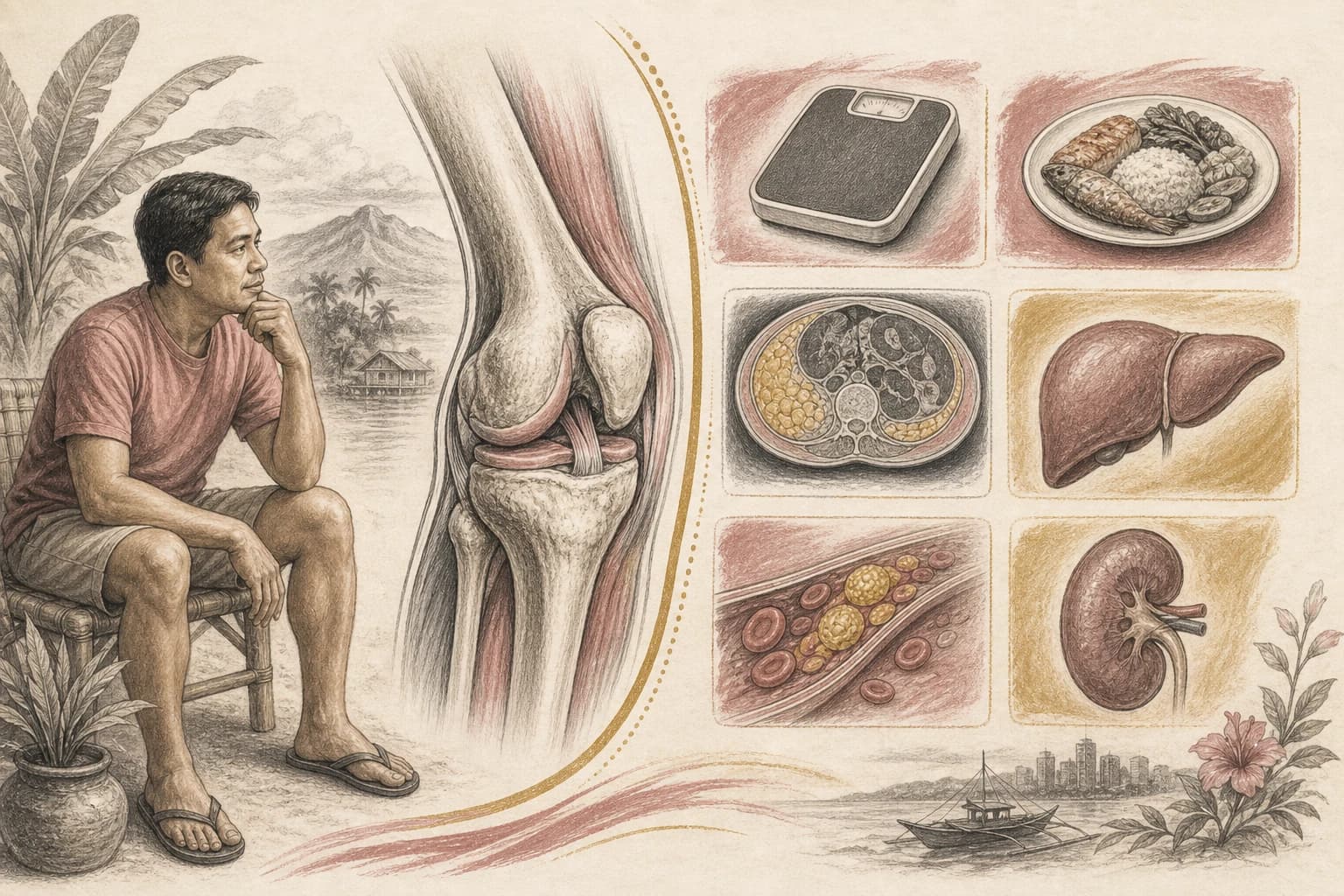
Published retatrutide research does not yet prove that the compound improves knee osteoarthritis or repairs joint tissue. The studies in this research reviewed here measured diabetes control, body weight, appetite, fat mass, blood lipids, liver fat, and kidney-related outcomes. Those findings explain why researchers may ask future mobility questions, especially when body weight affects knee loading. They are not substitutes for trials that directly measure pain, function, imaging, or joint replacement. The endpoint matters as much as the molecule.123
Why are retatrutide and knee pain mentioned together?
Knee osteoarthritis and higher body weight often appear in the same health conversation. More body mass can increase the load placed through the joint during walking and climbing.
That connection makes metabolic weight-loss research interesting to arthritis researchers. It does not establish a direct effect on cartilage, inflammation, pain, or mobility.
Retatrutide is a triple receptor agonist studied mainly in obesity, type 2 diabetes, and related metabolic complications.2 “Triple” refers to activity at GIP, GLP-1, and glucagon receptors.
None of those words is a knee outcome. A biological pathway can generate a useful research question, but the answer still requires a suitable trial.
An article should therefore distinguish indirect interest from direct evidence. Lower weight might change joint loading; it does not automatically mean a compound healed the knee.
Readers researching Retatrutide can view its live catalog details below. The listing identifies the catalog item and is separate from the evidence discussed here.
What did retatrutide trials actually measure?
The published program includes outcomes for body weight, blood-sugar control, appetite, body composition, lipids, liver fat, and kidney-related questions.1
One phase 3 trial enrolled adults with type 2 diabetes whose blood sugar remained inadequately controlled with diet and exercise alone.3 That population and purpose should remain visible when the result is discussed.
A phase 2 analysis asked participants about hunger, appetite, and overeating-related behavior. Higher retatrutide exposure was linked with lower self-reported hunger measures than placebo.4
These were patient-reported eating measures. They were not knee-pain scores, walking tests, cartilage scans, or assessments of joint structure.4
A body-composition substudy found a greater reduction in total fat mass than placebo and dulaglutide among adults with type 2 diabetes.5
Again, a fat-mass endpoint is not an osteoarthritis endpoint. It may help explain why the research is discussed, but it cannot carry a claim about the knee.
What would a convincing knee study need?
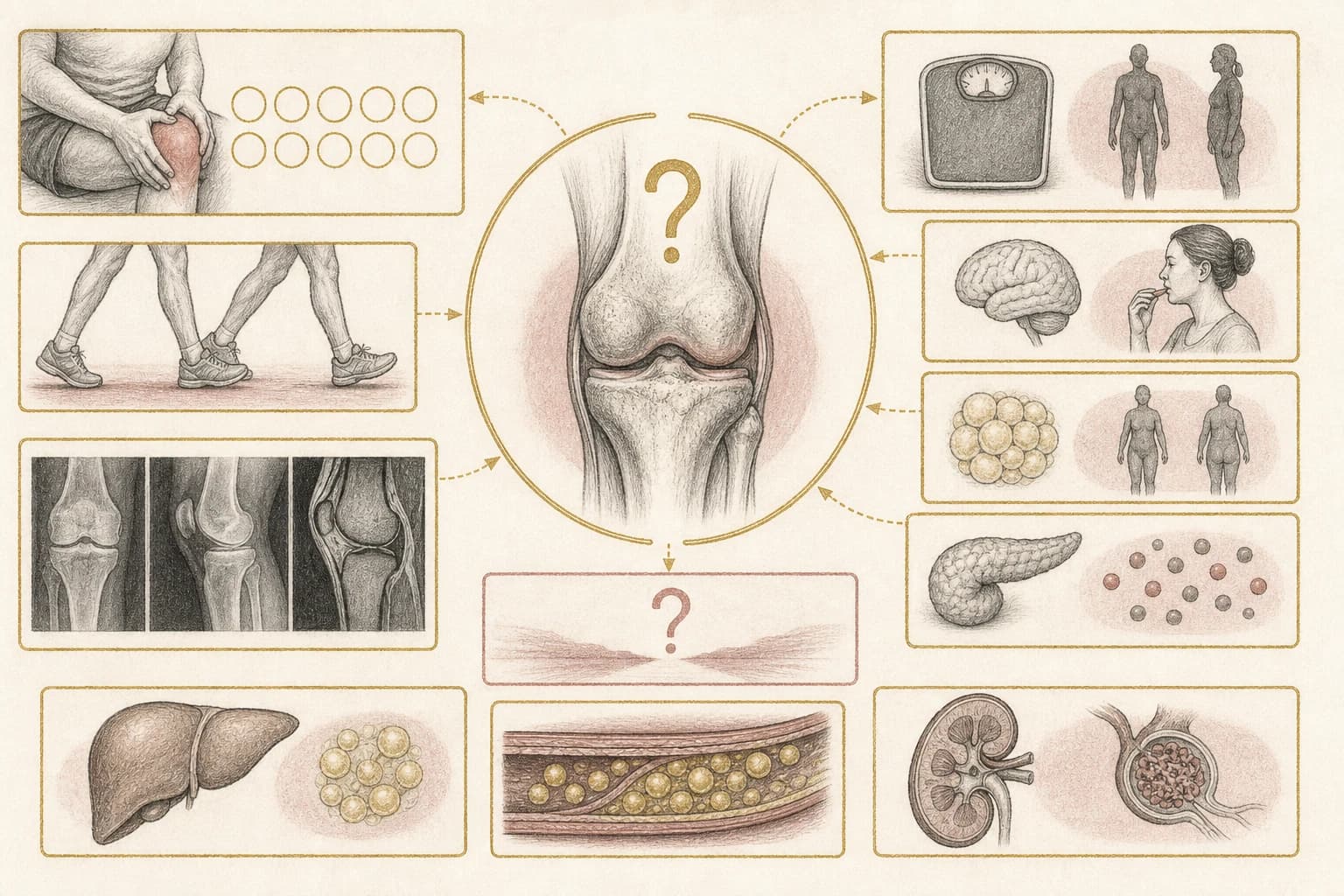
A useful osteoarthritis trial would define the knee condition, participant group, comparison, and follow-up before enrollment begins.
Pain should be measured with a validated scale at specified times. Function could include walking, stair use, or a standardized disability questionnaire in practice.
Imaging might assess joint structure, but a scan and a symptom do not always move together. Both can matter without being interchangeable.
Researchers would also need to separate effects linked with weight change from any proposed weight-independent pathway. That usually requires planned analyses and enough participants.
Adverse events and treatment discontinuation belong beside the benefit measures. A trial cannot be judged from the most appealing endpoint alone.
Finally, the duration must fit the claim. A short study may detect pain change, while structural joint claims often require longer observation.
Can weight loss still matter for the knee?
It can be clinically relevant, but this article’s retatrutide sources do not directly test that question. The responsible wording is that metabolic results create a reason for further study.
The distinction protects readers from a common marketing shortcut: outcome A influences a risk factor, so the product must improve outcome B. Human biology is rarely that automatic.
Pain can change with activity, sleep, injury history, mood, strength, and other conditions. Weight is one part of a larger clinical picture.
Likewise, a person can lose weight without a matching change in knee symptoms. Another person may improve function through rehabilitation despite little scale movement.
Readers comparing this topic with Tirzepatide can view its live catalog details below. It is a separate catalog reference, not a suggested combination.
Which online claims go too far?
“Retatrutide repairs cartilage” goes too far because the cited studies did not measure cartilage repair.
“Retatrutide improves arthritis pain” also exceeds these records. Hunger surveys and body-composition scans cannot stand in for a pain trial.
“Less body fat proves healthier joints” is too broad. A metabolic measurement and a joint outcome remain different endpoints.5
Even “research shows it helps the knee” is misleading when the research set is not knee-focused. The wording hides the exact population and measurement.
A more accurate sentence is simple: retatrutide has shown metabolic effects that may motivate osteoarthritis research, but direct knee benefits require direct testing.
What should Filipino readers check locally?
The Philippine FDA Verification Portal lists establishments separately from registered or notified health products.6 A licensed seller record does not automatically verify every item it offers.
Search for the exact product and compare its name, manufacturer, dosage form, and authorization details. A similar label is not the same record.
WHO warns that falsified medical products can closely resemble genuine ones and may require laboratory analysis.7 Visual inspection cannot confirm identity or quality.
This matters especially when a compound is discussed online before readers understand its regulatory status. Popularity and study activity do not create a Philippine authorization.
Research claims also apply to the material and protocol used in the study. An unidentified item cannot borrow certainty from an official paper.
How can a reader audit an osteoarthritis headline?
Start by finding the endpoint. Was the study about pain, function, imaging, weight, or a laboratory marker?
Next, identify the participants. Adults with type 2 diabetes in a metabolic trial are not automatically an osteoarthritis treatment population.3
Check the comparator and follow-up. A change from baseline is not the same as a difference from placebo or an active treatment.
Read the limitation beside the result. If the outcome was exploratory or self-reported, the article should say so.4
Finally, keep the conclusion attached to the exact source and product identity.8 That one habit prevents most evidence drift.
Bottom line
Retatrutide is being studied across metabolic conditions, and its program includes weight, appetite, body-composition, lipid, liver, and kidney outcomes. Those findings help explain interest in conditions where body weight may matter. They do not prove that retatrutide relieves knee pain, restores cartilage, or improves osteoarthritis.
A convincing answer needs trials with direct joint endpoints, suitable participants, adequate follow-up, and transparent safety reporting. Filipino readers should also verify current local product records separately. The honest headline today is not “retatrutide fixes knees”; it is “metabolic findings have created a question that joint research still has to answer.”
Frequently asked questions
Has retatrutide been established for treating knee osteoarthritis?
Not by the studies in this research reviewed here. They focused on metabolic outcomes.1
Did researchers measure knee pain or cartilage repair?
No. The cited appetite and body-composition analyses measured different endpoints.45
Why might weight change interest knee researchers?
Body weight can affect joint loading, which creates a plausible research question. It is not direct proof.
Does a lower hunger score show less knee pain?
No. Those are separate patient-reported outcomes.
Does a product card mean the compound is recommended for arthritis?
No. The cards are neutral catalog references, not treatment or combination advice.
Sources
Footnotes
-
Efficacy and safety of retatrutide, a GIP, GLP-1, and glucagon receptor agonist, in people with type 2 diabetes and inadequate glycaemic control with diet and exercise (TRANSCEND-T2D-1): a double-blind, randomised, phase 3 trial.; Rationale, design and baseline characteristics of the TRANSCEND-CKD trial of retatrutide in patients with chronic kidney disease.; Appetite, eating attitudes, and eating behaviours during treatment with retatrutide in adults with type 2 diabetes: Results of a phase 2 study.; Effects of retatrutide on body composition in people with type 2 diabetes: a substudy of a phase 2, double-blind, parallel-group, placebo-controlled, randomised trial.; Decreases in circulating ANGPTL3/8 concentrations following retatrutide treatment parallel reductions in serum lipids.; Triple hormone receptor agonist retatrutide for metabolic dysfunction-associated steatotic liver disease: a randomized phase 2a trial.. Multiple human trials and mechanistic substudies These are measured endpoints across studies, not a single unified outcome. ↩ ↩2 ↩3
-
Efficacy and safety of retatrutide, a GIP, GLP-1, and glucagon receptor agonist, in people with type 2 diabetes and inadequate glycaemic control with diet and exercise (TRANSCEND-T2D-1): a double-blind, randomised, phase 3 trial.; Rationale, design and baseline characteristics of the TRANSCEND-CKD trial of retatrutide in patients with chronic kidney disease.; Appetite, eating attitudes, and eating behaviours during treatment with retatrutide in adults with type 2 diabetes: Results of a phase 2 study.; Effects of retatrutide on body composition in people with type 2 diabetes: a substudy of a phase 2, double-blind, parallel-group, placebo-controlled, randomised trial.; Decreases in circulating ANGPTL3/8 concentrations following retatrutide treatment parallel reductions in serum lipids.; Triple hormone receptor agonist retatrutide for metabolic dysfunction-associated steatotic liver disease: a randomized phase 2a trial.. Human clinical trials and trial-related papers This is a research-context statement, not a claim about clinical benefit for knee osteoarthritis. ↩ ↩2
-
Efficacy and safety of retatrutide, a GIP, GLP-1, and glucagon receptor agonist, in people with type 2 diabetes and inadequate glycaemic control with diet and exercise (TRANSCEND-T2D-1): a double-blind, randomised, phase 3 trial.. Phase 3 randomised controlled trial This trial was not designed around knee osteoarthritis. ↩ ↩2 ↩3
-
Appetite, eating attitudes, and eating behaviours during treatment with retatrutide in adults with type 2 diabetes: Results of a phase 2 study.. Pre-specified exploratory analyses from a phase 2 trial These were patient-reported measures, not joint imaging or pain outcomes. ↩ ↩2 ↩3 ↩4
-
Effects of retatrutide on body composition in people with type 2 diabetes: a substudy of a phase 2, double-blind, parallel-group, placebo-controlled, randomised trial.. Phase 2 body-composition substudy This was a body-composition endpoint, not an osteoarthritis endpoint. ↩ ↩2 ↩3
-
Philippine FDA Verification Portal; FDA Advisory No. 2023-2238: Utilization of the FDA Verification Portal. Official Philippine regulatory verification service. A portal record applies to the exact product or establishment named in that record. ↩
-
WHO laboratory analysis of suspected falsified medical products; WHO laboratory testing for health-product regulation. WHO guidance on suspected falsified medical products and regulatory laboratory testing. Appearance alone cannot authenticate a product or establish a research outcome. ↩
-
Efficacy and safety of retatrutide, a GIP, GLP-1, and glucagon receptor agonist, in people with type 2 diabetes and inadequate glycaemic control with diet and exercise (TRANSCEND-T2D-1): a double-blind, randomised, phase 3 trial.; Rationale, design and baseline characteristics of the TRANSCEND-CKD trial of retatrutide in patients with chronic kidney disease.; Appetite, eating attitudes, and eating behaviours during treatment with retatrutide in adults with type 2 diabetes: Results of a phase 2 study.; Effects of retatrutide on body composition in people with type 2 diabetes: a substudy of a phase 2, double-blind, parallel-group, placebo-controlled, randomised trial.; Decreases in circulating ANGPTL3/8 concentrations following retatrutide treatment parallel reductions in serum lipids.; Triple hormone receptor agonist retatrutide for metabolic dysfunction-associated steatotic liver disease: a randomized phase 2a trial.; Philippine FDA Verification Portal; FDA Advisory No. 2023-2238: Utilization of the FDA Verification Portal. Editorial synthesis of the canonical research records and Philippine verification sources. This synthesis is educational and is not personal medical advice or a product recommendation. ↩