
TL;DR
- The official FDA record covers Rybelsus, an oral semaglutide product, and records its original US approval on September 20, 2019; the record does not establish catalog-item equivalence.1
- An indirect analysis of two separate obesity trials found broadly comparable weight outcomes for daily oral semaglutide 25 mg and weekly under-the-skin semaglutide 2.4 mg.2
- “Comparable” is not the same as proven interchangeable: participants were not randomly assigned between the two forms in one shared trial.3
- Oral semaglutide also has cardiovascular-outcome evidence in a defined high-risk diabetes population, showing that route questions extend beyond convenience or weight alone.4
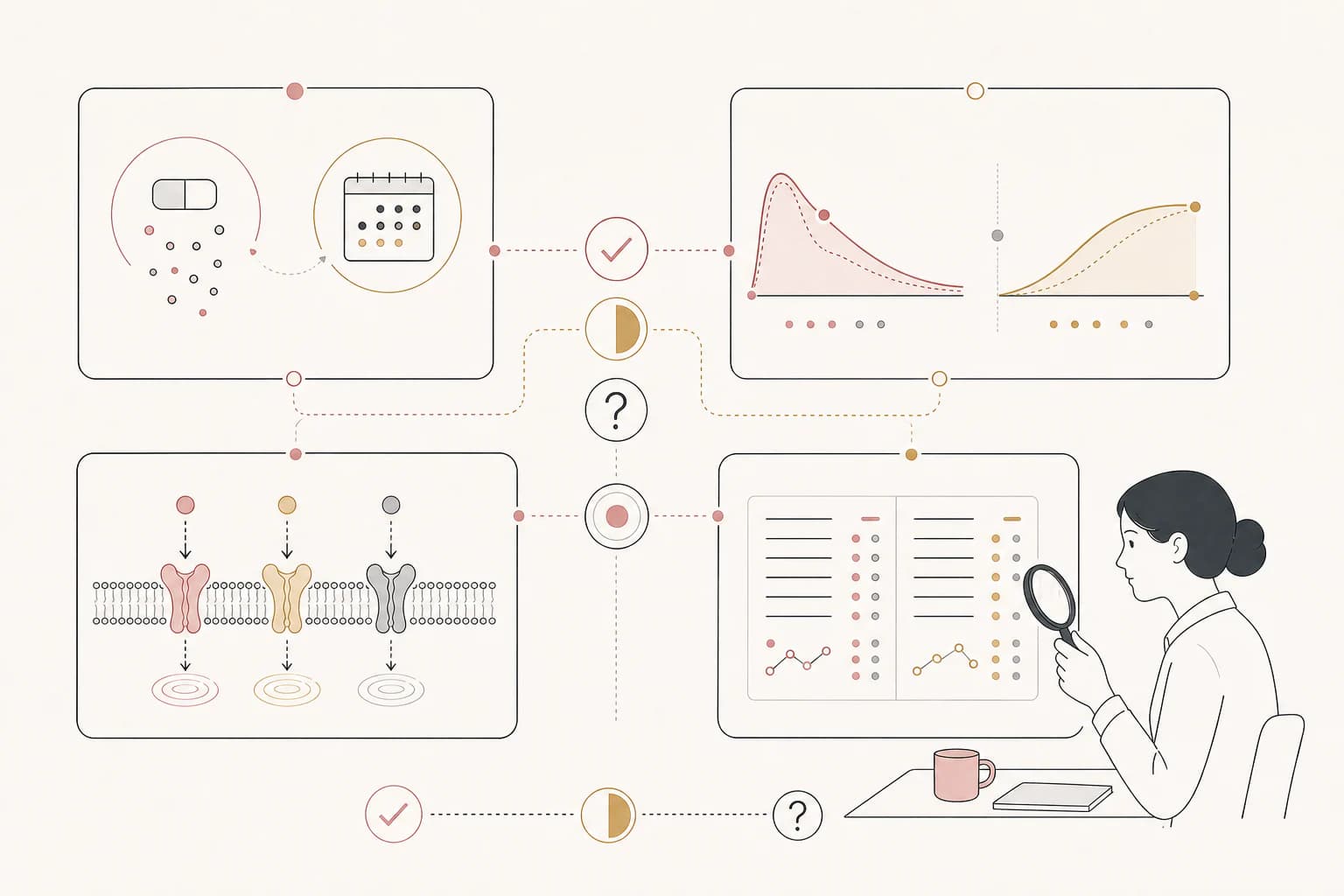
For Filipino readers, “tablet or weekly form?” sounds like a simple fork in the road. The research makes it a more interesting question. The molecule may be the same, but the products, schedules, study populations, and evidence histories are not.5 A fair comparison keeps those layers separate—and resists turning an indirect result into a claim that every outcome is identical.
One molecule does not mean one research question
Semaglutide appears in an oral product record and in studies of a weekly under-the-skin form.15 The selected papers ask separate questions about weight, cardiovascular events, kidney measures, and side effects.2467
That separation is the anchor. The weight paper aligned results from OASIS 4 and STEP 1.3 It did not randomly assign people between the two forms in one protocol.3 The active molecule stayed constant, while products and study questions changed.5
That difference changes how each result should be read. The FDA record names one oral product.1 The weight paper aligns two trial programs.23 SOUL follows a high-risk diabetes population.4 Those layers should not collapse into one claim.
For readers looking for the exact topic, the Semaglutide card below shows its live catalog details. It is a catalog reference, not research evidence or a recommendation.
What the official oral record establishes
The FDA record supplied for this topic lists Rybelsus under application NDA 213051 and records the original US approval date as September 20, 2019.1 That is a product-specific regulatory fact for the named oral medicine.1 It does not establish approval, quality, or equivalence for any catalog item.1
That narrowness is useful. The FDA record names one product and application.1 SOUL, by contrast, reports an outcome in enrolled participants.4 Combining those source types would blur the question each one answers.
This also prevents brand and molecule names from becoming shortcuts. Both compared forms contained semaglutide.5 Their product and trial contexts still determine what each source supports.12
What the indirect weight comparison found
A 2026 analysis compared two placebo-controlled obesity trials: OASIS 4 for daily oral semaglutide 25 mg and STEP 1 for weekly under-the-skin semaglutide 2.4 mg.2 Both trials enrolled adults with obesity, or overweight plus at least one related complication, and included similar lifestyle programs.2
The analysis found broadly comparable percentage weight change and weight-response thresholds.2 Some endpoints numerically favored one form or the other.2 The authors interpreted the overall weight pattern as comparable efficacy.2
Still, nobody in that paper was randomly assigned between the oral and weekly forms within one shared protocol.3 The analysis used results from two different trials and a naïve Bucher method, so unmeasured differences between the trial populations could remain.3 It supports a careful comparison, not a blanket interchangeability claim.
Oral cardiovascular evidence asks a different question
The SOUL analysis followed 9,650 adults aged 50 or older with type 2 diabetes plus atherosclerotic cardiovascular disease, chronic kidney disease, or both.4 Participants were randomized to oral semaglutide or placebo across 444 international sites and were followed for a median of 47.5 months.4 Oral semaglutide reduced the risk of the three-part major cardiovascular endpoint by 14% in the parent trial.4
A later analysis found that the cardiovascular association appeared stronger among participants with higher starting HbA1c and larger HbA1c reductions.8 The pattern was consistent across starting BMI categories and changes in BMI.8 Because this was a post hoc analysis, those subgroup patterns are exploratory rather than a new randomized test of why the benefit occurred.8
A review notes that PIONEER 6 met cardiovascular non-inferiority criteria.9 It also reports SOUL’s superior cardiovascular result for oral semaglutide.4 A major kidney outcome was not significantly reduced in SOUL.10 These findings need to be read one endpoint at a time.
For readers comparing nearby catalog topics, the Tirzepatide card below opens its live catalog details. It is a separate reference, not proof of compatibility or a recommendation.
Why separate clinic records cannot be spliced together
A retrospective hospital study in Pakistan followed 102 adults with type 2 diabetes receiving weekly semaglutide.6 It recorded nausea in 26 participants, or 25.5%, over follow-up lasting up to 12 months.6 Because there was no oral-semaglutide group, the study cannot compare tolerability between forms.6
Another retrospective study followed 36 Japanese adults who moved from liraglutide or dulaglutide to oral semaglutide. It associated the switch with lower albuminuria and slower kidney-function decline over three years.7 This was not a comparison between oral and weekly semaglutide.7 Its small observational design also leaves room for confounding.7
Putting the two clinic records side by side can suggest questions. Treating them as one direct comparison would erase their different designs.67
Experimental delivery platforms belong in the laboratory column
One record tested a semaglutide oral thin-film platform in 40 female Göttingen minipigs. The experiment lasted eight weeks, followed by one week of observation.11 Researchers compared a sublingual film, oral tablet, under-the-skin form, and placebo.11
That work explores a different oral surface in an animal model.11 Its short preclinical design cannot establish human effectiveness, safety, or product equivalence.11 The source belongs in the formulation-research column, not inside a human route comparison.
This boundary matters because an experimental platform and a studied human product answer different questions.
What can this record say? Only what happened inside one short minipig experiment.11
What changes—and what does not
The molecule remains semaglutide across the named oral and weekly-form records.5 The products and research programs are still distinct.12 Each outcome belongs to its named population and protocol.24
The weight comparison suggests broadly similar group outcomes at the studied amounts, but it is indirect.23 SOUL’s oral-product evidence comes from high-risk adults with type 2 diabetes.4 It was not a route-comparison trial.4 Weekly-form evidence in the selected meta-analysis came from four SUSTAIN trials against basal insulin or other GLP-1 medicines.12
That meta-analysis included 3,680 participants.12 Several findings had low certainty because of heterogeneity, open-label designs, and manufacturer sponsorship.12 Route is only one part of the comparison. Design and comparator matter just as much.
Reading the comparison from the Philippines
For Filipino readers, the useful task is analytical. Check the named product, form, schedule, population, endpoint, and comparison design. The FDA record concerns Rybelsus in the United States.1 SOUL and the indirect weight paper answer different clinical questions.24
When a headline says the forms are “the same,” ask whether it means molecule or outcome. Both forms contained semaglutide.5 Comparable weight results came from separate trials aligned after the fact.23
That vocabulary turns a vague product comparison into an evidence question. It also keeps a US regulatory record, an international cardiovascular trial, Asian clinic cohorts, and an animal formulation study in their proper lanes.146711
Bottom line
Oral and weekly under-the-skin forms contain the same semaglutide molecule.5 They do not share one undifferentiated research history. An indirect obesity analysis found broadly comparable weight outcomes, yet it did not directly assign people between forms.23 Oral semaglutide has cardiovascular evidence in a defined high-risk diabetes population.4 Separate clinic records and weekly-form trials answer other questions.6712 For Filipino readers, the clearest comparison names the product, schedule, population, endpoint, and design. That discipline keeps a useful comparison from becoming an oversized conclusion. Same molecule is an identity statement; same result requires its own evidence.5
Frequently asked questions
Are the oral and weekly forms the same medicine?
Both compared forms contained semaglutide.5 The official record applies specifically to Rybelsus.1 The weight analysis compared oral and weekly forms studied in separate trials.23 Shared identity does not establish blanket interchangeability across all purposes and outcomes.5
Did one head-to-head trial prove equal weight outcomes?
No. The comparison aligned OASIS 4 and STEP 1, two separate placebo-controlled trials.2 It found broadly comparable outcomes, but participants were not randomly assigned between oral and weekly semaglutide in one protocol.3 Unmeasured differences between trials may remain even when known baseline factors look similar.3
Does oral semaglutide have cardiovascular-outcome data?
Yes. SOUL included 9,650 high-risk adults with type 2 diabetes. It found a 14% reduction in its three-part major cardiovascular endpoint with oral semaglutide.4 That result belongs to the enrolled population. It does not establish identical evidence for every semaglutide form.4
Can clinic nausea rates compare the two forms?
Not when the clinic study includes only one form. The Pakistan cohort recorded nausea in 25.5% of 102 adults receiving weekly semaglutide.6 It had no oral-semaglutide group. Its rate describes that hospital record and cannot become a route comparison.6
What does the minipig film study add?
It shows that researchers tested an oral thin-film platform in an animal model.11 The experiment involved 40 minipigs and lasted eight weeks.11 It remains preclinical, so it cannot establish human safety, effectiveness, or product equivalence.11
How should Filipino readers check route claims?
Identify the named product and whether the comparison was direct or indirect.13 Match population and endpoint to the claim. Weight, cardiovascular events, kidney measures, and side effects come from different records.24106 Keep each result separate.
This article is educational research context, not medical advice. Catalog links are neutral references and do not imply a treatment or human-use recommendation.
Sources
Footnotes
-
FDA Drugs@FDA record for OZEMPIC (ORAL SEMAGLUTIDE). Official FDA regulatory record for the named oral product. The record applies only to Rybelsus and does not establish approval, quality, or equivalence for a catalog item. ↩ ↩2 ↩3 ↩4 ↩5 ↩6 ↩7 ↩8 ↩9 ↩10 ↩11 ↩12 ↩13
-
Semaglutide 25 mg Oral Versus Semaglutide 2.4 mg Injectable: An Indirect Treatment Comparison of Weight Loss Outcomes.. Naïve Bucher comparison of the separate placebo-controlled OASIS 4 and STEP 1 trials in adults with obesity or overweight plus a related complication. Participants were not randomized between the two forms within one shared trial, so the result does not establish blanket interchangeability. ↩ ↩2 ↩3 ↩4 ↩5 ↩6 ↩7 ↩8 ↩9 ↩10 ↩11 ↩12 ↩13 ↩14 ↩15 ↩16 ↩17 ↩18
-
Semaglutide 25 mg Oral Versus Semaglutide 2.4 mg Injectable: An Indirect Treatment Comparison of Weight Loss Outcomes.. Indirect treatment comparison using OASIS 4 and STEP 1 data. Unmeasured differences between the trials can remain even when their designs and measured baseline characteristics appear similar. ↩ ↩2 ↩3 ↩4 ↩5 ↩6 ↩7 ↩8 ↩9 ↩10 ↩11 ↩12 ↩13
-
Oral Semaglutide and CV Benefits in the SOUL Trial: How Do Baseline or Changes in HbA1c or BMI Affect Clinical Outcomes?. SOUL randomized 9,650 adults aged 50 or older with type 2 diabetes and atherosclerotic cardiovascular disease, chronic kidney disease, or both, with median follow-up of 47.5 months. This population-specific outcome does not establish identical cardiovascular evidence for every semaglutide product or form. ↩ ↩2 ↩3 ↩4 ↩5 ↩6 ↩7 ↩8 ↩9 ↩10 ↩11 ↩12 ↩13 ↩14 ↩15 ↩16 ↩17
-
Semaglutide 25 mg Oral Versus Semaglutide 2.4 mg Injectable: An Indirect Treatment Comparison of Weight Loss Outcomes.. OASIS 4 studied oral semaglutide 25 mg and STEP 1 studied weekly under-the-skin semaglutide 2.4 mg. Shared molecular identity does not establish that the products or all outcomes are interchangeable. ↩ ↩2 ↩3 ↩4 ↩5 ↩6 ↩7 ↩8 ↩9 ↩10
-
The efficacyand safety of once weekly injectable semaglutide (Ozempic) among patients with Type 2 diabete sintertiary care hospital: A Retrospective Study.. Adults with type 2 diabetes followed in one tertiary-care hospital, with outcomes recorded for up to 12 months. The study had no oral-semaglutide comparison group, so it cannot answer which form was better tolerated. ↩ ↩2 ↩3 ↩4 ↩5 ↩6 ↩7 ↩8 ↩9 ↩10
-
Three-year changes in renal function after switching from injectable GLP-1 receptor agonists to oral semaglutide in Japanese patients with type 2 diabetes: a retrospective cohort study.. Retrospective cohort of adults with type 2 diabetes who switched from other GLP-1 receptor agonists to oral semaglutide. This was not a direct comparison between oral and weekly semaglutide, and the small observational design leaves room for confounding. ↩ ↩2 ↩3 ↩4 ↩5 ↩6 ↩7
-
Oral Semaglutide and CV Benefits in the SOUL Trial: How Do Baseline or Changes in HbA1c or BMI Affect Clinical Outcomes?. Exploratory analysis of baseline and in-trial HbA1c and BMI within the randomized SOUL population. The subgroup patterns were post hoc and do not independently prove why the cardiovascular outcome differed. ↩ ↩2 ↩3
-
Oral Glucagon-Like Peptide-1 Receptor Agonists for Preventing Cardiorenal Complications.. Review of randomized evidence for oral GLP-1 receptor agonists in people with type 2 diabetes at cardiovascular risk. Non-inferiority and superiority answer different statistical questions and should not be merged. ↩
-
Oral Glucagon-Like Peptide-1 Receptor Agonists for Preventing Cardiorenal Complications.. Review of SOUL cardiovascular and kidney findings. This endpoint-specific result should not be generalized to every kidney measure or semaglutide form. ↩ ↩2
-
Electrospun Nanofiber Oral Thin Film Platform for Sublingual Peptide Delivery: A Promising Alternative to Conventional Semaglutide Formulations.. Preclinical comparison of a sublingual film, oral tablet, under-the-skin form, and placebo. This animal study cannot establish human safety, effectiveness, product equivalence, or Philippine product status. ↩ ↩2 ↩3 ↩4 ↩5 ↩6 ↩7 ↩8 ↩9
-
Efficacy and Safety of Once-Weekly Semaglutide Versus Basal Insulin and Other GLP-1 Receptor Agonists in Adults With Type 2 Diabetes Uncontrolled on Oral Antidiabetic Drugs: A Systematic Review and Pairwise Meta-Analysis.. Pairwise comparisons with basal insulin or other GLP-1 receptor agonists in adults with type 2 diabetes uncontrolled on oral medicines. Several findings had low certainty because of heterogeneity, open-label designs, and manufacturer sponsorship; the analysis did not compare weekly semaglutide with oral semaglutide. ↩ ↩2 ↩3 ↩4