TL;DR
- The 2021 Philippine nutrition survey reported overweight or obesity in 40.2% of adults, placing metabolic health firmly in the national conversation.1
- Obesity and diabetes overlap through several risk pathways, but they are not interchangeable labels, and body size alone does not establish diabetes.2
- Metabolic research attracts attention because it connects public-health trends with questions about insulin, inflammation, appetite signals, and how trials measure change.3
- The Philippine response described by health authorities reaches beyond laboratories to food environments, active spaces, labeling, prevention, screening, and health services.4
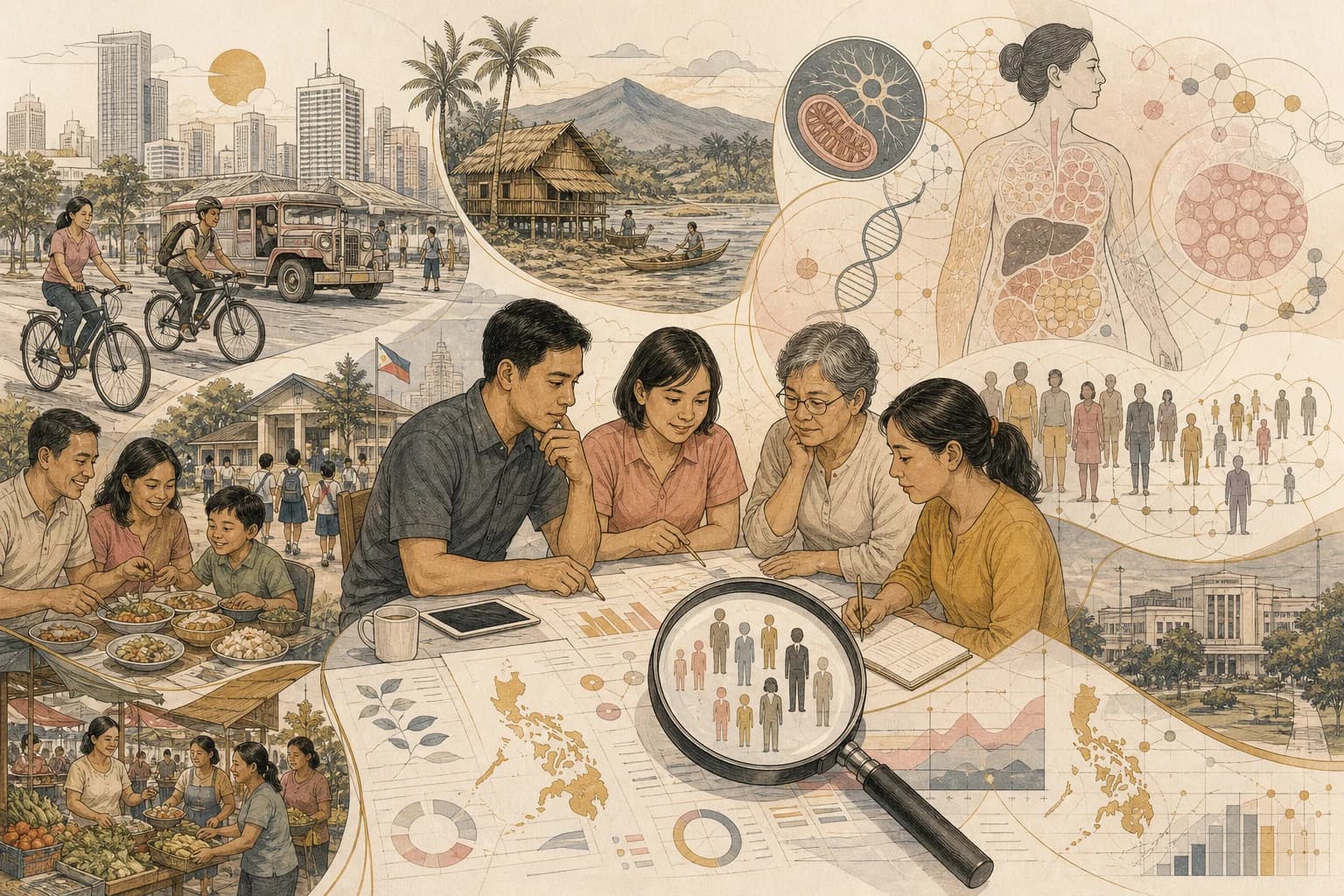
Across the Philippines, metabolic research now sits where household concern, public policy, and fast-moving science meet. The subject is personal for many families, but it is also easy to flatten into dramatic numbers or one-molecule stories. A better guide separates three questions: what national data show, what biology may explain, and what a clinical trial can test.5
Two connected conditions, not one label
Obesity and diabetes often appear in the same headline, yet they describe different things.6 WHO defines diabetes through problems with insulin production or use and the resulting control of blood glucose.6 WHO defines adult overweight and obesity with BMI thresholds, while also calling BMI a surrogate measure that may be paired with waist circumference.7
The connection is about risk, not identity.2 WHO lists overweight, insufficient activity, and genetics among contributors to type 2 diabetes.2 A person may have one condition without the other, and a body shape cannot reveal a blood-glucose result.6 This distinction explains why research uses separate measurements for weight, waist size, glucose, and insulin response.7 It also keeps a population statistic from becoming a verdict about one Filipino reader.8
For readers looking for the exact topic, the semaglutide card below shows its live catalog details.
The Philippine numbers explain the urgency
The clearest reason for attention is scale.1 A 2024 joint release from Philippine health institutions and WHO cited the 2021 Expanded National Nutrition Survey.1 It reported overweight or obesity in 14% of children aged 5–10, 13% of people aged 10–19, and 40.2% of adults.1 Those are age-specific estimates, not one measure that can be copied from children to adults.1
The Department of Health adds another view.9 Its National Objectives for Health reports adult obesity estimates of 8.8% for Filipino women and 6.4% for Filipino men.9 The same document gives diabetes estimates of 7.8% for adult women and 7.9% for adult men.9 These categories can overlap, but they cannot be added together.9
The figures turn an abstract topic into a planning problem for schools, cities, clinics, and households.4 They do not explain any individual case.8
The burden reaches beyond a trend line
National attention also reflects the consequences recorded by the health system.10 DOH reported 26,774 registered deaths due to diabetes mellitus from January through September 2022.10 That represented 6.4% of registered deaths during those nine months.10 It was not a full-year count or an estimate of everyone living with diabetes.10
This is why “metabolic” covers more than weight.5 WHO groups high blood glucose, overweight or obesity, raised blood pressure, and abnormal blood lipids as major metabolic risk factors within the wider noncommunicable-disease picture.5 They can be studied separately, yet health systems often meet them together.5
For Filipino readers, the useful question is not which single number sounds largest.9 It is how surveys, screening, and clinical measures describe different parts of the burden.5 A mortality record cannot replace a prevalence survey, and neither can diagnose a person.10

Biology is more complex than willpower
WHO now describes obesity as a chronic, relapsing disease shaped by interacting forces.8 These include genetics, neurobiology, eating behavior, food access, markets, and the wider environment.8 That framework matters in the Philippines because it moves discussion away from blame.4 It also explains why a single habit cannot account for every body or every metabolic result.8
Researchers still need practical measures.7 BMI uses weight relative to height and supplies a common population screen.7 Yet WHO calls it a stand-in marker for body fat rather than a direct measure of every tissue.7 Waist size can add context about fat distribution.7
This layered view supports two ideas at once.8 Biology matters inside the body, while food systems and physical environments shape what choices are realistic outside it.5 Good research must state which layer it examined.5
Insulin and inflammation offer clues, not slogans
Insulin helps regulate glucose in the blood.6 When the body cannot use insulin effectively, glucose control can be disrupted.6 Researchers therefore examine insulin sensitivity, which describes how strongly tissues respond to insulin under measured conditions.11
Inflammation is another active line of study.11 In one human project, researchers compared tissue inflammation with insulin sensitivity across three cohorts.11 Women with obesity showed higher inflammatory markers in fat tissue, isolated immune cells, and the liver.11 However, the first cohort showed no simple linear link between those markers and tissue-specific insulin sensitivity.11
A second comparison found stronger inflammatory gene and T-cell pathway signals among women with lower insulin sensitivity, independent of BMI.12 The two findings are not a contradiction.11 They show that the chosen tissue, group, and measurement can change the pattern.12 Association still does not prove which process caused the other.12
Gut hormones create a bridge between fields
Another branch of metabolic research focuses on incretins.3 These are gut-linked hormones that help coordinate what happens after food enters the digestive system.3 A 2024 review describes GLP-1 and GIP as signals involved in food intake and insulin release from pancreatic beta cells.3 It also notes that their effects on glucagon differ under different glucose conditions.3
That combination attracts researchers from several fields.3 Endocrinology asks about hormone signaling.3 Neuroscience examines appetite-related brain pathways, while diabetes research follows glucose control.3 Obesity trials may track body weight, waist measures, or cardiometabolic markers.7 One pathway can therefore generate many testable questions without supplying one universal answer.3
Mechanism diagrams remain explanations of biology, not proof of a clinical outcome.3 They also do not describe the identity or quality of any catalog item.3
Trial design sets the limits of the headline
Large trials draw attention because they test defined questions in selected groups.13 The STEP 1 report described 1,961 adults with overweight or obesity but without diabetes.13 Participants were randomized for 68 weeks, and both groups also received lifestyle intervention.13 The study tracked body-weight endpoints rather than every dimension of metabolic health.13
The SURMOUNT-1 report used another large randomized design.14 It involved 2,539 adults with overweight or obesity but without diabetes over 72 weeks.14 Percentage change in body weight was one coprimary endpoint.14
These details matter before anyone generalizes a headline.13 Adults without diabetes do not represent every person with diabetes.13 A fixed trial period does not describe a lifetime, and a body-weight endpoint does not answer every policy or health-system question.14 The published designs also do not establish a Philippines-specific result.14
For readers looking for the exact topic, the tirzepatide card below shows its live catalog details.
Research attention must include systems
The Philippine response described by public-health bodies is deliberately broader than laboratory work.4 The 2024 joint statement called for cooperation across sectors and highlighted food labeling, affordable healthy food, active transport, recreation space, and healthier food environments.4 These are population tools, not judgments about personal discipline.8
Health services hold another part of the response.5 WHO’s noncommunicable-disease framework includes detection, screening, care, and action on social, commercial, and physical environments.5 That is why metabolic research can involve a barangay environment, a national survey, a blood test, or a controlled trial.5
No one method replaces the others.5 Surveys estimate patterns, laboratory studies examine mechanisms, and trials test defined endpoints in selected participants.13 Policy research asks whether healthier choices become more practical and equitable.4 The attention is intense because the problem crosses all of those levels.5
Bottom line
Metabolic research attracts attention in the Philippines because the national burden is visible and the science crosses many boundaries.1 Obesity and diabetes are connected, but they are not the same condition.6 Hormones, insulin sensitivity, inflammation, behavior, food access, and city design each answer part of the story.8
The most responsible reading keeps each result inside its frame.5 A Philippine survey describes a population, a tissue study explores an association, and a randomized trial tests chosen endpoints in selected participants.13 None should become a shortcut for judging a person or promoting a catalog item.8 The lasting research question is how biology, prevention, services, and supportive environments can be understood together.5
This article is educational research context, not medical advice. Catalog links are neutral references and do not imply a treatment or human-use recommendation.
Frequently asked questions
Are obesity and diabetes the same condition?
No. WHO defines diabetes through problems with insulin production or use and blood-glucose control.6 Obesity is classified using measures such as BMI, with known limits.7 Overweight can contribute to type 2 diabetes risk, but one label does not automatically establish the other.2
What does “metabolic” mean in this article?
Here, metabolic refers to processes and risk markers involved in how the body handles energy and glucose.6 WHO’s noncommunicable-disease framework includes raised blood glucose, overweight or obesity, blood pressure, and blood lipids among metabolic risk factors.5 The term is broader than weight alone.5
Why is BMI used if it has limits?
BMI gives researchers and health systems a common ratio of weight to height for population screening.7 WHO also calls it a stand-in marker, so it does not capture every aspect of fat distribution or health.7 Measures such as waist size can add useful context.7
Does inflammation explain insulin resistance?
It may be associated, but one human study showed a more layered pattern.11 Some tissues had higher inflammatory markers without a simple linear link to insulin sensitivity.11 Another comparison found stronger inflammatory signals in participants with lower sensitivity, but association alone did not prove cause.12
Why do gut hormones receive so much attention?
GLP-1 and GIP connect several research questions.3 A review describes their roles in food-intake signaling and insulin release, with different glucagon effects under different glucose conditions.3 This creates links among appetite, brain signaling, glucose biology, and trial endpoints without guaranteeing one universal result.3
Can an international trial answer a Philippine public-health question?
It can inform a narrow scientific question when its participants, comparison, and endpoints fit that question.13 It cannot replace Philippine prevalence data, health-system records, or local policy research.1 Trial design and national surveillance operate at different scales, so both contexts should stay visible.5
Sources
Footnotes
-
DOH, NNC, WHO, and development partners call for actions to curb obesity in the Philippines. National Philippine survey estimates quoted in a 2024 joint release from WHO Philippines, DOH, NNC, and partner institutions. The figures combine overweight and obesity, use age-specific groups, and should not be treated as diabetes prevalence. ↩ ↩2 ↩3 ↩4 ↩5 ↩6 ↩7
-
Diabetes. WHO overview of type 2 diabetes risk factors. A risk factor is not a certain outcome, and body size alone does not establish diabetes. ↩ ↩2 ↩3 ↩4
-
Mechanisms of action and therapeutic applications of GLP-1 and dual GIP/GLP-1 receptor agonists.. Mechanistic review of incretin physiology and receptor signaling. A hormone pathway description does not establish a clinical result or the properties of a catalog item. ↩ ↩2 ↩3 ↩4 ↩5 ↩6 ↩7 ↩8 ↩9 ↩10 ↩11 ↩12 ↩13 ↩14
-
DOH, NNC, WHO, and development partners call for actions to curb obesity in the Philippines. Joint national public-health statement interpreting ENNS trends and outlining policy directions. The statement describes population trends and policy priorities, not the cause of any individual person's body size. ↩ ↩2 ↩3 ↩4 ↩5 ↩6
-
Obesity and overweight; Noncommunicable diseases. WHO fact sheets on obesity and noncommunicable diseases. Population policy and clinical research answer different questions and neither replaces individualized health assessment. ↩ ↩2 ↩3 ↩4 ↩5 ↩6 ↩7 ↩8 ↩9 ↩10 ↩11 ↩12 ↩13 ↩14 ↩15 ↩16 ↩17
-
Diabetes. Current WHO diabetes fact sheet. This general definition does not distinguish every diabetes type or diagnose a reader. ↩ ↩2 ↩3 ↩4 ↩5 ↩6 ↩7 ↩8
-
Obesity and overweight. Current WHO definition and measurement guidance for adults. BMI is a screening measure rather than a complete account of body composition or health. ↩ ↩2 ↩3 ↩4 ↩5 ↩6 ↩7 ↩8 ↩9 ↩10 ↩11
-
Obesity and overweight. Current WHO obesity fact sheet. This population framework does not diagnose an individual or assign one cause to every case. ↩ ↩2 ↩3 ↩4 ↩5 ↩6 ↩7 ↩8 ↩9
-
National Objectives for Health 2023–2028. National strategy document summarizing sex-specific country estimates from cited secondary sources. These estimates use different definitions and should not be added together or used to infer that the same people appear in both groups. ↩ ↩2 ↩3 ↩4 ↩5
-
National Objectives for Health 2023–2028. Philippine national mortality figures cited by DOH from the Philippine Statistics Authority. This is a nine-month registered-death count, not an annual total and not a measure of how many Filipinos live with diabetes. ↩ ↩2 ↩3 ↩4 ↩5
-
Tissue-specific inflammation and insulin sensitivity in subjects with obesity.. Human cohort research using adipose-tissue, liver, muscle, macrophage, and insulin-sensitivity measurements. The cohorts were small and addressed biological association, not Philippine prevalence or a catalog-product outcome. ↩ ↩2 ↩3 ↩4 ↩5 ↩6 ↩7 ↩8
-
Tissue-specific inflammation and insulin sensitivity in subjects with obesity.. Cross-sectional comparison of 24 women with obesity in upper and lower insulin-sensitivity quartiles. An association does not by itself prove that inflammation caused the difference in insulin sensitivity. ↩ ↩2 ↩3 ↩4
-
Once-Weekly Semaglutide in Adults with Overweight or Obesity.. Multicenter phase 3 human trial with body-weight coprimary endpoints. The design and population do not establish a Philippines-specific result or the identity, quality, or intended use of a catalog item. ↩ ↩2 ↩3 ↩4 ↩5 ↩6 ↩7 ↩8 ↩9
-
Tirzepatide Once Weekly for the Treatment of Obesity.. Multicenter phase 3 human trial designed around body-weight endpoints. The design and population do not establish a Philippines-specific result or the identity, quality, or intended use of a catalog item. ↩ ↩2 ↩3 ↩4 ↩5