
TL;DR
- NNMT transfers a methyl group to nicotinamide, connecting this enzyme to NAD+ recycling, methyl-donor use, and the wider study of cellular energy balance.1
- 5-amino-1MQ is a small-molecule NNMT inhibitor that researchers have examined in enzyme tests, cultured cells, mice, and rat pharmacokinetic work.2
- In one short obesity-model experiment, treated mice had lower body weight and white fat mass without a change in total food intake.3
- These records describe laboratory and animal findings, which can shape a research question but cannot establish human clinical benefit or a human safety profile.4
For Filipino readers, the initials “NNMT” can make a simple idea look more mysterious than it is. The enzyme moves one small chemical group between molecules.1 That step touches two busy parts of cell chemistry.5 One involves nicotinamide recycling, while the other involves methyl-donor use.5 Understanding the reaction makes the interest in 5-amino-1MQ easier to follow.4 It also makes the limits harder to miss.4
First, picture the enzyme as a transfer desk
NNMT stands for nicotinamide N-methyltransferase, a cytosolic enzyme found inside cells.1 Its job is to take a methyl group from S-adenosylmethionine, often shortened to SAM, and attach it to nicotinamide.1 The reaction produces 1-methylnicotinamide and S-adenosylhomocysteine.1
Why does that matter to researchers? Nicotinamide can feed the salvage pathway that rebuilds NAD+, a molecule involved in cellular redox reactions.5 SAM, meanwhile, supplies methyl groups for many cellular processes.5 NNMT therefore sits where two well-used chemical pools meet.5 In plain language, changing this enzyme may shift what a cell does with nicotinamide and methyl groups, but a pathway shift is not itself a health outcome.5
5-amino-1MQ is named here only to introduce the following neutral catalog reference.
Why NNMT drew metabolic interest
A 2014 mouse study brought NNMT into sharper focus for metabolism researchers.6 The investigators found higher Nnmt expression in white fat and liver from obese and diabetic mice than in comparison animals.6 They then reduced Nnmt expression in mouse fat and liver.6 Adipose NAD+ and SAM rose, polyamine processing changed, and cellular energy expenditure increased.6 The mice also gained less weight during high-fat feeding.6
That experiment used antisense knockdown, which lowers production of the enzyme.6 It did not test 5-amino-1MQ in people.6 This distinction is easy to lose in a headline: a gene-level mouse experiment can support interest in a biological target, yet it cannot tell readers how a separate small molecule would perform in a human body.6 The study mapped a mechanism and a model, not a consumer promise.6
What 5-amino-1MQ changed in cells
The lead 5-amino-1MQ paper first examined whether methylquinolinium compounds could reach their target and avoid several related enzymes.2 In the laboratory panels used, the compounds crossed membrane models and showed selectivity against the enzymes tested.2 That is a narrow result: a limited panel cannot describe every interaction or define safety in humans.2
In cultured mouse fat cells, 5-amino-1MQ lowered 1-methylnicotinamide, the product formed by NNMT.7 The same experiments reported higher intracellular NAD+ and SAM and lower measured lipogenesis, the cell process used to make lipids.7 These linked changes are useful because they show target engagement and a possible downstream path.7 They remain cell-culture observations, not measurements of body composition or wellbeing in people.7
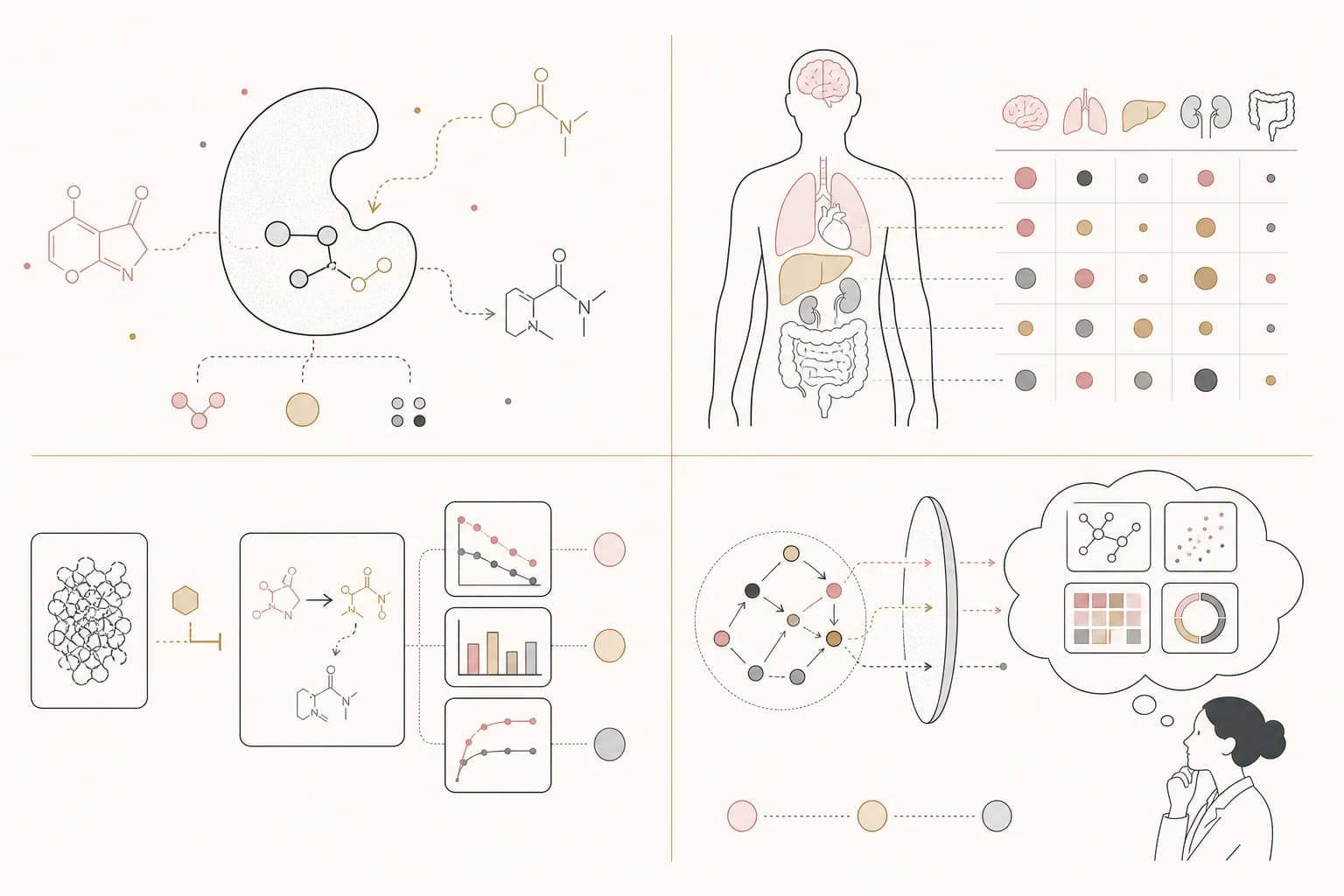
What the short mouse experiment found
The same paper then tested systemic 5-amino-1MQ in male mice with diet-induced obesity.3 Over 11 days, the treated group had lower body weight and white fat mass, smaller fat cells, and lower plasma total cholesterol than the saline group.3 Total food intake did not differ, so the reported weight pattern was not paired with a measured fall in eating during that experiment.3
The authors reported no observable adverse effects over the brief study window.8 That line must stay attached to its setting.8 A short mouse observation is not a human safety profile and cannot answer long-term questions.8 Species, route, diet model, and duration all shape what the result means.3 The fair summary is specific: an interesting mouse finding with clear borders.3
AOD-9604 is named here only to introduce the following neutral catalog reference.
Other models widened the research story
Researchers later used 5-amino-1MQ in 24-month-old mice after a controlled leg-muscle injury.9 Compared with controls, treated mice showed more muscle stem-cell activity, larger regenerating fibers, and greater peak torque in the injured muscle.9 Mouse-cell experiments in the same paper also found enhanced myoblast differentiation alongside changes in the NAD+/NADH redox state.9
This work explored recovery after an induced injury in aged mice.9 It did not test routine exercise, uninjured muscle, or athletic performance in people.9 That boundary matters because “muscle research” can sound much broader than the actual question asked.9
A separate rat study developed a method to measure 5-amino-1MQ in plasma and urine after oral and intravenous routes.10 It reported 38.4% oral bioavailability and different terminal half-lives by route.10 Those rat measurements do not define human exposure.10
Diet combinations need their full label
One mouse project studied 5-amino-1MQ together with a switch to a lower-calorie lean diet.11 The combination produced larger changes in weight, fat, the lean-mass-to-body-weight ratio, and liver measures than the diet switch alone.11 Both changes occurred in the same study arm.11 The reported outcome therefore belongs to the combination, not to either part by itself.11
A follow-up analysis examined the cecal microbiome in a similar combined setting.12 It found a distinct pattern in treated mice, while alpha diversity did not differ significantly between groups.12 The authors also reported taxonomic differences and correlations between some microbes and fat-tissue metabolites.12 Correlation does not show that the microbiome caused the body-composition pattern, so the result is best read as a lead for further experiments.12
Human tissue adds context, not a compound outcome
Human data can enter this story without being human 5-amino-1MQ data.13 One study measured NNMT-related markers across three groups.13 They included 199 surgical patients, 60 exercise-program participants, and 55 patients in a staged bariatric-surgery program.13 Adipose NNMT expression was about twofold higher in participants with type 2 diabetes than in controls.13 NNMT measures were also associated with insulin resistance.13
Those observations connect the enzyme with human metabolic variation, but they do not show that NNMT caused the differences.13 They also do not show what an NNMT inhibitor would do in participants.13
The biology is not a simple “more is bad” switch.14 In mouse liver work, 1-methylnicotinamide—the product of NNMT—mediated reported metabolic effects through stabilization of Sirt1 protein.14 Tissue and experimental context can therefore change the story.14
A better way to read the headline
Start by asking what was actually changed.4 Gene knockdown, enzyme tests, cultured cells, and animal experiments are different steps.6 Next, identify the outcome.4 A metabolite level, cell process, mouse tissue measure, or rat exposure curve is not a human clinical result.4
Then keep combinations intact.11 When 5-amino-1MQ and a diet switch appear together, the comparison supports the combined condition.11 Finally, attach any reassuring language to its clock and species.8 “No observable adverse effects” over 11 days in mice cannot be stretched into a broad safety statement.8
This reading method does not dismiss early research. It gives each experiment the right-sized meaning. The cell work helps explain a mechanism, animal work tests that idea in a whole organism, and human tissue associations show relevance without proving an intervention outcome.4
Bottom line
NNMT is interesting because one enzyme links nicotinamide use with methyl-donor chemistry.1 In cells and mice, changing NNMT activity shifted metabolites and several model-specific outcomes.6 The 5-amino-1MQ studies cited here include cultured fat cells, short obesity-model experiments, aged injured mice, rat pharmacokinetics, and combined diet studies.4
That range is scientifically useful, but it does not erase the boundaries between models.4 Human tissue associations concern the enzyme, not the compound’s effects in participants.13 For Filipino readers, the most accurate takeaway is measured curiosity: follow what each experiment tested, keep combination results together, and do not convert a laboratory or animal finding into a personal-use conclusion.11
This article is educational research context, not medical advice. Catalog links are neutral references and do not imply a treatment or human-use recommendation.
Frequently asked questions
What does NNMT stand for?
NNMT means nicotinamide N-methyltransferase.1 It is an enzyme that moves a methyl group from SAM to nicotinamide, creating 1-methylnicotinamide and S-adenosylhomocysteine.1 The name sounds technical, but it mainly describes the starting molecule and the chemical transfer the enzyme performs.1
Is 5-amino-1MQ the same thing as NNMT?
No. NNMT is the enzyme, while 5-amino-1MQ is a small molecule studied as an inhibitor of that enzyme.2 Keeping target and inhibitor separate helps prevent a common reading error: findings about NNMT expression do not automatically describe the effects of 5-amino-1MQ.13
What did the main weight-related study measure?
It followed male mice with diet-induced obesity for 11 days.3 Researchers measured body weight, white fat mass, fat-cell size, plasma total cholesterol, and food intake.3 The reported changes describe that short, high-fat-diet mouse model and should remain attached to its species, route, and duration.3
Did the research establish human safety?
The lead paper reported no observable adverse effects during its short mouse experiment.8 That limited observation cannot define safety in humans or over longer periods.8 The rat pharmacokinetic paper measured exposure and bioavailability, which answer different questions from clinical safety or benefit.10
Why do NAD+ and SAM appear in this topic?
NNMT uses nicotinamide and SAM in its methyl-transfer reaction.1 Nicotinamide can be recycled toward NAD+, while SAM donates methyl groups across cell biology.5 Researchers track these molecules to understand downstream pathway changes, but shifts in cellular chemistry are not automatically human health outcomes.5
How should Filipino readers interpret this research?
Read each finding with its model in view. The cited compound studies concern cells, mice, or rats, so they can explain a hypothesis without establishing a human clinical result.4 For Filipino readers, the useful habit is to keep every conclusion within the experiment that produced it.
Sources
Footnotes
-
Nicotinamide N-methyltransferase knockdown protects against diet-induced obesity.; Nicotinamide N-methyltransferase regulates hepatic nutrient metabolism through Sirt1 protein stabilization.. Biochemical pathway descriptions within mechanistic mouse and human-tissue research on NNMT. This reaction description does not establish what changing NNMT activity will do in a person. ↩ ↩2 ↩3 ↩4 ↩5 ↩6 ↩7 ↩8 ↩9 ↩10
-
Selective and membrane-permeable small molecule inhibitors of nicotinamide N-methyltransferase reverse high fat diet-induced obesity in mice.. Biochemical enzyme panels, artificial-membrane testing, and Caco-2 cell assays. Selectivity in a limited laboratory panel does not define complete safety or selectivity in humans. ↩ ↩2 ↩3 ↩4 ↩5
-
Selective and membrane-permeable small molecule inhibitors of nicotinamide N-methyltransferase reverse high fat diet-induced obesity in mice.. Short systemic-administration experiment in male diet-induced obese mice fed a high-fat diet. The duration, route, species, and disease model prevent direct translation to human outcomes. ↩ ↩2 ↩3 ↩4 ↩5 ↩6 ↩7 ↩8 ↩9
-
Selective and membrane-permeable small molecule inhibitors of nicotinamide N-methyltransferase reverse high fat diet-induced obesity in mice.; Small molecule nicotinamide N-methyltransferase inhibitor activates senescent muscle stem cells and improves regenerative capacity of aged skeletal muscle.; Development & validation of LC-MS/MS assay for 5-amino-1-methyl quinolinium in rat plasma: Application to pharmacokinetic and oral bioavailability studies.; Combined nicotinamide N-methyltransferase inhibition and reduced-calorie diet normalizes body composition and enhances metabolic benefits in obese mice.; Reduced calorie diet combined with NNMT inhibition establishes a distinct microbiome in DIO mice.. Synthesis across the cited cell, mouse, and rat studies of 5-amino-1MQ. This statement characterizes the contexts of these records and does not claim that no other record exists. ↩ ↩2 ↩3 ↩4 ↩5 ↩6 ↩7 ↩8 ↩9 ↩10
-
Nicotinamide N-methyltransferase knockdown protects against diet-induced obesity.. Mechanistic work in mouse adipose tissue and cultured adipocytes. A pathway link is a research rationale, not a clinical outcome. ↩ ↩2 ↩3 ↩4 ↩5 ↩6 ↩7 ↩8
-
Nicotinamide N-methyltransferase knockdown protects against diet-induced obesity.. Mouse antisense knockdown experiments and cultured mouse adipocyte studies. Gene knockdown in mice is not the same intervention as administering 5-amino-1MQ to humans. ↩ ↩2 ↩3 ↩4 ↩5 ↩6 ↩7 ↩8 ↩9 ↩10 ↩11
-
Selective and membrane-permeable small molecule inhibitors of nicotinamide N-methyltransferase reverse high fat diet-induced obesity in mice.. Differentiated 3T3-L1 mouse adipocyte experiments over short laboratory exposures. Cell-culture metabolic measurements are not evidence of a body-composition outcome in people. ↩ ↩2 ↩3 ↩4
-
Selective and membrane-permeable small molecule inhibitors of nicotinamide N-methyltransferase reverse high fat diet-induced obesity in mice.. Short diet-induced obese mouse experiment reported in the lead 5-amino-1MQ paper. A brief mouse observation cannot establish human safety, long-term safety, or a clinical safety profile. ↩ ↩2 ↩3 ↩4 ↩5 ↩6 ↩7
-
Small molecule nicotinamide N-methyltransferase inhibitor activates senescent muscle stem cells and improves regenerative capacity of aged skeletal muscle.. One- and three-week experiments in 24-month-old injured mice, supported by mouse myoblast culture work. This was an injury-regeneration model in aged mice, not a study of uninjured people or athletic performance. ↩ ↩2 ↩3 ↩4 ↩5 ↩6
-
Development & validation of LC-MS/MS assay for 5-amino-1-methyl quinolinium in rat plasma: Application to pharmacokinetic and oral bioavailability studies.. Analytical-method validation and pharmacokinetic measurements in rats. Rat exposure measurements do not provide a human dose, human pharmacokinetic profile, or clinical outcome. ↩ ↩2 ↩3 ↩4
-
Combined nicotinamide N-methyltransferase inhibition and reduced-calorie diet normalizes body composition and enhances metabolic benefits in obese mice.. Combined intervention in diet-induced obese mice switched from an obesity-promoting diet to a lean diet. The result belongs to the compound-plus-diet condition and cannot be assigned to either component alone. ↩ ↩2 ↩3 ↩4 ↩5 ↩6 ↩7
-
Reduced calorie diet combined with NNMT inhibition establishes a distinct microbiome in DIO mice.. Cecal microbiome analysis in diet-induced obese mice receiving a diet switch with or without 5-amino-1MQ. The study did not establish that the microbiome changes caused the body-composition findings. ↩ ↩2 ↩3 ↩4
-
Association of nicotinamide-N-methyltransferase mRNA expression in human adipose tissue and the plasma concentration of its product, 1-methylnicotinamide, with insulin resistance.. Human cohorts of 199 surgical patients, 60 exercise-program participants, and 55 bariatric-surgery patients. These associations do not show that NNMT caused insulin resistance or that an NNMT inhibitor changes human outcomes. ↩ ↩2 ↩3 ↩4 ↩5 ↩6 ↩7 ↩8 ↩9
-
Nicotinamide N-methyltransferase regulates hepatic nutrient metabolism through Sirt1 protein stabilization.. Mechanistic mouse liver experiments with supporting variation observed in human liver samples. This liver pathway complicates a simple good-or-bad description of NNMT and does not establish a human outcome from inhibition. ↩ ↩2 ↩3