
TL;DR
- NAD+ helps cells handle redox reactions linked with ATP production, but that biochemical role does not automatically mean sharper focus, less sleepiness, or more stamina during a long workday.1
- Workplace fatigue can come from disrupted sleep, extended hours, stress, demanding tasks, or heat, and it can affect attention, memory, reaction time, and judgment.2
- Human trials show why endpoints matter: raising an NAD-related blood marker, changing a walking test, and improving a sleep score are separate findings, not one universal “energy” result.3
- MOTS-c exercise findings discussed here combine mouse intervention experiments with human measurements of the body’s own peptide, so the two models should not be merged.4
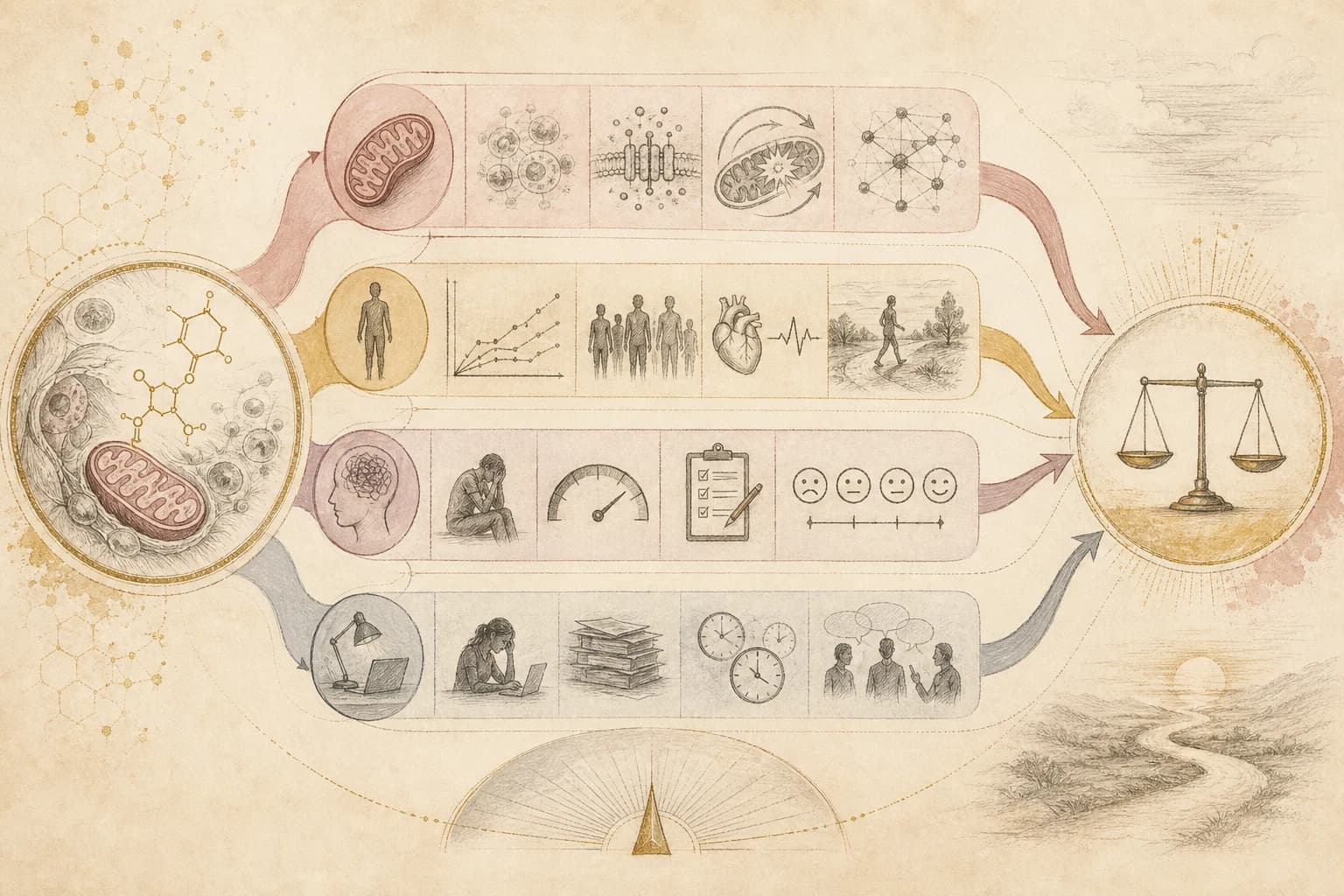
For Filipino readers moving between early commutes, office hours, family duties, night shifts, or overseas-team calls, “more energy” sounds practical. Yet the phrase can hide several questions. Does it mean less drowsiness, steadier attention, better exercise capacity, or a change inside cells? Research can measure each one differently.1 Reading the label well begins by asking which meaning was actually tested.
One word, several different outcomes
NAD+ is short for nicotinamide adenine dinucleotide, a cofactor found in cells.5 It shifts between NAD+ and NADH while carrying electrons through chemical reactions.5 In mitochondria, that cycling connects nutrient breakdown with processes that produce ATP, the cell’s usable chemical currency.5
That is cellular energy metabolism, not a direct reading of how awake someone feels at 4 p.m.1 A fatigue survey, reaction-time task, walking test, sleep score, and muscle biopsy each measure something different.1 Even when two papers use the word “energy,” their endpoints may not match.1 The first useful question is therefore simple: did researchers measure a molecule, a feeling, a task, or a health event?1
NAD+ is named here only as the neutral catalog reference below.
A long workday is more than a cell pathway
Workplace fatigue has several possible sources.2 NIOSH lists extended hours and sleep disruption alongside stress, demanding mental or physical tasks, and hot environments.2 Its effects can extend beyond sleepiness to slower reactions, weaker attention, limited short-term memory, and poorer judgment.2
This matters in a Philippine day that may include a crowded commute before or after the paid shift. A cellular marker cannot identify which part of that load is driving weariness.1 It also cannot replace a measure of concentration, safety, or sleep.1
Long hours deserve their own frame. WHO and ILO linked at least 55 work hours weekly with higher population-level risks of stroke and ischemic-heart-disease death than 35–40 hours.6 Those estimates concern long-term occupational exposure, not a momentary afternoon slump.6 A “boost” claim should never erase the work schedule itself.
A higher biomarker is not a felt boost
NAD+ precursor studies often begin by asking whether a compound changes NAD-related measurements.7 In one randomized crossover trial, 24 healthy middle-aged and older adults received nicotinamide riboside or placebo for six weeks at a time.7 The precursor increased measures of NAD+ metabolism.7
That finding answers a biochemical question.7 It does not by itself answer whether a person stayed alert through meetings, made fewer errors, or felt less drained after commuting.7 Those outcomes would need their own tests.1
The distinction is easy to miss because the pathway sits near ATP production.5 But “near a pathway” is not the same as “proved a daily experience.”1 A useful headline should name the actual endpoint: blood metabolite, muscle measure, questionnaire score, walking time, or another defined result.1
Muscle studies complicate the shortcut
Two human trials show why the mitochondria story cannot be reduced to a slogan.8 A six-week crossover study enrolled 13 overweight or obese adults and detected higher markers of NAD+ synthesis after nicotinamide riboside.8 It also reported some changes in muscle acetylcarnitine and body composition.8 Yet mitochondrial function, cardiac energy status, and measured energy metabolism did not change.8
A separate 12-week trial studied 40 obese, insulin-resistant men.9 Nicotinamide riboside did not change steady-state NAD+ in muscle, mitochondrial respiratory capacity, mitochondrial abundance, or network shape against placebo.9
These are defined muscle and metabolic findings, not verdicts on every person or tissue.9 They also did not recreate a desk shift, hospital duty, delivery route, or night call.8 Their value lies in showing that a precursor, a biomarker, and a functional outcome cannot be treated as synonyms.3
Fatigue trials depend on the fine print
A Japanese trial divided 108 older adults into morning or afternoon groups receiving NMN or placebo for 12 weeks.10 Researchers used questionnaires and physical tests, including repeated sit-to-stand movements.10 They found time-by-group interactions for drowsiness and sit-to-stand performance.10
The detail changes the story. Drowsiness improved from baseline in both afternoon NMN and afternoon placebo groups, while afternoon NMN produced the largest reported effect size.10 That is more specific than saying NMN “gave energy.” It identifies timing, population, comparison, and endpoint.10
The participants were older Japanese adults, not a general workforce sample.10 Drowsiness was one measured part of fatigue, not a complete test of focus, errors, commute safety, or job output.10 The result can remain interesting without being stretched into a universal workday promise.
Human results can point in different directions
Another 12-week trial enrolled 60 older adults and set a stepping test as its primary outcome.11 NMN and placebo did not differ on that test at four or 12 weeks.11 Secondary results favored NMN for four-metre walking time, blood NAD+ measures, and two sleep scores.11
Primary and secondary outcomes should keep their labels.11 A positive secondary sleep score does not rewrite a neutral primary physical test.11 The report also disclosed that three authors worked for the study sponsor.11
In another population, older men with diabetes and impaired physical performance received NMN or placebo for 24 weeks.12 The groups did not differ in improvements to grip strength or walking speed.12 Together, these records show why “energy” needs a noun after it: sleep score, walking time, strength, drowsiness, or cellular marker.1
MOTS-c is named here only as the neutral catalog reference below.
MOTS-c belongs on a separate evidence map
MOTS-c is a 16-amino-acid peptide encoded within mitochondrial genetic material.13 Its original report examined signaling in cell systems and metabolic outcomes in mice.13 Those experiments helped form a biological research question, but they did not test fatigue during a human workday.13
A later paper reported better treadmill performance after a MOTS-c intervention in young, middle-aged, and old mice.4 Its human component asked a different question.4 Researchers measured the body’s own MOTS-c in muscle and blood around exercise in 10 young men.4 Those participants did not receive MOTS-c.4
A separate 30-person exercise study found no correlation between circulating mitochondrial-derived peptides and fitness measures.14 MOTS-c showed a trend, rather than a clear reported rise, after endurance exercise.14 Mouse intervention, human peptide response, and human fitness are three distinct evidence lanes.4
Read an energy headline in five passes
First, replace “energy” with the exact endpoint.1 Was it ATP-related chemistry, blood NAD+, drowsiness, sleep quality, walking time, muscle respiration, or attention?1 Second, identify the population because healthy older adults, older patients, and insulin-resistant men are not interchangeable groups.9
Third, find the comparator and primary outcome.11 Improvement from baseline can appear in a placebo group, while a secondary measure can move when the primary test does not.10 Fourth, keep models apart: a treated mouse and a person whose natural peptide level was measured answer different questions.4
Finally, return to the working conditions. Extended hours, disrupted sleep, stress, demanding tasks, and heat can all contribute to fatigue.2 No cellular phrase makes those factors disappear. For a reader, the strongest claim is usually the narrowest one: what changed, in whom, against what, and for how long.
Bottom line
NAD+ has a real biochemical role in redox reactions and ATP-linked metabolism.5 The mistake begins when that role becomes a promise about every meaning of “energy.” A blood marker is not alertness; a sleep score is not work output; a walking test is not concentration.1 Human precursor trials have reported positive, neutral, and endpoint-specific results across different populations.3 MOTS-c research adds another model split, because intervention findings came from mice while human work measured endogenous responses to exercise.4 For long days, read the endpoint before the headline and keep workload, sleep, stress, heat, and recovery in view.2
This article is educational research context, not medical advice. Catalog links are neutral references and do not imply a treatment or human-use recommendation.
Frequently asked questions
Does NAD+ make ATP?
NAD+ does not act as a packet of usable calories. It cycles with NADH in redox reactions that help connect nutrient breakdown to mitochondrial ATP production.5 That biochemical role matters, but it does not directly measure alertness, motivation, drowsiness, or performance across a work shift.1
What does an increased NAD+ marker prove?
It shows that the measured part of NAD+ metabolism changed under that study’s conditions.7 It does not automatically show less fatigue or sharper attention.7 Those claims require matching human endpoints, such as a validated questionnaire, cognitive task, physical test, or work-related performance measure.1
Why can a primary result differ from secondary results?
A primary outcome is the main result a trial is designed to test, while secondary outcomes address additional questions.11 In one older-adult NMN trial, the primary stepping test did not differ from placebo, although walking time, blood markers, and sleep scores favored NMN.11
Did NMN reduce drowsiness in older adults?
One 12-week study found interactions involving drowsiness and timing.10 Both afternoon NMN and afternoon placebo groups improved from baseline, while afternoon NMN had the largest reported effect size.10 The finding belongs to older Japanese adults and does not establish a universal result for workers.10
What did muscle studies find with nicotinamide riboside?
One small crossover trial changed NAD-related and acetylcarnitine measures but not mitochondrial function or measured energy metabolism.8 Another trial in obese, insulin-resistant men found no change in muscle NAD+, mitochondrial respiration, abundance, or shape.9 Neither study recreated an ordinary long workday.
What does human MOTS-c exercise research show?
One study measured rising endogenous MOTS-c around exercise in 10 young men, while its MOTS-c performance interventions involved mice.4 Another human exercise study found no correlation with fitness measures and only a trend for MOTS-c after endurance exercise.14 These designs should remain separate.
Sources
Footnotes
-
Fatigue and Work; NAD(+) Metabolism and the Control of Energy Homeostasis: A Balancing Act between Mitochondria and the Nucleus. Synthesis of an NAD+ biochemistry review and NIOSH occupational-fatigue guidance. The distinction is conceptual; each human study must still define and measure its own endpoint. ↩ ↩2 ↩3 ↩4 ↩5 ↩6 ↩7 ↩8 ↩9 ↩10 ↩11 ↩12 ↩13 ↩14 ↩15 ↩16 ↩17
-
Fatigue and Work. Current occupational-health guidance from the US National Institute for Occupational Safety and Health. The guidance identifies common contributors and effects; it does not diagnose the cause of fatigue in an individual. ↩ ↩2 ↩3 ↩4 ↩5 ↩6
-
NAD(+) Precursors in Human Health and Disease: Current Status and Future Prospects. Review of NAD+ precursor metabolism, animal research, and human clinical studies. The statement summarizes varied compounds, populations, tissues, and outcomes rather than one unified effect. ↩ ↩2 ↩3
-
MOTS-c is an exercise-induced mitochondrial-encoded regulator of age-dependent physical decline and muscle homeostasis. Mixed-model study combining mouse intervention experiments with before-and-after human exercise sampling. The human component did not test administered MOTS-c or a long-workday performance outcome. ↩ ↩2 ↩3 ↩4 ↩5 ↩6 ↩7 ↩8 ↩9
-
NAD(+) Metabolism and the Control of Energy Homeostasis: A Balancing Act between Mitochondria and the Nucleus. Biochemistry review of NAD+ metabolism across mitochondria and the nucleus. A molecular role in energy metabolism does not by itself establish a change in alertness, fatigue, mood, or work performance. ↩ ↩2 ↩3 ↩4 ↩5 ↩6
-
Long working hours increasing deaths from heart disease and stroke: WHO, ILO. WHO/ILO joint estimates based on systematic reviews and global exposure data. These are population-level associations for a defined weekly exposure, not a prediction for a particular worker or a measure of momentary tiredness. ↩ ↩2
-
Chronic nicotinamide riboside supplementation is well-tolerated and elevates NAD(+) in healthy middle-aged and older adults. Double-blind, placebo-controlled, 2 × 6-week crossover trial. A biomarker response is not the same outcome as less fatigue or better performance during a long workday. ↩ ↩2 ↩3 ↩4 ↩5 ↩6 ↩7
-
Nicotinamide riboside supplementation alters body composition and skeletal muscle acetylcarnitine concentrations in healthy obese humans. Randomized, double-blind, placebo-controlled crossover study with metabolic phenotyping. The sample was small, the study lasted six weeks, and it did not test an ordinary office workday. ↩ ↩2 ↩3 ↩4 ↩5 ↩6
-
Nicotinamide riboside does not alter mitochondrial respiration, content or morphology in skeletal muscle from obese and insulin-resistant men. Randomized, placebo-controlled human trial using skeletal-muscle biopsies and respirometry. The result applies to the enrolled male population and measured muscle endpoints, not every tissue or every meaning of fatigue. ↩ ↩2 ↩3 ↩4 ↩5
-
Effect of 12-Week Intake of Nicotinamide Mononucleotide on Sleep Quality, Fatigue, and Physical Performance in Older Japanese Adults: A Randomized, Double-Blind Placebo-Controlled Study. Four-group, double-blind, placebo-controlled study comparing morning and afternoon NMN or placebo. Within-group improvement and the largest effect size do not mean every fatigue measure improved or that the result applies to younger workers. ↩ ↩2 ↩3 ↩4 ↩5 ↩6 ↩7 ↩8 ↩9 ↩10 ↩11
-
Ingestion of β-nicotinamide mononucleotide increased blood NAD levels, maintained walking speed, and improved sleep quality in older adults in a double-blind randomized, placebo-controlled study. Double-blind, placebo-controlled parallel trial in older adults with motor tests and questionnaires. Secondary outcomes are distinct from the primary result, and three authors were employees of the study sponsor. ↩ ↩2 ↩3 ↩4 ↩5 ↩6 ↩7 ↩8 ↩9
-
Effects of nicotinamide mononucleotide on older patients with diabetes and impaired physical performance: A prospective, placebo-controlled, double-blind study. Prospective, placebo-controlled, double-blind study in a specific older clinical population. The population differs from healthy workers, and these physical tests do not measure concentration or subjective workday fatigue. ↩ ↩2
-
The mitochondrial-derived peptide MOTS-c promotes metabolic homeostasis and reduces obesity and insulin resistance. Laboratory discovery paper using cell systems, rodents, and detection in human and rodent plasma. The intervention findings were preclinical and do not establish a workday-energy outcome in people. ↩ ↩2 ↩3
-
Acute endurance exercise stimulates circulating levels of mitochondrial-derived peptides in humans. Randomized comparison of acute endurance exercise, resistance exercise, and control with blood and muscle sampling. A short-term circulating peptide measurement is not evidence that administering the peptide changes alertness, fatigue, or job performance. ↩ ↩2 ↩3