
Quick answer
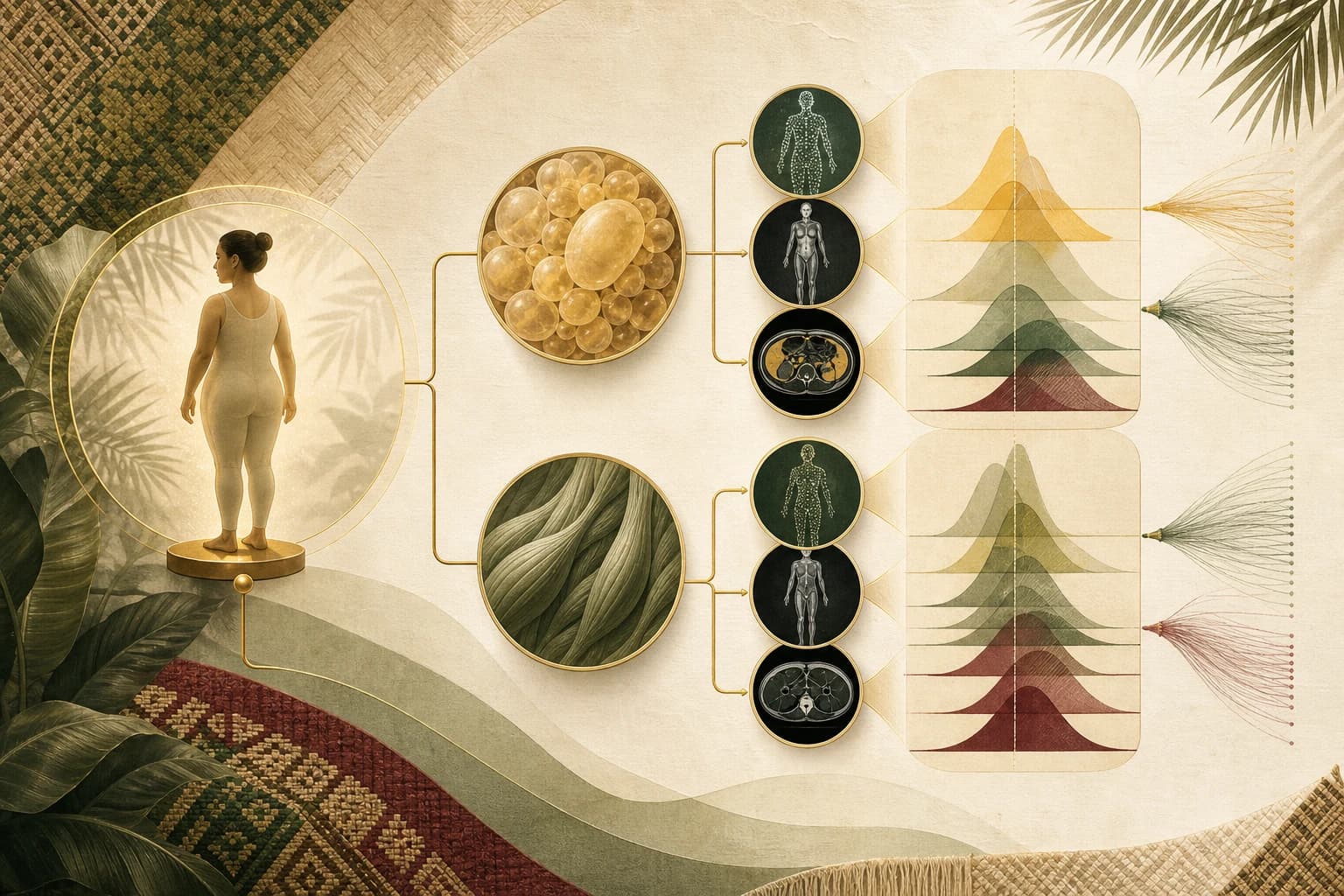
Fat mass and lean mass can both decline during substantial weight reduction, so a lower scale number does not show exactly what changed. In a 12-week tirzepatide routine-care study, about 78% of average weight loss came from fat mass, while estimated soft lean mass also fell.12
A review of 20 randomized trials estimated that lean mass represented 25.4% of weight lost with tirzepatide, with moderate variation across studies. That pooled percentage is not a personal forecast and “lean mass” is not identical to skeletal muscle. Filipino gym discussions need the measurement tool, population, timeframe, and uncertainty—not just one dramatic ratio.3
Is lean mass the same as muscle?
No. Lean mass is a measurement category that includes more than skeletal muscle.
Depending on the method, it can include organs, connective tissue, body water, and other non-fat compartments. Bone may be reported separately.
Calling every lean-mass change “muscle loss” makes the result sound more specific than the instrument allows.
Some studies estimate skeletal-muscle indexes or image a defined muscle area. Others report total lean soft tissue. Those endpoints should not be merged.
The first question for any gym headline is simple: what did the study actually measure? The answer determines how precisely the result can be described.
Language about “preservation” also needs a comparator. A group can lose some lean mass while preserving more than another group, or while retaining a larger proportion of starting tissue.
Without that reference, the word may hide whether researchers measured an absolute amount, relative share, or difference between groups.
Readers researching Tirzepatide can view its live catalog details below. The listing identifies the catalog item and is separate from the evidence discussed here.
What did the short routine-care study find?
A 12-week observational study followed 51 adults with obesity using bioelectrical impedance analysis, or BIA.
Average body weight fell by 8.75 kilograms. Fat mass fell by 6.87 kilograms, while soft lean mass fell by 1.73 kilograms.2
The authors calculated that approximately 78% of total weight loss came from fat mass. Relative lean-mass proportion increased because fat fell more, even though absolute soft lean mass decreased.2
This is why percentages can confuse. A compartment can become a larger share of a smaller body while its absolute amount still declines.
The cohort was small, follow-up was short, and BIA estimates are sensitive to hydration and testing conditions. The study provides an early pattern, not a universal result.
What do randomized reviews show?
A systematic review combined 20 randomized trials that used DXA or MRI to assess body composition.
It estimated that lean mass made up 25.4% of total weight lost with tirzepatide. The heterogeneity estimate was moderate, showing that the pooled figure carried meaningful variation.3
The same review found the proportional lean-mass share was broadly comparable with intensive lifestyle intervention. That was an indirect comparison across different trials.4
“Comparable” at the pooled group level does not mean equivalent for every participant or every program.
The review gives readers a broader estimate than one small cohort. It still cannot identify what percentage one individual will experience.
Pooled results also depend on which trials reported usable body-composition data. A weight trial without DXA or MRI cannot contribute the same compartment detail.
This reporting subset may differ from the full evidence program, so a body-composition review should not be assumed to include every participant from every major weight trial.
Why do BIA, DXA, and MRI differ?
BIA estimates body composition using electrical resistance. Hydration, food, recent activity, and testing conditions can affect the reading.
DXA uses low-radiation X-rays to estimate bone, fat, and lean soft tissue. MRI can map selected tissues and regions with greater anatomical detail.
No tool is a perfect direct count of every muscle fiber. Each relies on definitions, protocols, and analysis choices.
Comparing a BIA percentage with a DXA percentage as if they came from the same ruler can create false certainty.
Longitudinal studies are easier to interpret when participants use the same validated method under consistent conditions. Even then, the result remains an estimate with uncertainty.
What does a very small cohort add?
A Japanese retrospective study examined 24 adults with obesity and type 2 diabetes.
It reported declines in both body-fat index and skeletal-muscle index during tirzepatide treatment.5
The sample was very small, and most participants had previous exposure to another incretin treatment. The findings may not generalize to Filipino gym populations.5
Small cohorts can reveal which measurements are feasible and generate questions for larger studies. They are vulnerable to selection, missing data, and unstable percentages.
The country where a study occurred is also not the only generalizability issue. Age, diabetes status, starting body composition, treatment history, and follow-up all matter.
Why do individual results vary?
Group averages combine people with different starting points and trajectories.
Body size, age, health conditions, food intake, activity, sleep, illness, treatment exposure, and measurement timing may all differ. A study average does not assign one cause to each participant.
Rate of weight change may also coincide with different compartment patterns, but an observational association cannot automatically prove a mechanism.
Gym performance is another outcome. A body-composition estimate does not directly show strength, power, endurance, or physical function.
An informative discussion separates quantity of tissue, proportion of weight lost, and functional performance rather than using “muscle” for all three.
Photos and gym impressions add still another layer. Lighting, pose, glycogen, hydration, and clothing can change appearance without measuring tissue.
Visual change may be meaningful to a person, but it should not be presented as a validated body-composition result.
What should Filipino readers ask?
Ask whether the source measured lean mass, skeletal muscle, strength, or another endpoint. Check the tool, timeframe, sample, and absolute values.
Look for group variability instead of assuming the mean is a target or forecast. Notice whether a percentage refers to total weight lost or change from starting lean mass.
The Philippine FDA Verification Portal separates licensed establishments from registered or notified products. Search exact product and company records.6
WHO notes that falsified products may resemble genuine items and require laboratory analysis. A body-composition study cannot authenticate an online listing.7
Keep the measurement and exact product identity attached to the evidence claim.8
Readers comparing this topic with Semaglutide can view its live catalog details below. It is a separate catalog reference, not a suggested combination.
Bottom line
Weight reduction can include both fat and lean-mass change, but “lean mass” should not automatically be rewritten as skeletal muscle. Short routine-care research found that most average tirzepatide-associated change came from fat while soft lean mass also declined. Randomized reviews reported a pooled lean-mass share with meaningful between-study variation.
Filipino gym readers should check the tool, absolute and relative values, population, timeframe, and functional outcomes before repeating a percentage. Scale weight and a viral ratio cannot describe one person’s body composition or verify a product.
Frequently asked questions
Does lower lean mass always mean the same amount of muscle loss?
No. Lean-mass definitions include more than skeletal muscle.
Did fat mass fall more than soft lean mass in the 12-week study?
Yes. About 78% of average weight loss came from fat mass.2
Is 25.4% a personal prediction?
No. It is a pooled trial estimate with moderate heterogeneity.3
Does body composition measure gym performance?
No. Strength and physical function require separate outcomes.
Do the cards promise fat or muscle results?
No. They are neutral catalog references.
Sources
Footnotes
-
Early changes in body composition with tirzepatide in adults with obesity: a real-world BIA study.; Comparative Effects of Individual Glucagon-Like Peptide-1 Receptor Agonist-Based Medications on Direct Measurement of Body Composition Among Adults With Overweight or Obesity With or Without Type 2 Diabetes: A Systematic Review and Network Meta-Analysis of Randomised Controlled Trials.; Lean Mass Changes With Incretin Therapy Versus Lifestyle Intervention: A Systematic Review and Meta-Analysis of Randomised Controlled Trials.; Comparative Effects of Antidiabetic Drugs on Body Composition: A Systematic Review and Network Meta-Analysis.. Human evidence across a routine-care cohort and systematic reviews of randomized trials. The amount and proportion varied across populations, methods, interventions, and follow-up periods. ↩
-
Early changes in body composition with tirzepatide in adults with obesity: a real-world BIA study.. Human, observational, real-world study using bioelectrical impedance analysis. The cohort was small, follow-up was short, and bioelectrical impedance provides an estimate rather than a direct tissue measurement. ↩ ↩2 ↩3 ↩4
-
Lean Mass Changes With Incretin Therapy Versus Lifestyle Intervention: A Systematic Review and Meta-Analysis of Randomised Controlled Trials.. Human systematic review and meta-analysis of randomized trials using DXA or MRI. The pooled analysis reported moderate heterogeneity, so the estimate is not an individual prediction. ↩ ↩2 ↩3
-
Lean Mass Changes With Incretin Therapy Versus Lifestyle Intervention: A Systematic Review and Meta-Analysis of Randomised Controlled Trials.. Indirect comparison within a systematic review of randomized trials. The intervention groups came from different trials, and pooled averages do not establish equivalence for every person. ↩
-
Impact of tirzepatide on systemic arterial stiffness assessed by cardio-ankle vascular index in individuals with obesity complicated by type 2 diabetes: A retrospective cohort study in Japan.. Human retrospective observational cohort of 24 people using bioelectrical impedance. The sample was very small, most participants had prior incretin exposure, and the finding may not generalize. ↩ ↩2
-
Philippine FDA Verification Portal; FDA Advisory No. 2023-2238: Utilization of the FDA Verification Portal. Official Philippine regulatory verification service. A portal record applies to the exact product or establishment named in that record. ↩
-
WHO laboratory analysis of suspected falsified medical products; WHO laboratory testing for health-product regulation. WHO guidance on suspected falsified medical products and regulatory laboratory testing. Appearance alone cannot authenticate a product or establish a research outcome. ↩
-
Early changes in body composition with tirzepatide in adults with obesity: a real-world BIA study.; Comparative Effects of Individual Glucagon-Like Peptide-1 Receptor Agonist-Based Medications on Direct Measurement of Body Composition Among Adults With Overweight or Obesity With or Without Type 2 Diabetes: A Systematic Review and Network Meta-Analysis of Randomised Controlled Trials.; Lean Mass Changes With Incretin Therapy Versus Lifestyle Intervention: A Systematic Review and Meta-Analysis of Randomised Controlled Trials.; Comparative Effects of Antidiabetic Drugs on Body Composition: A Systematic Review and Network Meta-Analysis.; Philippine FDA Verification Portal; FDA Advisory No. 2023-2238: Utilization of the FDA Verification Portal. Editorial synthesis of the canonical research records and Philippine verification sources. This synthesis is educational and is not personal medical advice or a product recommendation. ↩