Quick answer
Human studies show that kisspeptin-10 can briefly raise luteinizing hormone, or LH, and may also raise testosterone in some men. That makes it useful for studying how the reproductive hormone system works. It does not yet prove that kisspeptin-10 improves fertility, improves low testosterone, manages PCOS, or produces lasting clinical benefits. Most published experiments were small, closely monitored physiology studies that measured hormones over hours rather than pregnancies, symptoms, or long-term health outcomes.1234
What is kisspeptin-10, in plain language?
Kisspeptin-10 is a short research peptide connected to the brain’s control of reproductive hormones. It acts near the beginning of that signaling chain. When the pathway responds, the brain releases gonadotropin-releasing hormone, which then prompts the pituitary gland to release LH and follicle-stimulating hormone.1
Those hormones help regulate the ovaries and testes. This explains why kisspeptin research appears in discussions about puberty, ovulation, testosterone, and fertility. It also explains a common misunderstanding: activating a hormone signal for a few hours is not the same as proving a fertility treatment works.
The distinction is important because nearly all the human evidence collected here measures short-term hormone movement. Researchers used controlled infusions, frequent blood samples, and carefully selected volunteers. They were studying the pathway itself, not testing an off-the-shelf wellness product.253
Readers researching Kisspeptin-10 can view its live catalog details below. The listing identifies the catalog item and is separate from the evidence discussed here.
What happened when healthy men received kisspeptin-10?
The clearest early human finding is a rapid rise in LH. In healthy male volunteers, intravenous kisspeptin-10 produced a exposure-dependent LH response. In other words, larger experimental exposures produced a larger hormone signal within the range studied.2
A related experiment used continuous infusion and intensive blood sampling. LH pulses became more frequent, and testosterone also rose. This was valuable physiology research because it showed that the pathway could remain active during the observation period.5
It was not a long-term testosterone study. The researchers did not establish sustained symptom improvement, muscle gain, fertility, or a durable correction of a diagnosed hormone disorder. The intervention and monitoring also belonged to a controlled research setting, so the result cannot be translated into a personal schedule or unsupervised use.53
An age-comparison study added another useful detail. LH rose after kisspeptin-10 across the male age groups, but a statistically significant testosterone rise appeared only in the younger adult group. That difference suggests that activating an upstream signal does not guarantee the same downstream response at every age.6
Do the studies in women show a fertility benefit?
No. The studies show that the reproductive hormone pathway responds, not that pregnancy or live-birth rates improve.
In healthy women, kisspeptin-10 increased LH during an experimental estrogen-feedback protocol. The researchers were examining how kisspeptin and another signaling molecule, neurokinin B, help translate estrogen feedback into pituitary hormone changes.7
A small study in women with polycystic ovary syndrome, or PCOS, asked a similarly narrow question. After researchers blocked the neurokinin-3 receptor, the LH response to kisspeptin-10 remained. That helped map the relationship between two signaling systems, but it did not test ovulation, cycle regularity, pregnancy, or PCOS symptoms.8
This is a good example of why headlines can overreach. “Reproductive hormones responded” is accurate. “Fertility improved” would describe an outcome the studies did not measure.
What do the diabetes and longer-infusion studies add?
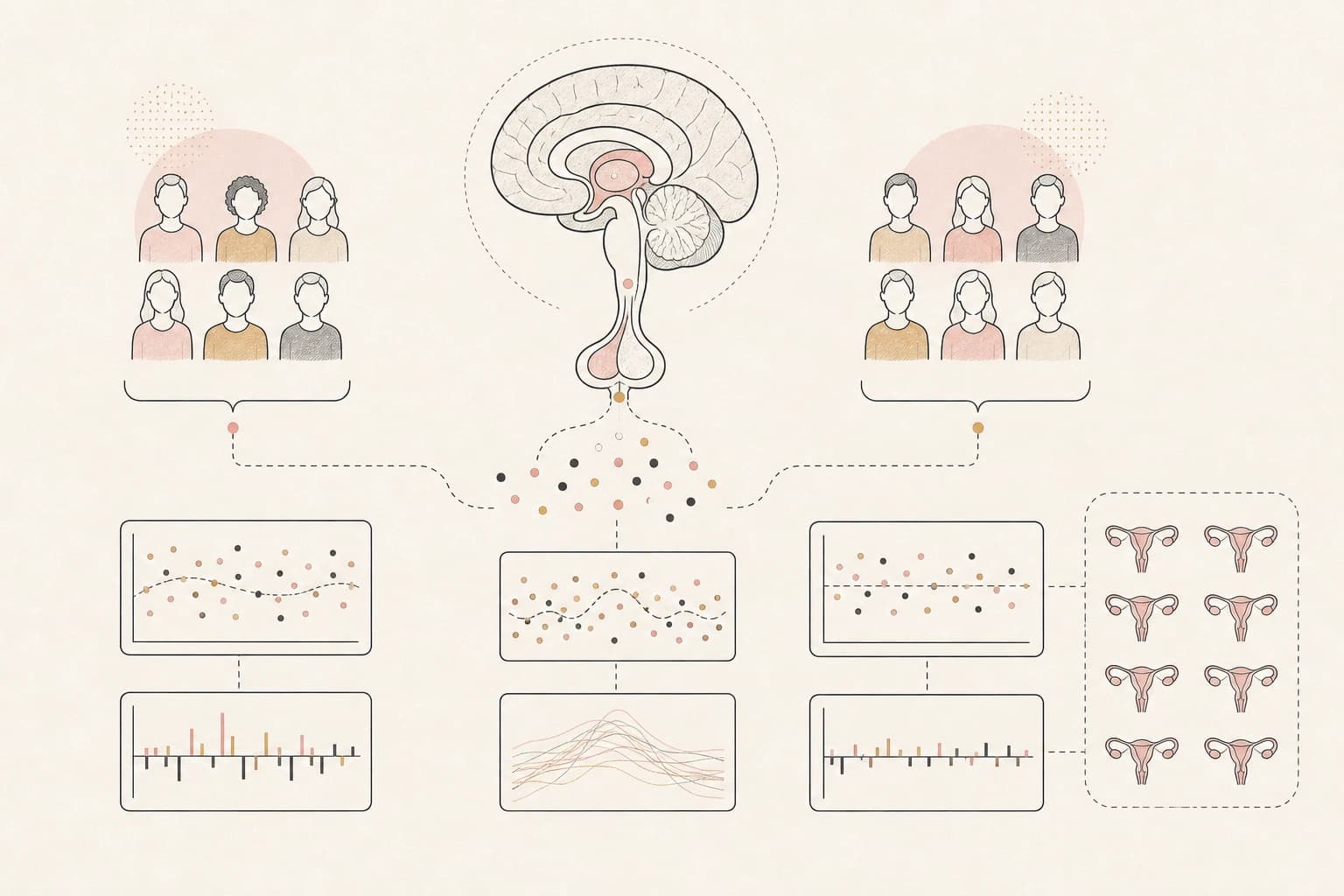
One proof-of-concept study involved only five men with type 2 diabetes and mild biochemical hypogonadism, alongside seven healthy comparison participants. Kisspeptin-10 increased LH and testosterone in the men with diabetes. The result supports further investigation, but five participants cannot establish treatment effectiveness, safety, or who would respond over time.9
A 2026 study was even smaller: three healthy men received a continuous infusion while researchers tracked LH over 24 hours. LH rose early, then partially declined. That pattern is scientifically interesting because it asks whether the response is maintained, but three volunteers cannot define durability or a clinical benefit.10
Together, these experiments show both the value and the limit of early physiology research. They can reveal when a signal rises, how quickly it changes, and whether the response varies by group. They cannot answer whether people feel better, conceive more often, or avoid long-term harms.9103
Readers comparing this topic with hCG can view its live catalog details below. It is a separate catalog reference, not a suggested combination.
Why isn’t a testosterone rise the same as testosterone therapy?
Testosterone is only one point in a larger hormone system. Kisspeptin-10 acts upstream, while many clinical decisions depend on the cause of a low result, repeated laboratory testing, symptoms, other hormones, health history, and the outcome that matters to the patient.
The collected kisspeptin studies mostly tracked short changes after an experimental infusion. They did not show sustained normalization, symptom relief, fertility outcomes, or long-term safety. Even the studies that recorded testosterone increases were designed primarily to understand signaling.596
This also means kisspeptin-10 should not borrow evidence from hCG or another reproductive hormone product. Related pathways do not make two compounds interchangeable. Each product requires its own identity, study design, measured outcome, and regulatory record.
What remains unanswered?
The largest gap is patient-centered evidence. The current records do not establish whether kisspeptin-10 improves pregnancy, live birth, sexual symptoms, quality of life, sustained testosterone levels, or athletic performance.34
Longer and larger controlled trials would also be needed to describe safety reliably. Small studies can miss uncommon adverse events and cannot show what happens with repeated exposure over months. A response seen in healthy volunteers may also differ from one seen in people with a diagnosed reproductive condition.
For Filipino readers, local product identity is another separate question. A foreign physiology paper does not authenticate an online listing or establish Philippine regulatory status. Research evidence, catalog identity, and local authorization must be checked through the records designed for each purpose.
Bottom line
Kisspeptin-10 clearly activates part of the human reproductive hormone pathway in small controlled studies. The most consistent finding is a short-term LH rise, with testosterone changes appearing in some male groups. That is meaningful biology, but it remains far short of proven fertility or testosterone treatment.2596
The honest reading is simple: these studies help explain the pathway and support further clinical research.2596 They do not establish pregnancy, symptom, performance, or long-term health benefits. Product cards identify catalog items only and do not turn early physiology findings into personal advice.
Frequently asked questions
Does kisspeptin-10 increase testosterone?
Some small human studies recorded short-term testosterone increases after monitored kisspeptin-10 exposure. The response was not identical across age groups, and the studies did not establish sustained treatment effects or symptom improvement.596
Does that mean kisspeptin-10 improves fertility?
No. The collected studies mainly measured LH, hormone pulses, and short-term testosterone changes. Pregnancy, live birth, and sustained fertility outcomes were not established by these experiments.873
What did the PCOS study find?
It found that women with PCOS still had an LH response to kisspeptin-10 after neurokinin-3 receptor blockade. The study examined hormone regulation, not ovulation, pregnancy, or overall PCOS improvement.8
Are kisspeptin-10 and hCG the same thing?
No. They occupy different places in reproductive-hormone discussions and must be evaluated separately. A study involving one compound cannot establish the identity, effectiveness, or safety of the other.
Why are the human studies still useful?
They show that the human reproductive axis responds to kisspeptin-10 and help researchers map that response. Their small size and short observation periods define what they cannot yet prove.210
Sources
Footnotes
-
Interactions Between Neurokinin B and Kisspeptin in Mediating Estrogen Feedback in Healthy Women.; Kisspeptin-10 is a potent stimulator of LH and increases pulse frequency in men.. Controlled physiology studies in healthy women and men. A short hormone response is not proof of fertility or long-term treatment benefit. ↩ ↩2
-
Kisspeptin-10 is a potent stimulator of LH and increases pulse frequency in men.. Dose-response and infusion physiology study in healthy male volunteers. The study measured short-term hormone responses, not pregnancy, fertility, muscle gain, or long-term health. ↩ ↩2 ↩3 ↩4 ↩5 ↩6
-
Kisspeptin and neurokinin B interactions in modulating gonadotropin secretion in women with polycystic ovary syndrome.; Age-dependent changes in the reproductive axis responsiveness to kisspeptin-10 administration in healthy men.; Interactions Between Neurokinin B and Kisspeptin in Mediating Estrogen Feedback in Healthy Women.; Kisspeptin-10 is a potent stimulator of LH and increases pulse frequency in men.; Exploring the pathophysiology of hypogonadism in men with type 2 diabetes: kisspeptin-10 stimulates serum testosterone and LH secretion in men with type 2 diabetes and mild biochemical hypogonadism.; Dynamic modulation of LH secretion by continuous kisspeptin infusion in healthy men.. Cross-study comparison of endpoints. Surrogate hormone outcomes should not be rewritten as established clinical benefits. ↩ ↩2 ↩3 ↩4 ↩5 ↩6
-
Kisspeptin and neurokinin B interactions in modulating gonadotropin secretion in women with polycystic ovary syndrome.; Kisspeptin-10 is a potent stimulator of LH and increases pulse frequency in men.; Exploring the pathophysiology of hypogonadism in men with type 2 diabetes: kisspeptin-10 stimulates serum testosterone and LH secretion in men with type 2 diabetes and mild biochemical hypogonadism.; Dynamic modulation of LH secretion by continuous kisspeptin infusion in healthy men.. Synthesis of early human physiology studies. Specific clinical uses require adequately powered controlled trials with patient-centered outcomes. ↩ ↩2
-
Kisspeptin-10 is a potent stimulator of LH and increases pulse frequency in men.. Controlled infusion study with intensive hormone sampling. A research infusion is not evidence for unsupervised use. ↩ ↩2 ↩3 ↩4 ↩5 ↩6 ↩7
-
Age-dependent changes in the reproductive axis responsiveness to kisspeptin-10 administration in healthy men.. Short hormone-response study in healthy adult, middle-aged, and older men. Age-group responses do not prove a testosterone treatment benefit. ↩ ↩2 ↩3 ↩4 ↩5
-
Interactions Between Neurokinin B and Kisspeptin in Mediating Estrogen Feedback in Healthy Women.. Crossover physiology study in regularly menstruating women. The experimental protocol does not establish a routine clinical use. ↩ ↩2
-
Kisspeptin and neurokinin B interactions in modulating gonadotropin secretion in women with polycystic ovary syndrome.. Small clinical physiology study involving eight treated and seven untreated women with PCOS. The study examined hormone regulation, not ovulation, pregnancy, or symptom improvement. ↩ ↩2 ↩3
-
Exploring the pathophysiology of hypogonadism in men with type 2 diabetes: kisspeptin-10 stimulates serum testosterone and LH secretion in men with type 2 diabetes and mild biochemical hypogonadism.. Very small experimental study with seven healthy comparison participants. The sample was too small to establish treatment effectiveness or safety. ↩ ↩2 ↩3 ↩4 ↩5 ↩6
-
Dynamic modulation of LH secretion by continuous kisspeptin infusion in healthy men.. Twenty-four-hour physiology study with frequent blood sampling. Three participants cannot define efficacy, durability, or safety. ↩ ↩2 ↩3