
Quick answer
Human research confirms that ipamorelin can trigger a brief growth-hormone release, but it has not shown the muscle, fat-loss, fertility, or sports-recovery benefits often attached to it online. The main controlled clinical trial tested recovery after bowel surgery and did not meet its key efficacy endpoint. Other positive-looking findings come from ferrets, fish, or a mouse combination model. Those studies can guide research, but they cannot establish the same outcomes in people.123456
What is ipamorelin actually designed to do?
Ipamorelin is a growth-hormone secretagogue. In simple terms, it is studied for its ability to tell the body to release growth hormone. That signal is why it appears in conversations about the growth hormone and IGF-1 pathway.
The pathway sounds familiar, but a hormone signal is not a finished health result. A study can show that growth hormone rose without showing that participants gained muscle, lost fat, recovered from injury, improved fertility, or felt better.1
That difference anchors the evidence. The human studies collected here answer two narrow questions: how ipamorelin behaves in the bloodstream and whether it helped bowel function after surgery. Neither was a bodybuilding, anti-aging, or athletic-recovery trial.12
Readers researching Ipamorelin can view its live catalog details below. The listing identifies the catalog item and is separate from the evidence discussed here.
What did the early volunteer study find?
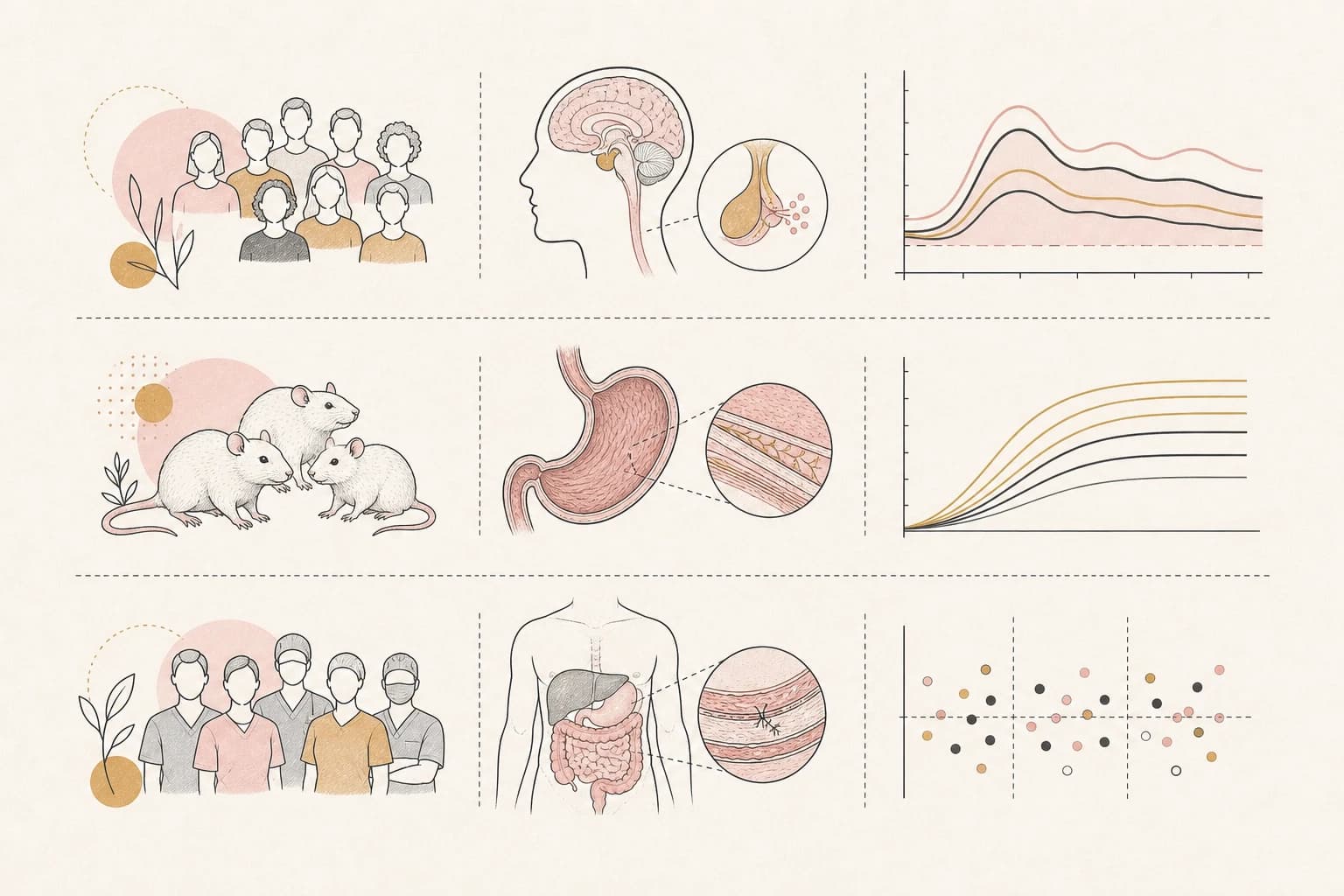
An early exposure-escalation study gave ipamorelin to healthy male volunteers and measured both drug exposure and growth-hormone release. Eight participants were included at each tested exposure level. The researchers saw a short episode of growth-hormone release across the experimental amount range.1
The study estimated a terminal half-life of roughly two hours. It also found substantial variation in growth-hormone responses, meaning participants did not all produce the same signal after exposure.7
This is useful pharmacology. It helps researchers understand timing, exposure, and biological activity. It does not prove a lasting benefit, because the experiment did not measure strength, body composition, sports performance, injury healing, or long-term symptoms.17
Short hormone studies are especially easy to oversell. A graph showing a clear peak can look decisive, even when the paper never asked whether that peak improved a patient-centered outcome.
Did ipamorelin improve recovery in a human trial?
Not on the trial’s key endpoint. A randomized, double-blind, placebo-controlled phase 2 study evaluated ipamorelin after bowel resection. The modified intention-to-treat analysis included 114 patients and focused on postoperative ileus, a delay in normal bowel function after surgery.2
Median time to the first tolerated meal was 25.3 hours with ipamorelin and 32.6 hours with placebo. Although the numbers were different, the difference was not statistically significant. It should therefore be described as an unproven numerical difference, not faster recovery.8
Overall treatment-emergent adverse events occurred at similar frequencies during the short inpatient study, and the investigators described the tested regimen as well tolerated. That result is limited to the monitored trial. It cannot establish long-term safety or safety in a different population or setting.9
The study also shows why the word “recovery” needs context. Here, recovery meant a specific gastrointestinal outcome after surgery. It did not mean tendon healing, gym recovery, muscle growth, or a quicker return to sport.28
What do the animal studies contribute?
Animal work offers possible research directions, but each model answers a species-specific question. In ferrets exposed to cisplatin, ipamorelin reduced delayed-phase weight loss but did not prevent vomiting. That finding concerned a drug-induced illness model, not human fat loss or appetite management.3
A 21-day study in cichlid fish reported changes in the reproductive axis after ipamorelin exposure. Fish biology cannot establish improved testosterone, fertility, or reproductive outcomes in people.4
A sports-medicine review also discussed a muscle-related finding for CJC-1295 plus ipamorelin in mice. That evidence has two boundaries: it came from an animal model, and it involved a combination. It cannot prove what ipamorelin alone does in humans.5
These are not useless studies. They help scientists decide what might deserve controlled human testing. The problem begins when a preclinical result loses its species, experimental condition, or combination label on the way to a sales page.
Readers comparing this topic with Sermorelin can view its live catalog details below. It is a separate catalog reference, not a suggested combination.
Why do online claims sound more certain than the evidence?
Growth-hormone language connects several appealing ideas: muscle, leanness, recovery, sleep, and healthy aging. Those associations make it easy to move from “this compound triggered a hormone” to “this compound delivers all the outcomes linked with that hormone.” The second statement requires direct trials.
A review of performance-related peptides described a gap between controlled evidence and online self-delivery claims. Popularity can identify the questions people are asking, but it cannot answer them.10
For ipamorelin, the collected evidence does not establish muscle building, fat loss, faster sports recovery, or improved fertility in humans. Each claim would need an adequately controlled study that enrolled the relevant people and measured the stated outcome.6
It is also incorrect to borrow evidence from another growth-hormone-pathway compound. A shared pathway does not make ipamorelin, sermorelin, or CJC-1295 interchangeable.
How should Filipino readers assess an ipamorelin claim?
Start by naming the outcome exactly. “Recovery” is too broad. Ask whether the claim concerns bowel function after surgery, muscle soreness, an injury, strength, or another measurable endpoint.
Next, check the study population. Healthy volunteers, postoperative patients, ferrets, fish, and mice are not interchangeable. Then check whether the paper tested ipamorelin alone or as part of a combination.
Finally, keep research identity separate from product identity. A published paper does not verify that an online item in the Philippines contains the same material or meets the same quality controls. Catalog cards display live product information; they do not certify a clinical outcome.
Bottom line
Ipamorelin has demonstrated biological activity in humans: it can produce a brief growth-hormone signal. Its main controlled patient trial, however, did not show a statistically significant improvement in the key postoperative recovery endpoint.128
Animal findings remain animal findings, and combination evidence remains combination evidence. The current record does not establish the popular muscle, fat-loss, fertility, or sports-recovery promises. The clearest article is therefore the narrow one: explain what changed, identify the study setting, and stop where the source stops.3456
That boundary protects both the research and the reader.
Frequently asked questions
Does ipamorelin release growth hormone in humans?
Yes. A small volunteer study recorded a brief growth-hormone response after ipamorelin. It was a pharmacology study and did not establish muscle, fat-loss, recovery, or long-term health benefits.17
Did the bowel-surgery trial succeed?
No. The time to the first tolerated meal was numerically shorter with ipamorelin, but the key difference was not statistically significant. The result cannot be presented as proven faster recovery.28
Do the ferret findings support human weight loss?
No. The ferrets were studied during cisplatin exposure, and the outcome was delayed-phase weight loss in that illness model. It was not a human body-fat or obesity study.3
Can combination research prove ipamorelin works alone?
No. A CJC-1295-plus-ipamorelin result belongs to that combination and its animal model. It cannot isolate ipamorelin or establish the same outcome in people.5
Is the Sermorelin card a suggested alternative?
No. It is a separate catalog reference for readers comparing growth-hormone-pathway topics. It does not imply equivalence, a combination, or a personal recommendation.
Sources
Footnotes
-
Pharmacokinetic-pharmacodynamic modeling of ipamorelin, a growth hormone releasing peptide, in human volunteers.. Human pharmacokinetic and pharmacodynamic study with eight participants at each dose level. A hormone response is not proof of muscle, recovery, or fat-loss benefit. ↩ ↩2 ↩3 ↩4 ↩5 ↩6 ↩7
-
Prospective, randomized, controlled, proof-of-concept study of the Ghrelin mimetic ipamorelin for the management of postoperative ileus in bowel resection patients.. Proof-of-concept study in 114 patients in the modified intention-to-treat population. The study tested postoperative ileus, not athletic recovery or body composition. ↩ ↩2 ↩3 ↩4 ↩5 ↩6
-
The growth hormone secretagogue receptor 1a agonists, anamorelin and ipamorelin, inhibit cisplatin-induced weight loss in ferrets: Anamorelin also exhibits anti-emetic effects via a central mechanism.. Animal experiment using intraperitoneal dosing in ferrets. The finding is species-specific and cannot establish a human treatment effect. ↩ ↩2 ↩3 ↩4
-
The influence of ghrelin agonist ipamorelin acetate on the hypothalamic-pituitary-testicular axis in a cichlid fish, Oreochromis mossambicus.. Twenty-one-day study in cichlid fish. Fish reproductive biology cannot support a human fertility, testosterone, or performance claim. ↩ ↩2 ↩3
-
Injectable Peptide Therapy: A Primer for Orthopaedic and Sports Medicine Physicians.. Narrative review comparing popular injectable peptides. Combination animal data do not establish a benefit for ipamorelin alone in people. ↩ ↩2 ↩3 ↩4
-
Prospective, randomized, controlled, proof-of-concept study of the Ghrelin mimetic ipamorelin for the management of postoperative ileus in bowel resection patients.; Pharmacokinetic-pharmacodynamic modeling of ipamorelin, a growth hormone releasing peptide, in human volunteers.; The growth hormone secretagogue receptor 1a agonists, anamorelin and ipamorelin, inhibit cisplatin-induced weight loss in ferrets: Anamorelin also exhibits anti-emetic effects via a central mechanism.; Injectable Peptide Therapy: A Primer for Orthopaedic and Sports Medicine Physicians.; The influence of ghrelin agonist ipamorelin acetate on the hypothalamic-pituitary-testicular axis in a cichlid fish, Oreochromis mossambicus.. Comparison of human mechanism and postoperative studies with animal and review evidence. Each consumer-facing outcome requires its own direct controlled human evidence. ↩ ↩2 ↩3
-
Pharmacokinetic-pharmacodynamic modeling of ipamorelin, a growth hormone releasing peptide, in human volunteers.. Short experimental infusion study in healthy men. The study characterized exposure and hormone release, not long-term outcomes. ↩ ↩2 ↩3
-
Prospective, randomized, controlled, proof-of-concept study of the Ghrelin mimetic ipamorelin for the management of postoperative ileus in bowel resection patients.. Key efficacy endpoint in the postoperative ileus trial. A numerical difference that misses significance cannot be presented as proven faster recovery. ↩ ↩2 ↩3 ↩4
-
Prospective, randomized, controlled, proof-of-concept study of the Ghrelin mimetic ipamorelin for the management of postoperative ileus in bowel resection patients.. Short inpatient phase 2 study after bowel surgery. This does not establish long-term safety or safety in unmonitored consumer use. ↩
-
The emerging landscape of performance-enhancing peptides modulating GH-IGF1 axis: bridging the gap between clinical evidence and patient self-administration.. Narrative review of growth hormone and IGF-1 pathway peptides. Online popularity is a topic signal, not evidence of benefit. ↩