
TL;DR
- Tirzepatide activates GIP and GLP-1 receptors, so “dual” means one molecule engages two signaling routes rather than two medicines being mixed together.1
- In a Chinese phase 3 trial, tirzepatide groups had larger HbA1c and body-weight reductions than placebo, with gastrointestinal events the most common treatment-emergent problems.2
- Receptor-gene variants may help explain differences in signaling, response, or some adverse events, but prospective studies are still needed for clinical use.3
- Mouse and cell studies can suggest downstream pathways, but their preclinical findings do not establish the same direct effects in Filipino patients.4
In the Philippines, health talk can move fast. A name heard in a clinic may soon appear in a family group chat or online post. Tirzepatide is often called a “dual agonist,” but that phrase needs unpacking.1 It describes action at two hormone receptors, not two medicines in one package.1 It also does not predict what will happen to an individual person.13
Begin with the two receptor signals
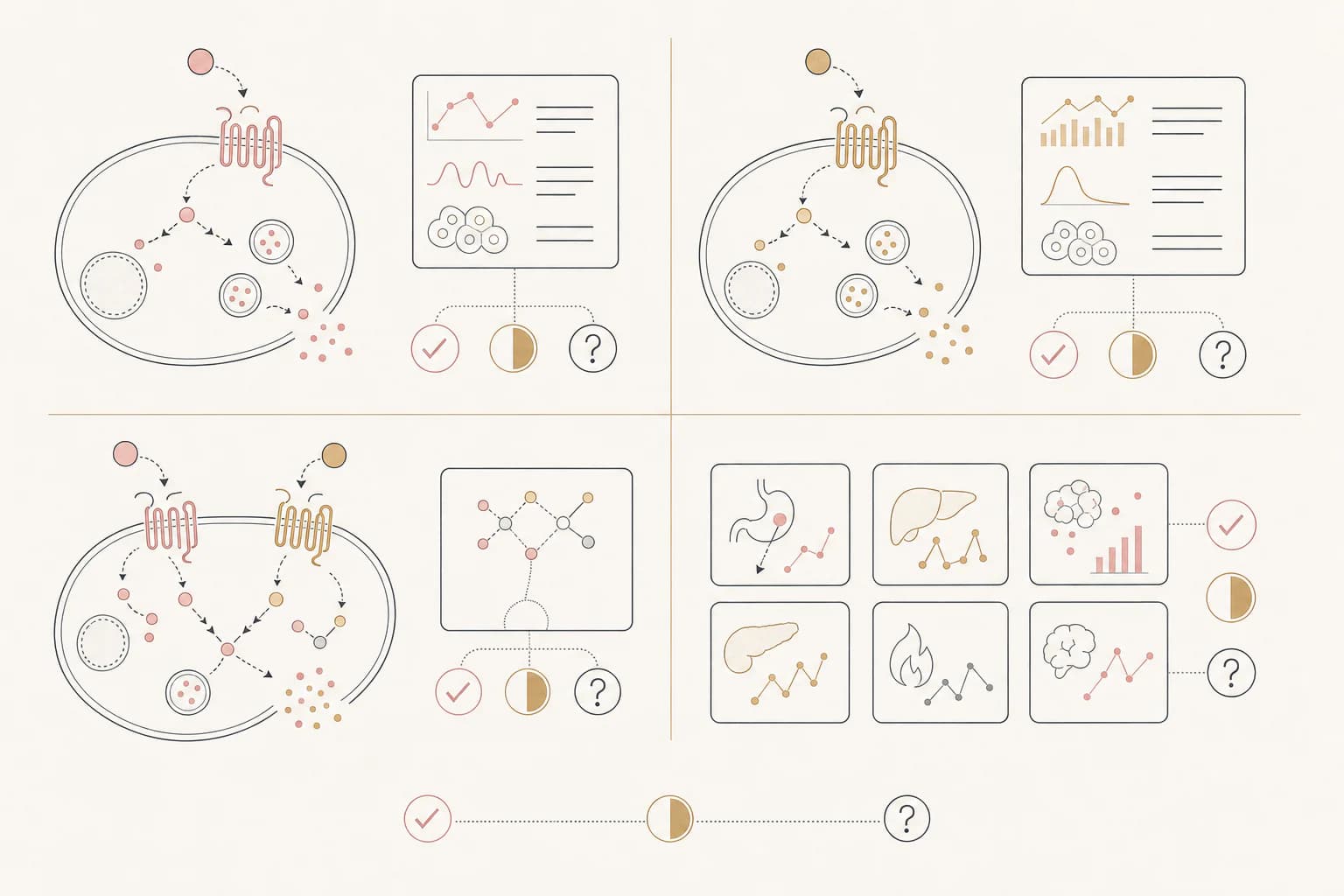
Scientific reviews describe tirzepatide as an agonist at the GIP and GLP-1 receptors.1 An agonist activates a receptor and starts signals inside cells.1 Here, “dual” means that one molecule engages both receptor systems.1 It does not mean two active medicines were simply blended together in one package.1
Clinical studies then measure results from that combined activity.2 Common outcomes include glycated hemoglobin, body weight, and adverse events.2 Researchers observe the integrated result in a person, not either receptor working alone.12 The phrase “GIP plus GLP-1” is therefore a useful starting point.1 It is not a full map of every later biological step.1
For a neutral catalog reference to the molecule discussed above, see the tirzepatide card.
What one human phase 3 trial found
A phase 3 study enrolled 206 Chinese adults with early type 2 diabetes.2 Participants were randomly assigned to tirzepatide groups or placebo for 40 weeks.2 Every active-treatment group had a larger average HbA1c reduction than placebo.2 Average body-weight reductions were also larger in the active groups.2
Gastrointestinal problems were the most common treatment-emergent adverse events in those groups.2 Investigators reported no clinically significant or severe hypoglycemia in this specific trial.2 These findings come from people, but the setting matters.2 Participants lived in China, had early type 2 diabetes, and followed a controlled study plan.2 Those group averages are not personal forecasts for Filipino readers.23
Why dual action is not simple arithmetic
The human trial tested the full molecule rather than each receptor pathway on its own.12 It cannot show that GIP produced one fixed percentage of the outcome.2 It also cannot assign the remaining percentage to GLP-1.2 Researchers instead see the result after both systems are activated.1
A 2026 review adds another layer: receptor genes can vary among people.3 The authors linked some GLP1R and GIPR variants with signaling, clinical response, or nausea and vomiting risk.3 They also said prospective studies are needed before these findings become clinically actionable.3 The review discussed several populations but did not establish a Filipino genetic response profile.3 Dual action names a mechanism; it is not an individual-results calculator.13
Appetite and energy: clues from a preprint
One preprint paired a human observation with experiments in mice fed to develop obesity.5 In the human data, baseline leptin levels correlated with later weight-loss response.5 A correlation does not show that leptin caused the response.5 The mouse experiments then studied tirzepatide together with leptin.5
In those mice, the combination had larger effects on food intake and energy expenditure.5 Researchers also reported changes in insulin sensitivity and hypothalamic neuron signaling.5 These findings offer clues about brain circuits and energy balance.5 Yet they remain preprint and animal evidence.5 They do not establish the same combination effect in people.5 They also cannot explain every human weight change.5
Beyond weight: plausible is not proven
Another preprint studied wire-injured arteries in mice and cultured human endothelial cells.4 Tirzepatide affected arterial remodeling in the mouse experiments.4 It also increased nitric oxide production in the cultured cells.4 Blocking nitric oxide synthesis removed one reported protective effect in mice.4 This is preclinical evidence, not proof of a direct vascular effect in people.4
A separate review examined obesity-related obstructive sleep apnea.6 It discussed inflammation, insulin sensitivity, adipokines, autonomic regulation, and breathing control.6 However, the review could not separate weight-related effects from effects independent of weight.6 Several pathways may be biologically plausible, while direct weight-independent effects in humans remain unsettled.46
Body weight does not describe every tissue
Scale weight combines fat, lean tissue, water, and other components.7 A phase 2 trial explored body composition in 102 adults with overweight or obesity.7 Both groups received tirzepatide.7 One group also received apitegromab, while the other received placebo.7
At 24 weeks, the apitegromab group preserved more lean mass.7 Total body-weight loss was similar between the groups.7 This result does not show that dual incretin activity preserved lean tissue.7 It shows that an experimental myostatin-targeting medicine changed body composition in a combination study.7 Because both groups received tirzepatide, the trial cannot identify each incretin receptor’s contribution.17 Total weight and tissue composition are related but separate outcomes.7
For a neutral catalog reference to the single-receptor comparator named in the supplied research, see the semaglutide card.
Maintenance results answer a different question
The phase 3b SURMOUNT-MAINTAIN trial began with a weight-loss period in US adults with obesity.8 Eligible participants then continued treatment, moved to a lower amount, or switched to placebo.8 At week 112, continued treatment maintained more prior weight reduction than switching to placebo.8
Gastrointestinal events were again the most common adverse events.8 They were mostly mild to moderate in this study.8 This result describes what happened after continuation or withdrawal under trial conditions.8 It does not reveal the separate contribution of either receptor.18 The US study also used eligibility rules, so its averages are not personal forecasts for Filipino readers.8 Mechanism and treatment course answer different research questions.18
Product names, records, and formulations
US FDA records identify Mounjaro and Zepbound as named tirzepatide autoinjector products.910 They sit under separate US applications.910 The records show original approvals in 2022 and 2023, respectively.910 Each record applies to the named regulated product and indication.910
Formulation is another question.11 An editorial survey found 33 compounded semaglutide or tirzepatide products on websites searched in 2025.11 The products varied in route, formulation, or added ingredients.11 Reporting of storage and beyond-use details was limited.11 The authors described efficacy and safety as largely unknown.11 The survey did not laboratory-test every compounded product.11 Receptor biology, regulatory identity, and product equivalence are separate layers.1911
Bottom line
Tirzepatide is one molecule that activates both GIP and GLP-1 receptors.1 Human trials show changes in HbA1c and body weight in defined populations.28 Gastrointestinal events appear repeatedly in the supplied clinical evidence.28 Those trials do not split outcomes neatly between the two receptors.12 Reviews, animal experiments, cell studies, and combination trials add possible detail.547 Their study contexts must stay attached to the findings.547 For Filipino readers, “dual agonist” is best treated as a precise receptor-level description.1 It is not a promise, a personal forecast, or proof that every similarly named product is equivalent.1911
Frequently asked questions
Is tirzepatide a combination of two medicines?
No. The reviewed literature describes one molecule that activates the GIP and GLP-1 receptors.1 “Combination” in this explainer refers to dual receptor activity.1 It does not mean two separately packaged active medicines were blended together.1 The human studies measure the integrated molecule.2
Does GIP do half the work and GLP-1 the other half?
The supplied human trials do not assign fixed percentages to each receptor.12 They test the complete molecule and observe the combined result.2 An exact split would go beyond those findings.2 “Dual” identifies two receptor targets, not two equal shares.1
What do human studies establish most clearly?
A Chinese phase 3 trial found larger HbA1c and body-weight reductions with tirzepatide than placebo over 40 weeks.2 A US maintenance trial found more prior weight reduction was maintained with continued treatment than after switching to placebo.8 Each finding belongs to its own population and protocol.28
Are all proposed mechanisms proven in people?
No. Leptin and neuron findings came mainly from mice in a preprint.5 Nitric oxide findings came from mice and cultured cells in another preprint.4 These studies can generate useful hypotheses.54 They cannot prove the same causal pathways in humans.54
Are outcomes the same for everyone?
Human responses vary.3 A review suggests that GLP1R and GIPR gene variants may affect signaling, outcomes, and some adverse-event risk.3 Prospective evidence is still needed before this becomes clinically actionable.3 The review did not establish a Filipino-specific genetic response profile.3
Does a US record apply to any item called tirzepatide?
No. The FDA records cited here cover the named US-regulated Mounjaro and Zepbound products.910 They also cover specific applications and indications.910 A record for one named product does not establish equivalence for another item using the ingredient name.910
How should readers judge comparison findings?
First check whether the evidence is a direct human trial, an indirect comparison, or preclinical work.1254 A network meta-analysis compares patterns across trials.12 Not every included medicine had a direct head-to-head study.12 Study type sets the limits.12
This article is educational research context, not medical advice. Catalog links are neutral references and do not imply a treatment or human-use recommendation.
Sources
Footnotes
-
Tirzepatide in Obesity-Related Obstructive Sleep Apnea: Beyond Weight Loss Toward Disease Modification?. ↩ ↩2 ↩3 ↩4 ↩5 ↩6 ↩7 ↩8 ↩9 ↩10 ↩11 ↩12 ↩13 ↩14 ↩15 ↩16 ↩17 ↩18 ↩19 ↩20 ↩21 ↩22 ↩23 ↩24 ↩25 ↩26 ↩27
-
Tirzepatide monotherapy in Chinese patients with early type 2 diabetes: A randomized, double-blind, placebo-controlled phase 3 trial (SURPASS-CN-MONO).. ↩ ↩2 ↩3 ↩4 ↩5 ↩6 ↩7 ↩8 ↩9 ↩10 ↩11 ↩12 ↩13 ↩14 ↩15 ↩16 ↩17 ↩18 ↩19 ↩20 ↩21 ↩22 ↩23 ↩24 ↩25
-
Personalization of incretin therapy: can GLP-1 and GIP receptor polymorphisms influence therapy response?. ↩ ↩2 ↩3 ↩4 ↩5 ↩6 ↩7 ↩8 ↩9 ↩10 ↩11 ↩12
-
Tirzepatide Attenuates Wire Injury-Induced Arterial Remodeling in Non-Diabetic and Diabetic Mice: Comparison with Semaglutide. ↩ ↩2 ↩3 ↩4 ↩5 ↩6 ↩7 ↩8 ↩9 ↩10 ↩11 ↩12 ↩13
-
Tirzepatide Synergizes with Leptin on Weight Loss and Restoring Metabolic Homeostasis in Diet-induced Obesity Model. ↩ ↩2 ↩3 ↩4 ↩5 ↩6 ↩7 ↩8 ↩9 ↩10 ↩11 ↩12 ↩13 ↩14 ↩15 ↩16
-
Tirzepatide in Obesity-Related Obstructive Sleep Apnea: Beyond Weight Loss Toward Disease Modification?. ↩ ↩2 ↩3 ↩4
-
Apitegromab for lean mass preservation during tirzepatide-induced weight loss: a randomized, double-blind, placebo-controlled phase 2 trial.. ↩ ↩2 ↩3 ↩4 ↩5 ↩6 ↩7 ↩8 ↩9 ↩10 ↩11 ↩12
-
Tirzepatide for maintenance of bodyweight reduction in people with obesity in the USA (SURMOUNT-MAINTAIN): a multicentre, double-blind, randomised, placebo-controlled trial.. ↩ ↩2 ↩3 ↩4 ↩5 ↩6 ↩7 ↩8 ↩9 ↩10 ↩11 ↩12 ↩13
-
FDA Drugs@FDA record for ZEPBOUND (TIRZEPATIDE). ↩ ↩2 ↩3 ↩4 ↩5 ↩6 ↩7 ↩8 ↩9
-
FDA Drugs@FDA record for MOUNJARO (TIRZEPATIDE). ↩ ↩2 ↩3 ↩4 ↩5 ↩6 ↩7
-
Compounded Semaglutide and Tirzepatide Products Use Unique Formulations but Efficacy and Safety Largely Unknown.. ↩ ↩2 ↩3 ↩4 ↩5 ↩6 ↩7 ↩8
-
Comparative Effectiveness of CagriSegma, Semaglutide, Cagrilintide and Tirzepatide in the Management of Overweight and Obesity: A Network Meta-Analysis of Randomized Clinical Trials.. ↩ ↩2 ↩3 ↩4