
TL;DR
- A 60-week randomized trial measured appetite, food reward, and laboratory meal intake in 120 adults with overweight or obesity, separating reported hunger from observed eating.1
- Participants assigned to semaglutide consumed less energy than placebo during laboratory lunches at weeks 20, 40, and 60, a controlled measure rather than a diary of daily food choices.2
- At week 20, semaglutide produced larger changes in appetite suppression, hunger, and food preoccupation than placebo within that specific assessment.3
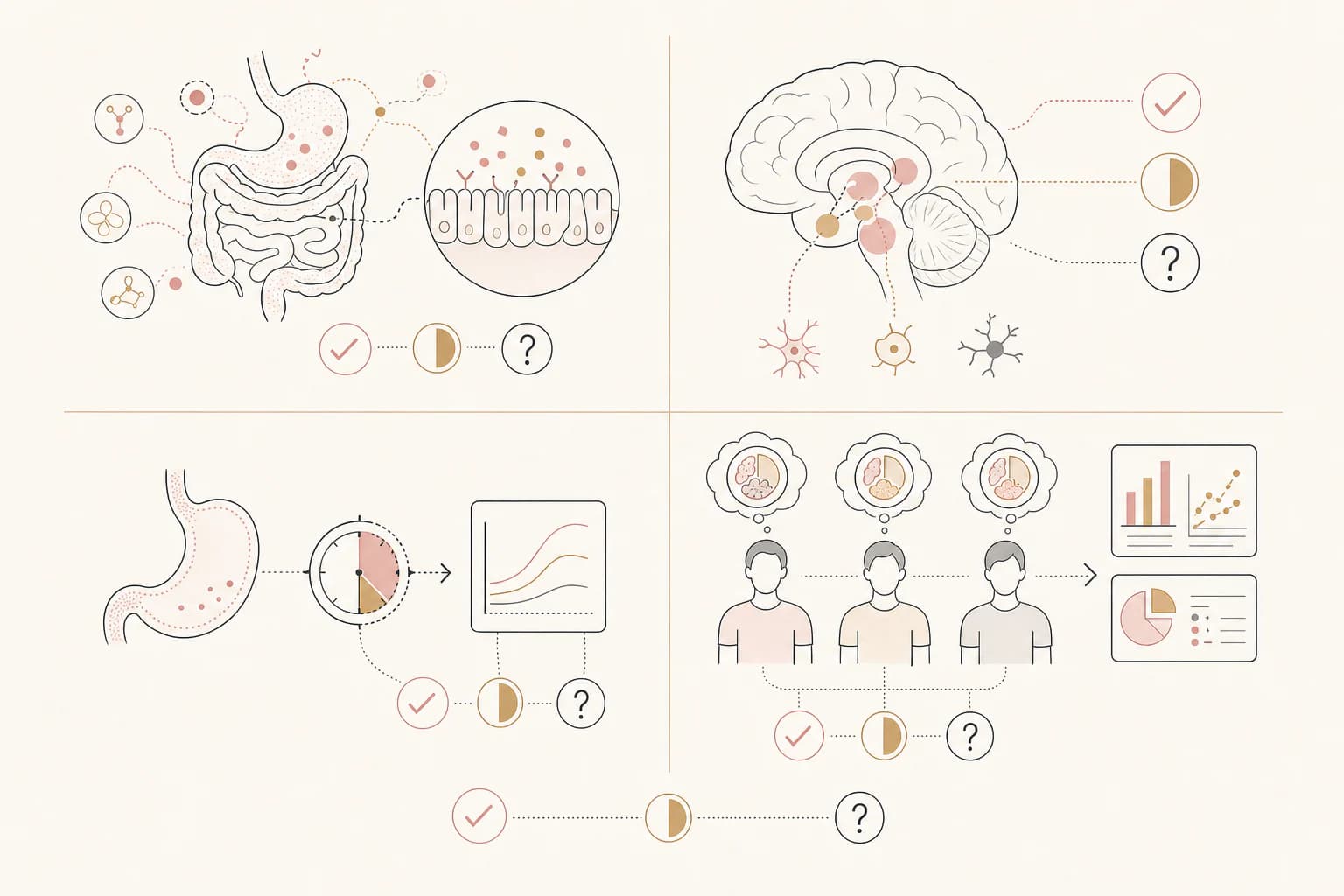
- Human, computational, and preclinical studies examine distinct appetite layers, including reported sensations, meal intake, food reward, modeled pathways, and neural signals.4
For Filipino readers, appetite science can sound more certain online than it does in research. One headline may mention hunger, another “food noise,” and another the gut-brain axis. The studies actually measure different things: feelings, meal intake, reward scales, biological signals, or simulations.4 Keeping those layers separate makes semaglutide’s appetite story clearer and more accurate.4
Appetite is more than one signal
The strongest human study here treated appetite as a set of measurable outcomes.1 Researchers followed 120 adults with overweight or obesity for 60 weeks.1 Participants were randomly assigned to semaglutide or placebo in a double-blind design.1 At several visits, they rated hunger before and after a standard breakfast.1 They also ate a lunch where intake could vary freely.1 A separate scale measured responsiveness to food and food preoccupation.1
These endpoints answer related but different questions.4 A person’s rating describes an internal sensation, while meal intake records behavior in one controlled setting.12 Food-reward scales capture another part of eating motivation.5 The design gives appetite several windows, rather than forcing it into one score.4 That separation helps readers avoid treating every appetite measure as the same outcome.4
For readers exploring the topic, the Semaglutide card below is a neutral catalog reference. It provides live catalog details, not research evidence or a recommendation.
The clearest long-term signal was meal intake
The laboratory lunch produced the most consistent result across the trial’s later visits.2 Compared with placebo, the semaglutide group consumed less energy at weeks 20, 40, and 60.2 That pattern continued even when some reported appetite effects became less distinct.26 It explains why “feeling less hungry” and “eating less” should not be used as identical phrases.26 One is a subjective report; the other is observed intake during a structured meal.1 The trial supports a sustained difference in that laboratory behavior.2 It does not turn one lunch into a full picture of eating at home, at work, or during celebrations.2 The useful conclusion is narrow: lower measured energy intake persisted across three scheduled assessments.2
Subjective hunger changed on a different timeline
At week 20, the semaglutide group reported greater appetite suppression after breakfast than placebo.3 They also reported larger reductions in hunger and food preoccupation over the prior week.3 Those findings fit the familiar language of feeling fuller or thinking about food less often.3 Yet the same between-group pattern did not remain significant for subjective appetite outcomes at weeks 40 or 60.6 This is not a contradiction.26 It shows that reported sensations and observed meal intake can follow different timelines.26 The laboratory meal difference persisted at both later visits.2 Careful reading avoids a sweeping claim that every appetite signal stays equally changed.236 The trial supports a more textured account of adaptation over time.26
Food reward adds another piece
Food reward is related to hunger, but the trial measured it separately.15 The semaglutide group showed larger reductions in responsiveness to food at weeks 20 and 40.5 The abstract did not state a significant between-group difference for that measure at week 60.5 Responsiveness to food can reflect how strongly food cues pull attention or motivation.5 It should not be confused with an addiction diagnosis or a direct brain scan.5 In this study, it came from a questionnaire scale.15 This distinction matters because everyday phrases like “food noise” can combine several experiences.135 The research separates past-week hunger, food preoccupation, post-meal appetite suppression, and responsiveness to food.135 Each measure contributes one part of the appetite picture.4
Withdrawal research links the gut and brain cautiously
A smaller study followed 28 women with obesity through treatment and a 12-week withdrawal period.7 Appetite rebound and weight regain were common after withdrawal.7 Because the human study had one group and no concurrent control, it cannot isolate every cause of those changes.7 The researchers also ran parallel experiments in female rats.8 After withdrawal, the animals showed changes in gut microbiota, bile acids, and hypothalamic appetite-pathway signals.8 Those findings offer a biological route worth investigating.8 They do not prove that identical pathways drove every human participant’s experience.8 The human and animal arms contribute different evidence: observed patterns in women, and mechanistic clues in rats.78
For readers comparing another incretin research topic, the Tirzepatide card below is a separate neutral catalog reference. It does not imply compatibility, equivalence, or a recommendation.
A model can connect signals without observing them
The SemaGBA project approached the gut-brain axis through computation.9 Its system-dynamics model linked 14 metabolic and neural variables.9 These included net energy intake, glucose, insulin, leptin, AgRP, POMC, and dopamine activity.9 The researchers calibrated part of the model against clinical weight and glucose outcomes.9 They then used simulations to generate hypotheses about longer-term connections.10 This helps researchers ask how many feedback loops might interact.910 However, a modeled neuron variable is not a direct recording from a person’s brain.9 The authors also noted that available data limited validation.10 SemaGBA should be read as a map for future questions, not as direct proof of every proposed pathway.10
Hindbrain experiments move closer to mechanism
A preclinical study focused on GLP-1-receptor-expressing neurons in the area postrema, a hindbrain region.11 The researchers described distinct activation patterns across neuron clusters.11 At the cellular level, semaglutide engaged both Gs- and Gq-dependent signaling.12 It also produced graded increases in cAMP within those neurons.12 Disrupting Gs or cAMP signaling changed downstream responses in the experimental system.12 These results help define intracellular machinery behind semaglutide’s neural action.1112 Still, neural activation is not the same endpoint as a person reporting fullness.11 The study belongs in preclinical mechanism research, beside the human meal and questionnaire data.111 That boundary preserves what the experiment can genuinely show.1112
Reward-circuit findings remain animal evidence
Another experiment studied healthy mice rather than people with obesity or diabetes.13 Semaglutide altered behavior in tests related to stress and reward pursuit.13 It also changed oscillatory activity in the nucleus accumbens across several frequency bands.13 The work broadens the preclinical picture beyond classic homeostatic appetite pathways.13 Yet mouse behavior does not translate directly into human motivation, mood, or eating choices.13 The population context matters too: these were healthy animals, not clinical trial participants.13 The finding is best read as a signal for more neuroscience, not a shortcut to claims about human reward.13 Alongside the hindbrain study, it shows how researchers probe different neural layers with different tools.111213
Bottom line
Semaglutide’s appetite story is not a single switch in the brain or gut.4 In a 60-week human trial, laboratory energy intake stayed lower at three visits.2 Reported hunger and appetite suppression showed clearer differences earlier than later.36 Food responsiveness followed its own pattern.5 A small withdrawal study connected human observations with separate rat findings, while a computational model linked possible feedback loops.789 Preclinical neuroscience then examined hindbrain signaling and reward-related activity.111213 Together, the studies support a layered explanation, provided each layer keeps its original context.4
This article is educational research context, not medical advice. Catalog links are neutral references and do not imply a treatment or human-use recommendation.
Frequently asked questions
Does semaglutide simply switch off hunger?
The human trial shows a more complicated pattern.236 Reported hunger and post-breakfast appetite suppression differed more at week 20.3 Those subjective differences were not significant at weeks 40 or 60, even though lower laboratory meal intake continued.26 Different appetite measures can move differently over time.4
What did researchers measure besides hunger?
They measured fasting and post-breakfast appetite, past-week hunger, food preoccupation, responsiveness to food, and energy eaten at a laboratory lunch.135 Each endpoint captures a different part of eating behavior or motivation.4 None alone represents every meal choice or every experience with food.12
Is “food noise” a scientific endpoint?
The trial used more specific measures, including food preoccupation and responsiveness to food.35 Those can overlap with what people informally call food noise, but they remain distinct questionnaire outcomes.15 The clearest account names the measured endpoint instead of treating a popular phrase as one settled biological signal.4
What does the withdrawal study add?
It followed 28 women and recorded appetite rebound and weight regain during a 12-week withdrawal period.7 Parallel rat experiments found changes in gut microbiota, bile acids, and hypothalamic signals.8 The animal findings offer mechanistic clues, but they cannot prove the same pathway caused each human change.78
Can researchers see these appetite pathways directly?
Different methods provide different views.4 A computational model connected metabolic and neural variables without directly observing human brain activity.910 Preclinical experiments measured cellular signaling and neural rhythms in animal systems.111213 Human trials measured reported appetite and eating behavior instead.12
What should Filipino readers take from this research?
Match every conclusion to its study design.4 Randomized human data best support the meal and questionnaire findings.12 Rat studies, mouse studies, and computational models offer pathway clues rather than direct human experiences.8913 This approach keeps the science informative without turning mechanisms into promises.4
Sources
Footnotes
-
Short- and long-term effects of semaglutide 2.4 mg on energy intake, appetite, and food reward: a 60-week, double-blind randomized controlled trial.. Human randomized controlled trial with repeated laboratory assessments. The participants and controlled setting do not represent every population or eating environment. ↩ ↩2 ↩3 ↩4 ↩5 ↩6 ↩7 ↩8 ↩9 ↩10 ↩11 ↩12 ↩13 ↩14 ↩15 ↩16 ↩17 ↩18 ↩19
-
Short- and long-term effects of semaglutide 2.4 mg on energy intake, appetite, and food reward: a 60-week, double-blind randomized controlled trial.. Human randomized trial; laboratory meal endpoint. A measured laboratory meal is not a complete record of everyday eating. ↩ ↩2 ↩3 ↩4 ↩5 ↩6 ↩7 ↩8 ↩9 ↩10 ↩11 ↩12 ↩13 ↩14 ↩15 ↩16 ↩17 ↩18 ↩19 ↩20
-
Short- and long-term effects of semaglutide 2.4 mg on energy intake, appetite, and food reward: a 60-week, double-blind randomized controlled trial.. Human randomized trial; subjective appetite measures. These between-group differences were specific to the week-20 assessment. ↩ ↩2 ↩3 ↩4 ↩5 ↩6 ↩7 ↩8 ↩9 ↩10 ↩11 ↩12
-
Short- and long-term effects of semaglutide 2.4 mg on energy intake, appetite, and food reward: a 60-week, double-blind randomized controlled trial.; Post-semaglutide weight regain in females with obesity: Associations with gut microbiota, bile acid metabolism, and central nervous system.; SemaGBA: A System Dynamics Model of the Semaglutide-Responsive Gut-Brain Axis A Model of How the Brain and Semaglutide Regulate Appetite and Weight.; Semaglutide drives weight loss through cAMP-dependent mechanisms in GLP1R-expressing hindbrain neurons.; Semaglutide alters behaviour and nucleus accumbens oscillatory activity in healthy mice.. Synthesis across human, computational, and preclinical research. The layers are complementary but cannot be treated as interchangeable evidence. ↩ ↩2 ↩3 ↩4 ↩5 ↩6 ↩7 ↩8 ↩9 ↩10 ↩11 ↩12 ↩13 ↩14 ↩15
-
Short- and long-term effects of semaglutide 2.4 mg on energy intake, appetite, and food reward: a 60-week, double-blind randomized controlled trial.. Human randomized trial; food-reward questionnaire endpoint. Food responsiveness is one measured dimension of food reward. ↩ ↩2 ↩3 ↩4 ↩5 ↩6 ↩7 ↩8 ↩9 ↩10 ↩11 ↩12 ↩13
-
Short- and long-term effects of semaglutide 2.4 mg on energy intake, appetite, and food reward: a 60-week, double-blind randomized controlled trial.. Human randomized trial; later subjective appetite assessments. This does not negate the lower laboratory energy intake measured at those visits. ↩ ↩2 ↩3 ↩4 ↩5 ↩6 ↩7 ↩8 ↩9 ↩10
-
Post-semaglutide weight regain in females with obesity: Associations with gut microbiota, bile acid metabolism, and central nervous system.. Small human single-arm interventional study with a withdrawal period. Without a concurrent control group, the study cannot isolate the cause of every post-withdrawal change. ↩ ↩2 ↩3 ↩4 ↩5 ↩6 ↩7
-
Post-semaglutide weight regain in females with obesity: Associations with gut microbiota, bile acid metabolism, and central nervous system.. Animal experiments conducted alongside the human study. The pathway findings in rats cannot be assumed to occur identically in people. ↩ ↩2 ↩3 ↩4 ↩5 ↩6 ↩7 ↩8 ↩9
-
SemaGBA: A System Dynamics Model of the Semaglutide-Responsive Gut-Brain Axis A Model of How the Brain and Semaglutide Regulate Appetite and Weight.. Computational modeling study calibrated partly against clinical outcomes. Modeled variables and simulations are not direct observations of human brain activity. ↩ ↩2 ↩3 ↩4 ↩5 ↩6 ↩7 ↩8 ↩9
-
SemaGBA: A System Dynamics Model of the Semaglutide-Responsive Gut-Brain Axis A Model of How the Brain and Semaglutide Regulate Appetite and Weight.. Computational modeling study. The model should be read as a hypothesis-generating framework. ↩ ↩2 ↩3 ↩4 ↩5
-
Semaglutide drives weight loss through cAMP-dependent mechanisms in GLP1R-expressing hindbrain neurons.. Preclinical mechanistic neuroscience study. The experiment does not establish a directly measured conscious appetite experience in humans. ↩ ↩2 ↩3 ↩4 ↩5 ↩6 ↩7 ↩8 ↩9
-
Semaglutide drives weight loss through cAMP-dependent mechanisms in GLP1R-expressing hindbrain neurons.. Preclinical cellular and neural signaling experiments. Intracellular signaling results should remain in their preclinical context. ↩ ↩2 ↩3 ↩4 ↩5 ↩6 ↩7 ↩8
-
Semaglutide alters behaviour and nucleus accumbens oscillatory activity in healthy mice.. Animal study in healthy mice. Mouse behavior and brain rhythms do not establish the same effects in people. ↩ ↩2 ↩3 ↩4 ↩5 ↩6 ↩7 ↩8 ↩9 ↩10 ↩11