
TL;DR
- BPC-157 gym talk fits an older forum pattern in which peers exchange performance-drug experiences, practical questions, risk concerns, and requests for reliable guidance.1
- A 2025 sports-medicine review included 36 BPC-157 studies through June 2024, with 35 preclinical records and one clinical report.2
- Rat tendon and ligament experiments produced favorable measurements, but those surgical models cannot establish recovery outcomes for a person with a gym injury.3
- The small human record was an uncontrolled phone follow-up, while FDA separately flags compounding concerns involving immune reactions, impurities, and ingredient characterization.4
In the Philippines, gym knowledge often arrives as a conversation before it arrives as a paper: a training partner mentions a podcast, a coach forwards a clip, or a group chat repeats a forum story. That familiar path can make BPC-157 sound settled. The useful question for Filipino readers is not who repeated the claim, but which kind of evidence sits underneath it.5
First, separate the name from the promise
BPC-157 is described in sports-medicine literature as a gastric pentadecapeptide, or a chain of 15 amino acids.6 The name can sound technical enough to carry authority. Yet a chemical label does not tell us whether an injured person recovers faster.6
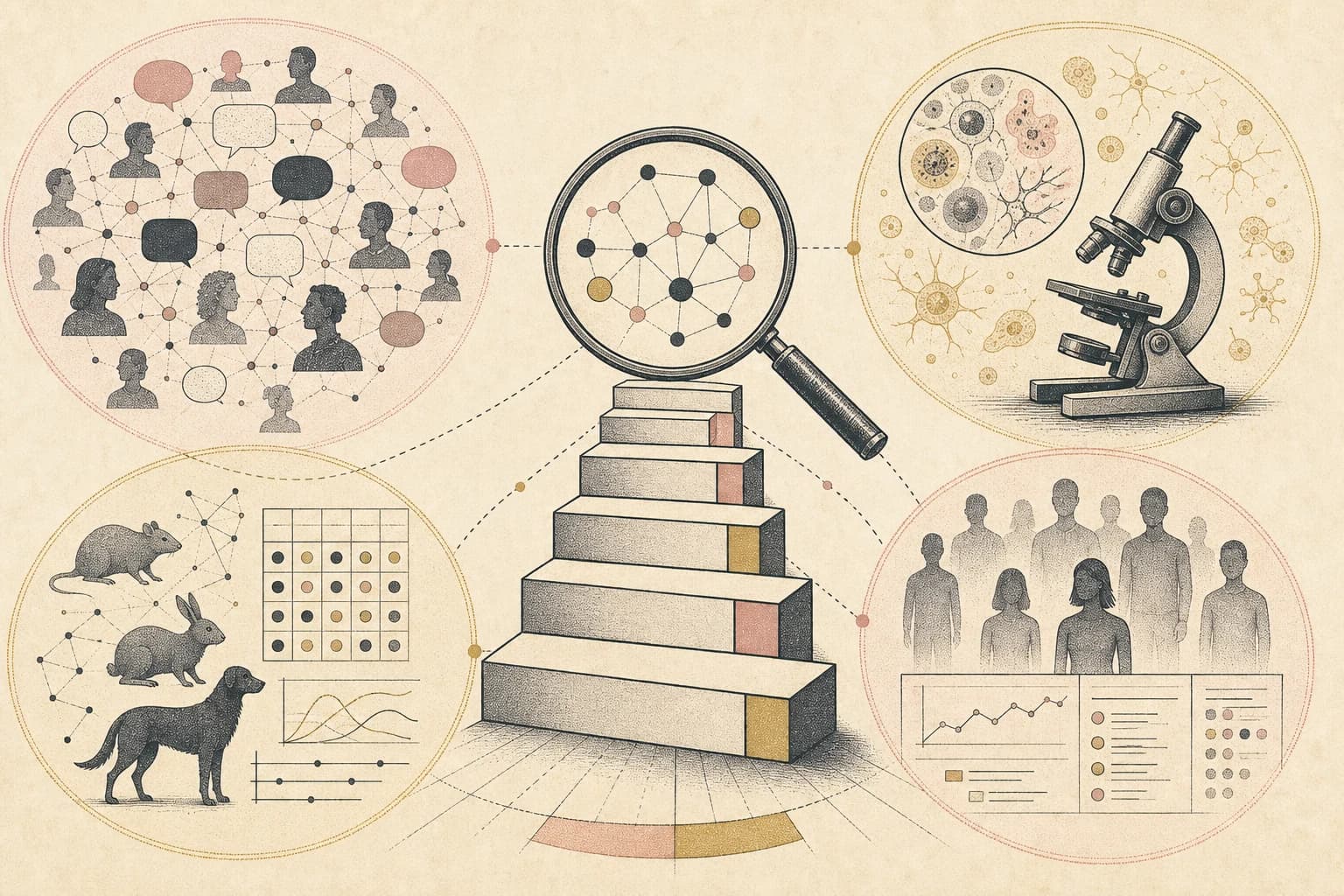
The evidence trail contains very different objects: forum posts, isolated rat cells, surgically injured animals, a small human chart review, a trial protocol, and a regulatory safety page.5 Each object answers a different question.5 A cell experiment can suggest a pathway.7 A rat study can measure tissue under controlled conditions.3 A human comparison would need to test a defined outcome in people.2 Keeping those layers separate is the first defense against a confident gym story becoming a scientific conclusion.5
BPC-157 is named here only to introduce the following neutral catalog reference.6
Why forum language travels so well
A study of three performance- and image-enhancing drug forums found members exchanging experience, practical information, risk discussion, and requests for trustworthy guidance.1 The study did not examine the Philippines or BPC-157 specifically.1 It still shows the social format that makes a recovery story portable: one person asks, another reports an experience, and a third translates it into a rule.1
That format feels useful because it is concrete. “My elbow felt better” is easier to repeat than a paragraph about study design.1 But a personal timeline has no comparison group and cannot isolate the reason for change.8 Rest, rehabilitation, changing training load, natural recovery, and expectation can all sit beside the experience.8 The responsible move is not to mock the story. It is to stop the story from carrying more certainty than its design can support.8
The research base is mostly preclinical
The 2025 systematic review searched PubMed, Cochrane, and Embase through June 3, 2024.2 It identified 544 records before screening and included 36 studies.2 Thirty-five were preclinical, while one was clinical.2 That balance matters more than the raw number of search hits.2
“Preclinical” covers research done before strong participant-level testing, including cell and animal models.2 Such work can help researchers define mechanisms, select measurements, and decide what deserves further study.2 It cannot be pooled into a hidden human trial.5 Ten favorable rat papers remain ten rat papers.2
The review count also has a date and eligibility rules.2 It should not be turned into the claim that another record could never exist.2 Its narrower message is enough: the musculoskeletal literature it included was overwhelmingly based on models outside controlled human research.2
What the tendon and ligament studies measured
One experiment created complete Achilles-tendon transections in rats and followed measurements for 14 days.3 Compared with saline controls, BPC-157 groups had better scores across function, biomechanics, microscopy, and gross anatomy.3 Those are relevant research outcomes inside that surgical model.3 They are not reports about a Filipino lifter’s sore shoulder, tendon irritation, or return to training.3
A separate study surgically transected the medial collateral ligament in rats.9 Researchers reported better functional, biomechanical, macroscopic, and tissue findings across several exposure routes during follow-up lasting as long as 90 days.9
The repeated positive direction helps explain why the papers are easy to quote in recovery discussions.3 The boundary is just as important: species, created injury, route, timing, and measurement all differ from ordinary human gym problems.9 The proper sentence must end by naming the rats and study conditions.9
A mechanism clue is not a recovery forecast
Another study used tendon fibroblasts isolated from rat Achilles tendons.7 Fibroblasts are cells involved in producing and organizing connective-tissue material.7 Under the tested laboratory conditions, BPC-157 increased growth hormone receptor expression at RNA and protein levels.7 When researchers later added growth hormone, measured cell proliferation also increased.7
This is the sort of pathway detail that can acquire a dramatic life online. A receptor rises, an arrow appears in a diagram, and the next retelling becomes “faster recovery.” The experiment did not measure a person, pain, training capacity, or return to sport.7 It measured prepared rat cells in a controlled setting.7
Mechanism work is valuable because it can sharpen later questions.7 It does not skip the need for participant-level testing.5 In plain language, a biological clue explains why researchers may keep looking; it does not tell a gym member what will happen.7
The small human report needs its full frame
The human report most often attached to the musculoskeletal story was a retrospective chart review from one U.S. practice.10 Investigators reached 16 of 17 patients by telephone.10 Twelve had received BPC-157 alone, while four had received BPC-157 with TB4.10 Among the BPC-157-only subgroup, 11 of 12 described significant pain improvement.8
That number sounds striking until its frame returns.8 There was no control group, follow-up varied, diagnoses were mixed, and the survey used no specific measures for function, quality of life, stiffness, or daily activity.10 The combination subgroup also prevents every response from being assigned to one substance.10
This report is human experience, so it should not be erased.10 It is also an uncontrolled observation, so it should not be promoted into a reliable estimate of effect.8 Both statements can be true at once.8
TB-500 is named here only to introduce the following neutral catalog reference.
Regulation asks a different question
ClinicalTrials.gov contains a phase 1 pilot protocol designed to study BPC-157 safety and pharmacokinetics in healthy volunteers aged 18 to 35.11 Pharmacokinetics means tracking how a substance moves through and leaves the body.11 The registry page describes a planned question and protocol; it does not establish a favorable outcome.11
FDA’s compounding record addresses product-quality and safety concerns instead of athletic recovery.4 It says compounded drugs containing BPC-157 may pose immune-response risks for certain routes and may involve peptide impurities or difficulties confirming the active ingredient.4 FDA lists similar immune-response and impurity concerns for thymosin beta-4 fragment, also called TB-500.12
These records answer safety and research questions within their stated contexts.4 Their useful lesson is narrower: biological activity, human benefit, and product quality are separate questions.5 Evidence for one cannot silently answer the others.5
Bottom line
For Filipino readers, BPC-157 can feel conversationally familiar because its story is portable: an injury, a technical name, favorable animal findings, and personal reports that are easy to retell.5 Research confirms pieces of that story, but not as one continuous promise.5
The cited cell work concerns rat fibroblasts.7 The stronger-looking tissue results come from surgical rat models.3 The human report is small, retrospective, and uncontrolled.10 FDA’s record raises separate compounding concerns.4 For Filipino readers, the soundest habit is simple: ask what was studied, in which model, against what comparison, and with which outcome.5 That keeps gym conversation useful without mistaking familiarity for proof.1
This article is educational research context, not medical advice. Catalog links are neutral references and do not imply a treatment or human-use recommendation.
Frequently asked questions
What does BPC-157 mean?
The sports-medicine review describes BPC-157 as a gastric pentadecapeptide.6 “Pentadecapeptide” simply means a chain of 15 amino acids.6 That identity explains the name, not a recovery outcome.6 Chemical description, biological activity, human evidence, and finished-product quality remain separate questions.5
Why do gym anecdotes sound convincing?
Anecdotes have a person, a timeline, and a clear before-and-after story. Forum research shows that peers exchange experience alongside practical and risk information.1 Yet an uncontrolled story cannot separate one suspected cause from rest, rehabilitation, changing activity, expectation, or natural recovery.8
Did the animal studies show anything useful?
Yes, within their models. Rat Achilles-tendon groups had better functional, biomechanical, microscopic, and gross measures than controls after surgical transection.3 A rat ligament experiment also reported better measures across several categories.9 Those findings guide research questions but do not establish a human recovery result.3
Was there a human BPC-157 study?
The cited retrospective report contacted 16 patients from one practice; 12 had received BPC-157 alone and four had received it with TB4.10 It recorded favorable self-reports, but lacked a control group and specific measures of function or daily activity.10 Its design supports observation, not a firm effect estimate.8
What does a trial-registry entry prove?
A registry entry can document what researchers planned to study. The cited phase 1 record describes safety and pharmacokinetic questions in healthy volunteers.11 It does not, by its existence, demonstrate that the substance produced a positive outcome.11 Protocol and result are different parts of the research process.11
Why is TB-500 mentioned beside BPC-157?
The human chart review included a small subgroup that received BPC-157 with TB4, so the two names appear together in that record.10 FDA separately identifies thymosin beta-4 fragment as TB-500 in its compounding safety page.12 Neither connection proves that the substances work together or share outcomes.12
Sources
Footnotes
-
Information sought, information shared: exploring performance and image enhancing drug user-facilitated harm reduction information in online forums. Thematic analysis of threads from three forums serving performance- and image-enhancing drug communities. The forums were not Philippine communities, and the study did not measure BPC-157 discussion specifically. ↩ ↩2 ↩3 ↩4 ↩5 ↩6 ↩7
-
Emerging Use of BPC-157 in Orthopaedic Sports Medicine: A Systematic Review. Systematic search of PubMed, Cochrane, and Embase for mechanism, musculoskeletal, metabolism, and safety records. The count reflects the review's search date, eligibility criteria, and definitions rather than an all-time proof of what exists. ↩ ↩2 ↩3 ↩4 ↩5 ↩6 ↩7 ↩8 ↩9 ↩10 ↩11 ↩12
-
Gastric pentadecapeptide BPC 157 accelerates healing of transected rat Achilles tendon and in vitro stimulates tendocytes growth. Controlled surgical injury experiment in rats with repeated measurements through day 14. A surgically transected rat tendon under laboratory conditions does not establish recovery in an injured person. ↩ ↩2 ↩3 ↩4 ↩5 ↩6 ↩7 ↩8 ↩9 ↩10
-
Certain Bulk Drug Substances for Use in Compounding that May Present Significant Safety Risks. Current U.S. FDA assessment of bulk drug substances proposed for compounding. This is a U.S. compounding safety assessment, not a Philippine regulatory-status statement or an assessment of any specific catalog item. ↩ ↩2 ↩3 ↩4 ↩5
-
Information sought, information shared: exploring performance and image enhancing drug user-facilitated harm reduction information in online forums; Emerging Use of BPC-157 in Orthopaedic Sports Medicine: A Systematic Review; Pentadecapeptide BPC 157 enhances the growth hormone receptor expression in tendon fibroblasts; Intra-Articular Injection of BPC 157 for Multiple Types of Knee Pain; Phase I, Pilot Study in Healthy Volunteers, to Assess the Safety and Pharmacokinetics of PCO-02, Which Active Ingredient is BPC-157, a Penta-deca-peptide From Gastric Source; Certain Bulk Drug Substances for Use in Compounding that May Present Significant Safety Risks. Synthesis of distinct source types used to explain why model and source category must stay attached to each statement. These sources answer different questions and should not be combined into a single claim of human effectiveness, safety, or local prevalence. ↩ ↩2 ↩3 ↩4 ↩5 ↩6 ↩7 ↩8 ↩9 ↩10 ↩11 ↩12
-
Emerging Use of BPC-157 in Orthopaedic Sports Medicine: A Systematic Review. 2025 systematic review defining the subject and its sports-medicine research context. A research name and chemical length do not establish a clinical effect or the identity and quality of a catalog item. ↩ ↩2 ↩3 ↩4 ↩5 ↩6
-
Pentadecapeptide BPC 157 enhances the growth hormone receptor expression in tendon fibroblasts. Cell-culture experiment measuring RNA, protein, signaling, and proliferation in rat tendon fibroblasts. A receptor-expression change in isolated rat cells is a mechanism clue, not evidence of faster recovery in people. ↩ ↩2 ↩3 ↩4 ↩5 ↩6 ↩7 ↩8 ↩9 ↩10
-
Intra-Articular Injection of BPC 157 for Multiple Types of Knee Pain. Patient-reported telephone follow-up after a retrospective chart review. The small uncontrolled survey cannot separate an exposure effect from placebo response, natural change, other care, diagnosis differences, or reporting bias. ↩ ↩2 ↩3 ↩4 ↩5 ↩6 ↩7 ↩8 ↩9
-
Pentadecapeptide BPC 157 (PL 14736) improves ligament healing in the rat. Rat ligament-injury experiment followed for as long as 90 days. The species, created injury, exposure routes, and endpoints differ from ordinary gym injuries and human outcomes. ↩ ↩2 ↩3 ↩4 ↩5
-
Intra-Articular Injection of BPC 157 for Multiple Types of Knee Pain. One-year chart review from a single U.S. practice with variable follow-up. The report had no control group, used mixed diagnoses and exposures, and did not use specific tools for function, quality of life, stiffness, or daily activity. ↩ ↩2 ↩3 ↩4 ↩5 ↩6 ↩7 ↩8 ↩9 ↩10
-
Phase I, Pilot Study in Healthy Volunteers, to Assess the Safety and Pharmacokinetics of PCO-02, Which Active Ingredient is BPC-157, a Penta-deca-peptide From Gastric Source. Official trial-registry protocol record. A registry description documents a planned study question and design; it does not establish a positive result. ↩ ↩2 ↩3 ↩4 ↩5 ↩6
-
Certain Bulk Drug Substances for Use in Compounding that May Present Significant Safety Risks. Current U.S. FDA compounding safety record for thymosin beta-4 fragment. The statement concerns the named fragment in a U.S. compounding review and does not describe Philippine access, status, or a catalog product. ↩ ↩2 ↩3