
TL;DR
- In the Philippines, useful checks begin with named FDA records—such as product registration, establishment licensing, and GMP certification—not a seller’s polished “grade” label.1
- A real certificate of analysis should connect one named material and batch to actual tests, acceptance limits, and numerical results.2
- “Compounded” is not another word for approved generic: the United States FDA says compounded drugs do not receive its premarket review for safety, effectiveness, or quality.3
- BPC-157 and TB-500 each appear in U.S. FDA compounding safety information, but those records are jurisdiction-specific assessments and not tests of catalog items.4
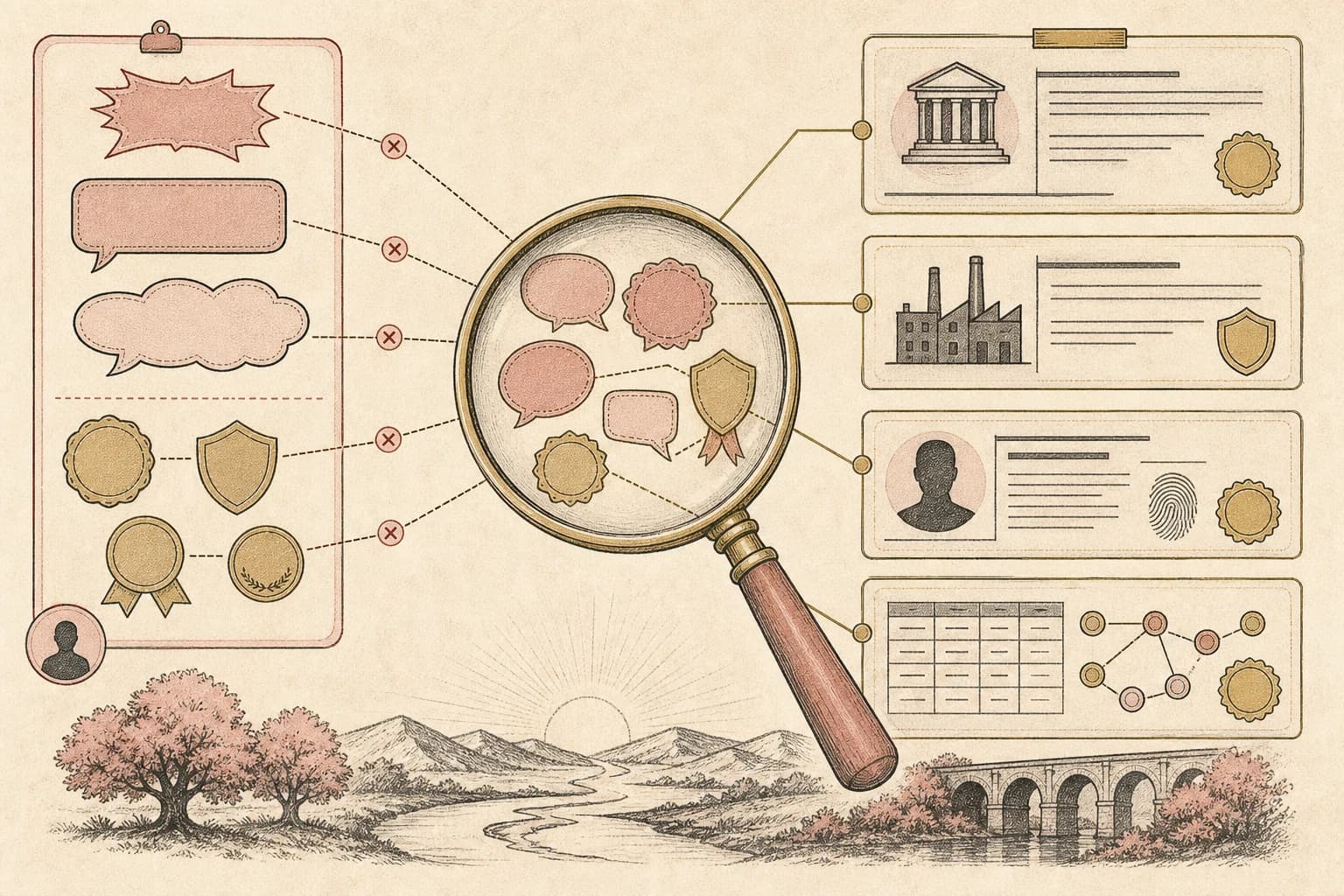
For Filipino readers, phrases like “hospital grade,” “pharma grade,” “clinical grade,” and “lab tested” can sound official before any document appears. The practical question is not whether the label feels reassuring. It is whether the seller can connect the exact item to records that name the product, facility, batch, tests, limits, and issuing body. That shift turns a slogan into a checkable claim.
Translate the phrase into a document
Start by asking what the phrase is supposed to prove. “Hospital grade” might suggest a supply channel, while “pharma grade” might suggest a material specification. Neither idea becomes evidence until it points to a named record.1 The Philippine FDA portal publishes concrete categories, including registered health products, licensed establishments, approved clinical trials, and GMP-certified manufacturers.1 Those categories let readers separate four questions: Who made it? Who may operate? What product was registered? What standard or authorization is being claimed?
A seller label cannot answer all four at once.1 The useful reply is specific: a registration entry, current licence, GMP certificate, or batch document that can be matched and checked.1
For readers looking for the exact topic, the BPC-157 card below opens its live catalog details.
Registration and manufacturing answer different questions
Product registration and GMP evidence are related, but they are not interchangeable.1 The Philippine portal lists registered products separately from licensed establishments and GMP-certified manufacturers.1 A facility record therefore should not be presented as if it were a product registration entry.1
GMP also has a precise scope. The Philippine FDA-hosted PIC/S guide defines it as part of quality management for consistent production and control.5 Its basic elements include defined processes, validation, trained staff, suitable facilities, records, production controls, and quality control.5 That is much broader than a purity number on a sales page.5
Ask for the facility name, certificate details, scope, and current record.5 Then check whether the named manufacturer and product trail actually connect.1 “Made in a GMP facility” is only the start of that chain.5
A certificate of analysis should be batch-specific
A certificate of analysis, often shortened to COA, is strongest when it behaves like a traceable batch record.2 Q7 says an authentic COA should name the material, identify the batch, list every required test, state each acceptance limit, and provide numerical results.2 This structure lets a reader compare what was required with what the laboratory reported.2
Traceability continues beyond the table. Q7 says the certificate should be dated and signed by authorized quality staff and should identify the original manufacturer.6 It also calls for supplier evaluation and regular checks on certificate reliability.6
A screenshot showing only “99%” leaves those links unstated.2 Ask which batch was tested, which method was used, what limit applied, and who issued the record.2 The answers should belong to the same item, not a sample or batch with another identifier.2
Purity is one result, not the whole quality story
“High purity” may describe one analytical result, but it does not automatically answer identity, strength, contamination, sterility, or manufacturing-control questions.7 FDA describes product-specific drug review as requiring evidence that manufacturing can reliably deliver expected identity, strength, quality, and purity.7 The four words sit together because each addresses a different part of the finished-product case.7
The grade field also needs context. Q7 places an appropriate grade designation beside the named material and batch on a COA.8 It does not make “grade” a free-standing verdict.8 A useful record names the specification behind that designation and shows the matching tests and limits.2
This is why a long list of badges can still be thin evidence.2 Translate every badge into a document, issuer, scope, date, and batch connection. If the details do not connect, the phrase remains a description rather than proof.
“Compounded” does not settle approval or quality
Compounding is a separate regulatory idea and is not another name for a pharmaceutical grade.3 Under the United States framework, compounded drugs are not FDA-approved, and FDA does not verify their safety, effectiveness, or quality before they are marketed.3 The agency also distinguishes a compounded drug from an approved generic drug.9
That distinction matters when seller copy blends “custom,” “pharmacy,” “generic,” and “approved” into one impression. Each word needs its own support. FDA notes that poor compounding practices can produce contamination or the wrong amount of active ingredient.9 That is a general risk statement, not evidence that any specific item has failed.9
For a Filipino reader, the U.S. rule should stay in its lane. It explains what a U.S. claim means; it does not decide Philippine status.3 Philippine checks should return to the local FDA portal and the exact authorization asserted.1
Research-use labels do not erase surrounding claims
“For research use only” describes an intended boundary, but the rest of a seller’s presentation still matters. In a 2025 warning letter, the U.S. FDA reviewed one peptide seller that used “research use only,” “lab purposes only,” and similar disclaimers.10 FDA concluded that other website content showed intended human drug use.10
That letter is narrow evidence.10 It concerns one seller, one set of pages, and United States law; it is not a ruling about every research supplier or the Philippines.10 Its useful lesson is about consistency. A disclaimer should not be read alone when adjacent copy points in another direction.10
Readers can compare the label with the full page: product descriptions, testimonials, bundles, instructions, and promised outcomes. The point is not to guess a seller’s motives. It is to notice whether the words support one coherent, document-backed purpose.
Named peptides show why exact records matter
The U.S. FDA’s compounding safety page discusses BPC-157 in terms of possible immune-response concerns for certain routes, peptide impurities, and active-ingredient characterization.4 FDA also says its safety information for the proposed routes is limited.4 This is a regulatory safety assessment, not a result from testing any catalog item.4
The same page discusses the thymosin beta-4 fragment known as TB-500.11 It cites possible immune-response concerns linked to aggregation and peptide impurities, alongside limited safety information.11 Again, the scope is U.S. compounding and the named fragment, not a universal verdict on every similarly labelled product.11
These records show why broad grade language is too coarse. Peptide identity, impurity control, and characterization require exact documentation.4 A seller adjective cannot transfer an agency assessment into product proof.
For readers looking for the exact topic, the TB-500 card below opens its live catalog details.
Use a proof ladder, not a trust shortcut
Begin with the exact claim: registered product, licensed establishment, GMP-certified maker, tested batch, or research material. Then request the record that fits it. The Philippine FDA portal exposes separate categories for several of these checks.1 Its own disclaimer says portal data supports verification but does not replace an FDA-issued certification.12
Next, match names and identifiers across the trail. The product, manufacturer, batch, dates, laboratory, tests, and acceptance limits should agree where each applies.2 A COA should also identify authorized quality staff and the original manufacturer.6
Finally, keep official categories separate. WHO distinguishes an authorized product that fails specifications from an unregistered product and from a falsified one.13 Those labels describe different problems.13 Careful checking avoids both easy trust and unsupported accusations.
Bottom line
“Hospital grade,” “pharma grade,” “clinical grade,” “research grade,” and “lab tested” are prompts for questions, not endpoints.1 In the Philippines, start with the exact FDA record being claimed and verify the product, establishment, or manufacturer in the right category.1 For batch quality, look for a COA that names the material, batch, tests, limits, results, issuer, and original manufacturer.2 Keep GMP, registration, compounding, purity, and research-use status in separate lanes.5 Official sources give each lane a different meaning.13 The fair standard is neither instant belief nor instant accusation. It is a clean chain from words to documents, then from documents to the exact item being discussed.
This article is educational research context, not medical advice. Catalog links are neutral references and do not imply a treatment or human-use recommendation.
Frequently asked questions
Is “hospital grade” an FDA Philippines registration category?
The Philippine FDA advisory lists portal categories such as registered health products, licensed establishments, approved clinical trials, and GMP-certified manufacturers.1 Treat “hospital grade” as a claim that needs translation into one of the exact records the seller says supports it, rather than as proof by itself.
What should I look for on a certificate of analysis?
Look for the named material, batch number, tests performed, acceptance limits, and numerical results.2 Q7 also calls for a date, an authorized quality signature, and the original manufacturer’s details.6 Those fields help connect the document to one batch and accountable parties.
Does “99% purity” prove the whole product is high quality?
Purity is one part of a larger product-specific case. FDA describes manufacturing review in terms of expected identity, strength, quality, and purity.7 A percentage becomes more useful when its method, limit, batch, laboratory, and surrounding tests are visible on a matching record.2
Are “substandard,” “unregistered,” and “falsified” interchangeable?
No. WHO uses “substandard” for an authorized product that fails standards or specifications.13 “Unregistered” concerns missing evaluation or approval for that market, while “falsified” involves deliberate misrepresentation of identity, composition, or source.13 Evidence for one category should not be stretched into another.
Does a research-use-only disclaimer settle the issue?
Not always under U.S. intended-use analysis. In one 2025 warning letter, FDA said a peptide seller’s research disclaimers did not outweigh other website statements showing intended human drug use.10 That seller-specific U.S. action is a reading example, not a Philippine ruling.10
Can the Philippine FDA portal replace an official certificate?
No. FDA Philippines says the portal is a public verification tool, but its information is not regulatory advice and does not replace certifications the agency may issue.12 Use it to cross-check names and records, then request the exact certification when a formal claim depends on one.
Sources
Footnotes
-
FDA Advisory No. 2023-2238: Utilization of the Food and Drug Administration Verification Portal. Philippine FDA advisory describing the categories and purpose of its public Verification Portal. The portal is a verification resource, not regulatory advice or a substitute for an FDA-issued certification. ↩ ↩2 ↩3 ↩4 ↩5 ↩6 ↩7 ↩8 ↩9 ↩10 ↩11 ↩12 ↩13 ↩14
-
Q7 Good Manufacturing Practice Guidance for Active Pharmaceutical Ingredients. International GMP guidance hosted by the U.S. FDA for active pharmaceutical ingredients. The guidance concerns batch documentation; a document still has to match the item and batch being discussed. ↩ ↩2 ↩3 ↩4 ↩5 ↩6 ↩7 ↩8 ↩9 ↩10 ↩11 ↩12 ↩13
-
Compounding and the FDA: Questions and Answers. U.S. FDA consumer and professional guidance on human drug compounding. This statement describes the U.S. federal compounding framework and does not establish Philippine status for a specific product. ↩ ↩2 ↩3 ↩4
-
Certain Bulk Drug Substances for Use in Compounding that May Present Significant Safety Risks. Current U.S. FDA safety information for bulk substances nominated for compounding. This is a U.S. compounding assessment, not a test of a catalog item or a Philippine regulatory decision. ↩ ↩2 ↩3 ↩4 ↩5
-
PIC/S Guide to Good Manufacturing Practice for Medicinal Products, Part I. Official manufacturing guidance adopted for medicinal-product GMP compliance in the Philippines. A general claim of GMP does not by itself identify a facility, certificate, product, or batch. ↩ ↩2 ↩3 ↩4 ↩5 ↩6
-
Q7 Good Manufacturing Practice Guidance for Active Pharmaceutical Ingredients. GMP guidance covering certificates, supplier qualification, and incoming-material controls. A logo, cropped result, or seller summary does not provide all of the traceability described by the guidance. ↩ ↩2 ↩3 ↩4
-
FDA's Concerns About Unapproved Drugs. U.S. FDA explanation of the assurances attached to its drug-approval process. This U.S. description does not establish the authorization status of a product in the Philippines. ↩ ↩2 ↩3 ↩4
-
Q7 Good Manufacturing Practice Guidance for Active Pharmaceutical Ingredients. Certificate-of-analysis content requirements for intermediates and active pharmaceutical ingredients. The meaning of a grade depends on the named specification and tests; the word alone does not disclose those details. ↩ ↩2
-
Compounding and the FDA: Questions and Answers. U.S. FDA explanation of compounding quality risks and regulatory distinctions. This general risk statement does not show that a specific item is contaminated or has incorrect strength. ↩ ↩2 ↩3
-
USApeptide.com Warning Letter. Seller-specific U.S. enforcement correspondence assessing website labeling and intended use. A warning letter is not a general Philippine ruling and should not be generalized beyond its facts and jurisdiction. ↩ ↩2 ↩3 ↩4 ↩5 ↩6 ↩7
-
Certain Bulk Drug Substances for Use in Compounding that May Present Significant Safety Risks. Current U.S. FDA safety information for a TB-500-related bulk substance nominated for compounding. The statement is limited to the named fragment and U.S. compounding context and does not test a catalog item. ↩ ↩2 ↩3
-
FDA Advisory No. 2023-2238: Utilization of the Food and Drug Administration Verification Portal. Disclaimer and use conditions in the Philippine FDA portal advisory. Readers should resolve inconsistent entries through the portal's correction process rather than infer a regulatory conclusion. ↩ ↩2
-
Definitions of Substandard and Falsified Medical Products. Definitions adopted through WHO's Member State mechanism for medical-product quality incidents. These categories describe different problems and should not be collapsed into one accusation about a specific seller or item. ↩ ↩2 ↩3 ↩4 ↩5