
TL;DR
- Published records use overlapping names for a native C-terminal sequence and the modified peptide AOD9604, so each result needs its exact study label.1
- A rat-tissue test found an effect on lipid formation but no significant rise in glycerol release, so “fat loss” is too broad.2
- Rat and mouse studies reported changes in weight gain, fat oxidation, and tissue markers, but these outcomes do not establish a human result.3
- FDA says the largest human AOD9604 trial did not beat placebo on the reported weight comparisons at 12 or 24 weeks.4
For Filipino readers, the online story often sounds simple: isolate the “fat” end of growth hormone and expect the scale to follow. The research story is less tidy. Names overlap, experiments measure different things, and striking mouse results meet a negative large human trial.1 Reading those layers separately gives a far clearer picture than repeating the headline.
First, know which fragment is being discussed
Human growth hormone is a much larger protein, while HGH Fragment 176-191 refers to a short sequence near its C-terminal end.5 FDA describes AOD9604 as a synthetic peptide based on residues 177-191.5 It has 16 amino acids, an added N-terminal tyrosine, and a disulfide bond.5 That wording matters because older papers also discuss hGH 177-191 or call AOD9604 a modified C-terminal fragment.1 Similar names can point to related constructs without proving that every labeled material has the same structure, purity, or formulation.1 This is not mere wordplay: the structure named in a source sets the bounds of its result.5 The safest reading is to keep each result attached to the exact peptide named in that experiment.1
For readers looking for the exact topic, hgh-fragment-176-191 appears below as a neutral catalog reference, not research evidence or a recommendation.
“Lipolysis” and “fat loss” are not synonyms
Lipolysis describes the breakdown of stored triglycerides, often tracked through markers such as glycerol release.2 Lipogenesis refers to the formation and storage of lipids, so an antilipogenic result asks a different question.2 In 1993, researchers tested synthetic hGH 177-191 in rats and rat fat tissue.2 They reported antilipogenic activity but found no significant lipolytic effect when they measured glycerol release from epididymal fat pads.2
That contrast is easy to lose in a sales-style summary. A tissue marker is not a body-weight result, and reduced lipid formation is not identical to increased lipid breakdown.2 The study was also a rat experiment, not a trial in Filipino adults or any other human population.2
The measurement sets the meaning, so those three outcomes should remain separate when the paper is summarized.2
What the rat study actually changed
A later experiment gave AOD9604 orally to genetically obese Zucker rats for 19 days.6 The paper reported body-weight gain of 15.8 grams in the treated animals and 35.6 grams in controls.6 In other words, the treated rats still gained weight, but their gain was lower under the study conditions.6 Researchers also reported higher lipolytic activity in adipose tissue.6
That finding is often flattened into a weight-loss line, yet the outcome was reduced weight gain in a specific rat model.6 The paper also reported no worse insulin sensitivity with AOD9604 in the animal clamp test.6 Intact growth hormone had a different result in that experiment.6 None of these measurements turns a 19-day rodent result into a human outcome.6
Even within animal research, the accurate summary is lower weight gain rather than weight loss.6
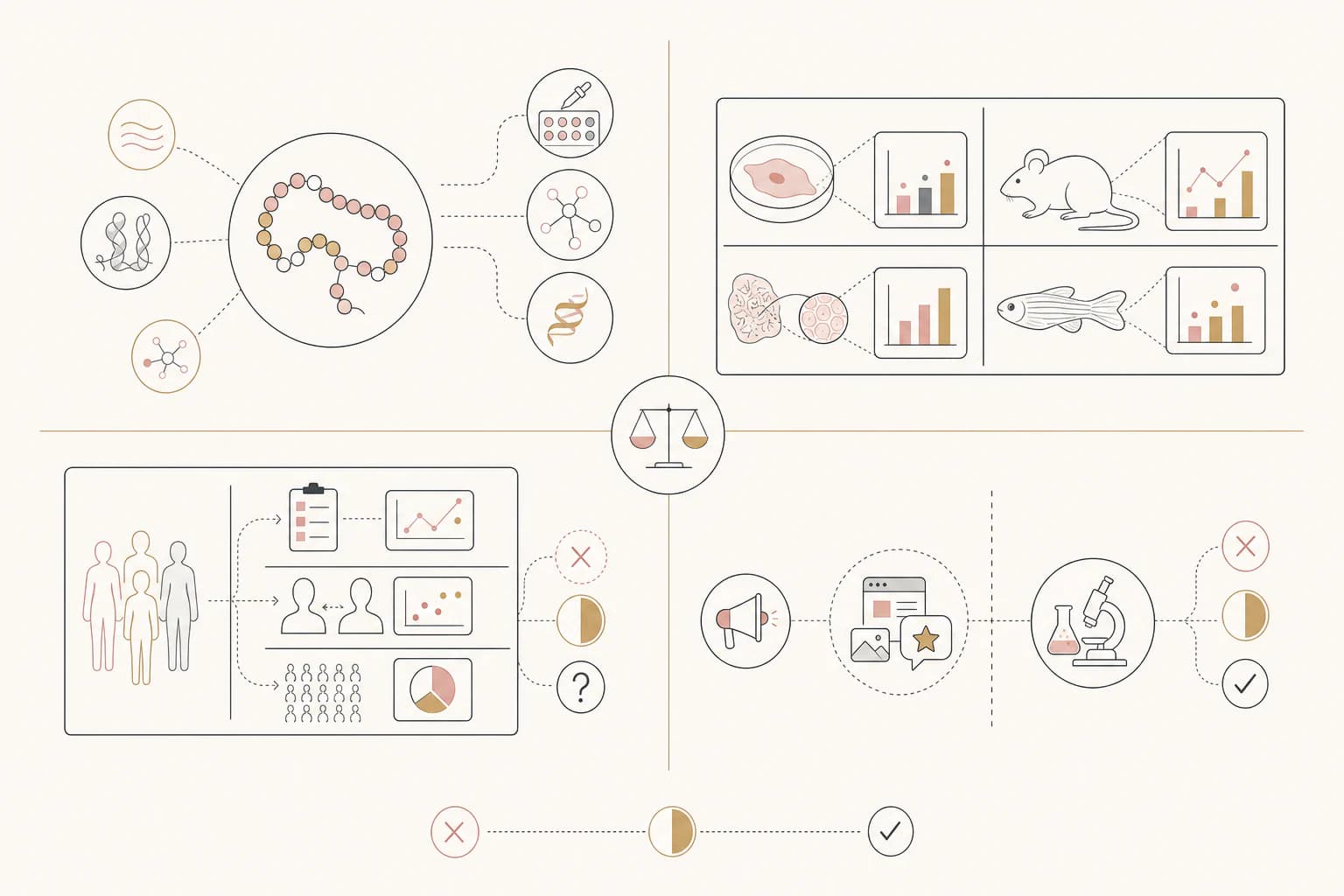
Mouse findings added detail, not certainty
In obese mice studied for 14 days, AOD9604 reduced body-weight gain and increased fat oxidation and plasma glycerol.3 A linked cell experiment found that the peptide did not compete for the growth-hormone receptor or trigger proliferation in receptor-transfected cells.3 Those results supported a biological hypothesis distinct from the actions of full-length growth hormone.3
A separate mouse study tested the beta-3 adrenergic receptor more directly.7 Chronic AOD9604 did not reproduce the body-weight and lipolysis changes in knockout mice that appeared in wild-type animals.7 Yet an acute knockout experiment still showed higher energy expenditure and fat oxidation.7 That split suggests a more complex pathway than one receptor acting as an on-off switch.7 It also leaves the mechanism within mouse research rather than establishing what happens in people.7
The chronic and acute tests asked different questions, so their results should not be merged into one mechanism claim.7
Early human signals did not settle the outcome
FDA summarized a four-week intravenous study involving 23 adults with obesity.8 Non-esterified fatty acids rose after administration, but the reported average 0.58-kilogram weight change was not statistically different from placebo.8 FDA noted that the published account contained limited detail about the methods and results.8
Another four-week study tested oral AOD9604 in 16 men with obesity.9 The same broad pattern appeared: the fat-metabolism marker rose, while weight change was not statistically significant against placebo.9 A marker can help researchers follow a biological signal, but it cannot stand in for a significant body-weight outcome.10 Short duration, small groups, and sparse reporting also narrow what either study can tell readers.89
Together, these short studies show why a signal in blood must not be recast as a result on the scale.10
For readers looking for the related topic, aod-9604 appears below as a neutral catalog reference, not research evidence or a recommendation.
The larger trial is the essential reality check
The most important human comparison was a 24-week randomized, double-blind trial.4 It enrolled 536 adults with obesity and randomized 502 to oral AOD9604 or placebo.4 Participants also joined a dietitian-supervised diet and exercise program.4 The primary test asked whether any study group produced a significant placebo-separated weight difference after 12 weeks.4
According to FDA’s review, the trial did not meet that primary weight endpoint.4 The reported comparison at 24 weeks also did not show a significant weight difference from placebo.4 FDA said full design and preliminary efficacy details were not published in the medical literature and relied partly on company-filed material.4 That reporting limit deserves notice, but it does not convert a missed endpoint into a positive result.11
Here, randomization and a placebo group made the weight question more direct than a stand-alone laboratory marker.4
Safety language needs the same restraint
FDA’s 2024 review found limited methodological and numerical detail across the human study summaries it evaluated.11 It also concluded that most identified studies did not show better weight reduction than placebo.11 That assessment is narrower than claiming that every related record everywhere says the same thing.11
For compounded drugs containing AOD9604, FDA flags possible immunogenicity for certain routes.12 It also identifies concerns about peptide-related impurities and active-ingredient characterization.12 The agency says safety information is limited.12 It notes serious adverse events that may be associated with AOD9604, while stating that causality is unclear.12 This US assessment concerns compounding, manufacturing questions, and certain routes rather than any specific catalog item.12
“Causality is unclear” means a reported event should not be presented as either confirmed harm or proof of safety.12
Bottom line
HGH Fragment 176-191 cannot be understood through one catchy mechanism line. The earliest rat work separated antilipogenic activity from a negative lipolysis measure.2 Later rodent studies reported reduced weight gain, fat oxidation, and tissue-marker changes under tightly defined conditions.63 Small human studies then found biomarker movement without a significant placebo-separated weight result.89 Most importantly, the larger randomized AOD9604 trial missed its reported weight endpoints at 12 and 24 weeks.4 The careful conclusion is not that the biology was imaginary. It is that preclinical signals and short-term markers did not establish the headline human outcome that the hype implies.10
This article is educational research context, not medical advice. Catalog links are neutral references and do not imply a treatment or human-use recommendation.
Frequently asked questions
Are HGH Fragment 176-191 and AOD9604 exactly the same?
The labels overlap, but source wording must stay precise.1 FDA defines AOD9604 as hGH residues 177-191 plus an N-terminal tyrosine, with a disulfide bond.5 Older experiments name hGH 177-191 or a modified C-terminal fragment.1 A name alone cannot establish equivalence between differently described materials.1
What did the first fragment experiment find?
The 1993 rat study reported antilipogenic activity for synthetic hGH 177-191.2 It found no significant lipolytic effect when glycerol release from rat fat pads was measured.2 That distinction matters because lipid formation, lipid breakdown, and whole-body weight change are separate endpoints.2
Did AOD9604 reduce weight in animals?
Animal papers reported reduced body-weight gain in obese rats and mice under their study conditions.63 One rat experiment lasted 19 days, while a mouse experiment lasted 14 days.63 These results describe specific preclinical models and cannot establish a comparable outcome in people.6
What happened in the largest human trial?
The 24-week trial enrolled 536 adults with obesity and randomized 502 participants.4 FDA reported no significant AOD9604 advantage over placebo for the primary 12-week weight endpoint or the reported 24-week comparison.4 Full trial details were not published in the medical literature.4
Why are fat-metabolism markers not enough?
A marker can show that a measured biological signal moved during an experiment.10 It does not automatically show meaningful change in body weight or composition.10 In the early human studies summarized by FDA, non-esterified fatty acids rose, yet weight differences were not significant against placebo.89
What does FDA say about safety?
FDA flags potential immunogenicity for certain compounded routes and difficulties involving peptide impurities and ingredient characterization.12 It also describes safety information as limited and says causality for reported serious events is unclear.12 That US assessment concerns compounded products and does not describe a specific catalog item.12
Sources
Footnotes
-
Antilipogenic action of synthetic C-terminal sequence 177-191 of human growth hormone.; Increase of fat oxidation and weight loss in obese mice caused by chronic treatment with human growth hormone or a modified C-terminal fragment.; FDA Briefing Document: Pharmacy Compounding Advisory Committee Meeting, December 4, 2024. Comparison of canonical PubMed records with FDA's chemical description. Results should be attached to the exact construct and experiment named by each source rather than transferred across labels automatically. ↩ ↩2 ↩3 ↩4 ↩5 ↩6 ↩7 ↩8
-
Antilipogenic action of synthetic C-terminal sequence 177-191 of human growth hormone.. Laboratory and rat-tissue study comparing a synthetic C-terminal fragment with intact human growth hormone. The experiment did not measure human body-weight change, and inhibition of lipid formation is not the same endpoint as increased lipid breakdown. ↩ ↩2 ↩3 ↩4 ↩5 ↩6 ↩7 ↩8 ↩9 ↩10 ↩11 ↩12
-
Increase of fat oxidation and weight loss in obese mice caused by chronic treatment with human growth hormone or a modified C-terminal fragment.. Comparative mouse experiment plus in-vitro receptor-binding and cell-proliferation assays. Mouse energy metabolism and a receptor-transfected cell system do not establish a clinically meaningful human outcome. ↩ ↩2 ↩3 ↩4 ↩5 ↩6 ↩7
-
FDA Briefing Document: Pharmacy Compounding Advisory Committee Meeting, December 4, 2024. Randomized, double-blind, placebo-controlled trial of oral AOD-9604 alongside a dietitian-supervised diet and exercise program. FDA noted that full study-design and efficacy details did not appear in the medical literature and relied partly on company-filed information. ↩ ↩2 ↩3 ↩4 ↩5 ↩6 ↩7 ↩8 ↩9 ↩10 ↩11 ↩12 ↩13
-
FDA Briefing Document: Pharmacy Compounding Advisory Committee Meeting, December 4, 2024. FDA chemical-characterization review of AOD-9604 free base and acetate for a 2024 Pharmacy Compounding Advisory Committee meeting. A shared residue range or informal name does not by itself establish that differently labeled materials have the same identity, structure, purity, or formulation. ↩ ↩2 ↩3 ↩4 ↩5
-
Metabolic studies of a synthetic lipolytic domain (AOD9604) of human growth hormone.. Oral AOD9604 experiment in a genetically obese rat model. The result concerned reduced weight gain in rats, not established fat loss in humans. ↩ ↩2 ↩3 ↩4 ↩5 ↩6 ↩7 ↩8 ↩9 ↩10 ↩11 ↩12 ↩13
-
The effects of human GH and its lipolytic fragment (AOD9604) on lipid metabolism following chronic treatment in obese mice and beta(3)-AR knock-out mice.. Fourteen-day chronic and separate acute experiments in obese, wild-type, and beta-3-receptor knock-out mice. The split chronic and acute findings do not identify a complete mechanism, and the model remains preclinical. ↩ ↩2 ↩3 ↩4 ↩5 ↩6
-
FDA Briefing Document: Pharmacy Compounding Advisory Committee Meeting, December 4, 2024. FDA summary of an early double-blind, dose-escalation AOD-9604 study. FDA noted limited published detail, and a short-term biomarker change does not establish a sustained body-composition outcome. ↩ ↩2 ↩3 ↩4 ↩5 ↩6
-
FDA Briefing Document: Pharmacy Compounding Advisory Committee Meeting, December 4, 2024. FDA summary of an early oral AOD-9604 study with multiple dose levels. The small sample, short duration, and limited methodological detail restrict interpretation. ↩ ↩2 ↩3 ↩4 ↩5
-
FDA Briefing Document: Pharmacy Compounding Advisory Committee Meeting, December 4, 2024. FDA comparison of early human pharmacodynamic observations with weight outcomes in placebo-controlled studies. Biomarkers may help frame a hypothesis, but clinical outcomes require their own prespecified measurements and statistical comparisons. ↩ ↩2 ↩3 ↩4 ↩5
-
FDA Briefing Document: Pharmacy Compounding Advisory Committee Meeting, December 4, 2024. FDA review of oral and intravenous AOD-9604 clinical summaries submitted or identified for the 2024 advisory process. This is FDA's assessment of the records it evaluated, not a claim that every possible study or regulatory record is absent. ↩ ↩2 ↩3 ↩4
-
Certain Bulk Drug Substances for Use in Compounding that May Present Significant Safety Risks. FDA compounding-risk table for withdrawn bulk-substance nominations. The statement concerns compounded drugs and specific manufacturing and route considerations; it does not establish the status of any Philippine catalog item. ↩ ↩2 ↩3 ↩4 ↩5 ↩6 ↩7 ↩8 ↩9