
TL;DR
- HGH Fragment 176-191 and AOD-9604 overlap in research naming, but those labels do not verify what any catalog item contains.1
- Rodent studies reported changes in weight gain, fat oxidation, and lipolysis after AOD-9604 exposure, but these were animal outcomes under laboratory conditions.2
- In the largest reported human obesity study, no tested AOD-9604 group met the primary weight-loss endpoint at 12 weeks.3
- Human safety summaries remain limited, and selected negative antibody tests do not settle risks across routes, formulations, or longer exposure.4
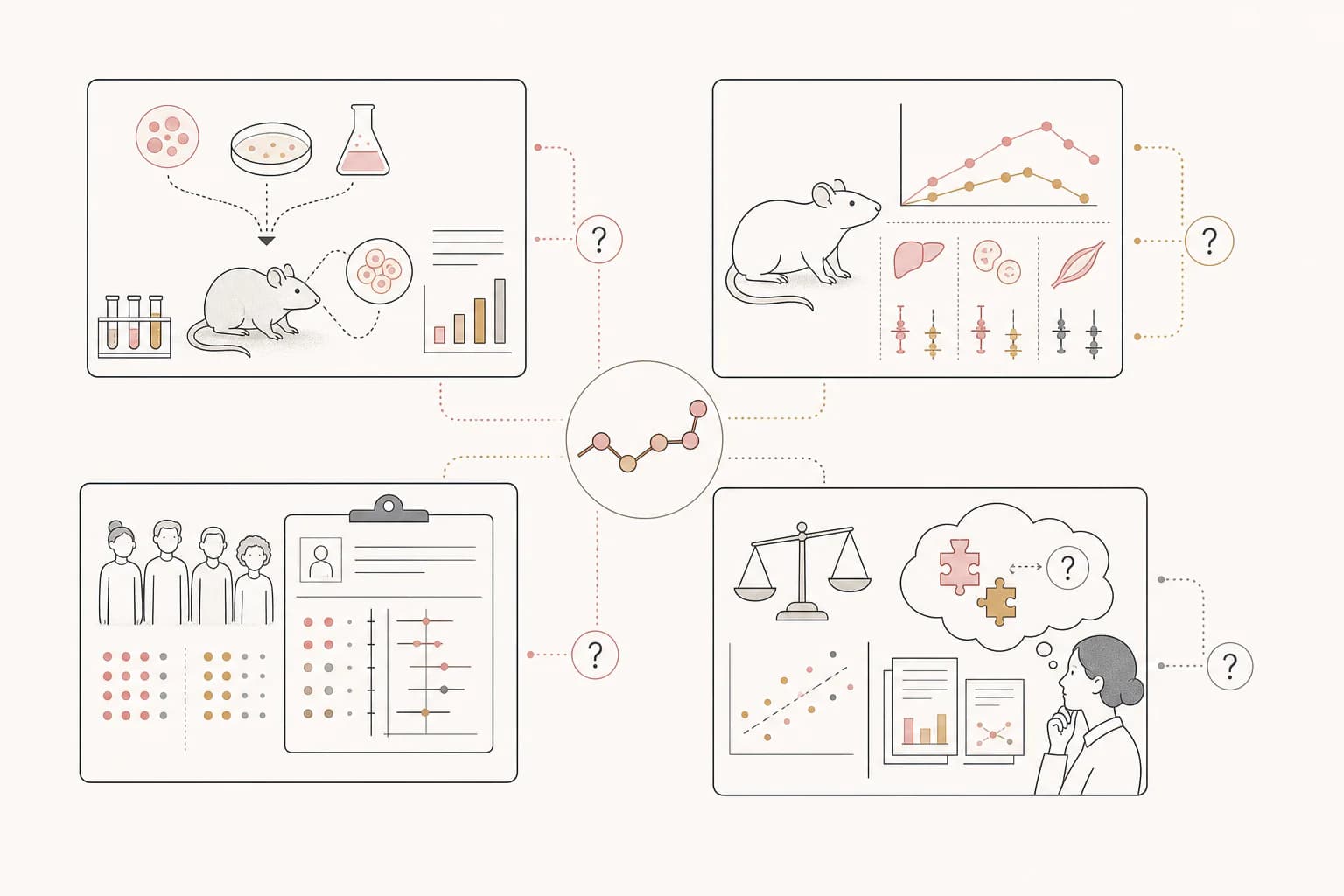
For Filipino readers, this topic is a useful lesson in scientific translation. A phrase such as “fat oxidation increased” may sound decisive.5 First ask where it happened: in a rat, a mouse, a dish of cells, or a person.5 The answer changes what the result can mean.5 With HGH Fragment 176-191, the key story is the distance between an early animal signal and a less convincing human outcome.3
First, sort out the names
Human growth hormone is a chain of 191 amino acids.1 The fragment discussed here comes from its C-terminal end.1 FDA describes AOD-9604 as a synthetic 16-amino-acid peptide.1 It contains growth-hormone residues 177–191 plus an extra tyrosine at the front.1 That addition explains why papers may call it AOD-9604, hGH 177–191, or hGH 176–191.1
The overlap is useful for following the literature, but it has a hard limit.1 A name on a paper does not confirm the composition, purity, or identity of a catalog item.1 It also does not make every result about AOD-9604 automatically applicable to every material sold under “HGH Fragment 176-191.”1 The careful approach is to track the exact research material, model, route, and endpoint each time.1
hgh-fragment-176-191 is named here only to introduce the following neutral catalog reference.
Why the early rat result drew attention
One early experiment used obese Zucker rats, a genetic model in metabolic research.5 The animals received oral AOD9604 daily for 19 days.5 Treated rats had more than a 50% reduction in body-weight gain versus controls.5 This was not a demonstration of the same percentage of weight loss.5 Their fat tissue also showed more lipolytic activity.5 In this setting, that meant more breakdown of stored fat.5
That distinction between weight gain and weight loss matters.5 A growing animal gaining less weight is not the same outcome as an adult human losing a similar share of body weight.5 The investigators also used a specific rat strain, controlled conditions, and a short study window.5 The experiment offered a biological lead worth testing, but it did not supply a human result.5
What the obese-mouse study added
A second project compared full-length human growth hormone with AOD9604 in obese and lean mice over 14 days.2 In obese mice, both compounds reduced body-weight gain and increased fat oxidation and plasma glycerol, which the researchers used as an index of lipolysis.2 The AOD9604 findings again described a short laboratory experiment rather than a clinical outcome.2
The study also explored whether the fragment behaved like the full hormone.6 In receptor-transfected cells, AOD9604 did not compete for the human growth hormone receptor and did not drive cell proliferation through that receptor.6 In the mice, it also did not produce the hyperglycemia seen with full-length growth hormone.6 These differences made the fragment scientifically interesting, yet they did not establish its full molecular target, clinical safety, or long-term behavior in people.6
A knockout mouse made the mechanism less tidy
Researchers next compared ordinary mice with mice engineered without beta-3 adrenergic receptors.7 After chronic exposure, AOD9604 reduced body weight and body fat in obese wild-type mice, but the same weight and lipolysis changes did not appear in the knockout animals.7 The result suggested that this receptor pathway mattered to the chronic response.7
The acute experiment complicated that simple story.8 AOD9604 still increased energy expenditure and fat oxidation in knockout mice during short-term testing.8 The authors therefore concluded that the lipolytic action was not mediated directly through the beta-3 receptor, even though the pathway could contribute to sensitivity over time.8 This is what mechanism research often looks like: one experiment narrows the map without identifying the final destination.8 It remains a mouse map, not a confirmed human pathway.8
A cell study answered a different question
A 2022 paper used the exact phrase “human growth hormone fragment 176-191.”9 Its question was not about body weight.9 Researchers placed the peptide and doxorubicin in chitosan nanoparticles.9 They then ran computer simulations and a viability test in MCF-7 breast-cancer cells.9 The dual-loaded particles slowed growth in that cell line more than particles with doxorubicin alone.9
This finding should stay inside its experimental box.9 It involved one cancer cell line, an engineered nanoparticle carrier, and another active compound.9 It does not show what the peptide alone does throughout a human body, and it does not establish a clinical cancer outcome.9 Its value here is methodological: a laboratory signal may be real within one setup while remaining unable to answer a human health question.9
AOD-9604 is named here only to introduce the following neutral catalog reference.
Small human studies did not mirror the animal story
FDA reviewed three small early studies involving 23, 16, and 36 adults with obesity.10 The studies used oral or intravenous AOD-9604 and reported short follow-up periods.10 None showed statistically significant weight loss compared with placebo, according to FDA’s summary.10 The agency also found that the available reports contained limited methods, unclear study parameters, and sparse numerical detail.10
A separate 12-week randomized study enrolled 300 adults with obesity.11 It reported small signals in selected study groups.11 However, the information appeared only in a scientific-meeting abstract.11 FDA did not locate a full publication.11 Important methods, measurements, and laboratory values were missing.11 FDA found that the abstract could not establish a meaningful effect.11 A conference summary is not equal to a complete trial report.11
The largest reported human test was negative
The OPTIONS study is the clearest human reality check in the record.3 It enrolled 536 adults with obesity.3 Of these, 502 entered one of three oral AOD-9604 groups or a placebo group.3 Everyone also joined a supervised diet-and-exercise program during the 24-week study.3 The primary test asked whether any AOD-9604 group lost more weight than placebo after 12 weeks.3
No tested group met that primary endpoint.3 Sponsor-reported results said the gap also stayed too small at 24 weeks.3 Development for obesity was then stopped.3 Yet the evidence has a transparency problem.3 The complete study methods and results were not published in the medical literature.3 The conclusion is narrow but important: the largest human comparison did not repeat the earlier animal weight story.3
Safety data need the same restraint
FDA’s review covered six sponsor-funded human studies, but it described the overall clinical safety information as limited.4 Selected participants in oral studies had antibody testing, and no anti-AOD-9604 antibodies were detected in those tested subsets.4 That finding cannot rule out immune responses with other formulations, routes, populations, or longer exposure.4
The agency also separated a research peptide from a compounded finished product.12 It identified concerns about peptide impurities, aggregation, and possible immunogenicity.12 Manufacturing and product checks affect those concerns.12 FDA stated that AOD-9604 free base and acetate were not components of an FDA-approved drug.12 This finding is specific to the named substances and United States compounding.12 It does not identify any catalog material.12
Bottom line
The animal research gave scientists a reason to keep asking questions.5 Rats and mice showed changes in weight gain, fat oxidation, and lipolysis.2 A possible adrenergic pathway also emerged under controlled conditions.7 Those findings did not travel cleanly into human trials.10 The largest reported randomized study missed its primary weight endpoint.3 Its full report was not published in the medical literature.3
The practical skill is to keep the evidence ladder visible.3 A rodent outcome is not a human outcome, a cell experiment is not a clinical result, and a negative primary endpoint should not be rewritten as a positive claim.9 Safety also remains tied to the formulation, route, exposure, and quality of the studied material.4
This article is educational research context, not medical advice. Catalog links are neutral references and do not imply a treatment or human-use recommendation.
Frequently asked questions
Are HGH Fragment 176-191 and AOD-9604 the same name?
Research papers often connect the labels because AOD-9604 contains growth-hormone residues 177–191 plus an added N-terminal tyrosine.1 This structure is also described as hGH 176–191 in reviews.1 The naming overlap does not confirm the identity, purity, or composition of any catalog item.1
Did animal studies report weight loss?
The wording varies by experiment.5 In obese Zucker rats, the key result was reduced body-weight gain versus controls.5 In obese mice, researchers reported reduced body weight or body fat alongside increased fat oxidation.2 Neither model directly predicts the size or direction of a human response.2
What did the largest human obesity study find?
In OPTIONS, 502 adults with obesity entered three oral AOD-9604 groups or placebo.3 All followed a supervised diet-and-exercise program.3 No AOD-9604 group had an advantage on the primary 12-week weight endpoint.3 The complete trial report was not published in the medical literature.3
Did any human study show a positive signal?
A 300-person conference abstract reported small signals in selected groups and time points.11 FDA found the report too incomplete to establish a meaningful effect.11 Key methods, measurements, and laboratory details were missing.11 A limited abstract should not outweigh the planned negative result from the larger OPTIONS comparison.3
Does the breast-cancer cell study change the human conclusion?
No clinical conclusion follows from that experiment.9 It tested hGH fragment 176-191 with doxorubicin inside chitosan nanoparticles against one breast-cancer cell line.9 The setup can inform laboratory research, but it does not demonstrate a cancer outcome, safety profile, or general effect in people.9
What do the human studies tell us about safety?
They provide limited, short-term information.4 Selected antibody tests were negative, but FDA said those results could not settle risk across routes, formulations, populations, or longer exposure.4 Product quality also matters because peptide impurities and aggregation can affect possible immune responses.12
Sources
Footnotes
-
The emerging landscape of performance-enhancing peptides modulating GH-IGF1 axis: bridging the gap between clinical evidence and patient self-administration.; FDA Evaluation of AOD-9604-Related Bulk Drug Substances (AOD-9604 (free base) and AOD-9604 acetate).. A peer-reviewed narrative review and an FDA identity and compounding evaluation. Overlapping names in publications do not verify the composition or identity of any catalog item. ↩ ↩2 ↩3 ↩4 ↩5 ↩6 ↩7 ↩8 ↩9 ↩10 ↩11 ↩12 ↩13
-
Increase of fat oxidation and weight loss in obese mice caused by chronic treatment with human growth hormone or a modified C-terminal fragment.. Preclinical comparison in obese and lean mice using mini-osmotic pumps. The study measured short-term responses in mice under controlled laboratory conditions. ↩ ↩2 ↩3 ↩4 ↩5 ↩6 ↩7
-
The emerging landscape of performance-enhancing peptides modulating GH-IGF1 axis: bridging the gap between clinical evidence and patient self-administration.; FDA Evaluation of AOD-9604-Related Bulk Drug Substances (AOD-9604 (free base) and AOD-9604 acetate).. Sponsor-reported randomized, double-blind, placebo-controlled phase 2B study summarized in an FDA evaluation and a peer-reviewed narrative review. The complete study methods and efficacy results were not published in the medical literature. ↩ ↩2 ↩3 ↩4 ↩5 ↩6 ↩7 ↩8 ↩9 ↩10 ↩11 ↩12 ↩13 ↩14 ↩15 ↩16 ↩17 ↩18 ↩19 ↩20 ↩21
-
FDA Evaluation of AOD-9604-Related Bulk Drug Substances (AOD-9604 (free base) and AOD-9604 acetate).. FDA synthesis of oral and intravenous studies plus product-quality and immunogenicity considerations. No detected antibodies in selected trial subsets does not rule out immunogenicity or other harms in different formulations, routes, populations, or longer exposure. ↩ ↩2 ↩3 ↩4 ↩5 ↩6 ↩7
-
Metabolic studies of a synthetic lipolytic domain (AOD9604) of human growth hormone.. Controlled metabolic study in obese Zucker rats. The outcome was reduced weight gain in a rat model, not established weight reduction in humans. ↩ ↩2 ↩3 ↩4 ↩5 ↩6 ↩7 ↩8 ↩9 ↩10 ↩11 ↩12 ↩13 ↩14 ↩15 ↩16
-
Increase of fat oxidation and weight loss in obese mice caused by chronic treatment with human growth hormone or a modified C-terminal fragment.. Mouse metabolic measures combined with in-vitro receptor-binding and cell-proliferation assays. These assays do not establish the full mechanism, clinical safety, or long-term effects in people. ↩ ↩2 ↩3 ↩4
-
The effects of human GH and its lipolytic fragment (AOD9604) on lipid metabolism following chronic treatment in obese mice and beta(3)-AR knock-out mice.. Fourteen-day experiments comparing obese mice, beta-3 adrenergic receptor knockout mice, and wild-type controls. A knockout model can probe a possible pathway but cannot establish an identical pathway in humans. ↩ ↩2 ↩3 ↩4
-
The effects of human GH and its lipolytic fragment (AOD9604) on lipid metabolism following chronic treatment in obese mice and beta(3)-AR knock-out mice.. Acute and chronic metabolic experiments in beta-3 adrenergic receptor knockout mice. The study did not identify a complete molecular target or human mechanism. ↩ ↩2 ↩3 ↩4 ↩5
-
Human Growth Hormone Fragment 176-191 Peptide Enhances the Toxicity of Doxorubicin-Loaded Chitosan Nanoparticles Against MCF-7 Breast Cancer Cells.. Molecular-docking work and a cell-viability assay in one human breast-cancer cell line. A cell-line and nanoparticle experiment is not evidence of a clinical cancer outcome or a general effect of the peptide in people. ↩ ↩2 ↩3 ↩4 ↩5 ↩6 ↩7 ↩8 ↩9 ↩10 ↩11 ↩12 ↩13
-
FDA Evaluation of AOD-9604-Related Bulk Drug Substances (AOD-9604 (free base) and AOD-9604 acetate).. FDA review of small intravenous or oral studies involving 23, 16, and 36 adults with obesity. The underlying reports were sparse, so the studies cannot answer every human efficacy or safety question. ↩ ↩2 ↩3 ↩4 ↩5
-
FDA Evaluation of AOD-9604-Related Bulk Drug Substances (AOD-9604 (free base) and AOD-9604 acetate).. FDA assessment of a scientific-meeting abstract describing oral AOD-9604. The limited abstract did not provide sufficient methodology, results, or laboratory values for firm interpretation. ↩ ↩2 ↩3 ↩4 ↩5 ↩6 ↩7 ↩8 ↩9 ↩10
-
FDA Evaluation of AOD-9604-Related Bulk Drug Substances (AOD-9604 (free base) and AOD-9604 acetate).. United States FDA evaluation for possible inclusion on the section 503A bulk drug substances list. This is a specific US regulatory and compounding assessment; it does not establish Philippine regulatory status or the identity of a catalog product. ↩ ↩2 ↩3 ↩4 ↩5 ↩6 ↩7