
TL;DR
- Healthy aging is better understood as keeping the ability to meet needs, move, decide, connect, and contribute—not chasing a younger-looking number.1
- Philippine health policy places functional ability across the Filipino life course at the center, with special relevance for older people.2
- Short human trials show that an NAD-related biomarker can change without proving a broad gain in daily function, healthspan, or lifespan.3
- MOTS-c findings discussed here come from cell work, mouse experiments, and a small human exercise study that measured the body’s own peptide response.4
For Filipino readers, healthy-aging advice arrives through family chats, clinic visits, short videos, and polished product pages. The loudest message often promises one switch for energy, memory, or a younger “biological age.” A research-first view starts somewhere more useful: what can a person still do, what support surrounds them, and what did each study actually measure?5 That shift makes room for science without turning hope into a sales line.
Start with function, not a youth scoreboard
WHO defines healthy ageing around functional ability: the capacity to meet basic needs, learn, make decisions, move, maintain relationships, and contribute.1 This is broader than looking young or receiving a favorable result from one laboratory panel.1 It also allows for real differences among people of the same age.5
Function comes from both intrinsic capacity—the physical and mental resources a person can draw on—and the environment around that person.5 A safer home, reliable transport, supportive relatives, and usable health services can matter alongside strength, sight, hearing, memory, and mood.5 Healthy aging is therefore a practical life question, not a contest to erase birthdays.1
For readers looking for the exact topic, the NAD-plus card below opens its live catalog details.
Put each claim on the right level
NAD+ is a molecule used in cellular metabolism and enzyme activity.6 That role explains why researchers study NAD-related pathways, but it does not make NAD+ a direct meter of a person’s aging quality.6 “Mechanism” tells us what may happen in a pathway; “biomarker” tells us what a test measured.6
A daily-life outcome asks a different question.3 Can a participant walk farther, think more clearly, recover function, or carry out valued tasks under a defined study protocol?1 Lifespan asks something narrower again: whether survival time differs.3 When a headline moves from a changed metabolite to “age reversal,” it has crossed several evidence levels without showing the steps.3
The disciplined reading move is simple: name the measured endpoint before interpreting its meaning.3
Human NAD studies show why endpoints matter
One randomized crossover trial followed 24 healthy middle-aged and older adults who completed six weeks of nicotinamide-riboside and placebo periods.7 The study found increased NAD-related metabolism during the nicotinamide-riboside period.7 Its cardiovascular analyses were exploratory, so the paper called for larger trials rather than declaring a broad healthy-aging result.7
Another randomized crossover trial involved 12 older men over 21 days.8 Researchers found changes in muscle NAD-related metabolites and gene-expression patterns, but measured mitochondrial bioenergetics did not change.8 These details are not a contradiction.3 They show that a pathway signal and a functional measurement are separate endpoints.3
Neither trial tested whether a catalog card changes lifespan or everyday function.3 Their value is precision: short human experiments can answer specific biological questions while leaving grander marketing language unsupported by those measurements.3
Build on the basics
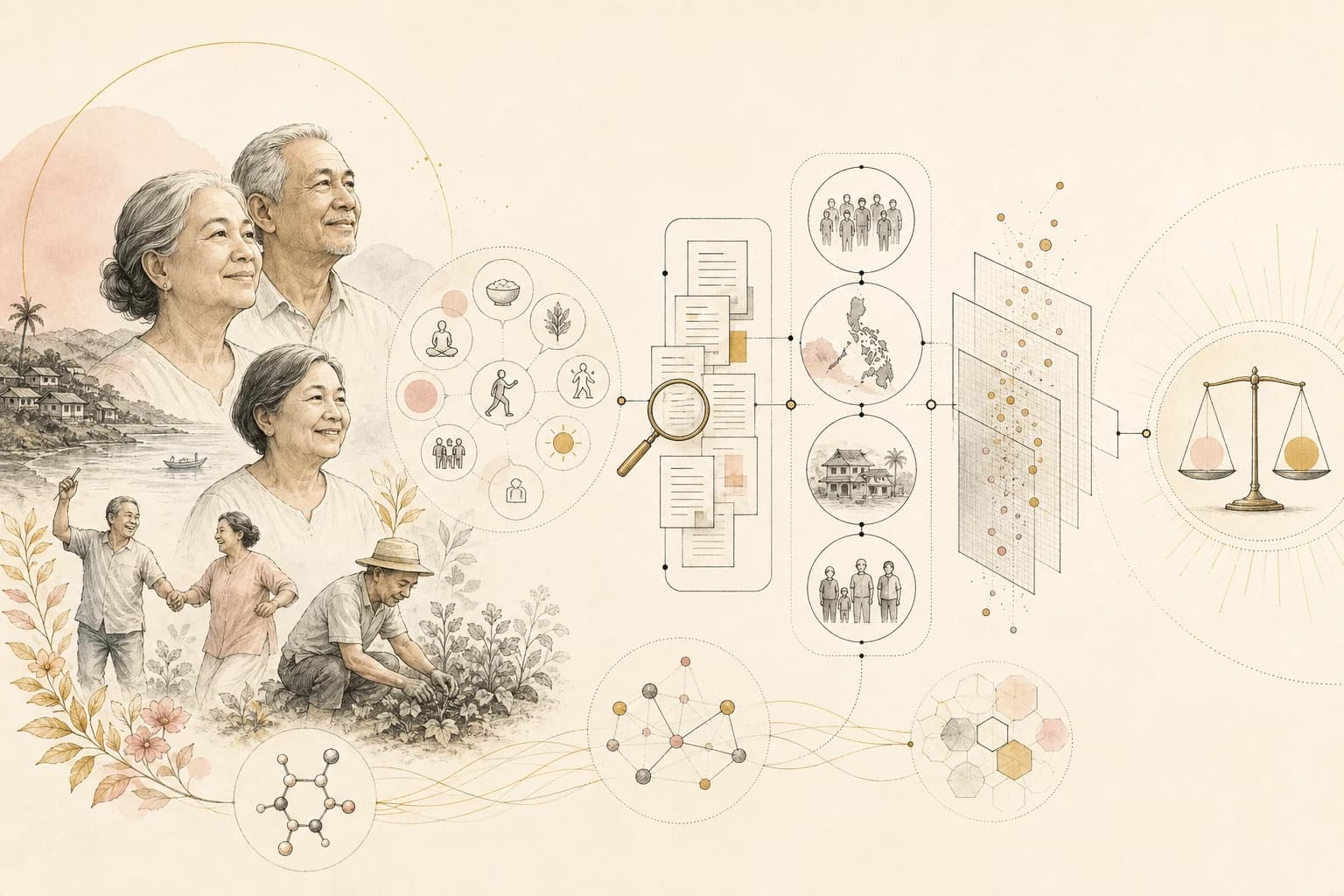
The Philippine DOH healthy-aging program describes the goal as helping Filipinos maintain functional ability across life, especially in older age.2 This local framing fits WHO’s wider model of capacity, environment, and meaningful activity.5 It puts attention on what supports ordinary days rather than on a single “anti-aging” object.2
WHO advises adults to build toward 150 to 300 minutes of moderate aerobic activity each week, or the vigorous equivalent.9 For older adults, the guidance also includes balance, coordination, and muscle-strengthening work.9 The same guidance says activity can include transport, work, household tasks, sport, or leisure.9
Food guidance is flexible in a similar way.10 WHO centers adequacy, balance, moderation, diversity, and safety, while allowing the exact pattern to reflect culture and locally available food.10 A Filipino plate can follow those principles without pretending one imported menu fits every household.10
MOTS-c starts in another research lane
MOTS-c is a 16-amino-acid peptide identified from a short reading frame within mitochondrial 12S RNA.11 The 2015 report examined pathway activity in cells and metabolic outcomes in mice.11 Those experiments are useful for identifying a biological signal and forming later questions.11
They are not participant outcomes.11 A cell dish cannot report mobility, independence, or quality of life, while a mouse model differs from a Filipino adult in species, setting, and measured endpoints.11 The label “mitochondrial” may sound advanced, but it still tells readers to inspect the model rather than assume a human result.11
The result can guide the next research question, but its model must stay in the sentence.11
MOTS-c is named here only as the neutral catalog reference below.
The later study kept its models separate
A 2021 paper studied MOTS-c across several layers.12 In young, middle-aged, old, and very old mice, researchers reported physical-performance and muscle findings after experimental exposure.12 Those results belong to mouse protocols and cannot be rewritten as a forecast for people.12
The paper also included a small exercise experiment in healthy young men.4 After stationary cycling, the participants’ own MOTS-c increased in skeletal muscle and circulation.4 This was an endogenous response, meaning the peptide was produced within their bodies.4 The human experiment did not test an external MOTS-c catalog item or measure healthy aging over time.4
Keeping these layers separate preserves both findings.12 The mouse work studied experimental exposure and performance, while the human work measured a short exercise-linked response.4
Four checks for a bold headline
First ask, “What was the model?” because cells, mice, and enrolled people answer different questions.11 Next ask, “What changed?” because a metabolite, gene-expression pattern, cycling response, and daily function are not interchangeable endpoints.3
Third, check the design and timeline.7 A short randomized crossover trial can compare conditions within participants, yet it cannot automatically answer a lifelong question.7 Fourth, look for the leap: did the headline move from a pathway to function, or from a mouse result to a person?12
This filter works in a Manila group chat, a Cebu waiting room, or a late-night search anywhere in the Philippines. It does not require cynicism. It asks writers, sellers, and readers to keep the model, endpoint, population, and timeframe attached to every result.3
Bottom line
Healthy aging is not a promise to become young again.1 It is a practical effort to protect the abilities and support that make a valued life possible.5 Philippine health policy and WHO guidance both place function at the center.2 Movement, balance, strength, varied food, and supportive environments belong in that broad picture.9
NAD+ and MOTS-c remain valid research subjects when each result keeps its boundaries.6 Short NAD-precursor trials measured biological changes, not a general reversal of aging.3 MOTS-c papers combined cell, mouse, and limited human exercise observations that answer different questions.4 Research-first reading neither mocks curiosity nor rewards miracle language; it asks every claim to stop where its measurement stops.3
This article is educational research context, not medical advice. Catalog links are neutral references and do not imply a treatment or human-use recommendation.
Frequently asked questions
What does healthy aging mean?
WHO defines it through functional ability in older age.1 That includes meeting needs, making decisions, moving, maintaining relationships, and contributing.1 The idea does not demand perfect health or a youthful appearance.1 It focuses on what people value and can do within their real environment.5
Is a higher NAD-related reading proof of slower aging?
No single biomarker carries that meaning.6 In short randomized trials, NAD-related metabolites changed, while the measured endpoints and results remained specific to each protocol.3 A laboratory change can support a biological finding without establishing better daily function, longer healthspan, or longer life.3
What did the older-adult NAD trials find?
One six-week crossover trial found increased NAD-related metabolism in 24 completers.7 A 21-day crossover trial in 12 older men found muscle metabolite and gene-expression changes without altered mitochondrial bioenergetics.8 Both results must stay attached to their short timelines and specific measurements.3
Does the MOTS-c research describe people or animals?
It describes several models.12 The 2015 paper reported cell and mouse findings.11 The 2021 paper added mouse performance experiments and a small human exercise component.12 In that human component, researchers measured participants’ own MOTS-c response rather than an external catalog item.4
Why discuss movement and food in a research guide?
Healthy aging covers function and environment, not one molecule.5 WHO provides population guidance for aerobic activity, strength, balance, and coordination.9 Its food guidance centers adequacy, balance, moderation, diversity, and safety while allowing cultural and local variation.10 These are broad principles, not personal plans.10
How can Filipino readers check a bold aging claim?
Name the model, endpoint, population, and timeframe.3 Then ask whether the headline quietly jumps from cells to people, from mice to daily life, or from a biomarker to lifespan.12 A careful summary keeps each result tied to what researchers actually measured.3
Sources
Footnotes
-
Healthy ageing and functional ability. WHO public-health definition of healthy ageing and functional ability. The definition is a framework for well-being, not a test score, biological-age claim, or promise of disease-free aging. ↩ ↩2 ↩3 ↩4 ↩5 ↩6 ↩7 ↩8 ↩9
-
Health and Wellness Program for Senior Citizens (National Program for Healthy Aging). Philippine national program brief for the Health and Wellness Program for Senior Citizens. This program goal does not establish the effectiveness, status, or availability of any catalog product. ↩ ↩2 ↩3 ↩4
-
Chronic nicotinamide riboside supplementation is well-tolerated and elevates NAD+ in healthy middle-aged and older adults; Nicotinamide Riboside Augments the Aged Human Skeletal Muscle NAD+ Metabolome and Induces Transcriptomic and Anti-inflammatory Signatures. Comparison of endpoint types measured in two short randomized human trials. This distinction does not dismiss biomarker research; it limits the conclusion to what each trial measured. ↩ ↩2 ↩3 ↩4 ↩5 ↩6 ↩7 ↩8 ↩9 ↩10 ↩11 ↩12 ↩13 ↩14 ↩15 ↩16 ↩17 ↩18
-
MOTS-c is an exercise-induced mitochondrial-encoded regulator of age-dependent physical decline and muscle homeostasis. Small exercise experiment measuring participants' own MOTS-c before and after stationary cycling. Measuring an endogenous response to exercise does not test an external MOTS-c product or establish a healthy-aging outcome. ↩ ↩2 ↩3 ↩4 ↩5 ↩6 ↩7 ↩8
-
Healthy ageing and functional ability. WHO explanation of intrinsic capacity and environmental support in healthy ageing. People of the same age can have very different capacities and support needs. ↩ ↩2 ↩3 ↩4 ↩5 ↩6 ↩7 ↩8
-
Chronic nicotinamide riboside supplementation is well-tolerated and elevates NAD+ in healthy middle-aged and older adults; Nicotinamide Riboside Augments the Aged Human Skeletal Muscle NAD+ Metabolome and Induces Transcriptomic and Anti-inflammatory Signatures. Background biology and measured NAD-related metabolites in two randomized human trials. A molecular role or a higher measured metabolite does not by itself establish longer life, better function, or a clinical outcome. ↩ ↩2 ↩3 ↩4 ↩5
-
Chronic nicotinamide riboside supplementation is well-tolerated and elevates NAD+ in healthy middle-aged and older adults. Small randomized, double-blind, placebo-controlled crossover trial in healthy adults. The trial was short, and its blood-pressure and arterial-stiffness analyses were exploratory rather than proof of broad healthy-aging effects. ↩ ↩2 ↩3 ↩4 ↩5 ↩6
-
Nicotinamide Riboside Augments the Aged Human Skeletal Muscle NAD+ Metabolome and Induces Transcriptomic and Anti-inflammatory Signatures. Small randomized, double-blind, placebo-controlled crossover trial with skeletal-muscle sampling. The biomarker and transcript findings cannot be turned into a claim about lifespan, daily function, or outcomes in women or broader populations. ↩ ↩2 ↩3
-
WHO guidelines on physical activity and sedentary behaviour: at a glance. WHO global physical-activity guidance summarized for adults and older adults. Activity should be adapted to ability and health circumstances; the guideline is not an individualized exercise plan. ↩ ↩2 ↩3 ↩4 ↩5
-
Healthy diet. WHO healthy-diet fact sheet covering life-course nutrition principles. The principles do not prescribe one menu for every person or replace individualized nutrition care. ↩ ↩2 ↩3 ↩4 ↩5
-
The mitochondrial-derived peptide MOTS-c promotes metabolic homeostasis and reduces obesity and insulin resistance. Laboratory cell experiments and mouse models used to identify and characterize MOTS-c. Cell and mouse findings do not establish a healthy-aging outcome in people. ↩ ↩2 ↩3 ↩4 ↩5 ↩6 ↩7 ↩8 ↩9
-
MOTS-c is an exercise-induced mitochondrial-encoded regulator of age-dependent physical decline and muscle homeostasis. Mouse experiments across age groups, including late-life intermittent exposure. Species, experimental exposure, and laboratory endpoints prevent direct translation into a result for people. ↩ ↩2 ↩3 ↩4 ↩5 ↩6 ↩7 ↩8