
Quick answer
GLP-1 agonists, amylin analogues, multi-receptor agonists, and small laboratory compounds are not one interchangeable category. Semaglutide has large randomized human trials through the GLP-1 pathway. Cagrilintide follows amylin-related biology and has been studied alone and with semaglutide. Tirzepatide and retatrutide combine receptor signals in different ways. By contrast, 5-amino-1MQ is a small NNMT inhibitor studied in cells and mice. Cross-trial weight-loss percentages cannot rank these programs because their populations, protocols, durations, and evidence stages differ.12345
What belongs in the GLP-1 family?
GLP-1 is an incretin hormone. Incretins are gut-derived signals that help regulate insulin secretion after eating and influence food-intake pathways.5
Semaglutide is a GLP-1 receptor agonist. It imitates part of that signal at the receptor.
In STEP 1, 1,961 adults without diabetes were randomized to semaglutide or placebo alongside lifestyle intervention for 68 weeks.2
That trial provides human clinical evidence in a defined population. Its result should remain attached to its comparator, duration, and analysis.
GLP-1 biology is not identical to every medicine that includes a GLP-1 component. Adding another receptor changes the intervention.
The family name is therefore a starting point for classification, not permission to share outcomes.
Formulation and exposure remain part of identity. A receptor class does not tell readers how reliably a compound reaches its target, how long it remains active, or what other components accompany it. Those properties are measured, not inherited from the category.
Readers researching Semaglutide can view its live catalog details below. The listing identifies the catalog item and is separate from the evidence discussed here.
How are amylin analogues different?
Cagrilintide is a long-acting amylin-related compound with activity at amylin and calcitonin receptors.3
Semaglutide acts at the GLP-1 receptor, so the two compounds begin from different biological strategies.3
Amylin biology includes meal-ending and gut-brain signals. That mechanism creates a rationale for research but does not prove a superior outcome.
Cagrilintide has been studied alone and in combination with semaglutide. Combination results must keep both components in the conclusion.
The phrase “amylin analogue” tells a reader what type of signal is being imitated. It does not disclose study size, follow-up, or regulatory status.
Combination programs add a second layer. When an amylin-related compound is studied with semaglutide, the result belongs to the joint intervention. It should not be used as a monotherapy percentage or evidence of routine combining.
Where do tirzepatide and retatrutide fit?
Tirzepatide is a dual GIP and GLP-1 receptor agonist. Retatrutide adds glucagon-receptor activity to GIP and GLP-1 signaling.
GIP and GLP-1 bind different receptors and influence insulin secretion and food-intake signaling.5
The multi-receptor designs are not simply stronger versions of semaglutide. They produce distinct pharmacology that must be measured as a whole.
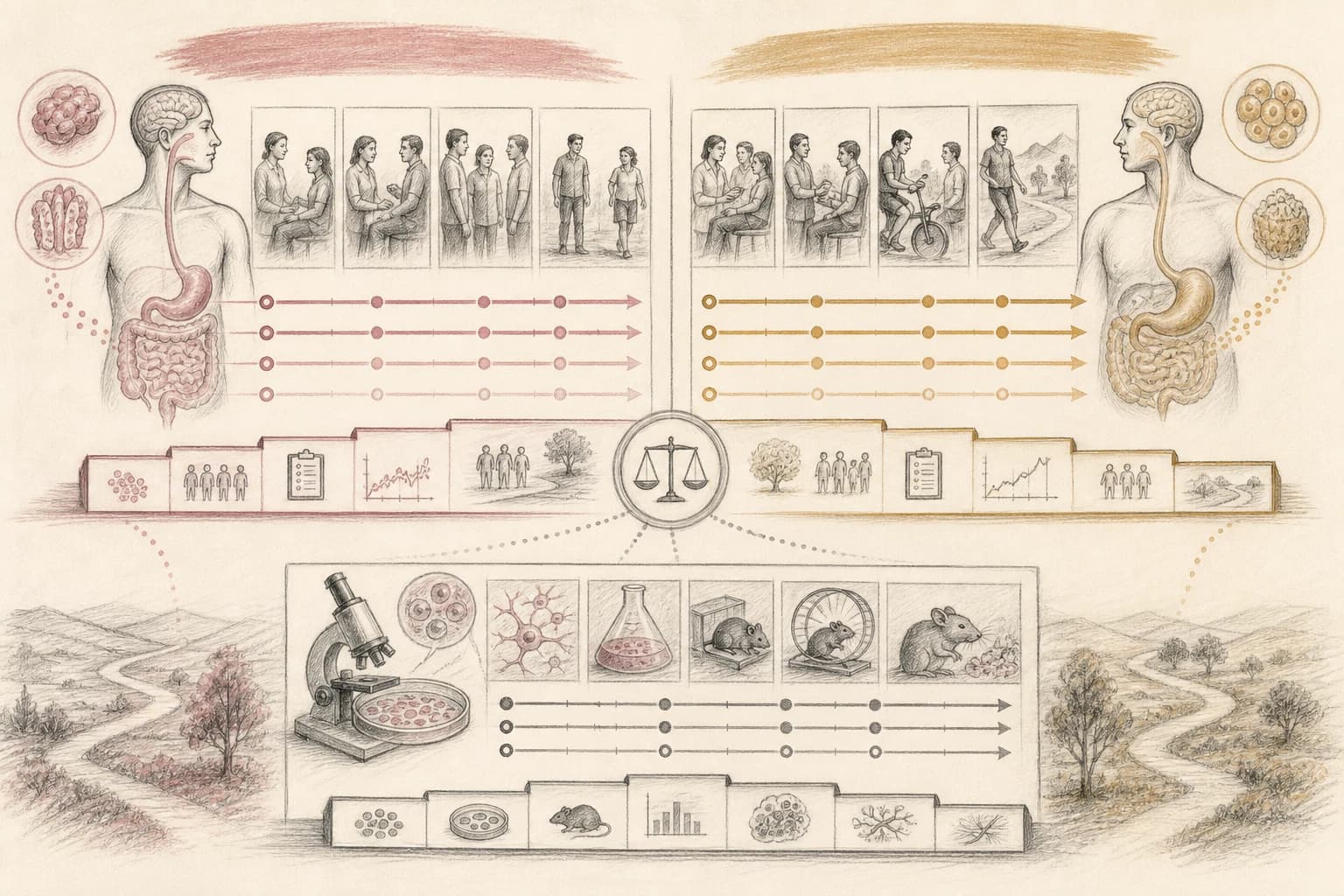
SURMOUNT-1, the retatrutide phase 2 trial, STEP 1, and the cagrilintide-semaglutide trial each used different protocols and populations.1
Their headline percentages are real inside their own studies. Placing the largest numbers in a ranking table does not create a randomized comparison.
A fair comparison needs common eligibility, duration, endpoints, and analysis under one protocol.
It also needs comparable safety collection. One program may actively solicit a symptom at every visit while another records only spontaneous reports. Event percentages from those methods can look comparable while measuring different surveillance.
Why is 5-amino-1MQ in a separate category?
5-amino-1MQ is a small-molecule inhibitor of nicotinamide N-methyltransferase, or NNMT.4
It is not a GLP-1 agonist, an amylin analogue, or a multi-receptor peptide. The molecular class and target are different.
The cited research involved cultured fat cells and diet-induced obese mice.4 That is preclinical evidence rather than an obesity trial in people.
Cell and animal findings can reveal biological possibilities. They cannot be compared directly with 68-week human trial percentages.
The route from laboratory target to useful medicine includes identity, exposure, safety, exposure finding, and several stages of clinical testing.
Negative findings matter along that route. A mechanism can look persuasive in cultured cells and fail when absorption, metabolism, whole-body signaling, or tolerability are tested. Publication should show unsuccessful paths as well as early-stage ones.
Calling all “metabolic compounds” peers erases that evidence ladder.
Why do cross-compound rankings fail?
STEP 1, SURMOUNT-1, REDEFINE 1, and the retatrutide phase 2 trial tested different compounds in separate groups.1
They also differed in phase, follow-up, exposure schedules, participant characteristics, comparators, and statistical plans.1
Mean change may be estimated under different assumptions for treatment discontinuation or missing data.
Trial phase provides another clue. Phase 2 often explores experimental amount and initial efficacy, while phase 3 is usually larger and designed to confirm defined outcomes. Phase labels do not guarantee quality, but they reveal where a program sits.
Lifestyle programs can differ, and trial sites may support participants in different ways.
Even a similar percentage can hide different adverse events, withdrawals, or responder distributions.
The honest comparison describes each program’s evidence stage before discussing the size of its result.
What should Filipino readers verify?
The Philippine FDA Verification Portal separates licensed establishments from registered or notified products.6
Verify the exact item, manufacturer, form, and current authorization. A mechanism category or international trial is not a Philippine product record.
WHO notes that falsified medical products can closely resemble genuine products and may require quality-control analysis.7
An online label can also misclassify a compound. Calling a small NNMT inhibitor a “GLP-1 alternative” does not make the evidence comparable.
Keep the source, research stage, identity, and regulatory record attached to every conclusion.8
What is a useful way to compare programs?
Start with molecule class and target. This prevents unlike compounds from being treated as interchangeable.
Use a separate column for evidence maturity. A mechanism, animal result, early human signal, and confirmatory trial should never share an unlabeled cell.
Then identify the highest human evidence tier. A large randomized trial and a mouse experiment should not occupy the same row without a clear label.
Add population, comparator, duration, and primary endpoint. These details make percentages interpretable.
Report safety, discontinuation, and uncertainty beside effectiveness. A larger average does not answer every tradeoff.
End with current product identity and regulatory status. Research promise and market authorization are separate facts.
Readers comparing this topic with Cagrilintide can view its live catalog details below. It is a separate catalog reference, not a suggested combination.
Bottom line
Semaglutide, cagrilintide, tirzepatide, retatrutide, and 5-amino-1MQ belong to different biological and evidentiary categories. GLP-1, amylin, dual-receptor, and triple-receptor programs have human research at different stages, while 5-amino-1MQ remains represented here by cell and mouse studies.
Separate trial percentages cannot produce a trustworthy ranking because the protocols and populations differ. Filipino readers should compare mechanism, evidence tier, endpoint, safety, identity, and local product status in that order. The most useful table is not the one with the biggest number; it is the one that prevents unlike evidence from looking equal.
Frequently asked questions
Is cagrilintide a GLP-1 agonist?
No. It is a long-acting amylin-related compound.3
Is tirzepatide the same as semaglutide?
No. Tirzepatide acts at GIP and GLP-1 receptors.
Is 5-amino-1MQ a peptide or incretin medicine?
No. It is a small NNMT inhibitor studied here in cells and mice.4
Can separate trial percentages name the strongest compound?
No. Different protocols and populations prevent a direct ranking.1
Do the catalog cards mean semaglutide and cagrilintide should be combined?
No. They are separate neutral references.
Sources
Footnotes
-
Coadministered Cagrilintide and Semaglutide in Adults with Overweight or Obesity.; Triple-Hormone-Receptor Agonist Retatrutide for Obesity - A Phase 2 Trial.; Once-Weekly Semaglutide in Adults with Overweight or Obesity.; Tirzepatide Once Weekly for the Treatment of Obesity.. Comparison of four separate randomized trial records. Each result should be read with its own comparator, phase, population, endpoint, and follow-up. ↩ ↩2 ↩3 ↩4 ↩5
-
Once-Weekly Semaglutide in Adults with Overweight or Obesity.. Randomized, double-blind human trial in adults with obesity or overweight plus a related condition. The result belongs to the trial population, comparator, follow-up, and analysis. ↩ ↩2
-
Long-acting amylin-related peptides as therapies for obesity and type 2 diabetes.. Narrative review of long-acting amylin-related peptides. Mechanistic difference provides a research rationale, not proof of a superior clinical result. ↩ ↩2 ↩3 ↩4
-
Selective and membrane-permeable small molecule inhibitors of nicotinamide N-methyltransferase reverse high fat diet-induced obesity in mice.; Nicotinamide N-methyltransferase inhibition mitigates obesity-related metabolic dysfunction.. Laboratory assays and two animal pharmacology studies. The research models and target differ from the human incretin and amylin trials. ↩ ↩2 ↩3 ↩4
-
Mechanisms of action and therapeutic applications of GLP-1 and dual GIP/GLP-1 receptor agonists.. Mechanistic review covering GLP-1 and dual GIP/GLP-1 receptor agonists. A mechanism review does not establish a clinical outcome for every compound that reaches these receptors. ↩ ↩2 ↩3
-
Philippine FDA Verification Portal; FDA Advisory No. 2023-2238: Utilization of the FDA Verification Portal. Official Philippine regulatory verification service. A portal record applies to the exact product or establishment named in that record. ↩
-
WHO laboratory analysis of suspected falsified medical products; WHO laboratory testing for health-product regulation. WHO guidance on suspected falsified medical products and regulatory laboratory testing. Appearance alone cannot authenticate a product or establish a research outcome. ↩
-
Coadministered Cagrilintide and Semaglutide in Adults with Overweight or Obesity.; Triple-Hormone-Receptor Agonist Retatrutide for Obesity - A Phase 2 Trial.; Once-Weekly Semaglutide in Adults with Overweight or Obesity.; Tirzepatide Once Weekly for the Treatment of Obesity.; Long-acting amylin-related peptides as therapies for obesity and type 2 diabetes.; Philippine FDA Verification Portal; FDA Advisory No. 2023-2238: Utilization of the FDA Verification Portal. Editorial synthesis of the canonical research records and Philippine verification sources. This synthesis is educational and is not personal medical advice or a product recommendation. ↩