
Quick answer
For “AOD-9604: Fat-burning peptide claims what laboratory results can,” fDA's 2024 review described the human safety information as limited because study summaries lacked detailed adverse-event breakdowns, laboratory values, and longer follow-up.1
This describes limits of the reviewed safety record rather than proving that a particular harm occurred.1 For Filipino readers, “AOD-9604: Fat-burning peptide claims what laboratory results can” is best read by matching every conclusion to the exact study, population, outcome, and product identity.
What is AOD-9604, in plain language?
For “AOD-9604: Fat-burning peptide claims what laboratory results can,” start with the recorded result, not the marketing version. FDA's 2024 review described the human safety information as limited because study summaries lacked detailed adverse-event breakdowns, laboratory values, and longer follow-up.1
Within “AOD-9604: Fat-burning peptide claims what laboratory results can,” FDA evaluation of published summaries and nominated material.1 This describes limits of the reviewed safety record rather than proving that a particular harm occurred.1
For “AOD-9604: Fat-burning peptide claims what laboratory results can,” that boundary keeps one result from becoming a universal promise. The result can be informative without becoming a personal recommendation or a promise about a catalog item.
For “AOD-9604: Fat-burning peptide claims what laboratory results can,” the clearest route is to separate the result from its interpretation. WHO states that some falsified medical products can closely resemble genuine products and may require quality-control analysis.2
Within “AOD-9604: Fat-burning peptide claims what laboratory results can,” WHO guidance on suspected falsified medical products and regulatory laboratory testing.2 Appearance alone cannot authenticate a product or establish a research outcome.2
In “AOD-9604: Fat-burning peptide claims what laboratory results can,” the careful reading is narrower than a social-media headline. The result can be informative without becoming a personal recommendation or a promise about a catalog item.
The plain-language rule for “AOD-9604: Fat-burning peptide claims what laboratory results can” is simple: identify what was measured before asking what it might mean elsewhere. A precise answer can still be interesting; it simply keeps the reader oriented.
Readers researching Aod 9604 can view its live catalog details below. The listing identifies the catalog item and is separate from the evidence discussed here.
What did the first evidence source report?
For “AOD-9604: Fat-burning peptide claims what laboratory results can,” one precise finding is more useful than a broad slogan. AOD9604 is the human-growth-hormone C-terminal fragment covering amino acids 177-191 with an additional tyrosine at the peptide's N-terminus.3
Within “AOD-9604: Fat-burning peptide claims what laboratory results can,” Identity statement from a PubMed-indexed analytical study.3 This chemical identity does not establish a human outcome.3
That distinction gives “AOD-9604: Fat-burning peptide claims what laboratory results can” a useful answer without making it sound larger than the evidence. The result can be informative without becoming a personal recommendation or a promise about a catalog item.
For “AOD-9604: Fat-burning peptide claims what laboratory results can,” the study becomes easier to read when its boundaries remain visible. The evidence is most useful when every conclusion stays attached to its exact source, study context, and product identity.4
Within “AOD-9604: Fat-burning peptide claims what laboratory results can,” Editorial synthesis of the canonical research records and Philippine verification sources.4 This synthesis is educational and is not personal medical advice or a product recommendation.4
Keeping that boundary visible makes “AOD-9604: Fat-burning peptide claims what laboratory results can” clearer for a general reader. The result can be informative without becoming a personal recommendation or a promise about a catalog item.
A useful magazine explanation of “AOD-9604: Fat-burning peptide claims what laboratory results can” should make the main point easy to find. It should also keep the study boundary close enough that readers do not need to hunt for it.
What did the next result add?
For “AOD-9604: Fat-burning peptide claims what laboratory results can,” a useful summary begins with the outcome the researchers actually recorded. FDA states that compounded drugs containing AOD-9604 may pose immunogenicity and peptide-impurity risks and that the agency lacks enough information to determine whether human exposure would cause harm.5
Within “AOD-9604: Fat-burning peptide claims what laboratory results can,” Current FDA compounding safety page.5 FDA also notes that causality is unclear for serious adverse events it identified.5
This is the point where “AOD-9604: Fat-burning peptide claims what laboratory results can” changes from a claim into an evidence question. The result can be informative without becoming a personal recommendation or a promise about a catalog item.
This reading of “AOD-9604: Fat-burning peptide claims what laboratory results can” avoids two common errors. It does not dismiss a narrow finding, and it does not stretch that finding beyond the question researchers asked.
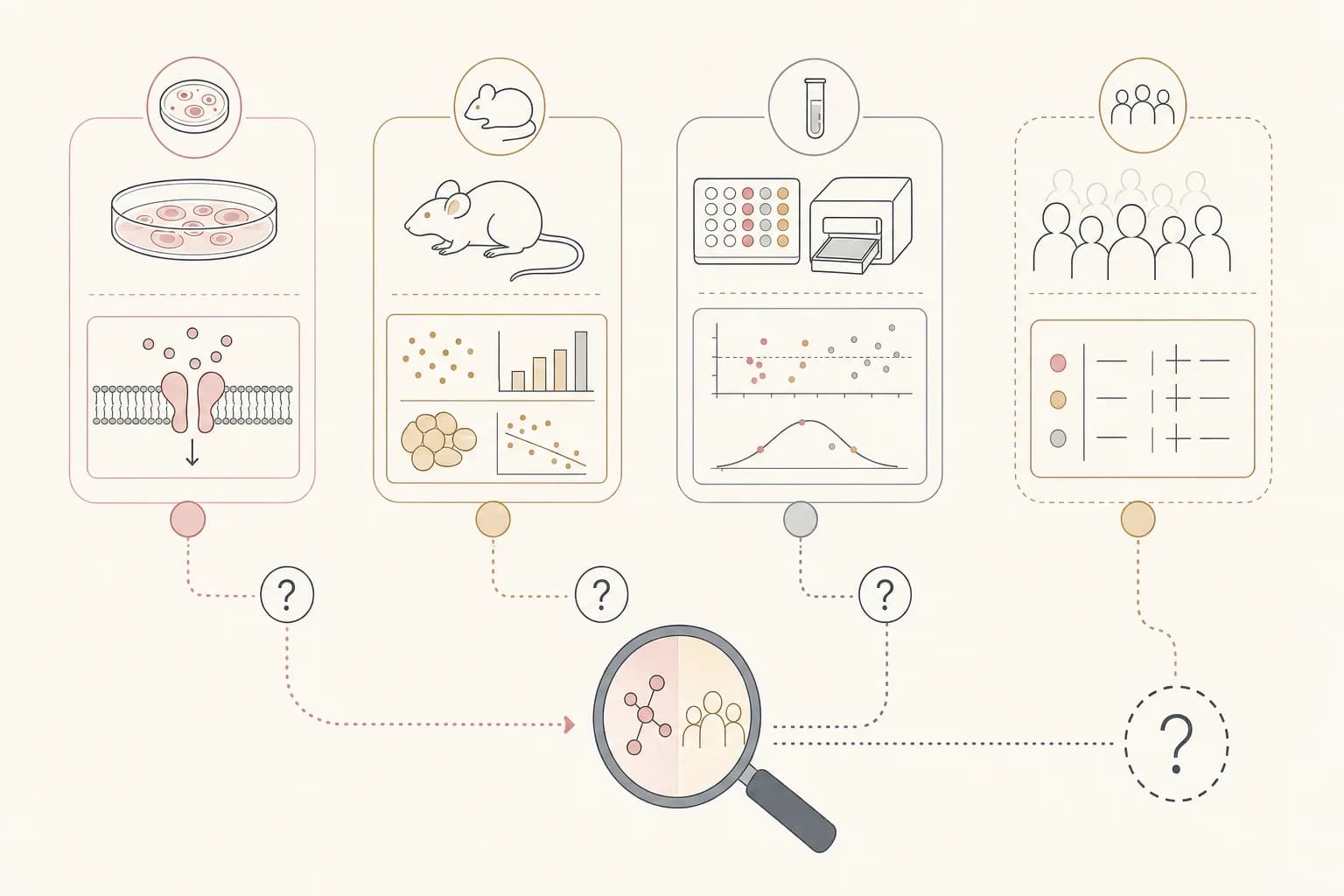
Which limits belong beside the headline?
For “AOD-9604: Fat-burning peptide claims what laboratory results can,” start with the recorded result, not the marketing version. A 1993 study found that synthetic hGH 177-191 reduced lipid formation in rat tissue to a degree reported as identical to intact human growth hormone.6
Within “AOD-9604: Fat-burning peptide claims what laboratory results can,” Laboratory measurements using tissue from peptide-exposed rats.6 This was not a clinical outcome in people.6
For “AOD-9604: Fat-burning peptide claims what laboratory results can,” that boundary keeps one result from becoming a universal promise. The result can be informative without becoming a personal recommendation or a promise about a catalog item.
The result in “AOD-9604: Fat-burning peptide claims what laboratory results can” becomes more useful when the comparison stays fair. Population, method, outcome, and timing should remain attached to the conclusion.
How does product identity fit the story?
For “AOD-9604: Fat-burning peptide claims what laboratory results can,” one precise finding is more useful than a broad slogan. The same 1993 study found no significant increase in glycerol release from the rat fat pads used to measure lipid breakdown.7
Within “AOD-9604: Fat-burning peptide claims what laboratory results can,” Laboratory measurement in epididymal fat pads from rats.7 The result was negative for this specific lipid-breakdown measure.7
That distinction gives “AOD-9604: Fat-burning peptide claims what laboratory results can” a useful answer without making it sound larger than the evidence. The result can be informative without becoming a personal recommendation or a promise about a catalog item.
A catalog card does not change the evidence boundary in “AOD-9604: Fat-burning peptide claims what laboratory results can”.4 It helps readers locate a live item while the article keeps scientific and product questions separate.4
Readers comparing this topic with HGH Fragment 176 191 can view its live catalog details below. It is a separate catalog reference, not a suggested combination.
What is the practical Philippine reading?
For “AOD-9604: Fat-burning peptide claims what laboratory results can,” a useful summary begins with the outcome the researchers actually recorded. The Philippine FDA Verification Portal separates licensed establishments from registered or notified health products.8
Within “AOD-9604: Fat-burning peptide claims what laboratory results can,” Official Philippine regulatory verification service.8 A portal record applies to the exact product or establishment named in that record.8
This is the point where “AOD-9604: Fat-burning peptide claims what laboratory results can” changes from a claim into an evidence question. The result can be informative without becoming a personal recommendation or a promise about a catalog item.
Bottom line
For “AOD-9604: Fat-burning peptide claims what laboratory results can,” fDA evaluation of published summaries and nominated material.1 This describes limits of the reviewed safety record rather than proving that a particular harm occurred.1
The Philippine FDA Verification Portal separates licensed establishments from registered or notified health products.8 For “AOD-9604: Fat-burning peptide claims what laboratory results can,” this check belongs beside the science rather than underneath it.
The practical conclusion for “AOD-9604: Fat-burning peptide claims what laboratory results can” is informed interest with exact source, context, and product boundaries intact. That makes the article useful without turning it into a sales promise or a personal recommendation.
Frequently asked questions
What is the fastest way to understand AOD-9604?
FDA's 2024 review described the human safety information as limited because study summaries lacked detailed adverse-event breakdowns, laboratory values, and longer follow-up.1 For “AOD-9604: Fat-burning peptide claims what laboratory results can,” begin there, then keep the study setting and stated limit beside the result instead of jumping to a broader conclusion.
Does one positive finding settle the whole topic?
No. This chemical identity does not establish a human outcome.3 In “AOD-9604: Fat-burning peptide claims what laboratory results can,” a finding can be useful while remaining narrow, early, or tied to one measured outcome.
Why does the study context matter?
Current FDA compounding safety page.5 For “AOD-9604: Fat-burning peptide claims what laboratory results can,” changing the population, design, formulation, or outcome changes the question being answered.
What should Filipino readers verify?
The Philippine FDA Verification Portal separates licensed establishments from registered or notified health products.8 While reading “AOD-9604: Fat-burning peptide claims what laboratory results can,” check the exact product and establishment details rather than relying on a familiar molecule name.
Do the Aod 9604 and HGH Fragment 176 191 cards prove a benefit?
No. In “AOD-9604: Fat-burning peptide claims what laboratory results can,” they are live catalog references for navigation. They do not turn a study result into a product claim, prove equivalence, or suggest using the items together.4
Sources
Footnotes
-
FDA Briefing Document: Evaluation of AOD-9604-Related Bulk Drug Substances (AOD-9604 (free base) and AOD-9604 acetate). FDA evaluation of published summaries and nominated material. This describes limits of the reviewed safety record rather than proving that a particular harm occurred. ↩ ↩2 ↩3 ↩4 ↩5 ↩6 ↩7 ↩8
-
WHO laboratory analysis of suspected falsified medical products; WHO laboratory testing for health-product regulation. WHO guidance on suspected falsified medical products and regulatory laboratory testing. Appearance alone cannot authenticate a product or establish a research outcome. ↩ ↩2 ↩3
-
Detection and in vitro metabolism of AOD9604.. Identity statement from a PubMed-indexed analytical study. This chemical identity does not establish a human outcome. ↩ ↩2 ↩3 ↩4
-
FDA Briefing Document: Evaluation of AOD-9604-Related Bulk Drug Substances (AOD-9604 (free base) and AOD-9604 acetate); Detection and in vitro metabolism of AOD9604.; Certain Bulk Drug Substances for Use in Compounding that May Present Significant Safety Risks; Philippine FDA Verification Portal; FDA Advisory No. 2023-2238: Utilization of the FDA Verification Portal. Editorial synthesis of the canonical research records and Philippine verification sources. This synthesis is educational and is not personal medical advice or a product recommendation. ↩ ↩2 ↩3 ↩4 ↩5 ↩6
-
Certain Bulk Drug Substances for Use in Compounding that May Present Significant Safety Risks. Current FDA compounding safety page. FDA also notes that causality is unclear for serious adverse events it identified. ↩ ↩2 ↩3 ↩4
-
Antilipogenic action of synthetic C-terminal sequence 177-191 of human growth hormone.. Laboratory measurements using tissue from peptide-exposed rats. This was not a clinical outcome in people. ↩ ↩2 ↩3
-
Antilipogenic action of synthetic C-terminal sequence 177-191 of human growth hormone.. Laboratory measurement in epididymal fat pads from rats. The result was negative for this specific lipid-breakdown measure. ↩ ↩2 ↩3
-
Philippine FDA Verification Portal; FDA Advisory No. 2023-2238: Utilization of the FDA Verification Portal. Official Philippine regulatory verification service. A portal record applies to the exact product or establishment named in that record. ↩ ↩2 ↩3 ↩4 ↩5