
TL;DR
- Laboratory findings can show that a peptide changes activity in isolated tissue, but they cannot show a whole-body weight outcome in a person.1
- Short rodent studies linked AOD-9604 with altered fat-tissue activity and lower weight gain or body weight under specific experimental conditions.2
- Early human summaries did not find statistically significant weight differences from placebo, and their methods and numerical reporting were limited.3
- A larger 24-week study also missed its primary 12-week weight endpoint, so earlier biological signals did not become a positive human trial result.4
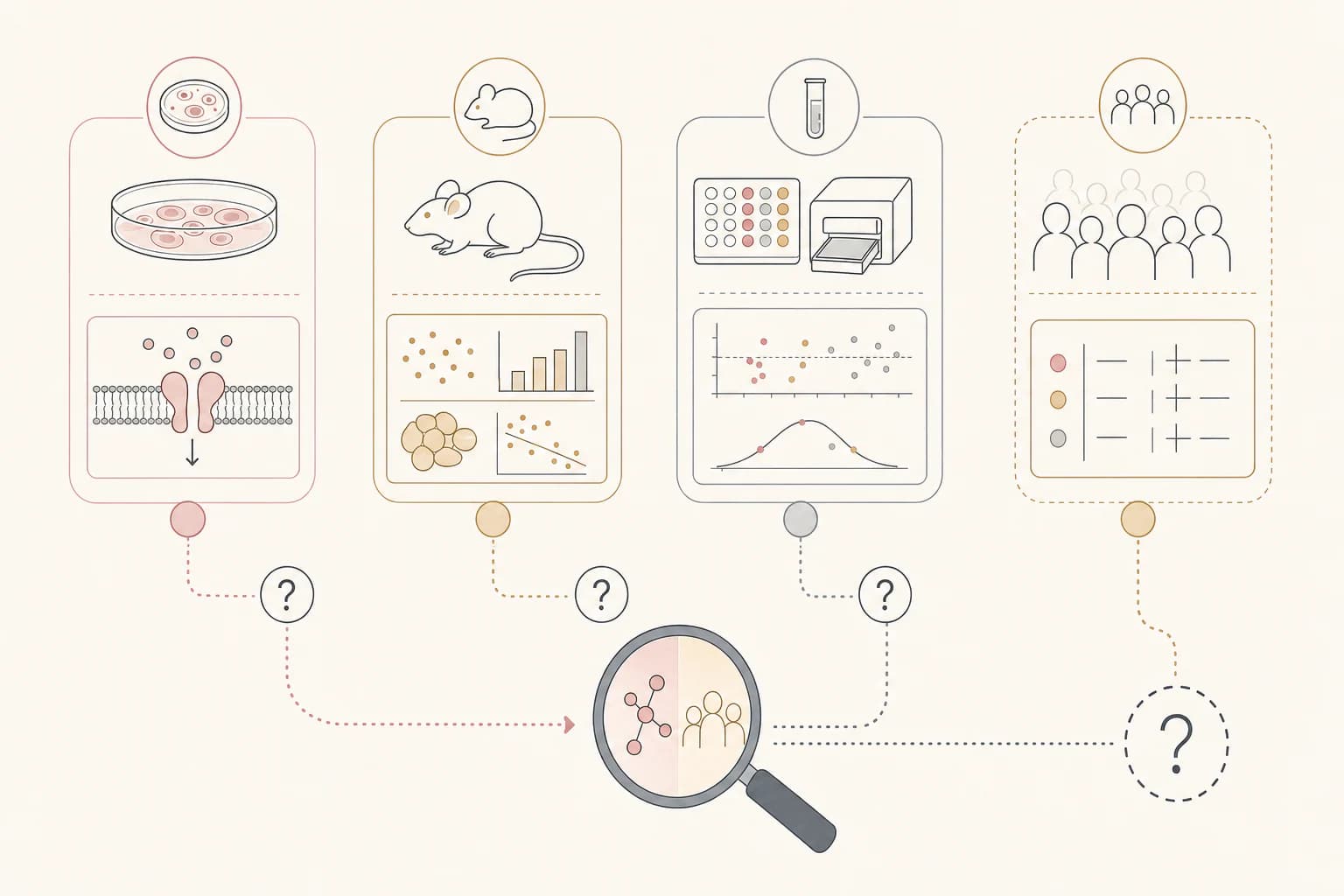
For Filipino readers, “fat-burning peptide” can sound like a finished verdict. In research, it is only a claim to unpack. A dish of cells, an animal experiment, and a human trial answer different questions.1 AOD-9604 is a useful case study because its record includes all three layers.2 They do not tell one simple story.4
Start by asking what was actually measured
A laboratory can measure whether fat tissue releases stored lipids or makes fewer new ones after exposure.1 It can also examine gene activity, energy use, or chemical breakdown under controlled conditions.5 These measurements may show biological activity.1 They are not the same as a lasting change in a person’s weight or body composition.1
The model matters just as much as the measurement.2 Isolated tissue lacks the full mix of appetite, digestion, movement, hormones, and daily behavior in a person.1 Rodents add a whole organism.6 Yet species, exposure route, and study length still set firm limits around the result.6 The first reading rule is simple: name the model before repeating the finding.1
AOD-9604 is named here only to introduce the following neutral catalog reference.7
A cell response is a clue, not a body outcome
One published experiment exposed isolated adipose tissue from humans and rodents to a related growth-hormone fragment labeled AOD-9401.1 The researchers reported increased lipolytic activity and decreased lipogenic activity in that tissue.1 Those terms describe laboratory measurements of lipid release and lipid formation; they do not report a participant’s weight change.1
The identity detail also deserves care.1 The paper called its peptide AOD-9401.1 Its tissue findings should not be silently relabeled as direct AOD-9604 evidence.1 Related molecules can help form a hypothesis. Yet similarity does not erase naming, structure, or test differences.7
Another laboratory study incubated AOD-9604 in serum and urine and identified six potential metabolites.8 That result helps explain detection and breakdown in prepared samples.8 It says nothing by itself about a meaningful change in human body composition.8
Rodent experiments add context—and new limits
In obese Zucker rats, researchers reported that 19 days of oral AOD-9604 reduced body-weight gain by more than half relative to controls.2 The same study found increased lipolytic activity in adipose tissue taken from the treated rats.2 This is a whole-animal result, but the outcome was reduced gain over 19 days, not evidence of sustained weight reduction in people.2
A separate experiment gave AOD-9604 to obese mice by intraperitoneal administration for 14 days.6 The study reported lower body weight and body fat along with increased expression of beta-3 adrenergic receptor RNA.6 These findings linked an organism-level change with a possible pathway signal under the study’s conditions.6
Neither experiment can answer what happens in an adult person.2 Species, exposure route, duration, and endpoints all changed before a human trial began.6
Mechanism results can be informative and mixed
The mouse research went beyond observing weight and tissue changes.5 Investigators also used mice lacking the beta-3 adrenergic receptor to test whether that pathway was necessary.5 With chronic exposure, the knockout mice did not show the same weight and lipolysis changes seen in wild-type controls.5
Yet an acute experiment still found higher energy use and fat oxidation in the knockout mice.5 The pattern suggests that the pathway may contribute without explaining every observed effect.5 FDA later reviewed the animal work.9 It concluded that the main molecular targets and mechanisms remained unknown.9
This is why a pathway diagram should not be mistaken for a forecast.9 A mechanism study can narrow possible explanations, but it cannot supply a human outcome that the experiment never measured.5 The result remains a research clue with boundaries.9
HGH fragment 176-191 is named here only to introduce the following neutral catalog reference.7
Small human studies did not confirm the pitch
FDA’s 2024 review summarized three early studies of oral or intravenous AOD-9604 in adults with obesity.3 One involved 23 adults, another involved 16 men, and a third involved 36 men.3 The reported weight changes did not differ significantly from placebo.3
Some laboratory markers moved even when the clinical weight result did not.3 In the first two studies, non-esterified fatty acids rose after exposure, yet the reported weight differences from placebo were not significant.3 That contrast is the central lesson of this evidence trail: a biomarker can change without establishing the outcome used in a marketing-style claim.3
FDA also noted small samples, unclear study details, and few numerical results.3 The fair conclusion is narrow.3 These early summaries did not confirm a weight result that differed from placebo.3
A larger study changed the weight of the evidence
A 12-week study abstract described 300 adults with obesity assigned to five AOD-9604 groups or placebo.10 It reported a nonlinear pattern across those groups.10 The largest rate of change appeared at one exposure level, not as a steady trend.10 FDA found the small differences hard to read because the abstract gave sparse methods and incomplete measurements.10
The later OPTIONS study enrolled 536 adults with obesity and randomized 502 of them.4 It compared three AOD-9604 groups with placebo for 24 weeks.4 All groups also joined a supervised diet and exercise program.4 The primary test compared weight change after 12 weeks.4
It did not.4 FDA reported that the trial missed that primary endpoint and that the overall population did not respond consistently.4 Detailed methods and results were not published in the medical literature.4
Safety and product quality are separate questions
A biological signal does not establish safety.11 A short safety summary also cannot settle long-term questions.11 FDA reviewed six company-funded oral and intravenous study summaries.11 It found key limits in duration, event detail, and laboratory reporting.11 FDA reported that human exposure across routes was not clearly described.11
Product quality adds another layer.12 FDA states that compounded AOD-9604 may pose immune-response risks for certain routes.12 It may also involve peptide impurities, clumping, and testing problems.12 Those concerns depend partly on the formula, manufacturing, storage, and route.12 A tissue or mouse experiment does not assess them in a finished product.12
FDA also notes serious adverse events that may be associated with AOD-9604.12 It says the causal link is unclear.12 The assessment does not describe any specific catalog item.12
Bottom line
The AOD-9604 story shows why “fat-burning peptide” carries more certainty than the evidence allows.4 Tissue experiments measured lipid activity.1 Rodent studies recorded short-term metabolic and weight-related changes.2 Mechanism experiments produced an incomplete pathway picture.9 These findings remain useful when their models stay attached.9
Human evidence asked the more relevant question and produced a different answer.3 Small early summaries did not show significant weight differences from placebo, while a larger randomized study missed its primary weight endpoint.4 Safety and product-quality questions also remain separate from laboratory activity.12 The fairest reading is neither hype nor dismissal: report what each experiment measured, then stop where that model stops.1
This article is educational research context, not medical advice. Catalog links are neutral references and do not imply a treatment or human-use recommendation.
Frequently asked questions
What does lipolysis mean in a laboratory study?
Lipolysis describes the release of stored lipids from fat cells or tissue under measured conditions.1 A higher laboratory reading shows that this process changed in the sample.1 It does not, on its own, tell readers whether a person’s body weight or body composition changed over time.1
Does human fat tissue make a study a human trial?
No. Isolated human adipose tissue can reveal a local biochemical response, but it is outside the full living body.1 It cannot capture appetite, digestion, activity, organ interactions, or sustained weight outcomes together.1 A controlled human trial must measure those participant-level outcomes directly.3
Why are mouse and rat findings still useful?
Animal studies let researchers observe tissue, metabolism, and whole-body measures together under controlled conditions.2 They can also test mechanisms using genetic models, as the beta-3 receptor experiment did.5 Their value is hypothesis-building, while species and study-design differences limit translation to people.6
What did the larger human study find?
The OPTIONS study randomized 502 adults with obesity to three AOD-9604 groups or placebo for 24 weeks with a supervised diet and exercise program.4 FDA reported no significant difference on the primary 12-week weight endpoint, and detailed results were not published in the medical literature.4
Can a biomarker change without a weight result?
Yes. In two small human study summaries, non-esterified fatty acids rose after exposure, but weight change was not statistically different from placebo.3 A biomarker can show that one measured process moved; it cannot substitute for a separate clinical endpoint that failed to differ.3
Does a laboratory result establish safety?
No. A measure of lipid activity or short-term animal weight cannot answer all safety questions.11 FDA found limits in the duration and detail of the available human summaries.11 It also raised separate concerns about immune responses, peptide impurities, clumping, and product testing.12
Sources
Footnotes
-
Effects of oral administration of a synthetic fragment of human growth hormone on lipid metabolism.. In vitro and ex vivo adipose-tissue experiments paired with a 30-day obese-mouse experiment. Isolated human tissue cannot show whole-body weight change, and AOD-9401 should not be silently treated as identical to AOD-9604. ↩ ↩2 ↩3 ↩4 ↩5 ↩6 ↩7 ↩8 ↩9 ↩10 ↩11 ↩12 ↩13 ↩14 ↩15 ↩16 ↩17 ↩18 ↩19 ↩20
-
Metabolic studies of a synthetic lipolytic domain (AOD9604) of human growth hormone.. Controlled rodent experiment using obese Zucker rats and tissue metabolic measurements. The result concerns short-term weight gain and tissue activity in rats, not weight reduction in humans. ↩ ↩2 ↩3 ↩4 ↩5 ↩6 ↩7 ↩8 ↩9
-
FDA briefing document: Evaluation of AOD-9604-related Bulk Drug Substances for Inclusion on the 503A Bulk Drug Substances List. Small studies in adults with obesity, summarized in a 2024 FDA briefing document. FDA noted small samples, unclear parameters, sparse numerical information, and limited reporting. ↩ ↩2 ↩3 ↩4 ↩5 ↩6 ↩7 ↩8 ↩9 ↩10 ↩11 ↩12 ↩13 ↩14
-
FDA briefing document: Evaluation of AOD-9604-related Bulk Drug Substances for Inclusion on the 503A Bulk Drug Substances List. OPTIONS phase 2B study with three oral AOD-9604 groups, placebo, and a dietitian-supervised diet and exercise program. Detailed methods and results were not published in the medical literature; FDA relied on company regulatory submissions and announcements. ↩ ↩2 ↩3 ↩4 ↩5 ↩6 ↩7 ↩8 ↩9 ↩10 ↩11 ↩12 ↩13
-
The effects of human GH and its lipolytic fragment (AOD9604) on lipid metabolism following chronic treatment in obese mice and beta(3)-AR knock-out mice.. Mechanistic comparison of genetically altered and wild-type mice, with separate chronic and acute experiments. The mixed pattern suggests pathway involvement but does not identify a complete mechanism or predict a human outcome. ↩ ↩2 ↩3 ↩4 ↩5 ↩6 ↩7 ↩8
-
The effects of human GH and its lipolytic fragment (AOD9604) on lipid metabolism following chronic treatment in obese mice and beta(3)-AR knock-out mice.. Obese mouse experiment comparing chronic AOD-9604 and human growth hormone exposure. The route, duration, species, and measured outcomes prevent direct translation to a human result. ↩ ↩2 ↩3 ↩4 ↩5 ↩6 ↩7
-
Detection and in vitro metabolism of AOD9604.; FDA briefing document: Evaluation of AOD-9604-related Bulk Drug Substances for Inclusion on the 503A Bulk Drug Substances List. Canonical PubMed chemistry record and FDA regulatory review describing the peptide identity. Chemical identity does not establish a biological outcome, clinical benefit, or the identity and quality of a marketed product. ↩ ↩2 ↩3
-
Detection and in vitro metabolism of AOD9604.. Analytical laboratory study designed for detection and metabolism characterization. Detectability and breakdown products do not establish body-composition change, clinical effectiveness, or safety. ↩ ↩2 ↩3
-
FDA briefing document: Evaluation of AOD-9604-related Bulk Drug Substances for Inclusion on the 503A Bulk Drug Substances List. FDA synthesis of available nonclinical pharmacology and receptor-related findings. A plausible pathway signal is not the same as a complete mechanism or a demonstrated human outcome. ↩ ↩2 ↩3 ↩4 ↩5 ↩6
-
FDA briefing document: Evaluation of AOD-9604-related Bulk Drug Substances for Inclusion on the 503A Bulk Drug Substances List. Conference abstract summarized in FDA's regulatory review, with multiple oral dose groups and placebo. FDA did not locate a full publication of the methods and results, and the abstract did not provide complete measurements. ↩ ↩2 ↩3 ↩4
-
FDA briefing document: Evaluation of AOD-9604-related Bulk Drug Substances for Inclusion on the 503A Bulk Drug Substances List. FDA review of six company-funded oral and intravenous clinical-study summaries and safety databases. Limited reporting cannot establish long-term safety, and a lack of spontaneous reports does not demonstrate safety. ↩ ↩2 ↩3 ↩4 ↩5 ↩6 ↩7
-
FDA briefing document: Evaluation of AOD-9604-related Bulk Drug Substances for Inclusion on the 503A Bulk Drug Substances List; Certain Bulk Drug Substances for Use in Compounding that May Present Significant Safety Risks. Current FDA compounding safety page and the supporting 2024 regulatory review. This is a U.S. compounding assessment; it does not establish Philippine regulatory status or the quality of any specific catalog item. ↩ ↩2 ↩3 ↩4 ↩5 ↩6 ↩7 ↩8 ↩9 ↩10