
TL;DR
- Exercise training changes the mitochondrial system inside human skeletal muscle, but the size of that change depends on the training program and how researchers measure it.1
- MOTS-c is a tiny peptide encoded within mitochondrial DNA, making it an intriguing clue about how mitochondria may send stress and metabolism signals.2
- One cycling experiment in ten young men found a brief rise in the body’s own MOTS-c, while performance findings after researchers provided MOTS-c came from mice.3
- A small exercise trial produced different MOTS-c results across two participant subgroups, warning against a single story for every population.4
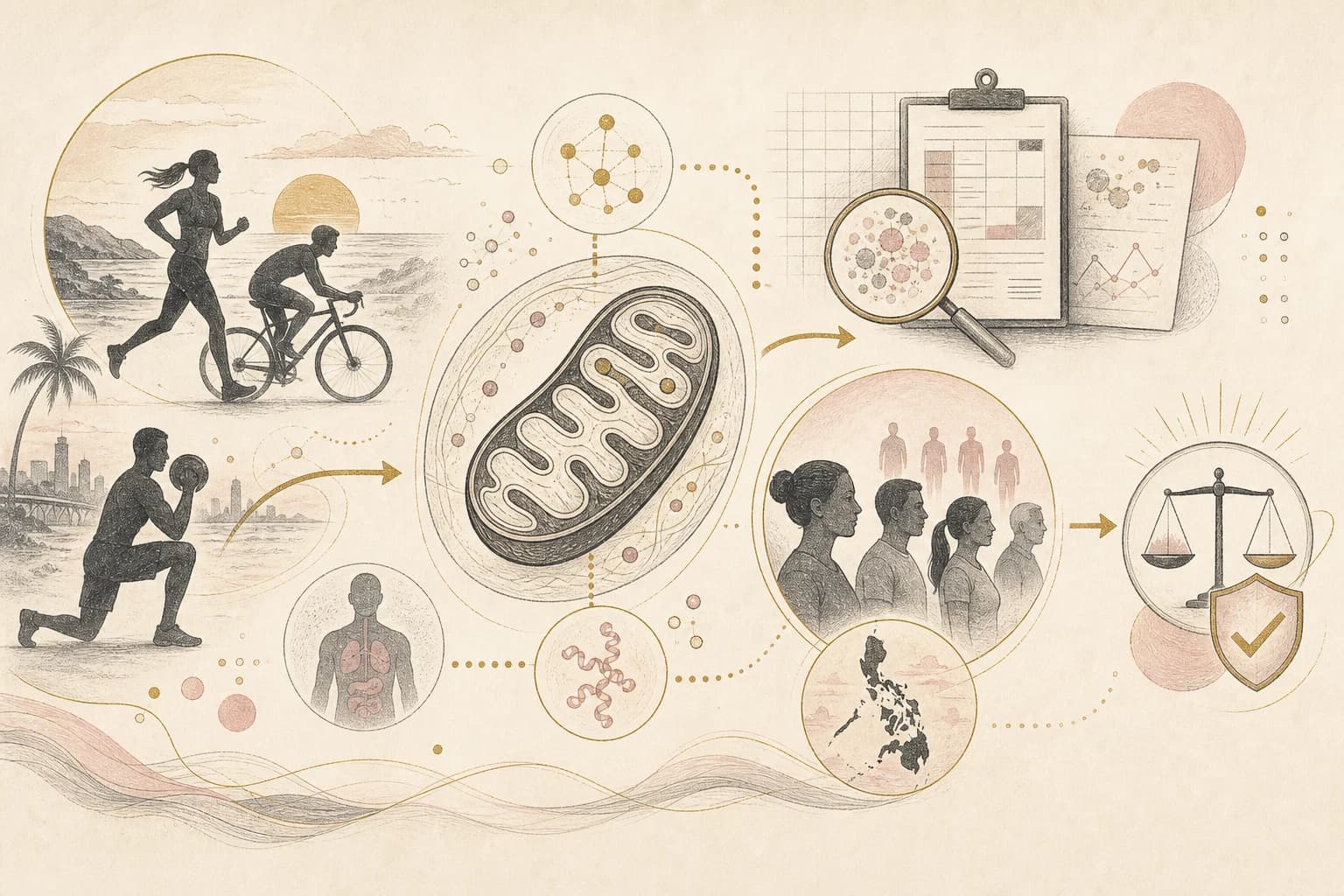
For Filipino readers, “exercise changes your mitochondria” may sound far from ordinary life. Movement often fits around commutes, shifting schedules, family duties, or rainy days. The idea is closer than it seems: working muscle must repeatedly meet changing energy demand.5 MOTS-c is one clue in that story.3 It makes sense only when human observations stay separate from cell and animal results.3
Mitochondria are more than a battery metaphor
Mitochondria help cells convert fuel into usable chemical energy, including ATP.5 In skeletal muscle, that energy system must respond when a relaxed walk becomes a fast climb or a short run for transport.5 The familiar “powerhouse” label is helpful, but incomplete: mitochondria also participate in signals that shape how cells respond to changing demand.5
Training can increase mitochondrial content in human muscle, giving the tissue more machinery for energy metabolism.1 This is an adaptation across repeated sessions, not a claim that every workout instantly rebuilds a person’s cells.1 It also does not mean that one molecule explains exercise.5 MOTS-c matters here because it is one of the small signals researchers are studying at the border between mitochondrial genetics, muscle, and stress.2
MOTS-c is named here only to introduce the following neutral catalog reference.2
Exercise changes the system, not one magic switch
A large systematic review examined mitochondrial measurements from 353 research articles involving 5,973 participants.1 After adjustment, endurance training, high-intensity intervals, and sprint intervals produced broadly similar average percentage increases in skeletal-muscle mitochondrial content.1 That does not make the programs interchangeable for every person.1
Session intensity, training frequency, program length, starting fitness, and laboratory method differed across the underlying research.1 Think of adaptation less like pressing one button and more like reorganizing a busy kitchen.1 Capacity can grow, but the result reflects the work pattern, materials, and starting setup.1
This broader view protects against a common shortcut.5 If exercise changes hundreds of connected processes, a change in MOTS-c can be meaningful without being the sole cause of better fitness.3 Researchers still have to ask whether it is a signal, a helper, a consequence, or some context-dependent mix.6
What the name MOTS-c actually describes
MOTS-c is a peptide only 16 amino acids long.2 Its instructions sit in a short open reading frame within the 12S rRNA region of mitochondrial DNA.2 An open reading frame is a stretch of genetic sequence that can be read to produce a peptide or protein.2 The discovery expanded the older picture of mitochondrial DNA as a genome with only a familiar set of larger protein instructions.2
The original report used cell and mouse experiments to study a possible MOTS-c pathway.7 It linked folate metabolism and AICAR buildup with AMPK activation and changes in glucose use.7 Those steps form a proposed biological pathway, not a forecast for a person.7
The distinction is crucial for any catalog reader.3 Finding that the body makes a peptide does not show what a manufactured version will do in humans.7 A pathway diagram also cannot supply an outcome that the experiment never measured.7
What happened during one human cycling test
The clearest acute human exercise finding came from ten sedentary, healthy young men who completed a cycling session.8 MOTS-c measured in skeletal muscle rose about 11.9-fold after exercise.8 Circulating MOTS-c rose about 1.5- to 1.6-fold during and after the session.8 Circulating levels returned to baseline after four hours of rest.8
This result shows a short-lived response in the body’s own peptide under one demanding protocol.8 It does not show that a larger rise is better or that every group follows the same pattern.8 The measurement also did not predict a health outcome.8 Ten participants leave little room to describe normal variation across communities.8
Most importantly, the participants were not given MOTS-c.3 The tests with researcher-provided MOTS-c involved cells and mice, while the human portion tracked endogenous MOTS-c around exercise.3 Combining those arms into one “human performance” claim would change what the study actually did.3
Cell and mouse findings answer different questions
Cell experiments can ask where a molecule moves when nutrients or energy conditions change.6 Under metabolic stress, researchers observed MOTS-c moving into the nucleus in an AMPK-dependent manner and influencing stress-responsive gene expression.6 That is evidence about cellular signaling under controlled conditions, not about running speed or recovery in a person.6
Mouse experiments can add a whole living system.3 In the multi-model exercise paper, researcher-provided MOTS-c improved several performance measures in mice of different ages.3 A separate rodent paper found more muscle MOTS-c after four to eight weeks of voluntary running.9 Mice in that paper also performed better in an acute exercise test after receiving MOTS-c.9
These results support research questions about muscle adaptation and performance mechanisms.9 They do not erase the species boundary.9 A mouse protocol controls diet, genetics, housing, exposure, and exercise in ways that do not reproduce Filipino daily life.9
NAD+ is named here only to introduce the following neutral catalog reference.
A small exercise trial produced a mixed pattern
Another human paper analyzed MOTS-c as a secondary outcome in a 16-week combined aerobic and resistance exercise trial among breast cancer survivors.10 The analysis included 25 Hispanic and 24 non-Hispanic White participants who had completed treatment.10 Plasma MOTS-c increased in the non-Hispanic White exercise subgroup but did not significantly change in the Hispanic exercise subgroup.4
That difference should slow the story down, not invite a biological stereotype.4 The sample was small, the groups differed at baseline, and the analysis cannot prove ethnicity caused the contrasting result.4 It also cannot be relabeled as evidence about Filipino participants.10
The study is still useful because it shows why a result from ten young men cannot become a universal response chart.8 Population, health history, training design, timing, and measurement all matter when comparing experiments.10 This contrast is not clutter to remove; it shows the boundaries of a claim.4
Genetics adds context, not a personal verdict
Mitochondrial DNA can vary among people, including at the sequence that encodes MOTS-c.11 One m.1382A>C variant changes an amino acid in the peptide.11 A three-cohort analysis of 27,527 people linked that variant with type 2 diabetes prevalence in men but not women.11 Association does not prove that the variant caused the condition.11
In one Japanese cohort, the association in men appeared in the lowest physical-activity group, suggesting a possible interaction between genetic context and activity.12 That subgroup finding can be shaped by confounding and does not provide a personal risk calculation.12 It is also not a study of Filipino ancestry.12
For readers in the Philippines, the responsible local connection is therefore about perspective, not prevalence.12 Research samples carry histories and limits, and “Asian” is far too broad to make one cohort stand in for another.12 A genetic clue can guide another experiment without defining an individual or a nation.11
Bottom line
Exercise biology is a network story.5 Human training research shows that skeletal-muscle mitochondria adapt across several training styles, while the exact response depends on the program and measurement.1 Mitochondrial DNA encodes MOTS-c.2 Exercise changed its endogenous level in one small human experiment.8
The limits are as important as the signal.3 Human cycling research measured the body’s own MOTS-c.3 Cell work mapped stress signaling.6 Performance experiments with researcher-provided MOTS-c used mice.3 A second human study produced a mixed subgroup pattern that cannot be projected onto Filipino readers.4 The basic biology matters because it helps us ask sharper questions without turning an early mechanism into a catalog promise.7
This article is educational research context, not medical advice. Catalog links are neutral references and do not imply a treatment or human-use recommendation.
Frequently asked questions
What is a mitochondrion?
A mitochondrion is a structure inside a cell that helps convert fuel into usable chemical energy, including ATP.5 Muscle cells adjust their mitochondrial system as energy demands change.5 The “powerhouse” nickname captures part of the job, but mitochondria also take part in wider cellular communication.5
Does exercise always increase MOTS-c?
Not in every reported group.4 An acute cycling study found increases in ten young men.8 A 16-week exercise analysis found an increase in one breast cancer survivor subgroup but not another.4 The protocols, participants, timing, and measurement methods were different.10
Is MOTS-c the reason exercise improves fitness?
The research does not support a one-molecule explanation.3 Exercise training changes a broad mitochondrial system, while MOTS-c studies examine one possible signal within it.1 Human research has measured an endogenous response, and mouse or cell experiments have explored performance and mechanisms separately.3
What does AMPK mean in this story?
AMPK is an energy-sensing enzyme used in the proposed MOTS-c pathway.7 The original report linked MOTS-c, AICAR accumulation, and AMPK activation in cell and mouse experiments.7 Another cell study found AMPK-dependent movement of MOTS-c into the nucleus during metabolic stress.6
Why can’t mouse performance results predict mine?
Mouse experiments use a different species under tightly controlled diet, housing, exposure, and exercise conditions.9 They can test mechanisms and generate focused questions, but they do not reproduce a person’s physiology or daily setting.9 The performance findings with researcher-provided MOTS-c discussed here were animal results.3
How does NAD+ connect with exercise biology?
NAD+ and NADH are coenzymes that carry electrons in reactions involved in mitochondrial ATP generation.13 Exercise can shift their levels and ratio in skeletal muscle, linking energy demand with redox and signaling questions.13 A mechanistic connection does not make a catalog entry evidence for an exercise outcome.13
Sources
Footnotes
-
Effects of Exercise Training on Mitochondrial and Capillary Growth in Human Skeletal Muscle: A Systematic Review and Meta-Regression.. Quantitative synthesis covering mitochondrial measurements from 353 research articles and 5,973 participants. Training frequency, intervention length, baseline fitness, measurement method, and other protocol details varied across the underlying studies. ↩ ↩2 ↩3 ↩4 ↩5 ↩6 ↩7 ↩8 ↩9 ↩10 ↩11
-
The mitochondrial-derived peptide MOTS-c promotes metabolic homeostasis and reduces obesity and insulin resistance.. The original report identifying and experimentally characterizing MOTS-c. Molecular identity alone does not establish a human exercise, health, or treatment outcome. ↩ ↩2 ↩3 ↩4 ↩5 ↩6 ↩7 ↩8
-
MOTS-c is an exercise-induced mitochondrial-encoded regulator of age-dependent physical decline and muscle homeostasis.. A multi-model paper with a small acute human exercise experiment and separate cell and mouse experiments. The mouse administration findings are not human intervention results and should not be merged with the human exercise-response finding. ↩ ↩2 ↩3 ↩4 ↩5 ↩6 ↩7 ↩8 ↩9 ↩10 ↩11 ↩12 ↩13 ↩14 ↩15 ↩16
-
Effect of aerobic and resistance exercise on the mitochondrial peptide MOTS-c in Hispanic and Non-Hispanic White breast cancer survivors.. Subgroup comparison within a small exercise study of breast cancer survivors. The subgroup result does not prove that ethnicity caused the difference, and it cannot be projected onto Filipino readers. ↩ ↩2 ↩3 ↩4 ↩5 ↩6 ↩7 ↩8
-
Effects of Exercise Training on Mitochondrial and Capillary Growth in Human Skeletal Muscle: A Systematic Review and Meta-Regression.; NAD(+)/NADH and skeletal muscle mitochondrial adaptations to exercise.. A systematic review and meta-regression of human skeletal-muscle training research, alongside a mechanistic review of NAD+/NADH and mitochondrial ATP production. Mitochondria have functions beyond energy metabolism, and average training responses do not predict one person's response. ↩ ↩2 ↩3 ↩4 ↩5 ↩6 ↩7 ↩8 ↩9 ↩10
-
The Mitochondrial-Encoded Peptide MOTS-c Translocates to the Nucleus to Regulate Nuclear Gene Expression in Response to Metabolic Stress.. Mechanistic experiments using cultured human cells, glucose restriction, imaging, and gene-expression analyses. Cellular movement and gene-expression changes do not establish an exercise-performance or clinical outcome in people. ↩ ↩2 ↩3 ↩4 ↩5 ↩6
-
The mitochondrial-derived peptide MOTS-c promotes metabolic homeostasis and reduces obesity and insulin resistance.. Laboratory cell work and metabolic experiments in mice. A pathway observed in cells and mice cannot be assumed to produce the same magnitude or outcome in people. ↩ ↩2 ↩3 ↩4 ↩5 ↩6 ↩7 ↩8
-
MOTS-c is an exercise-induced mitochondrial-encoded regulator of age-dependent physical decline and muscle homeostasis.. Small, acute human exercise experiment using muscle samples, blood samples, western blotting, and ELISA. The experiment involved ten young men, had no non-exercise control arm for this acute test, and measured short-term endogenous levels rather than health outcomes. ↩ ↩2 ↩3 ↩4 ↩5 ↩6 ↩7 ↩8 ↩9 ↩10 ↩11
-
MOTS-c increases in skeletal muscle following long-term physical activity and improves acute exercise performance after a single dose.. Chronic voluntary-running experiments in rats and mice plus an acute administered-peptide exercise experiment in mice. The training response and administered-dose performance result were animal findings, not evidence of a human outcome. ↩ ↩2 ↩3 ↩4 ↩5 ↩6 ↩7
-
Effect of aerobic and resistance exercise on the mitochondrial peptide MOTS-c in Hispanic and Non-Hispanic White breast cancer survivors.. Randomized exercise-versus-usual-care trial with MOTS-c assessed as a secondary outcome after cancer treatment. The sample was small, population-specific, and not designed to represent Filipino adults or the general population. ↩ ↩2 ↩3 ↩4 ↩5
-
A pro-diabetogenic mtDNA polymorphism in the mitochondrial-derived peptide, MOTS-c.. Meta-analysis of three cohorts totaling 27,527 people, supported by cell and mouse comparisons of the common and variant peptides. This was an association, not proof that the variant caused diabetes, and sex-specific findings require careful interpretation. ↩ ↩2 ↩3 ↩4 ↩5
-
A pro-diabetogenic mtDNA polymorphism in the mitochondrial-derived peptide, MOTS-c.. Subgroup analysis from one cohort in a larger genetic association paper. A subgroup association can be affected by confounding and does not establish a rule for individuals, other populations, or Filipino ancestry. ↩ ↩2 ↩3 ↩4 ↩5
-
NAD(+)/NADH and skeletal muscle mitochondrial adaptations to exercise.. Mechanistic review of NAD+/NADH metabolism and skeletal-muscle mitochondrial adaptation to acute and chronic endurance exercise. The review emphasizes that the contribution of NAD-related signaling to exercise adaptation was not fully resolved. ↩ ↩2 ↩3