Quick answer
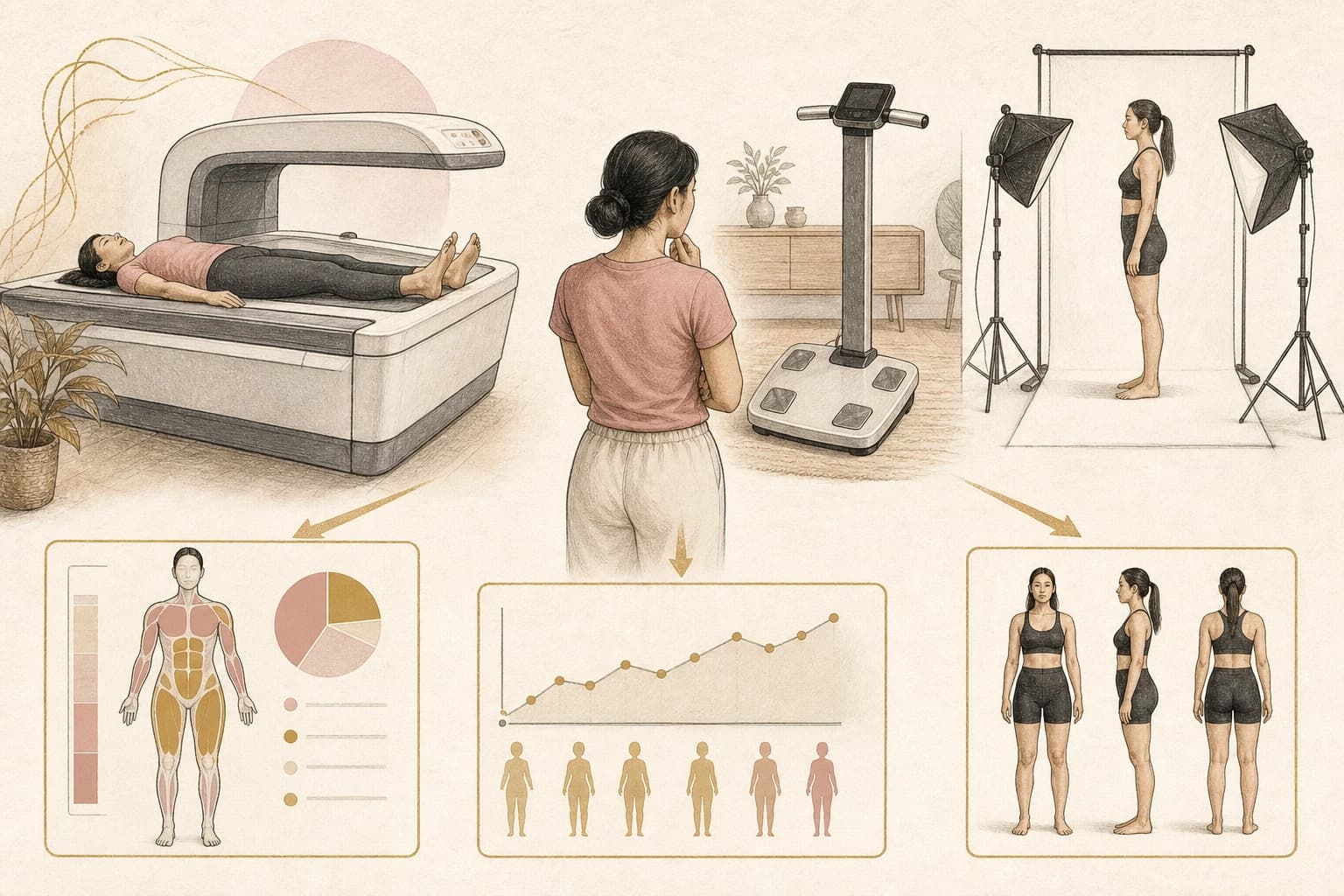
DEXA, bioelectrical-impedance scales, and progress photos do not measure the same thing. DEXA estimates lean mass, fat mass, bone measures, and related totals. A body-fat scale estimates composition through electrical impedance and a prediction equation. A photo records appearance.
None is a perfect direct reading of every tissue. DEXA varies by equipment and procedure, impedance may be repeatable yet disagree with a reference method, and photos depend heavily on standardized capture. Filipino readers should choose a method for the question, repeat it consistently, and avoid comparing numbers from different systems as if they were interchangeable.123
What does a DEXA body-composition scan report?
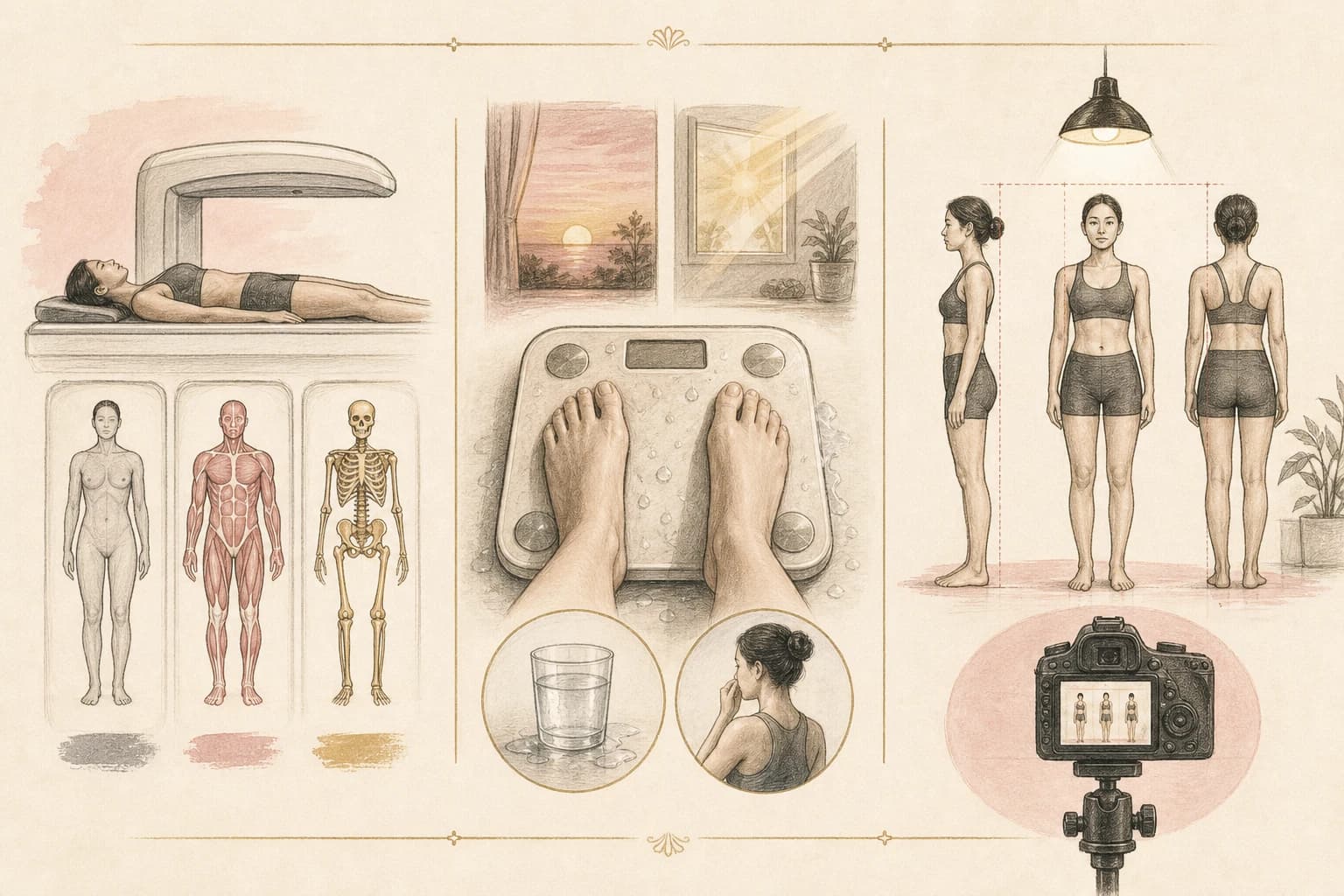
A standard DEXA report can include total mass, lean mass, fat mass, percentage fat, bone mineral content, bone mineral density, and BMI. These are distinct estimates rather than one universal score.1
DEXA uses low-experimental amount X-ray measurements and a model to divide the scanned body into tissue categories. It is widely used because it provides more detail than a bathroom scale.
Still, the result is not a direct count of every fat or muscle cell. An expert guide notes that validity and repeatability vary with the reference method, population, manufacturer, and equipment model.2
Positioning, calibration, clothing, recent changes in hydration, and analysis software can affect comparisons. A follow-up scan is most useful when the clinic uses consistent equipment and procedures.
Readers researching Tesamorelin can view its live catalog details below. The listing identifies the catalog item and is separate from the evidence discussed here.
How does a body-fat scale work?
Most consumer body-fat scales use bioelectrical impedance. The device sends a small electrical signal and combines the measured impedance with a prediction equation.
That equation may include height, weight, age, sex, or other inputs. Its performance depends on the device and how closely a person resembles the population used to build the model.4
Hydration, recent food, exercise, skin temperature, foot contact, and time of day can move the displayed estimate. This is why repeated measurements under similar conditions are more useful than isolated readings.
A small controlled study of 14 healthy military-age adults found that one multi-frequency device was highly repeatable. Yet it differed systematically from DEXA for body-fat percentage, fat-free mass, and fat mass.5
Repeatability means the device gives similar results under similar conditions. Accuracy or agreement asks whether those results match a stronger comparison method. A tool can do well on the first question and less well on the second.3
How accurate are impedance estimates for individuals?
A 2026 systematic review examined 12 studies in healthy, weight-stable, non-athlete, non-pregnant adults. Bioimpedance estimates were generally not equivalent to four-compartment estimates at the individual level.6
A four-compartment model combines multiple measurements to estimate water, mineral, fat, and protein components. It is more complex than a home scale and often used as a research comparison.
The review does not mean every impedance scale is useless. A consistent device may help show a personal trend when measurement conditions remain stable.
It does mean that a displayed body-fat percentage should not be treated as exact. Small changes may sit within normal measurement noise, especially when hydration or testing conditions changed.
Comparing one brand’s number with another brand or a DEXA result can create a false trend. The method changed along with the measurement.
What can progress photos show?
Photos document visible appearance. They can show shape, posture, skin surface, and how clothing fits, but they do not divide weight into fat, lean tissue, water, and bone.
A review of clinical photography emphasizes consistent image quality and capture conditions. Standardization makes comparisons more useful.7
For personal progress photos, that means matching camera distance, height, lens, lighting, background, clothing, posture, and time of day. Flexing in one image and relaxing in another can manufacture a dramatic change.
Research has developed algorithms that estimate body-fat percentage from two photographs plus demographic and body-size inputs. One method was validated against DEXA in children and adults.8
That does not turn ordinary before-and-after photos into a body-fat test. The research used a defined algorithm, standardized inputs, and a comparison method.8
Readers comparing this topic with Semaglutide can view its live catalog details below. It is a separate catalog reference, not a suggested combination.
Which method should a Filipino reader choose?
Choose based on the decision. A clinic may use DEXA when regional lean and fat estimates or bone measures matter. A home scale may be convenient for frequent trends. Photos may document visible change.
Consider cost and access. The most sophisticated method is not always necessary if the goal is simply to monitor a broad, long-term trend.
Use the same device and protocol whenever possible. A DEXA scan from one manufacturer and a follow-up from another may introduce a system difference that looks like a body change.2
For impedance, measure at a similar time under similar hydration and meal conditions. Record the scale model so later comparisons remain traceable.4
Track the expected size of change as well. If the device normally varies from morning to evening, a smaller movement should not be celebrated or feared as a true tissue change. Several measurements can reveal the usual noise.
Clinical decisions may require a stronger method than personal trend tracking. Convenience and diagnostic usefulness are different standards, so the same tool need not serve every purpose.
For photos, standardize the scene and protect privacy. Clinical photography guidance emphasizes both consistent capture and safekeeping.7
How should measurement claims appear in an article?
Name the method next to the result. “Fat mass fell on DEXA” is clearer than “body fat disappeared.”
Report whether the value is total, regional, visceral, subcutaneous, lean mass, or a percentage. These measurements can move differently.
Keep the same method across time when describing change. If methods differ, say so rather than joining the values into one line.
Avoid false precision. A consumer scale displaying a decimal place does not guarantee the estimate is accurate to that decimal.
Finally, pair the number with its limitation. A scan, scale, or photograph can be useful without being perfect. Honest measurement language makes progress easier to understand, not less meaningful.
Bottom line
DEXA, body-fat scales, and progress photos provide different views of body composition. DEXA offers several tissue and bone estimates but remains equipment- and procedure-dependent. Bioimpedance is convenient and can be repeatable, yet individual estimates may disagree with stronger reference methods. Photos show appearance only when capture conditions are consistent.
Filipino readers should select the method that matches the question, repeat it under similar conditions, and avoid mixing values across systems. The best tool is not the one with the most impressive decimal; it is the one used consistently with its limits clearly understood.
Frequently asked questions
Does DEXA directly measure every tissue?
No. It estimates tissue categories using a device and model, with method-specific limits.2
Can a body-fat scale be consistent but inaccurate?
Yes. One device was repeatable but differed systematically from DEXA.53
Are progress photos a body-fat test?
No. Ordinary photos record appearance and need standardized conditions for fair comparison.7
Should I compare two different scale brands?
Treat that comparison cautiously because devices and prediction equations differ.4
Do the product cards prove a body-composition effect?
No. They are separate live catalog references and are not evidence, treatment advice, or a combination recommendation.
Sources
Footnotes
-
The Official Positions of the International Society for Clinical Densitometry: body composition analysis reporting. Professional reporting position for DXA body-composition reports. A report lists estimates from a specific DXA system; it is not a single universal body-composition score. ↩ ↩2
-
Methodological standards for body composition assessment—an expert-endorsed guide for research and clinical applications. International expert-endorsed methodological guide for clinical and research body-composition assessment. A DXA result is an estimate with method-specific limits, not a perfect direct reading of every tissue compartment. ↩ ↩2 ↩3 ↩4
-
Reliability, biological variability, and accuracy of multi-frequency bioelectrical impedance analysis for measuring body composition components; The Validity of Bioelectrical Impedance Analysis Compared to a Four-Compartment Model in Healthy Adults: A Systematic Review. A small repeated-measures device study and a systematic review of individual-level agreement. Repeatability and agreement answer different measurement questions. ↩ ↩2 ↩3
-
Methodological standards for body composition assessment—an expert-endorsed guide for research and clinical applications. International expert-endorsed methodological guide for bioimpedance assessment. A number displayed by one scale is not automatically interchangeable with a number from another scale or a different reference method. ↩ ↩2 ↩3
-
Reliability, biological variability, and accuracy of multi-frequency bioelectrical impedance analysis for measuring body composition components. Repeated measurements of 14 healthy military-age adults under controlled conditions with comparison to DXA. The finding applies to the tested device and conditions, not to every scale or every person. ↩ ↩2
-
The Validity of Bioelectrical Impedance Analysis Compared to a Four-Compartment Model in Healthy Adults: A Systematic Review. Systematic review of 12 studies comparing bioimpedance with a four-compartment model. The review concerns the studied healthy adult groups and does not establish the accuracy of every device in every setting. ↩
-
Picture Perfect: Standardizing and Safekeeping Clinical Photography in Plastic Surgery. Review of clinical photography practices in plastic surgery. A standard progress photo records appearance; it does not itself divide body mass into fat, lean tissue, and bone mineral. ↩ ↩2 ↩3
-
A method for measuring human body composition using digital images. Validation research involving 97 children and 226 adults. This was a defined computer algorithm with specified inputs and validation; it is not evidence that ordinary before-and-after photos yield a body-fat estimate. ↩ ↩2