
TL;DR
- A polished label cannot authenticate a peptide because WHO says some falsified medical products look almost identical to genuine versions.1
- A counterfeit medicine may carry the wrong ingredient, an incorrect amount, no active ingredient, or another harmful substance behind familiar branding.2
- In the Philippines, product registration and establishment licensing are separate checks available through the FDA Verification Portal.3
- Research about a named peptide cannot verify a seller’s vial; even a current BPC-157 registry entry describes a planned protocol, not findings.4
For Filipino readers, a recovery-peptide vial may arrive with details that feel reassuring: a known name, neat typography, a batch code, and technical language. The central risk is what those details cannot settle. A label is a claim about identity, not a chemical test. Reading the science responsibly therefore begins before any recovery headline—with provenance, official records, and the limits of appearance.
A label is a promise, not proof
WHO uses two related but different terms.5 A substandard product is authorized but fails its quality standards or specifications.5 A falsified product deliberately misrepresents its identity, composition, or source.5 One category points to failed quality; the other adds deception.5
That distinction matters when a familiar peptide name appears on a small vial. The printed name tells you what the seller says it is. It cannot show whether the material matches that name, whether its strength is accurate, or whether impurities are present. WHO warns that some falsified medical products look almost identical to genuine versions.1 A clean design may lower suspicion while leaving the main identity question untouched.
For readers looking for the exact topic, the BPC-157 card below opens its live catalog details.
The hidden risk has several layers
Counterfeit is not simply another word for “low quality.” A falsified label can misstate identity, composition, or source on purpose.5 A substandard item may come from an authorized product that failed its specifications.5 A compounded product is a third regulatory category in the United States, where FDA does not review it through the standard approval process before marketing.6
Those categories answer different questions. Was the item honestly identified? Did it meet a quality standard? Which oversight pathway applied? A vial can look professional while those questions remain unresolved.1
The distinction also keeps the discussion fair. Suspicion is not a verdict on every seller or every person who bought a product. The Philippine FDA says suspected counterfeit medicines go through product verification.7 That official step matters because appearance can raise a question, but it cannot settle composition.7
What the label may be hiding
US FDA lists several possible counterfeit patterns: the wrong ingredient, too much, too little, none of the active ingredient, or another harmful ingredient.2 WHO likewise warns about incorrect ingredients or amounts, contaminants, and toxic substances.8 These are possible failure modes, not a laboratory result for every suspect vial.2
Peptides add their own quality questions. US FDA flags compounded BPC-157 for possible immune reactions, peptide-related impurities, and problems characterizing the active ingredient.9 Its wording is cautious because the record describes potential risks and limited safety information, not the composition of every BPC-157-labelled item.9
This separates two uncertainties that online discussion often blends. One concerns the named substance and its research record. The other concerns what is physically in a specific container. A paper about BPC-157 can address the first question under stated study conditions. It cannot authenticate material bought elsewhere.
Philippine verification needs two searches
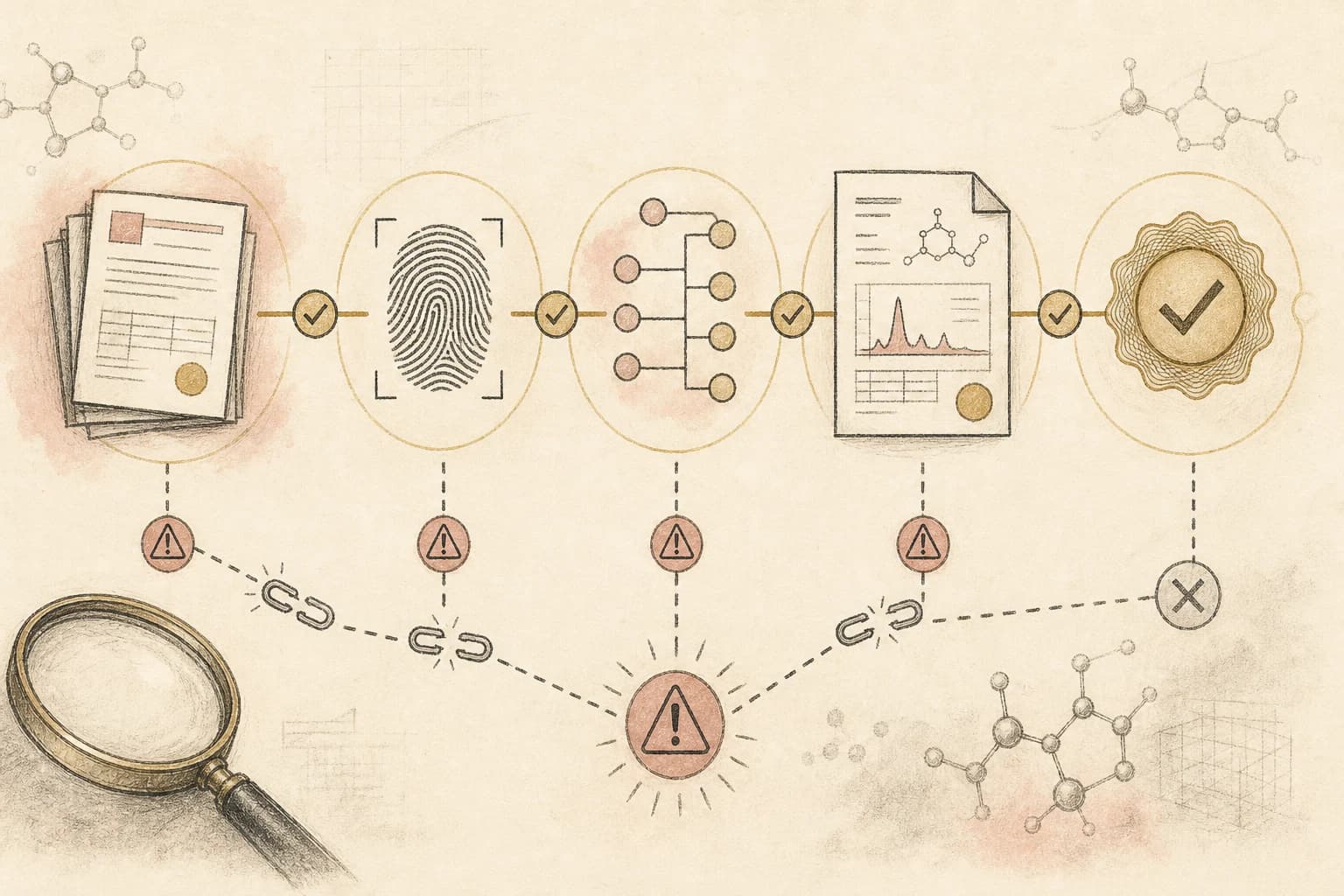
For readers in the Philippines, the FDA Verification Portal offers two separate kinds of records.3 One list covers establishments with a License to Operate.3 Another covers health products with a Certificate of Product Registration or Notification.3 The portal also includes licensed online drugstores.3
That structure makes a useful point: seller status and product status are not interchangeable. Finding an establishment does not automatically verify every item associated with its name. Finding a product name does not confirm that an unrelated account or parcel came through the listed establishment. The exact details must match the record being checked.3
A screenshot of a licence number is also not the same as an independent portal search. The portal lets a reader compare the establishment name, recorded activity, address, licence dates, and product information against the claim in front of them.3 This is a Philippine process claim, not a statement about local peptide availability.
Red flags are clues, not a home laboratory
WHO advises consumers to inspect packaging condition, spelling, dates, and unexpected differences in appearance.1 Yet WHO also says some falsified products are nearly indistinguishable from genuine ones.1 That means a typo can be a warning, while perfect spelling cannot clear a product.
The same logic applies to batch codes, QR graphics, seals, and laboratory-looking paperwork. Each detail can be copied, detached from its original context, or presented without a verifiable chain back to the named organization. A seller-supplied image therefore remains a clue supplied by the seller.
Check the source next. WHO identifies unauthorized online sellers and informal markets as common routes for substandard and falsified medical products.10 This global warning does not label a particular Philippine page or vendor.10 It explains why an independently verified establishment record carries more weight than visual polish or social proof.
A research name does not authenticate a vial
A 2025 scoping review characterized the BPC-157 musculoskeletal record as largely preclinical and described three human pilot studies in other settings.11 The model must remain attached whenever a result is repeated.11
A newer ClinicalTrials.gov entry describes a recruiting phase 2 hamstring-strain protocol.4 The listed outcomes are plans for what researchers intend to measure, not positive findings.4 The registry page documents a study plan, not a finished result.4 It cannot certify the origin, purity, or identity of a commercial vial.
The lesson is broader than one peptide. A familiar scientific name can make packaging sound connected to a paper. That connection must never be assumed. Research identifies the exact material and protocol studied; product verification asks whether the item in hand matches its own claims.
For readers looking for the exact topic, the TB-500 card below opens its live catalog details.
Make the evidence chain do the work
A calm check starts with separate questions. What exact identity does the label claim? Who manufactured or supplied it? Does the Philippine FDA portal show the exact establishment and product details?3 Do those details match without relying on a seller’s cropped screenshot?
Next, separate research from merchandise. A PubMed abstract can describe a study model.11 A trial registry can describe a protocol.4 Neither source verifies an online listing or the contents of a parcel. For TB-500, US FDA separately flags possible immune-response concerns linked to aggregation and peptide-related impurities in compounded products.12 That concern is about a named compounding substance, not proof about any specific vial.12
Finally, know where suspicion goes. Philippine FDA guidance says a suspected counterfeit medicine should be reported to the agency and identifies the legitimate product owner as another possible contact.13 Official verification turns a private hunch into information that can be assessed.
Bottom line
The strongest-looking part of a counterfeit can be the part designed to feel familiar. WHO’s warning that some falsified products closely resemble genuine ones makes appearance a weak final test.1 The more useful questions concern identity, composition, source, and independent records.5
In the Philippines, that means checking both the establishment and the health-product record through the FDA Verification Portal.3 It also means keeping research in its proper lane. A preclinical review or recruiting protocol may explain why a peptide name attracts attention, but neither authenticates merchandise.4 When a product seems suspect, Philippine FDA guidance points readers toward official reporting and product verification.13
This article is educational research context, not medical advice. Catalog links are neutral references and do not imply a treatment or human-use recommendation.
Frequently asked questions
Can a professional label prove that a peptide is genuine?
No. WHO says some falsified medical products can look almost identical to genuine versions.1 Print quality, seals, codes, and careful spelling may offer clues, but they do not confirm chemical identity or purity. Authentication needs evidence beyond the appearance supplied with the product.
What is the difference between substandard and falsified?
WHO calls an authorized product substandard when it fails quality standards or specifications.5 A falsified product deliberately misrepresents identity, composition, or source.5 The practical risks may overlap, but the formal difference turns on failed specifications versus deliberate deception.
What should Filipino readers verify online?
The Philippine FDA portal lets readers search licensed establishments and registered or notified health products separately.3 Match the exact name, address, activity, licence dates, and product details shown in the official record. A seller’s screenshot should not replace an independent portal search.
Does a published BPC-157 paper verify a vial?
No. The paper or review describes material used under its own research conditions. A 2025 review characterized the musculoskeletal literature as largely preclinical.11 It does not establish the origin, purity, strength, or identity of an item carrying the same name.
Does a trial registration mean the result was positive?
No. The current ClinicalTrials.gov entry for a BPC-157 hamstring study is a recruiting phase 2 protocol.4 Its endpoints describe measurements the researchers plan to collect. Registry descriptions document study plans; they should not be rewritten as findings or product claims.
Are BPC-157 and TB-500 quality concerns identical?
Not exactly. US FDA lists BPC-157 concerns that include peptide impurities and active-ingredient characterization.9 It separately lists TB-500 concerns involving aggregation and peptide-related impurities.12 Both records describe potential compounding risks, not proof about a particular item.
What does Philippine FDA guidance say about a suspect medicine?
The agency’s Drug Safety Newsletter says not to take a suspected counterfeit medicine and to report it to FDA.13 It also names the legitimate product owner as another possible contact.13 The agency describes product verification as the process for assessing suspicion.7
Sources
Footnotes
-
Substandard and falsified medical products: Advice to patients and consumers. WHO consumer guidance on recognizing suspect medical products. A visual check may identify warning signs but cannot confirm the contents. ↩ ↩2 ↩3 ↩4 ↩5 ↩6 ↩7
-
Counterfeit Medicine. US FDA consumer guidance about counterfeit medicine composition. These are possible counterfeit patterns, not a laboratory finding about a particular product. ↩ ↩2 ↩3
-
FDA Verification Portal. Current Philippine regulatory verification portal for establishments and health products. A portal entry must match the exact establishment and product details being checked. ↩ ↩2 ↩3 ↩4 ↩5 ↩6 ↩7 ↩8 ↩9 ↩10
-
BPC 157 for Acute Hamstring Muscle Strain Repair. Recruiting randomized protocol registered on ClinicalTrials.gov. Planned endpoints and rationale do not establish a positive or negative outcome. ↩ ↩2 ↩3 ↩4 ↩5 ↩6 ↩7
-
Substandard and falsified medical products. WHO public-health definitions for medical-product quality and falsification. The categories can overlap in practical risk, but intent separates the formal definitions. ↩ ↩2 ↩3 ↩4 ↩5 ↩6 ↩7 ↩8 ↩9
-
Understanding the Risks of Compounded Drugs. US regulatory explanation of compounded-drug oversight. This is a US regulatory distinction and is not a Philippine approval statement. ↩
-
FDA Drug Safety Newsletter, Volume 2 Issue 4. Philippine FDA Drug Safety Newsletter describing the agency's counterfeit-response process. Suspicion by a consumer is not the same as official verification. ↩ ↩2 ↩3
-
Substandard and falsified medical products. WHO global public-health overview of composition and quality failures. The statement describes possible failure modes, not the contents of any specific vial. ↩
-
Certain Bulk Drug Substances for Use in Compounding that May Present Significant Safety Risks. US FDA safety summary for bulk substances nominated for compounding. The record describes potential risks and limited safety information, not a finding about every BPC-157-labelled product. ↩ ↩2 ↩3
-
Substandard and falsified medical products. WHO global overview of supply-chain and consumer risk factors. The source does not establish the status of any named Philippine seller or catalog item. ↩ ↩2
-
Regeneration or Risk? A Narrative Review of BPC-157 for Musculoskeletal Healing. Narrative scoping review of BPC-157 research related to musculoskeletal recovery. A review summary does not authenticate a commercial vial or turn findings from one model into outcomes for another. ↩ ↩2 ↩3 ↩4
-
Certain Bulk Drug Substances for Use in Compounding that May Present Significant Safety Risks. US FDA safety summary for bulk substances nominated for compounding. The record describes potential risks and does not establish the contents of a particular TB-500-labelled vial. ↩ ↩2 ↩3
-
FDA Drug Safety Newsletter, Volume 2 Issue 4. Philippine FDA Drug Safety Newsletter consumer response guidance. The guidance concerns suspect medicines and does not identify any catalog item as counterfeit. ↩ ↩2 ↩3 ↩4