
TL;DR
- GHK-Cu is a copper-binding tripeptide, but that chemical identity does not tell us whether a finished skincare formula changes visible skin outcomes.1
- In a small post-laser trial, objective reviewers found no GHK-Cu advantage for redness, wrinkles, or overall skin quality, although participant satisfaction differed.2
- Retinoids, vitamin C, and niacinamide each have randomized human evidence, yet their studies involve distinct formulas, people, controls, and endpoints.3
- A long Australian trial gives sunscreen a prevention-focused benchmark that cannot be replaced by a serum’s mechanism or a laboratory penetration result.4
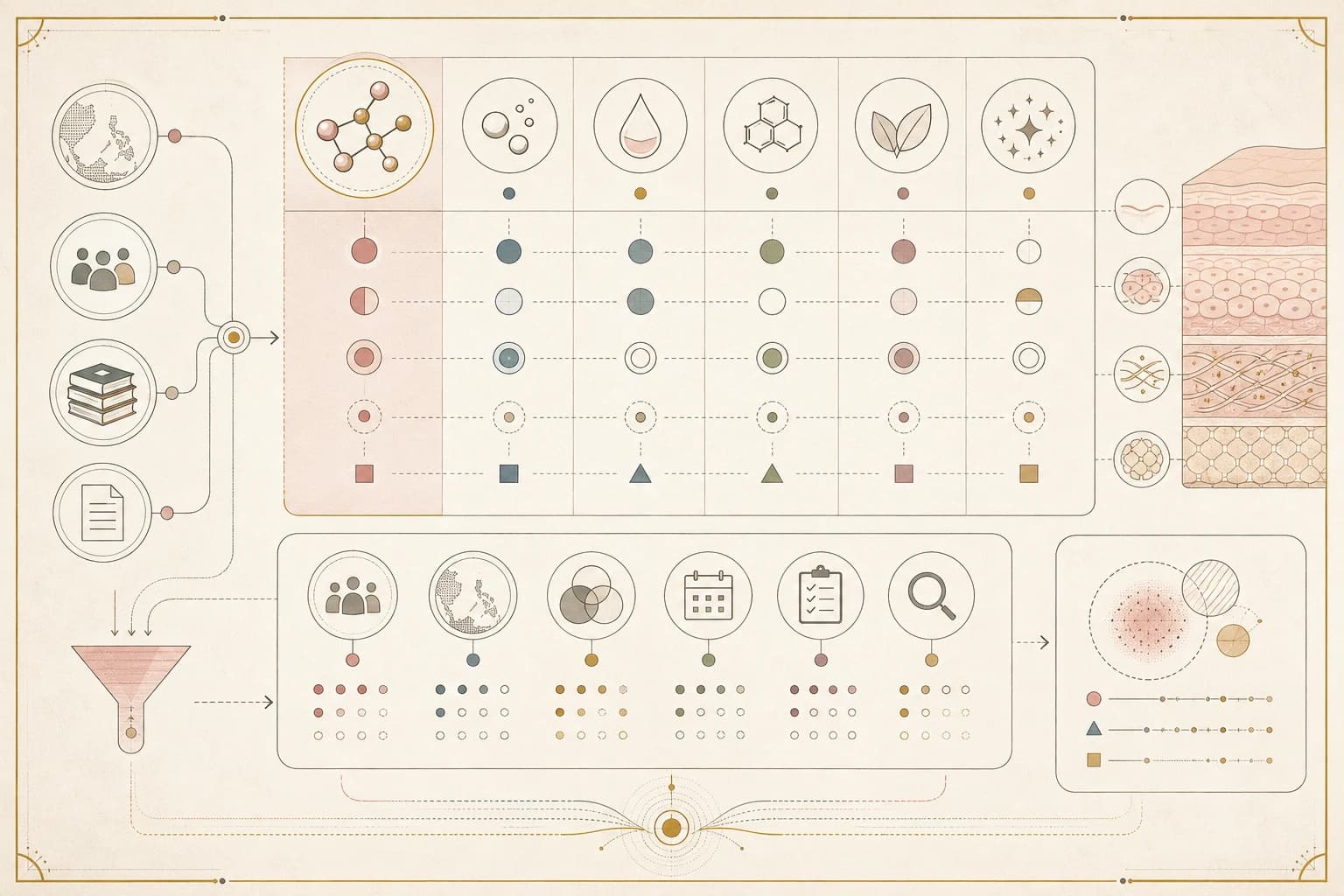
For Filipino readers, skincare comparisons often arrive as crowded shelf talk: one bottle for texture, another for spots, and a peptide presented as the clever new step. So the useful question is not which active “wins.” Build a clear map instead. Keep each kind of fact in its lane. Separate what a molecule is, what a laboratory measured, and what people actually experienced in a controlled study.5
Start with the label, not the promise
GHK is a tripeptide, or a short chain of three amino acids, that can bind copper and form GHK-Cu.1 That description explains the name “copper peptide,” but it is not a result on wrinkles, texture, or pigmentation.1 A molecule’s proposed biology and a finished formula’s visible effect are different research questions.5
This matters when comparing a peptide with retinoids, vitamin C, niacinamide, or sunscreen.6 Each category has been studied through different formulas, controls, time frames, and measurements.3 Instead of treating “active” as one league table, ask three things: what was tested, on whom or what tissue, and which outcome was measured.5 That simple check makes a Filipino routine conversation more precise without turning it into a shopping contest.
For readers looking for the exact topic, the GHK-Cu catalog card below shows its live catalog details. It is a separate reference, not research evidence or a recommendation.
The clearest human GHK-Cu result is mixed
One randomized study placed GHK-Cu in a very specific setting: skincare after carbon-dioxide laser resurfacing around the mouth.7 Thirteen participants completed the study, and assessments continued for 12 weeks.7 It was a small and narrow test.7 That population differs from people simply comparing everyday serums.7
Computer analysis and blinded evaluators found no significant between-group advantage for faster redness resolution.2 They also found no objective advantage for wrinkles or overall skin quality.2 Yet the participant questionnaire showed higher satisfaction in the GHK-Cu group.8
These findings can sit together without forcing a winner.8 A person’s experience is meaningful, but satisfaction and blinded measurement are different endpoints.2 The small post-procedure study therefore supports a careful statement: GHK-Cu was tested in people, but this trial did not show an objective edge on its main visible measures.2
Penetration is a laboratory question
Another GHK-Cu paper asked whether a copper tripeptide could move into and through skin layers.5 Researchers placed isolated human skin tissues in diffusion cells and tracked copper for 48 hours.5 It was a lab test, not a face trial.5 The setup used a water-based test liquid under excess-exposure laboratory conditions.9
That experiment is useful for formulation science, because an ingredient must reach the measured tissue before it can be studied there.5 It still cannot tell a reader whether a face looked smoother, whether redness changed, or whether a routine felt comfortable.5 Those outcomes require a study in living participants.7
The distinction is practical when a product page mentions absorption or delivery.9 A penetration number belongs to its vehicle, tissue model, exposure, and test period.9 It cannot predict a cosmetic result for a different finished formula.5
Retinoids bring a broader trial record
A systematic review of topical tretinoin for photoaging included seven randomized controlled trials.6 Their study periods ranged from three to 24 months.6 That gives tretinoin a wider human trial base than the single small GHK-Cu study discussed above.7
The comparison still needs restraint.3 The review found that formulas and outcome measures differed, even within one active family.3 The reviewers asked for more work across strengths and direct comparisons with other agents.3
This is why “copper peptides versus retinoids” is too broad to answer with a simple score.3 A class name does not specify the formula, control, population, or follow-up.6 The fair conclusion is about research depth: tretinoin has several randomized photoaging trials, while the GHK-Cu human result here comes from 13 post-laser participants.7
Vitamin C shows promise with formulation caveats
A systematic review of topical vitamin C found seven publications covering 139 volunteers.10 The pool was still small.10 The included prospective randomized trials studied melasma or photodamage, rather than one uniform skincare goal.10 Across skin-topography studies, treated areas appeared smoother and less wrinkled.11 Objective pigmentation measures also showed lightening at treated sites.11
The review did not turn “vitamin C” into one interchangeable product category.11 Its authors called for more research and said the ideal concentration remained uncertain.11 Different forms, formulas, and protocols can therefore matter when readers compare labels.11
Beside GHK-Cu, vitamin C offers a useful lesson in scale.10 Several randomized studies can point in a similar direction while still leaving formulation questions open.11 That is more informative than assuming every antioxidant story produces the same visible result.11
Niacinamide offers a tidy split-face example
A 12-week niacinamide study enrolled 50 white women aged 40 to 60.12 Each participant used a control moisturizer on one side of the face and the same moisturizer with 5% niacinamide on the other.12 The split-face design let each person serve as her own comparison.12
The niacinamide side improved versus control on measured fine lines, pigmentation spots, texture, red blotchiness, and yellowing.13 Those findings belong to the tested moisturizer, population, and follow-up.13 They do not prove that any percentage, derivative, or combination will behave identically.12
For a routine conversation, the study is easy to read because the control is concrete.12 It compares two closely related formulas rather than placing niacinamide against an unrelated peptide product.12 GHK-Cu and niacinamide still lack a direct head-to-head result in the records used for this article.7
For readers looking for the exact topic, the glutathione catalog card below shows its live catalog details. It is a separate reference, not research evidence or a recommendation.
Sunscreen answers a different, longer question
An Australian community trial followed 903 adults assigned to regular or discretionary broad-spectrum sunscreen application.4 After four and a half years, the regular-application group had 24% less measured skin aging.4 The time span matters.4 The report also noted missing outcome data and modest power to detect moderate effects.4
This trial asked about prevention over years, not whether a serum changed one facial feature in weeks.4 Its endpoint therefore should not be ranked beside a peptide penetration assay or a post-laser satisfaction score.5 Different questions deserve different columns on the evidence map.
For Filipino readers arranging a routine, that separation keeps the conversation grounded. Sunscreen, retinoids, vitamin C, niacinamide, and GHK-Cu are not five contestants completing one shared test.6 They come with different study designs, time scales, and limits.3 A sensible comparison preserves those differences before discussing personal preferences.
Bottom line
GHK-Cu fits best as a distinct research category, not as a proven replacement for every familiar active.2 Its name describes a copper-binding tripeptide, while its clearest human study here involved only 13 people after laser resurfacing.1 That trial found higher satisfaction but no objective advantage for redness, wrinkles, or overall skin quality.8
Tretinoin, vitamin C, niacinamide, and sunscreen each bring different kinds of human evidence.6 None creates a universal scoreboard because the formulas, participants, controls, endpoints, and timelines differ.3 The most useful routine conversation is therefore evidence-aware: define the goal, identify the exact study question, and keep each result inside the setting that produced it.5
This article is educational research context, not medical advice. Catalog links are neutral references and do not imply a treatment or human-use recommendation.
Frequently asked questions
Is GHK-Cu the same as copper in general?
No. GHK is a specific three-amino-acid peptide that binds copper to form GHK-Cu.1 Studies of other copper salts, devices, or compounds do not automatically describe this complex.1 The exact chemical identity matters before any skincare finding can be compared.
Did the human GHK-Cu study improve wrinkles?
The 13-person post-laser study found no objective between-group advantage for wrinkles, redness, or overall skin quality.2 Participants using the GHK-Cu regimen did report higher satisfaction.8 Those two endpoints should be reported separately, and the unusual post-procedure setting should stay visible.
Does skin penetration prove visible results?
No. The penetration paper used isolated human skin layers in laboratory diffusion cells.5 It measured copper movement and retention over 48 hours, not facial appearance.5 A visible result would need a clinical outcome study using a defined formula and participant group.
Are retinoids automatically better than copper peptides?
The sources here do not provide a direct head-to-head trial.3 They show that topical tretinoin has a systematic review covering seven randomized photoaging trials.6 GHK-Cu’s clearest human result here is a small post-laser study, so their research records differ in depth and setting.7
What does the vitamin C evidence actually cover?
The review included seven publications and 139 volunteers in randomized protocols for melasma or photodamage.10 It reported smoother topography and objective pigmentation lightening at treated sites.11 The authors still requested more studies and did not settle the ideal concentration.
Why is sunscreen in this comparison?
Sunscreen supplies a prevention-focused reference point rather than another serum claim.4 In one Australian trial, the regular-application group had 24% less measured skin aging after 4.5 years.4 Its long timeline and preventive endpoint make it different from short cosmetic appearance studies.
Sources
Footnotes
-
The potential of GHK as an anti-aging peptide.. Narrative review of GHK and GHK-Cu laboratory, animal, and proposed aging research. The identity and binding description does not establish a visible skincare outcome. ↩ ↩2 ↩3 ↩4 ↩5 ↩6
-
Effects of topical copper tripeptide complex on CO2 laser-resurfaced skin.. Objective and blinded outcomes in a randomized post-laser human study. The result is specific to a small study and a post-procedure population. ↩ ↩2 ↩3 ↩4 ↩5 ↩6 ↩7
-
Topical tretinoin for treating photoaging: A systematic review of randomized controlled trials.. Limitations and conclusion of the systematic review. A class-level review does not make every retinoid product interchangeable. ↩ ↩2 ↩3 ↩4 ↩5 ↩6 ↩7 ↩8 ↩9
-
Sunscreen and prevention of skin aging: a randomized trial.. Community-based randomized factorial trial in adults younger than 55. The result came from one Australian community and compared assigned use patterns, not brands or cosmetic serums. ↩ ↩2 ↩3 ↩4 ↩5 ↩6 ↩7 ↩8
-
Human skin penetration of a copper tripeptide in vitro as a function of skin layer.. In-vitro experiment using isolated stratum corneum, heat-separated epidermis, and dermatomed skin. The experiment measured movement through excised tissue, not appearance or tolerability in a living face. ↩ ↩2 ↩3 ↩4 ↩5 ↩6 ↩7 ↩8 ↩9 ↩10 ↩11 ↩12 ↩13
-
Topical tretinoin for treating photoaging: A systematic review of randomized controlled trials.. Systematic review of randomized controlled trials. The included studies used different formulations and outcome measures. ↩ ↩2 ↩3 ↩4 ↩5 ↩6 ↩7
-
Effects of topical copper tripeptide complex on CO2 laser-resurfaced skin.. Human study after circumoral carbon-dioxide laser resurfacing with 12-week assessments. This small post-procedure setting is not equivalent to an ordinary daily skincare routine. ↩ ↩2 ↩3 ↩4 ↩5 ↩6 ↩7 ↩8 ↩9
-
Effects of topical copper tripeptide complex on CO2 laser-resurfaced skin.. Participant questionnaire at 12 weeks in the randomized post-laser study. A subjective satisfaction result did not match the study's objective between-group findings. ↩ ↩2 ↩3 ↩4
-
Human skin penetration of a copper tripeptide in vitro as a function of skin layer.. Laboratory diffusion-cell protocol. Its exposure conditions do not represent every finished cosmetic formula or normal consumer application. ↩ ↩2 ↩3
-
Efficacy of topical vitamin C in melasma and photoaging: A systematic review.. Systematic review of topical vitamin C randomized controlled protocols. The total evidence base was small and covered different protocols. ↩ ↩2 ↩3 ↩4 ↩5
-
Efficacy of topical vitamin C in melasma and photoaging: A systematic review.. Findings and conclusion across the included topical vitamin C studies. These study-level findings do not predict results from every vitamin C form or formula. ↩ ↩2 ↩3 ↩4 ↩5 ↩6 ↩7 ↩8
-
Topical niacinamide reduces yellowing, wrinkling, red blotchiness, and hyperpigmented spots in aging facial skin.. Randomized facial appearance study. The population was narrow, and the comparison concerned two specific formulas. ↩ ↩2 ↩3 ↩4 ↩5 ↩6
-
Topical niacinamide reduces yellowing, wrinkling, red blotchiness, and hyperpigmented spots in aging facial skin.. Measured appearance endpoints after 12 weeks. The findings should remain attached to that formula, population, and follow-up. ↩ ↩2