
Quick answer
Published research does not establish CJC-1295 plus ipamorelin as a proven human “stack.” CJC-1295 alone increased growth hormone and IGF-1 in controlled studies of healthy adults, but those studies measured hormone concentrations and pharmacokinetics—not muscle growth, fat loss, recovery, or athletic performance.
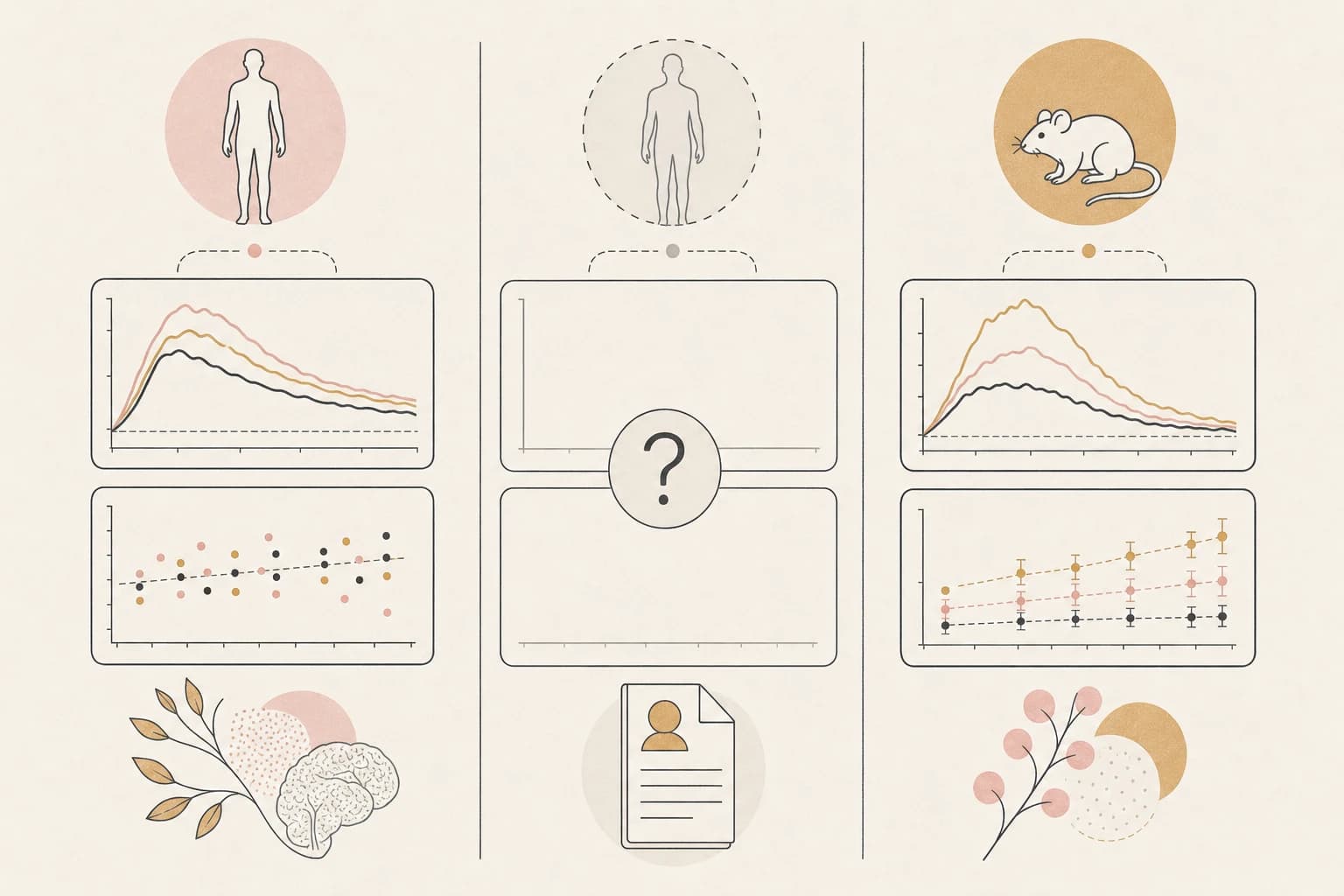
The combination result commonly cited in sports-medicine discussions comes from mice with glucocorticoid-induced muscle loss. That finding cannot be merged with the human CJC-1295 data to create a human combination trial. Filipino readers should ask whether both compounds, the same population, and the promoted outcome appeared in one relevant study.1234
What does “stack evidence” need to include?
A stack claim requires research on the actual combination. It is not enough to show that compound A changes one biomarker and compound B has a different mechanism.
The study should identify both compounds, confirm their forms, use them together, include a suitable comparison, and measure the outcome being promoted. Without those elements, the evidence describes components rather than a stack.
Timing matters too. Two compounds appearing in separate papers, years apart, do not become combination evidence because a social post places their names on one slide. The intervention section of one study must show that participants actually received both.
The outcome must also be direct. Hormone concentrations can establish a biological response. They cannot by themselves establish muscle gain, lower body fat, faster healing, better sleep, or improved athletic performance.
CJC-1295 is a long-acting analogue of growth hormone-releasing hormone. Controlled studies enrolled healthy adults aged 21 to 61, but they tested CJC-1295 alone.1
Readers researching CJC-1295 with DAC can view its live catalog details below. The listing identifies the catalog item and is separate from the evidence discussed here.
What did the human CJC-1295 studies find?
The randomized, placebo-controlled studies measured growth hormone, IGF-1, and pharmacokinetic variables after CJC-1295. Investigators reported increases in growth hormone and IGF-1 concentrations.25
No serious adverse reactions were reported in those controlled studies. That observation belongs to the participants, exposure, and follow-up described in the paper; it is not a general safety guarantee for unverified products or combinations.5
The studies did not test an online stack. They did not report a CJC-1295 plus ipamorelin group, nor did they measure resistance-training progress, muscle size, injury recovery, or competitive performance.2
This distinction prevents a common wording error. “CJC-1295 increased IGF-1” may describe the paper. “The stack builds muscle” adds a second compound and a new endpoint that the study did not evaluate.
The participant description should stay attached as well. Healthy adults aged 21 to 61 are more relevant to human biology than mice, but the study still did not recreate a resistance-training program or measure a sports result.1
Even a positive biomarker result can coexist with uncertainty about practical benefit, longer-term safety, and product identity. Those questions need their own evidence rather than an assumption that the pathway guarantees them.
Where does the combination evidence come from?
A sports-medicine review described combined CJC-1295 and ipamorelin in mice with glucocorticoid-induced muscle loss. The review reported improved maximum tetanic tension in that model.3
The result is relevant to early combination research, but it remains an animal finding in an induced disease state. It cannot show that healthy people will gain the same muscle, recovery, or performance effect.6
Mouse tension testing also differs from a Filipino gym member’s goals. A controlled contraction in an animal preparation is not the same endpoint as training volume, one-repetition maximum, body composition, injury return, or real-world sport performance.
Why can two real findings create one false conclusion?
The pieces look compatible: CJC-1295 changed human hormone concentrations, and the CJC-1295–ipamorelin combination changed muscle tension in mice. Both statements can be accurate while the combined human performance conclusion remains unsupported.534
This is evidence splicing. It removes the boundary between species, health conditions, interventions, and endpoints, then presents the joined story as if one experiment tested all of it.
The easiest way to spot splicing is to build a two-row table. Put the human CJC-1295 paper in one row and the mouse combination report in another. The differences in species, intervention, health context, and outcome become visible immediately.4
A 2026 sports-medicine review said clinical adoption of injectable peptides has moved faster than high-quality evidence and regulatory consensus. That gap helps explain why clear-sounding stack diagrams may circulate before relevant human trials exist.7
Readers comparing this topic with Ipamorelin can view its live catalog details below. It is a separate catalog reference, not a suggested combination.
Does a registered trial prove the stack works?
No. A ClinicalTrials.gov record describes a planned phase 2 study of CJC-1295 in people with HIV-associated visceral obesity. The record does not report completed efficacy results, and it does not establish a CJC-1295–ipamorelin performance stack.8
Registry entries are valuable because they show what researchers intended to test. Unless results are posted or published, they cannot support a positive outcome statement.
They also cannot support a negative outcome statement. “No posted result” means the result is not reported in that record, not that the intervention failed. A careful article should say exactly that.
The population also matters. HIV-associated visceral obesity is a specific clinical context, not a substitute for bodybuilding, anti-aging, or general fat-loss research.
What identity questions should Filipino readers ask?
First, determine which CJC-1295 form is being discussed. A review distinguishes versions with and without a drug affinity complex and improves ipamorelin as a separate compound.9
Second, ask whether the product identity was independently established. The same review describes uncertain composition and combination practices in unregulated supply chains. A familiar nickname does not prove that a container matches a research material.910
Third, keep catalog cards in their proper role. They display live names, handles, availability, and links from Medusa. They do not verify a study product, establish approval, or convert separate items into a recommended combination.
Finally, look for the exact missing study: both verified compounds, used together in people, compared appropriately, with the claimed muscle, recovery, body-composition, or performance outcome. If a post cannot point to that design, it should not call the stack proven.
This checklist does not require every early study to be large or perfect. It requires the wording to match what researchers actually tested. Narrow animal or biomarker results can be discussed honestly without being promoted as a finished human protocol.
Bottom line
CJC-1295 has controlled human evidence showing changes in growth hormone and IGF-1, but those studies did not test ipamorelin or gym outcomes. The combination finding cited in sports-medicine literature comes from mice with induced muscle loss.
Joining the human biomarker result to the animal combination result creates a conclusion that neither study reached. A planned CJC-1295 registry entry does not supply missing results. Filipino readers should verify the exact CJC-1295 form, product identity, population, combination, and outcome before accepting a stack claim. Separate product cards remain catalog references, not a protocol.
Frequently asked questions
Was CJC-1295 studied in healthy adults?
Yes. Controlled studies in healthy adults measured hormone concentrations and pharmacokinetics after CJC-1295 alone.12
Did those studies include ipamorelin?
No. The cited human CJC-1295 studies did not test the combination or an online stack outcome.2
Is the mouse combination finding positive?
The review reported improved maximum tetanic tension in the mouse model. It does not establish the same result in people.36
Does the ClinicalTrials.gov record report success?
No. It describes a planned CJC-1295 study and does not report completed efficacy results for a stack.8
Do the product cards recommend using both compounds?
No. They are separate identity and catalog references. They do not recommend a combination, human use, amount guidance, or treatment.
Sources
Footnotes
-
Prolonged stimulation of growth hormone (GH) and insulin-like growth factor I secretion by CJC-1295, a long-acting analog of GH-releasing hormone, in healthy adults.. Two controlled human studies of CJC-1295 alone in healthy adults. The studies did not test an online CJC-1295 and ipamorelin combination. ↩ ↩2 ↩3 ↩4
-
Prolonged stimulation of growth hormone (GH) and insulin-like growth factor I secretion by CJC-1295, a long-acting analog of GH-releasing hormone, in healthy adults.. Human randomized, placebo-controlled studies of CJC-1295 alone. Hormone and pharmacokinetic measurements do not establish a combined-product effect. ↩ ↩2 ↩3 ↩4 ↩5
-
Injectable Peptide Therapy: A Primer for Orthopaedic and Sports Medicine Physicians.. Murine model of drug-induced muscle loss. The result is animal evidence and does not establish a human result. ↩ ↩2 ↩3 ↩4
-
Prolonged stimulation of growth hormone (GH) and insulin-like growth factor I secretion by CJC-1295, a long-acting analog of GH-releasing hormone, in healthy adults.; Injectable Peptide Therapy: A Primer for Orthopaedic and Sports Medicine Physicians.. Comparison of controlled human CJC-1295 studies with a mouse combination model. The comparison preserves study population, intervention, and outcome differences. ↩ ↩2 ↩3
-
Prolonged stimulation of growth hormone (GH) and insulin-like growth factor I secretion by CJC-1295, a long-acting analog of GH-releasing hormone, in healthy adults.. Healthy adults in short controlled studies of CJC-1295 alone. This limited trial finding cannot define safety or outcomes for a different compound combination. ↩ ↩2 ↩3
-
Injectable Peptide Therapy: A Primer for Orthopaedic and Sports Medicine Physicians.. Inference from a mouse study with a specific induced-muscle-loss model. Human outcomes require human studies designed to measure them. ↩ ↩2
-
Injectable Peptides in Sports Medicine: A Structured Narrative Review of Evidence, Safety, and Antidoping Implications.. Structured narrative review of injectable peptides relevant to sports medicine. A review summarizes a field; it is not a direct trial of a specific stack. ↩
-
A Multicenter, Randomized, Placebo-Controlled, Double-Blind, Phase 2 Study to Evaluate the Efficacy and Safety of CJC 1295 Administered for 12 Weeks in HIV Infected Patients With HIV Associated Visceral Obesity. Registry description of a planned multicenter randomized study. A study description states what researchers intended to assess, not what was found. ↩ ↩2
-
The emerging landscape of performance-enhancing peptides modulating GH-IGF1 axis: bridging the gap between clinical evidence and patient self-administration.. Narrative review comparing published evidence with online self-administration protocols. The review does not verify the identity or contents of a particular listing. ↩ ↩2
-
The emerging landscape of performance-enhancing peptides modulating GH-IGF1 axis: bridging the gap between clinical evidence and patient self-administration.; Injectable Peptides in Sports Medicine: A Structured Narrative Review of Evidence, Safety, and Antidoping Implications.. Reviews of evidence categories and sports-medicine concerns around injectable peptides. This does not identify or test any individual catalog item. ↩