
TL;DR
- Night-shift fatigue is not one switch to flip: sleep loss, body-clock timing, stress, workload, and the work setting can all shape how tired and alert a person feels.1
- The small human DSIP sleep study involved 16 people with chronic insomnia, not night workers, and its authors described the statistically significant effects as weak.2
- A cited epithalon finding concerns melatonin and cortisol rhythms in older female rhesus monkeys, not fatigue or work performance in people doing overnight shifts.3
- Better framing starts with the actual problem and outcome, while workplace fatigue controls may involve sleep opportunity, scheduling, breaks, light, and naps.4
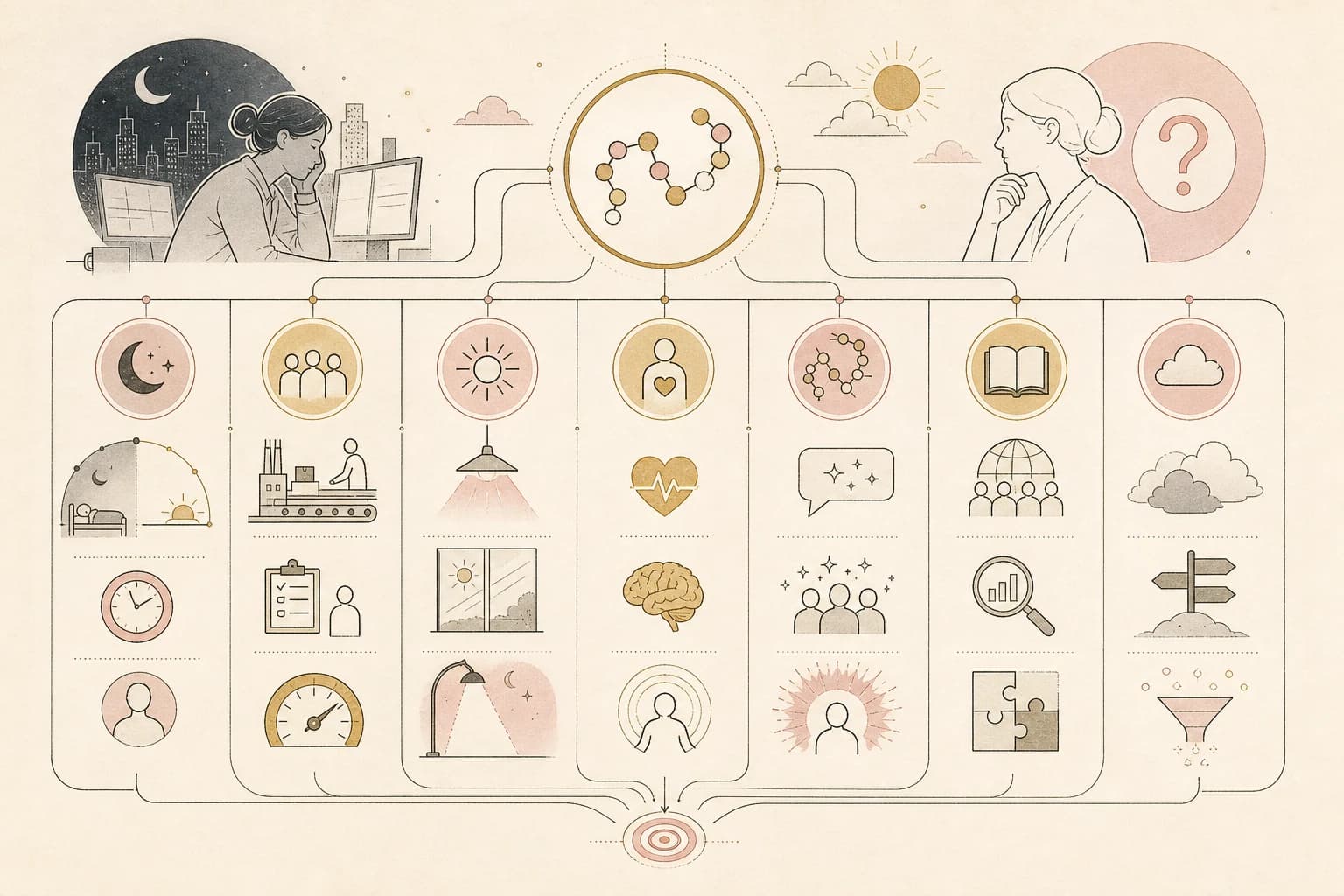
Across the Philippines, an overnight shift may end with a bright morning commute, daytime household duties, street noise, or another demand on recovery. Those details matter because “fatigue” is broader than simply wanting sleep.1 A peptide question can skip the most useful first step: deciding whether the problem is short sleep, body-clock mismatch, heavy work, persistent insomnia, or something else.1
Separate sleep, alertness, and fatigue
Three questions often hide inside “Can something fix night-shift fatigue?”1 The first is about sleep: can a worker get enough rest after clocking out?5 The second is about alertness: can that worker stay attentive when the body clock is promoting sleep?5 The third is about fatigue, which may also reflect stress, demanding tasks, heat, or long hours.1
These outcomes overlap, but they are not interchangeable.1 A change in a sleep-stage reading does not automatically show safer decisions on a shift.6 A hormone rhythm does not automatically show better recovery the next day.3 A useful claim must therefore name the population, setting, measurement, and time window.7
DSIP is named here only as the neutral catalog reference below.8
Night work pulls two clocks apart
Sleep is guided partly by pressure that builds during time awake and partly by a circadian rhythm tied to day and night.5 During an overnight shift, those systems can pull in awkward directions.5 Sleep pressure rises as the worker stays awake, while the circadian system may promote its strongest sleepiness from about 2 a.m. to 6 a.m.5
After work, the same mismatch can disturb recovery.5 A tired worker may fall asleep quickly in the morning, yet the rising daytime signal for wakefulness can make sleep shorter or easier to interrupt.5 That pattern helps explain why extra tiredness is not simply a failure of discipline.5
It also shows why the word “fix” is too blunt.1 The relevant target might be sleep duration, unwanted sleepiness, reaction time, concentration, or the design of the roster itself.1
Tired after a shift is not a diagnosis
Shift work disorder has a narrower clinical meaning than ordinary post-shift tiredness.9 A clinical review describes it through excessive sleepiness, insomnia, or both in relation to the work schedule.9 That definition matters because one hard night does not carry the same meaning as a persistent pattern.9
Fatigue also reaches beyond sleepiness.1 NIOSH notes that it can slow reaction time and reduce attention, short-term memory, and judgment.1 Those effects make the question relevant to the trip home, handovers, screens, machinery, patient care, and other tasks where an error matters.1
The practical first move is classification, not self-blame.1 Is the main complaint trouble sleeping, sleepiness while working, low energy, poor concentration, or several of these together?1 Each description points to a different outcome that research would need to measure.7
What the small DSIP sleep study measured
The name delta sleep-inducing peptide came from a nine-amino-acid peptide isolated during a rabbit experiment involving sleep-inducing brain stimulation.8 That history explains the label, but a label is not a human result.8
One double-blind study enrolled 16 people with chronic insomnia, paired them into DSIP and placebo groups, and observed five nights in a sleep laboratory.10 The researchers measured sleep structure, objective and subjective sleep quality, and tiredness.10 Objective sleep efficiency and time to fall asleep favored DSIP.2
The authors still described the statistically significant effects as weak.2 They noted that part of the difference might reflect an incidental change in the placebo group.2 Subjective sleep quality and most other measures did not change, and the paper concluded that major therapeutic benefit was unlikely.2 The participants had chronic insomnia, not an overnight work protocol.10
Another DSIP result came from anaesthesia
A later randomized study placed DSIP in a very different setting: 24 women receiving isoflurane anaesthesia.6 Researchers recorded brain electrical activity, a processed anaesthetic-depth index, and heart-rate variability.6 They tested DSIP while participants were awake and again during anaesthesia.6
The result did not follow the simple story suggested by the peptide’s name.6 At one tested amount during isoflurane anaesthesia, DSIP reduced delta rhythm and changed other readings.6 The authors concluded that it probably lightened measured anaesthetic depth.6
Anaesthesia is not ordinary sleep, and an anaesthetic-depth index is not workplace alertness.6 Taken together, the cited human studies cover short laboratory sleep in chronic insomnia and physiology during anaesthesia.7 They do not provide a night-shift performance result because neither used that population or endpoint.7
Epithalon belongs to an animal circadian study
Epithalon enters this conversation through a different research route.11 One study measured melatonin and cortisol in female rhesus monkeys across age groups.11 In the older monkeys, researchers reported increased evening melatonin synthesis and a normalized cortisol secretion rhythm.11
That is a hormone-timing result in an aging animal model.3 It is not a measured change in fatigue, attention, errors, commute safety, or daytime sleep among human night workers.3 “Circadian” may appear in both discussions, but the shared word does not make the study settings equivalent.3
The boundary is straightforward: report the species, age group, biomarkers, and observed rhythm.11 Do not replace those measurements with a job-performance outcome that the experiment never collected.3
Epithalon is named here only as the neutral catalog reference below.
Better questions lead to practical controls
Once the outcome is clear, practical research becomes easier to read.4 A review of 13 mainly small nap studies found that most reported lower sleepiness and better sleep-related performance after planned night-shift naps.12 Brief grogginess after waking, called sleep inertia, also appeared, and the studies did not measure workplace safety outcomes.12
Light research is less tidy.13 A five-study analysis in shift-working nurses found favorable results with one statistical model, but another model did not confirm them because study results varied and the set was small.13 That finding argues against treating “bright light” as one universal recipe.13
NIOSH frames fatigue control as shared work between employers and workers.4 Its approaches include enough sleep opportunity, a suitable sleep setting, carefully timed light, breaks, and naps.4 The better question asks which risk and outcome need to change.4
Bottom line
Night-shift fatigue can reflect a clash between sleep pressure, circadian timing, workload, stress, and limited recovery.1 That mix cannot be reduced to one sleep-stage or hormone measurement.3 The small DSIP insomnia study reported weak effects in a population unlike night workers, while the anaesthesia study measured a different physiological state.7 The epithalon result came from hormone rhythms in older female rhesus monkeys.3 None of those endpoints can stand in for overnight job performance.7 A better frame names the problem first: sleep opportunity, persistent insomnia, on-shift sleepiness, attention, workload, or recovery.4 It then matches that problem with evidence and shared workplace controls designed for the same outcome.4
This article is educational research context, not medical advice. Catalog links are neutral references and do not imply a treatment or human-use recommendation.
Frequently asked questions
Is night-shift fatigue the same as shift work disorder?
No. Fatigue can follow disrupted sleep, stress, demanding work, heat, or several factors together.1 Shift work disorder is a narrower term involving excessive sleepiness, insomnia, or both in relation to the work schedule.9 A difficult shift alone does not establish that clinical pattern.9
Why not judge DSIP by its name?
The name came from a nine-amino-acid peptide isolated during a rabbit experiment with sleep-inducing brain stimulation.8 Names preserve research history, but they do not prove a result in another population.8 Human outcomes still need to come from the actual study design and measurements.7
What did the 16-person DSIP study find?
Objective sleep efficiency and time to fall asleep favored DSIP over placebo in people with chronic insomnia.2 The authors called those effects weak and noted a possible incidental placebo-group change.2 Subjective sleep quality and most other measures did not change.2
Did the DSIP studies test night workers?
The cited sleep study enrolled people with chronic insomnia for five laboratory nights.10 The other cited human study involved women under isoflurane anaesthesia.6 Those designs measured sleep or anaesthetic physiology, not alertness, errors, or performance during an overnight work shift.7
What does the epithalon study add?
It adds a specific animal finding.11 Researchers measured melatonin and cortisol in female rhesus monkeys and reported rhythm changes in the older group.11 Because fatigue and job performance were not its endpoints, the study cannot supply those outcomes for human night workers.3
Are naps and bright light settled answers?
The nap review found mostly favorable sleepiness and performance findings, but its 13 studies were mainly small and did not measure workplace safety.12 The bright-light meta-analysis produced different conclusions under two statistical models.13 Both approaches need to stay tied to timing, setting, and outcome.4
Sources
Footnotes
-
Fatigue and Work. Current NIOSH occupational fatigue overview. The page describes occupational risk factors and effects, not a diagnosis for any individual worker. ↩ ↩2 ↩3 ↩4 ↩5 ↩6 ↩7 ↩8 ↩9 ↩10 ↩11 ↩12 ↩13 ↩14 ↩15
-
Effects of delta sleep-inducing peptide on sleep of chronic insomniac patients. A double-blind study. Authors' interpretation of objective and subjective outcomes in the 16-person study. One tiredness measure changed within the DSIP group, while subjective sleep quality and other measures did not. ↩ ↩2 ↩3 ↩4 ↩5 ↩6 ↩7 ↩8
-
Synthetic tetrapeptide epitalon restores disturbed neuroendocrine regulation in senescent monkeys. Interpretation constrained to the study's species, age group, biomarkers, and endpoints. A biomarker result cannot be substituted for an outcome the experiment did not measure. ↩ ↩2 ↩3 ↩4 ↩5 ↩6 ↩7 ↩8 ↩9
-
Fatigue and Work; Managing Fatigue During Times of Crisis: Guidance for Nurses, Managers, and Other Healthcare Workers. Public occupational-health guidance for fatigue risk management. These measures must fit the worker, schedule, task, and workplace; they are not a substitute for clinical assessment when symptoms persist. ↩ ↩2 ↩3 ↩4 ↩5 ↩6 ↩7 ↩8
-
Desynchronization of Homeostatic and Circadian Processes. NIOSH training module explaining homeostatic sleep pressure and circadian wakefulness during night work. Timing and adaptation differ among workers and schedules. ↩ ↩2 ↩3 ↩4 ↩5 ↩6 ↩7 ↩8
-
Delta sleep-inducing peptide alters bispectral index, the electroencephalogram and heart rate variability when used as an adjunct to isoflurane anaesthesia. Human anaesthesia study using EEG, bispectral index, and heart-rate variability. Anaesthetic depth is not ordinary sleep, alertness at work, or recovery from a night shift. ↩ ↩2 ↩3 ↩4 ↩5 ↩6 ↩7 ↩8 ↩9
-
Effects of delta sleep-inducing peptide on sleep of chronic insomniac patients. A double-blind study; Delta sleep-inducing peptide alters bispectral index, the electroencephalogram and heart rate variability when used as an adjunct to isoflurane anaesthesia. Comparison of the enrolled populations, settings, and endpoints in two human DSIP studies. This claim is limited to these two cited studies and does not infer that other records do not exist. ↩ ↩2 ↩3 ↩4 ↩5 ↩6 ↩7 ↩8
-
The delta EEG (sleep)-inducing peptide (DSIP). XI. Amino-acid analysis, sequence, synthesis and activity of the nonapeptide. Original isolation, sequencing, and naming study in rabbits. The origin of a name does not establish a human sleep or fatigue outcome. ↩ ↩2 ↩3 ↩4 ↩5
-
Shift Work and Shift Work Sleep Disorder: Clinical and Organizational Perspectives. Clinical and organizational review of shift work and shift work disorder. Feeling tired after a difficult shift does not by itself establish this disorder. ↩ ↩2 ↩3 ↩4 ↩5
-
Effects of delta sleep-inducing peptide on sleep of chronic insomniac patients. A double-blind study. Small parallel-group human sleep-laboratory study in chronic insomnia, not night-shift workers. Its population, setting, and brief follow-up do not match occupational fatigue. ↩ ↩2 ↩3 ↩4
-
Synthetic tetrapeptide epitalon restores disturbed neuroendocrine regulation in senescent monkeys. Animal neuroendocrine study in older female rhesus monkeys. It did not study Filipino workers, occupational fatigue, work performance, or daytime sleep after a night shift. ↩ ↩2 ↩3 ↩4 ↩5 ↩6
-
Effects of napping on sleepiness and sleep-related performance deficits in night-shift workers: a systematic review. Systematic review of planned naps during simulated or actual night shifts. The designs and samples varied, and the authors called for larger randomized trials with direct safety outcomes. ↩ ↩2 ↩3
-
The effectiveness of bright light exposure in shift-worker nurses: A systematic review and meta-analysis. Systematic review and meta-analysis of interventional studies in shift-working nurses. The findings do not support a universal lighting formula for every job or schedule. ↩ ↩2 ↩3 ↩4