
Quick answer
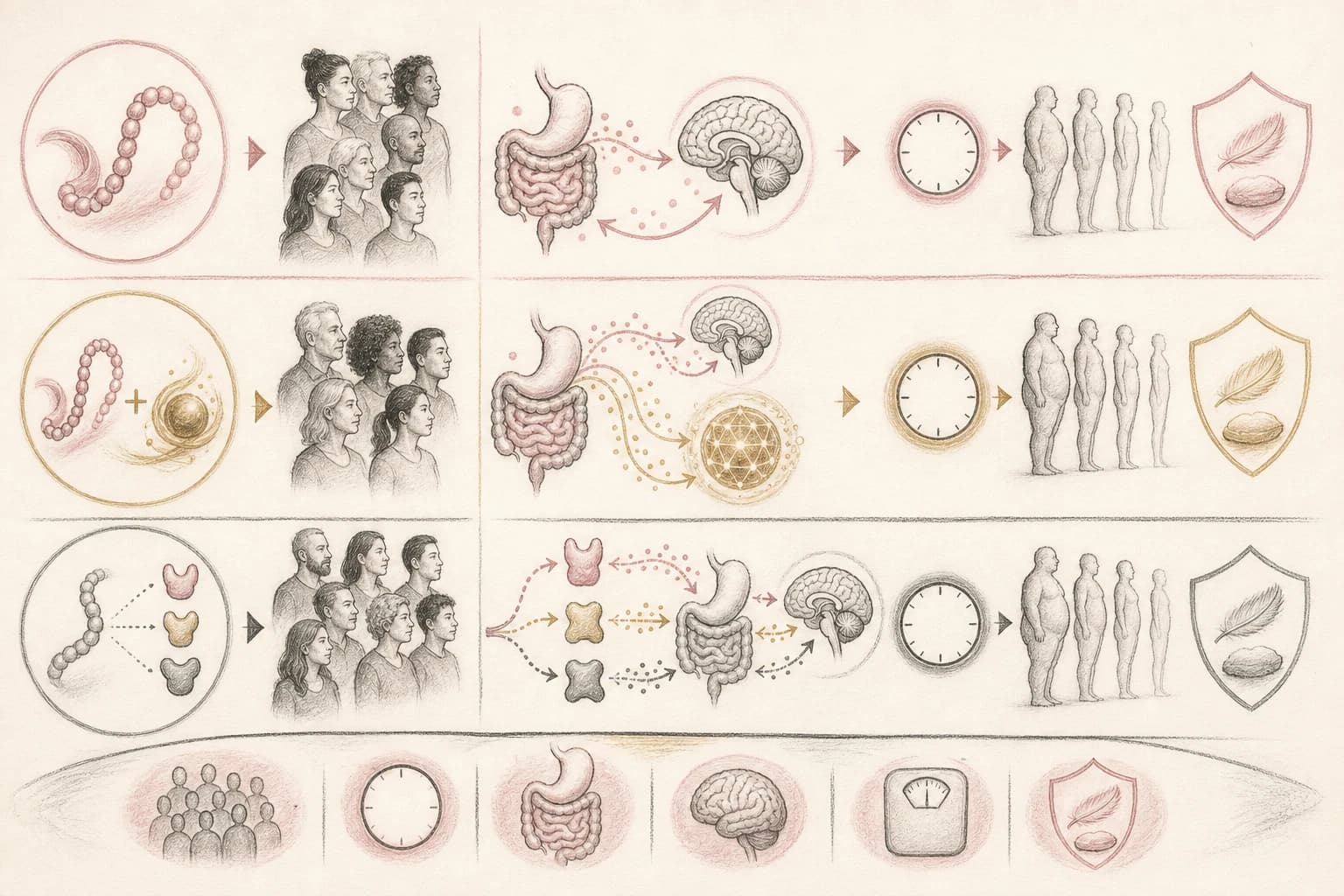
Cagrilintide and retatrutide represent different research strategies, not two versions of the same idea. Cagrilintide is a long-acting analogue of amylin, a hormone involved in meal-ending and gut-brain signals. Retatrutide activates GIP, GLP-1, and glucagon receptors. Both programs report body-weight findings, but separate trials, populations, and combinations cannot identify a winner. In particular, results from cagrilintide combined with semaglutide must not be credited to cagrilintide alone.12345
How does cagrilintide’s strategy work?
Cagrilintide is designed as a long-acting analogue of amylin.1 An analogue is a molecule made to act like a natural biological signal while lasting or behaving differently.
Amylin is released with insulin after eating. Its biology includes signals involved in ending a meal and communication between the digestive system and brain.1
That description explains the research idea. It does not guarantee a particular amount of weight change or predict how one person will respond.
Amylin also should not be reduced to a slogan such as “switches off hunger.” Appetite is shaped by many signals, food environment, sleep, stress, habits, and health conditions.
The better question is what a specific trial measured, in which population, over what period, and against which comparator.
Readers researching Cagrilintide can view its live catalog details below. The listing identifies the catalog item and is separate from the evidence discussed here.
How is retatrutide different?
Retatrutide activates three receptor systems: GIP, GLP-1, and glucagon.2 That is why it is described as a triple agonist.
The design brings several metabolic signals into one molecule. It is not the same as imitating amylin, and receptor count is not a quality score.
A review has reported substantial body-weight reductions in retatrutide research.5 That summary belongs to retatrutide studies and does not directly compare it with cagrilintide.
The pathways may influence appetite, energy use, blood sugar, and other measures in different ways. Only trials can show the overall balance produced in people.
More targets can create more questions as well as possibilities. Researchers must study tolerability, exposure response, discontinuation, and longer-term outcomes.
Mechanism diagrams can also make uncertainty look smaller than it is. A clean arrow from receptor to outcome skips absorption, experimental amount, adaptation, and individual biology. The pathway is the beginning of a research program, not its final clinical answer.
Calling one approach “more advanced” because it has more receptors mistakes molecular design for clinical evidence.
What has cagrilintide research found?
Cagrilintide has been studied by itself and together with semaglutide.3 Those are distinct interventions and should be presented separately.
A meta-analysis pooled four randomized trials with 5,023 adults and found body-weight reductions versus placebo for cagrilintide-based therapies.4
The phrase “cagrilintide-based” matters. The pooled review included both cagrilintide and combination therapy, so one headline number cannot describe every arm.4
Combination research can test whether two mechanisms work together. It cannot reveal how much of the result came from each component without a design that supports that comparison.
The pooled estimate is also a group result. Participants can differ in response, adverse events, and whether they complete follow-up.
This is why the strongest honest wording names the intervention, comparator, time point, and study type in the same paragraph.
Why can’t the headline percentages choose a winner?
Cross-trial comparisons are tempting because they look simple. They are unreliable when eligibility rules, baseline weight, follow-up, lifestyle support, and missing-data methods differ.
A trial can also select a different primary endpoint or use a different statistical estimate. Two percentages may not represent the same question.
Treatment exposure can differ even when the follow-up dates look similar. stepwise escalation schedules, pauses, missed visits, and early discontinuation influence how much intervention participants actually received. A fair comparison reports those details instead of treating enrollment as identical exposure.
Cagrilintide combination results create a further problem. Comparing CagriSema with retatrutide is not the same as comparing cagrilintide alone with retatrutide.34
A proper head-to-head study would randomize comparable participants to clearly defined interventions and measure common outcomes on the same schedule.
Even then, “better” must include tolerability and discontinuation, not only average weight change. Access, regulatory status, and long-term evidence also matter.
The history of each program deserves attention. A newer strategy may have fewer repeat studies and less post-trial observation. That is not proof that it is worse; it means the uncertainty is wider. Evidence maturity and effect size are separate dimensions.
Readers comparing this topic with Retatrutide can view its live catalog details below. It is a separate catalog reference, not a suggested combination.
Which claims should make readers pause?
“Amylin is stronger than triple agonism” is unsupported because pathway names do not replace a comparison trial.
“Cagrilintide achieved the full CagriSema result” incorrectly assigns a combination outcome to one component.3
“Retatrutide has three targets, so it must work better” improves receptor count as proof. The evidence does not support that shortcut.2
“Next generation” is also a marketing phrase unless the article explains what changed and which outcome improved.
The disciplined alternative is less exciting but clearer: both strategies have weight-related evidence, while direct comparative certainty is missing.
What should Filipino readers verify?
The Philippine FDA Verification Portal separates licensed establishments from registered or notified health products.6 A company record does not confirm every item advertised by that company.
Check the exact product name, manufacturer, form, and current authorization details. A research molecule’s popularity cannot substitute for a live record.
WHO explains that falsified products can closely resemble genuine ones and may need laboratory analysis.7 Packaging appearance cannot authenticate contents.
This matters when emerging compounds are sold with borrowed brand-like language. A published study applies to its tested material, not an unidentified product.
The evidence, molecule identity, and Philippine regulatory record should stay connected but distinct.8
How can the comparison be made more useful?
Begin with the mechanism in plain language, then move quickly to human outcomes. Readers need both, but they should not be confused.
Separate monotherapy from combination therapy. A combined arm deserves its own label every time it appears.3
Show the comparison group and trial duration. “Lost weight” means little without knowing what happened in the other arm.
Report uncertainty and safety beside the positive result, not buried at the end. Emerging programs often have shorter histories.
Finally, allow “not directly known” to remain the answer. Scientific comparison improves when writers stop forcing a ranking.
Bottom line
Cagrilintide follows an amylin-based gut-brain strategy, while retatrutide combines three receptor pathways. Each has produced body-weight research findings, but the programs are too different for a clean winner based on headline percentages.
Cagrilintide-alone results must remain separate from cagrilintide-plus-semaglutide results, and retatrutide reviews are not direct comparisons. Filipino readers should also verify the exact local product record and identity. The most useful comparison explains how the strategies differ, what each study measured, and where a randomized head-to-head answer is still missing.
Frequently asked questions
Is cagrilintide a GLP-1 receptor agonist?
It is described as a long-acting amylin analogue.1
Is retatrutide an amylin analogue?
No. It activates GIP, GLP-1, and glucagon receptors.2
Can CagriSema results be assigned to cagrilintide alone?
No. It is combination research involving semaglutide.3
Has a direct cagrilintide-versus-retatrutide winner been established?
Not by the evidence reviewed here.
Do the product cards suggest using the compounds together?
No. They are separate neutral catalog references.
Sources
Footnotes
-
Amylin Analogs: The Next Major Class of Weight Loss Therapy: A Review of Experimental Data and Early-Phase Clinical Trials.. Narrative review of experimental data and early-phase clinical research. Mechanistic descriptions do not establish comparative clinical outcomes. ↩ ↩2 ↩3 ↩4
-
Novel GLP-1-based Medications for Type 2 Diabetes and Obesity.. Peer-reviewed review of novel GLP-1-based medicines. Receptor design alone does not prove clinical superiority. ↩ ↩2 ↩3 ↩4
-
Amylin Analogs: The Next Major Class of Weight Loss Therapy: A Review of Experimental Data and Early-Phase Clinical Trials.. Narrative review covering amylin-based monotherapy and combination research. Combination outcomes cannot be attributed to cagrilintide alone. ↩ ↩2 ↩3 ↩4 ↩5 ↩6
-
Cagrilintide and CagriSema for weight reduction and metabolic risk modification in overweight or obesity: a systematic review and meta-analysis.. Systematic review and meta-analysis of four randomized trials with 5,023 adults. Pooled cagrilintide and combination estimates describe distinct interventions. ↩ ↩2 ↩3 ↩4
-
Obesity pharmacotherapy reimagined: The era of multi-receptor agonists and next-generation metabolic modulators, perspectives and controversies.. Review article covering emerging multi-receptor metabolic agents. A review summary is not a direct comparison with cagrilintide. ↩ ↩2
-
Philippine FDA Verification Portal; FDA Advisory No. 2023-2238: Utilization of the FDA Verification Portal. Official Philippine regulatory verification service. A portal record applies to the exact product or establishment named in that record. ↩
-
WHO laboratory analysis of suspected falsified medical products; WHO laboratory testing for health-product regulation. WHO guidance on suspected falsified medical products and regulatory laboratory testing. Appearance alone cannot authenticate a product or establish a research outcome. ↩
-
Amylin Analogs: The Next Major Class of Weight Loss Therapy: A Review of Experimental Data and Early-Phase Clinical Trials.; Novel GLP-1-based Medications for Type 2 Diabetes and Obesity.; Philippine FDA Verification Portal; FDA Advisory No. 2023-2238: Utilization of the FDA Verification Portal. Editorial synthesis of the canonical research records and Philippine verification sources. This synthesis is educational and is not personal medical advice or a product recommendation. ↩