
TL;DR
- Cagrilintide is a long-acting research compound that activates amylin and calcitonin receptors; receptor images alone cannot predict real-world human outcomes.1
- Amylin research studies a signal linked with meal-ending pathways, offering a route distinct from the incretin story many readers already know.2
- Animal studies map brain circuits, while human trials test outcomes, so these evidence layers should never be treated as interchangeable.3
- The strongest late-stage findings mostly involve cagrilintide combined with semaglutide, and that evidence cannot be assigned to cagrilintide alone.4
For Filipino readers, the headlines can feel both familiar and oddly incomplete. Semaglutide made one hormone pathway widely discussed; cagrilintide brings another into view. The useful question is not whether excitement exists. It is what researchers have actually learned, in which study setting, and where careful uncertainty still belongs today.2
First, what is cagrilintide?
Cagrilintide is a long-acting compound designed to activate amylin and calcitonin receptors.1 Amylin is a hormone released with insulin from pancreatic beta cells.2 It participates in signals that slow stomach emptying, suppress glucagon, and help end a meal.2 This makes amylin biology different from, though potentially complementary to, GLP-1 biology.2 Laboratory structures show cagrilintide sitting in several amylin receptors and the calcitonin receptor.5 Its binding resembles amylin, yet the receptor complexes move in distinctive ways.5 Those molecular observations explain scientific curiosity, not a certain effect in a person.5 Cagrilintide is therefore best understood as a research subject spanning molecular, animal, and human studies.1
Cagrilintide is named here as a neutral catalog reference, separate from the research discussion.1
Why amylin has become a bigger research story
The attention starts with biology, then grows because researchers can now test longer-acting amylin compounds.2 A 2026 narrative review described amylin as part of meal termination and metabolic regulation.2 It also placed cagrilintide among several newer amylin-based candidates studied alone or in combinations.2 That wider field matters: cagrilintide is not the whole amylin story.2
Researchers are interested in whether distinct biological pathways can produce complementary effects.2 That idea is plausible, but it is not automatically confirmed by naming two targets.5 Molecular studies can show receptor engagement, while trials must establish outcomes and unwanted effects in defined groups.5 The growing attention therefore reflects a chain of evidence, not one decisive experiment.6 Each link has a different level of certainty.6
What receptor studies can—and cannot—tell us
A laboratory study resolved cagrilintide bound to three amylin receptors and the calcitonin receptor.5 The researchers reported an amylin-like binding pattern alongside distinct movements within these receptor complexes.5 This gives scientists a detailed hypothesis for how the compound sends signals.5 It may also help compare cagrilintide with older amylin-related peptides.5
However, a receptor structure is not a miniature clinical trial.5 It cannot show how much weight a person will lose, whether blood sugar changes, or which unwanted effects occur.5 The authors only proposed that the distinct dynamics could contribute to clinical effects.5 “Could” is doing important work there.5 Laboratory evidence strengthens biological plausibility, while leaving effectiveness and safety to human research.5 This distinction keeps an elegant molecular picture from becoming an oversized promise.5
Brain-circuit clues remain mainly animal evidence
Researchers have also examined where cagrilintide-related signals travel in the brainstem.3 One atlas analyzed more than 530,000 cells across rat, mouse, and macaque tissue.3 It identified two conserved neuron populations in the dorsal vagal complex that responded to cagrilintide.3 Functional experiments then pointed toward prolactin-releasing hormone neurons in rats.7
When researchers reduced that hormone signal in the rat brainstem, cagrilintide’s effects were blocked.7 The same intervention did not block semaglutide’s effects, suggesting distinct pathways in that animal model.7 A separate male-mouse study found weakened cagrilintide-associated effects when two amylin-receptor components were absent.8 Together, these experiments sharpen the mechanism story.3 They do not prove the same circuit controls outcomes in Filipino adults.7 Conserved cells across species are a clue, not a clinical conclusion.3
What standalone and pooled human evidence shows
The human record is more complicated than a single headline.6 A 2026 meta-analysis pooled four randomized trials with 5,023 participants.6 It found that cagrilintide-based interventions reduced body weight more than placebo.6 Adverse events were also more frequent with active treatment, while discontinuation rates were comparable with placebo.6
The important limitation is grouping.6 The analysis covered both cagrilintide alone and its combination with semaglutide.6 A pooled estimate can summarize a field, but it can blur differences between interventions and trial populations.6 Only four trials were included.6 So this review supports a genuine human signal without settling every practical question.6 For readers, the broad category should not quietly become evidence about cagrilintide by itself.6
Combination trials are driving much of the attention
In a 68-week phase 3 trial, 3,417 adults without diabetes entered four randomized groups.4 The cagrilintide-semaglutide group had a 20.4% estimated mean body-weight reduction.4 Placebo participants had a 3.0% reduction, with lifestyle intervention included across groups.4 These numbers describe group averages under trial conditions, not personal forecasts.4
Gastrointestinal events affected 79.6% of combination participants and 39.9% of placebo participants.9 Reported events included nausea, vomiting, diarrhea, constipation, and abdominal pain.9 They were mainly temporary and mild to moderate, according to the trial report.9 Still, “mainly” does not mean universally minor.9 Most importantly, this was combination evidence.4 It cannot reveal how much of the outcome came from cagrilintide by itself.4
East Asian and diabetes trials add context
A phase 3 trial in Japan and Taiwan included 331 adults with overweight or obesity.10 Some participants also had type 2 diabetes.10 At 68 weeks, mean body-weight change was 18.4% lower with the combination and 11.9% lower with semaglutide.10 The study offers geographically closer evidence for Filipino readers, but it did not include a Philippine cohort.10
Gastrointestinal disorders were the most common events in both groups, at 53% and 51%.11 Another 68-week trial studied adults with type 2 diabetes on specified background medicines.12 The combination lowered average HbA1c slightly more than semaglutide alone.12 The difference was 0.16 percentage points between groups.12 That result is statistically significant but modest in size.12 Neither trial turns a population average into an individual expectation.10
Semaglutide is named here as a neutral catalog reference because it was the active comparator in later combination research.10
How to read the excitement without outrunning evidence
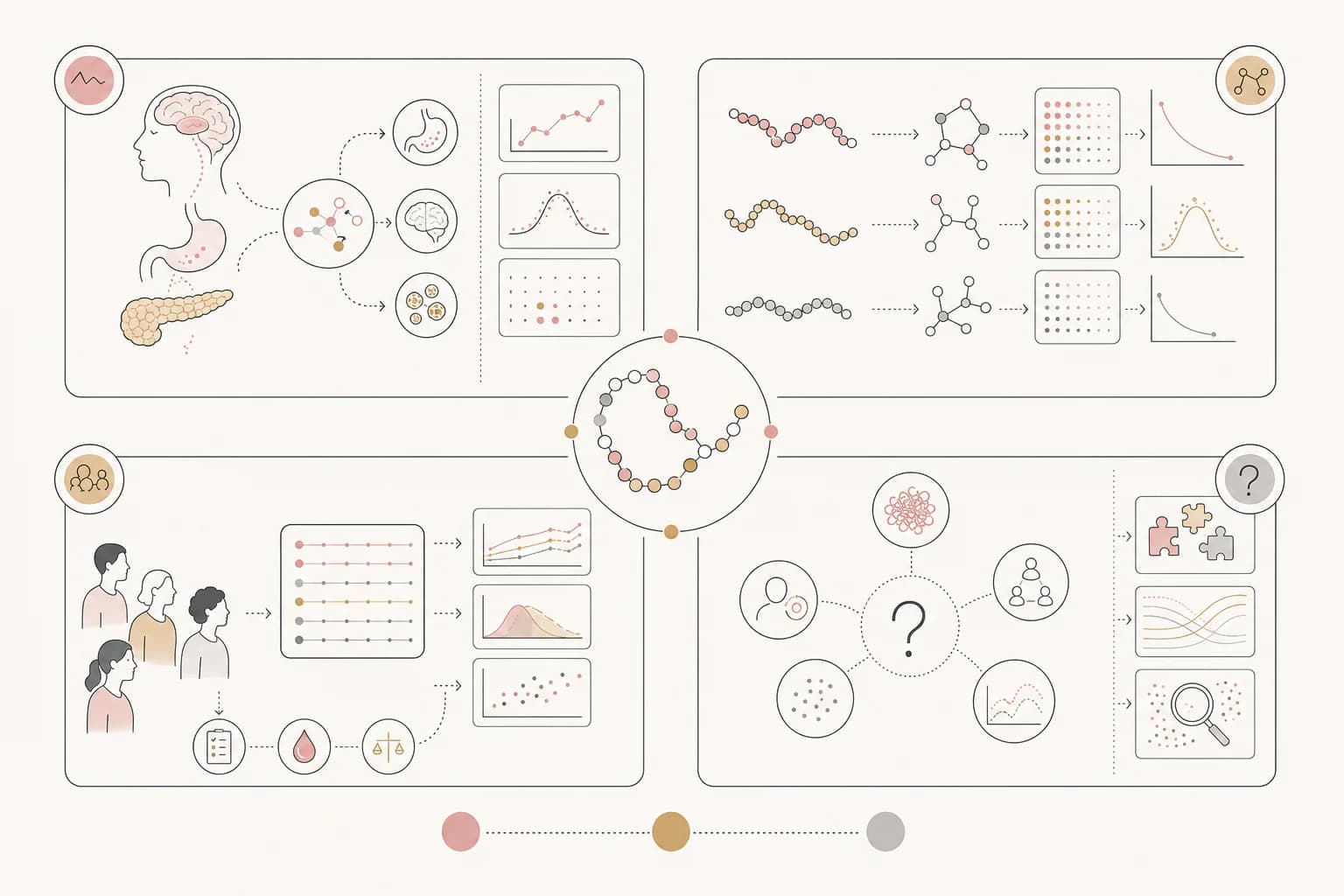
The most useful reading habit is to label every result by context.6 Receptor imaging is laboratory evidence; brain-circuit mapping is largely animal evidence.5 Randomized trials provide human evidence, but only for their enrolled populations and tested interventions.4 A combination result belongs to the combination.4
Funding and design also matter.4 Several major phase 3 trials were funded by the compound’s developer, while using randomization and masking to reduce bias.4 Those features should be considered together, not selectively.4 Philippine relevance requires similar care because nearby East Asian data are not locally representative data.10 The research is substantial enough to merit attention, yet context limits every conclusion.6 Scientific interest is strongest when it stays proportionate to what each study can actually answer.6
Bottom line
Cagrilintide is attracting attention because amylin offers a biologically distinct research pathway.2 Structural and animal studies are making that pathway more specific, from receptor motion to brainstem neurons.5 Human trials also show measurable outcomes, especially when cagrilintide is paired with semaglutide.4 Yet combination findings should remain combination findings.4 Animal mechanisms should remain animal mechanisms.7 For Filipino readers, the East Asian trial adds regional context without becoming Philippine-specific evidence.10 The balanced conclusion is neither dismissal nor hype.6 Cagrilintide research is worth following because several evidence layers now connect, while important questions about attribution and local relevance remain.6
Frequently asked questions
Is cagrilintide the same as amylin?
No.1 Amylin is a naturally released hormone involved in meal-related signaling.2 Cagrilintide is a long-acting research compound designed to activate amylin and calcitonin receptors.1 That distinction matters because an analogue can resemble a biological signal without being identical to it.5
Why study cagrilintide with semaglutide?
The two compounds act through different receptor systems, creating a scientific reason to test complementary effects.2 Randomized trials have evaluated the pair as one intervention.4 Their results show what happened with the combination, not what cagrilintide would necessarily achieve alone.4
Does the brain research involve people?
The strongest functional brain-circuit experiments described here were conducted in rats and mice.7 Researchers also mapped conserved cell populations across several species and assessed human conservation.3 That cross-species overlap supports further study, but it does not prove identical human function.3
What did the largest phase 3 trial find?
Among adults without diabetes, the combination produced a greater average body-weight reduction than placebo over 68 weeks.4 Gastrointestinal events were more common with the combination and were mainly temporary and mild to moderate.9 These are group findings from a controlled trial.4
Are there data relevant to East Asian populations?
Yes, a randomized trial enrolled adults in Japan and Taiwan.10 It found greater average body-weight reduction with the combination than semaglutide alone.10 However, the study did not enroll a Filipino cohort, so it should not be described as Philippine-specific evidence.10
What is the biggest evidence gap for readers?
Attribution is a key limit because much late-stage evidence concerns cagrilintide plus semaglutide.4 Nearby regional evidence also differs from Philippine evidence.10 Pooled analyses can combine unlike interventions and groups.6
This article is educational research context, not medical advice. Catalog links are neutral references and do not imply a treatment or human-use recommendation.
Sources
Footnotes
-
Structural and dynamic features of cagrilintide binding to calcitonin and amylin receptors.. Laboratory structural study of receptor-bound cagrilintide. Receptor structure does not establish clinical outcomes. ↩ ↩2 ↩3 ↩4 ↩5 ↩6
-
Amylin Analogs: The Next Major Class of Weight Loss Therapy: A Review of Experimental Data and Early-Phase Clinical Trials.. Narrative review of amylin physiology and preclinical and clinical research. This is a review-level summary, not a finding unique to cagrilintide. ↩ ↩2 ↩3 ↩4 ↩5 ↩6 ↩7 ↩8 ↩9 ↩10 ↩11 ↩12 ↩13
-
A cross-species atlas of the dorsal vagal complex reveals neural mediators of the effects of cagrilintide on energy balance.. Transcriptomic and spatial research across rats, mice, and macaques, with conservation assessed in human data. Most functional experiments were conducted in rats. ↩ ↩2 ↩3 ↩4 ↩5 ↩6 ↩7 ↩8
-
Coadministered Cagrilintide and Semaglutide in Adults with Overweight or Obesity.. Randomized, double-blind, multicenter phase 3 human trial with 3,417 adults. The result applies to the studied combination and population, not cagrilintide alone or Filipino adults specifically. ↩ ↩2 ↩3 ↩4 ↩5 ↩6 ↩7 ↩8 ↩9 ↩10 ↩11 ↩12 ↩13 ↩14 ↩15 ↩16 ↩17 ↩18 ↩19
-
Structural and dynamic features of cagrilintide binding to calcitonin and amylin receptors.. Laboratory structural and dynamic receptor analysis. The authors state these dynamics could contribute to clinical effects; the study does not prove that link. ↩ ↩2 ↩3 ↩4 ↩5 ↩6 ↩7 ↩8 ↩9 ↩10 ↩11 ↩12 ↩13 ↩14 ↩15 ↩16 ↩17 ↩18
-
Cagrilintide and CagriSema for weight reduction and metabolic risk modification in overweight or obesity: a systematic review and meta-analysis.. Systematic review and random-effects meta-analysis of four human trials totaling 5,023 participants. The pooled analysis combined cagrilintide alone and combination evidence, and estimates varied. ↩ ↩2 ↩3 ↩4 ↩5 ↩6 ↩7 ↩8 ↩9 ↩10 ↩11 ↩12 ↩13 ↩14 ↩15 ↩16 ↩17 ↩18
-
A cross-species atlas of the dorsal vagal complex reveals neural mediators of the effects of cagrilintide on energy balance.. Animal mechanistic experiment in rats. The result cannot be assumed to operate identically in people. ↩ ↩2 ↩3 ↩4 ↩5 ↩6
-
Cagrilintide lowers bodyweight through brain amylin receptors 1 and 3.. Three-week animal experiment in male knockout and wild-type mice fed a high-fat diet. This mechanistic animal result does not establish human effectiveness. ↩
-
Coadministered Cagrilintide and Semaglutide in Adults with Overweight or Obesity.. Safety results from a randomized phase 3 human combination trial. Trial reporting does not predict any individual's experience. ↩ ↩2 ↩3 ↩4 ↩5
-
Efficacy and safety of co-administered cagrilintide and semaglutide versus semaglutide alone in adults with overweight or obesity with or without type 2 diabetes in Japan and Taiwan (REDEFINE 5): a multicentre, randomised, active-controlled, phase 3a trial.. Randomized phase 3 human trial in 331 adults in Japan and Taiwan. The trial did not enroll a Filipino cohort and studied the combination rather than cagrilintide alone. ↩ ↩2 ↩3 ↩4 ↩5 ↩6 ↩7 ↩8 ↩9 ↩10 ↩11 ↩12
-
Efficacy and safety of co-administered cagrilintide and semaglutide versus semaglutide alone in adults with overweight or obesity with or without type 2 diabetes in Japan and Taiwan (REDEFINE 5): a multicentre, randomised, active-controlled, phase 3a trial.. Safety results from a randomized phase 3 human trial in Japan and Taiwan. Between-group percentages were close, and the result remains specific to the studied participants. ↩
-
Cagrilintide-semaglutide (CagriSema) versus semaglutide or cagrilintide in people with type 2 diabetes (REIMAGINE 2): a double-blind, randomised, controlled, phase 3 study.. Randomized, double-blind phase 3 human trial in adults receiving metformin with or without an SGLT2 inhibitor. The finding concerns a defined diabetes population and the combination, not cagrilintide alone. ↩ ↩2 ↩3 ↩4