
TL;DR
- Caffeine has pooled evidence from placebo-controlled trials that directly measured short-term attention in rested, healthy adult volunteers.1
- Its familiar lift is not one simple effect, because sleep timing, habitual use, and the task being tested can change what researchers observe.2
- Semax studies discussed here measured a brain-imaging pattern or outcomes in specific patient groups, not the same everyday attention question.3
- Selank adds another evidence lane: one record concerns patients with anxiety-related diagnoses, while a memory experiment was conducted in rats.3
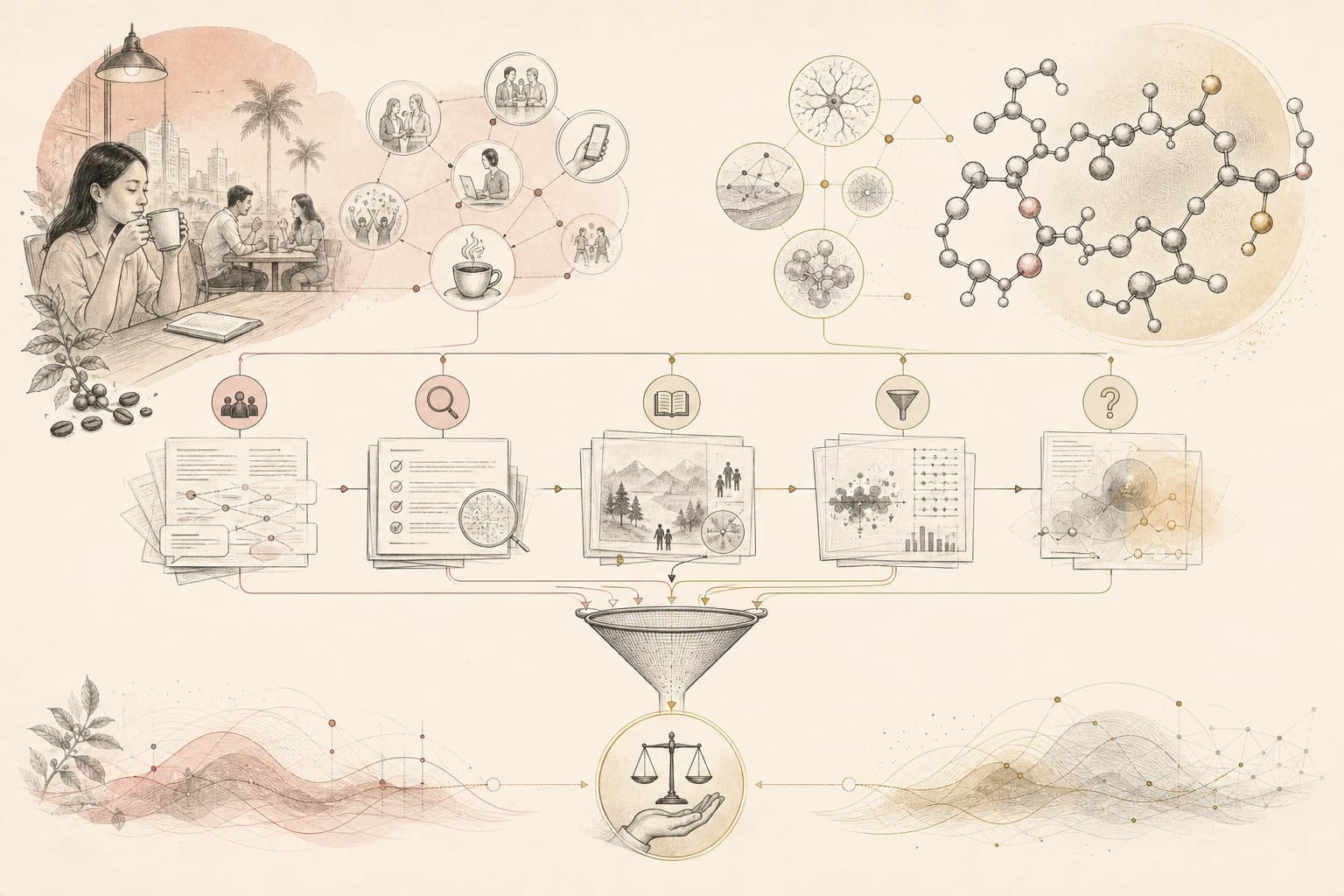
For Filipino readers moving between early classes, long commutes, shifting work hours, and late deadlines, “focus” can sound like one universal target. Yet a cup of coffee and a peptide described as nootropic arrive with very different research histories. The useful question is not which label feels more advanced. It is what researchers measured, in whom, and against what comparison.
First, separate the evidence lanes
A caffeine attention trial can give healthy adults caffeine or placebo, then time their responses on a task.1 A brain scan can instead map changes in activity or network shape without measuring better attention or memory.4 A rehabilitation study asks how patients with a diagnosed condition change on clinical scales.5 An animal experiment can connect behavior with biology under controlled conditions, but its result remains an animal result.6
These are not interchangeable versions of “brain performance.”3 They have different groups and endpoints.3 Their controls and time frames also differ.3 The word nootropic does not flatten those differences.3 Start with the study design.3 Then read the finding and carry its limit into the conclusion.3
For readers looking for the exact topic, the Semax card below opens its live catalog details.
Caffeine can answer a direct attention question
A 2025 review pooled 31 randomized, double-blind, placebo-controlled trials of pure caffeine in 1,455 rested healthy adults.1 The researchers combined behavioral attention tests rather than relying on opinions about feeling productive.1 The pooled effects favored caffeine for both accuracy and reaction time, and the average effects were small.1
That is a fairly direct match for a narrow question: can acute caffeine change performance on an attention task?1 It is not a measure of creativity, judgment, school grades, or an entire workday.1 It also does not turn every coffee, tea, or energy drink into the same experimental intervention.1
Even the amount analysis resisted a simple “more is better” story.7 Reaction time and accuracy followed different curves.7 Accuracy improved only to a point before declining.7 The result is a group-level research pattern, not a personal instruction.7
The caffeine story includes sleep and habit
Attention is only one part of the caffeine record.8 A systematic review found that caffeine typically delayed sleep onset and shortened total sleep time.8 It also reduced sleep efficiency and worsened perceived sleep quality.8 The review found patterns related to timing and amount across the included literature.8 These results do not predict an identical night for every reader.8
Habit can also change the comparison.2 In a study of 17 moderate daily caffeine consumers, effects on mood and choice reaction time were greater after 30 hours without caffeine.2 Selective attention and memory improved after caffeine both following abstinence and during normal caffeine use.2
That mixed pattern matters.2 Some of the familiar “back to normal” feeling may reflect relief after abstinence, while other task effects appeared in both states.2 One small study cannot define every routine, but it shows why culture and pharmacology can become tangled.2
A Semax brain scan measured a different endpoint
Semax is described in a clinical report as a synthetic derivative of the ACTH(4-10) peptide sequence.9 That identity says what the molecule is related to; it does not by itself demonstrate a cognitive result.9
The most directly relevant healthy-volunteer record here used resting-state functional magnetic resonance imaging, often shortened to fMRI.4 Researchers scanned 24 healthy volunteers before and shortly after the intervention.4 Fourteen received Semax and 10 received placebo.4 The report described a larger rostral medial-frontal part of the default mode network in the Semax group.4
That is an imaging endpoint, not a score for focus, recall, output, or daily function.4 A changed scan pattern can be a research observation without proving that a person performed a task better.4 It therefore cannot be placed beside caffeine reaction-time data as if both studies ran the same race.3
Patient findings stay with their patient groups
Other Semax records asked clinical questions in people with neurological disease.3 A 1997 report compared 30 patients during acute ischemic stroke who received Semax with combined intensive care against 80 patients receiving conventional care.10 The authors described faster restoration of some neurological functions in the combined-care group.10 The abstract did not describe random assignment, and its result cannot be reassigned to healthy-person focus.10
A later study followed 110 people after ischemic stroke.5 It separated early from late rehabilitation, then divided each group by Semax exposure.5 Researchers reported findings involving plasma BDNF, motor measures, and the Barthel index, a scale of everyday functioning after illness.5
Those endpoints matter within rehabilitation research.5 They do not answer whether a healthy reader becomes more attentive during study, office work, or a night shift.5 Population and purpose must travel with the finding.3
Mixed results deserve the same visibility
A 27-person Semax study in motor neuron disease offers a useful check against one-direction storytelling.11 It was open-label and used sequential groups, meaning participants and researchers were not working inside the same blinded setup as the caffeine trials.11 The report found no influence on chronic partial denervation or the clinical estimates it followed.11
The same abstract described a change in total quality-of-life scoring linked to emotional state and motivation.11 Both parts belong in the summary: the negative clinical findings and the reported positive quality-of-life finding.11 Neither part becomes evidence for sharper attention in a healthy person.11
This is what “mixed” should mean in practice.11 It does not erase a positive observation, and it does not hide a negative result.11 It keeps each measured outcome visible and tied to a small, specific patient study.11
Selank changes the question again
The selected human Selank record involved 62 patients with generalized anxiety disorder or neurasthenia, not rested healthy volunteers taking an attention test.12 Thirty received Selank and 32 received medazepam, an active comparator.12 The abstract reported similar anxiety-scale effects and additional antiasthenic and psychostimulant findings for Selank.12 It supplied limited numerical and design detail, so its wording should remain close to the report.12
A separate memory study was conducted in Wistar rats trained with a food reward.6 Researchers reported changes in serotonin metabolism and greater stability of a learned memory trace on later tests.6 That animal experiment may inform a hypothesis, but it cannot establish a matching memory effect in people.6
The two Selank records answer different questions from each other.3 Both also differ from the caffeine meta-analysis.3 A shared “nootropic” label does not make their endpoints comparable.3
For readers looking for the exact topic, the Selank card below opens its live catalog details.
Compare studies without building a false scoreboard
Begin with the population.3 Rested healthy adults, stroke patients, people with anxiety-related diagnoses, and rats are four different research settings.3 Next, name the endpoint: reaction time, scan pattern, rehabilitation scale, symptom rating, or learned animal behavior.3
Then inspect the comparator.3 Placebo-controlled caffeine trials, an active-drug Selank comparison, conventional-care stroke controls, and saline in a rat experiment do not create one common benchmark.3 Finally, note whether the result was acute, measured during rehabilitation, or followed across an animal memory protocol.3
This method prevents a common category error.3 A brain image is not a reaction-time score, and a patient-scale change is not proof of everyday enhancement in a healthy reader.3 The fair comparison is about evidence architecture, not a winner.3 Once the lanes are visible, the language becomes calmer and more accurate.3
Bottom line
Caffeine and nootropic peptides should not be presented as two entries on one focus menu.3 Caffeine has pooled, placebo-controlled evidence for small acute changes in attention tasks among rested healthy adults.1 Its wider story also includes sleep and the effects of habitual use.8 The Semax records here concern brain imaging and defined neurological patient groups.3 One small Semax study reported both negative and positive patient outcomes.11 The Selank records concern an anxiety-related patient comparison and a rat memory experiment.3
For readers in the Philippines, a sound method is to ask who or what was studied, which outcome moved, what served as the comparison, and where the conclusion must stop.3
This article is educational research context, not medical advice. Catalog links are neutral references and do not imply a treatment or human-use recommendation.
Frequently asked questions
Is caffeine a nootropic?
“Nootropic” is a broad label, while the strongest caffeine result discussed here is narrow and measurable.1 The meta-analysis found small acute improvements in accuracy and reaction time on attention tasks in rested healthy adults.1 That finding does not automatically cover every part of thinking or every caffeinated drink.1
Does caffeine always improve focus?
No single group average predicts every person or situation.1 The pooled attention result was acute and task-specific.1 The amount analyses differed for accuracy and reaction time.7 Sleep timing and habitual use add further context, so “focus” should be broken into the actual outcome being measured.8
Did the Semax fMRI study prove better cognition?
No. The 24-person study reported a difference in part of the brain’s default mode network after Semax compared with placebo.4 It measured resting-state imaging, not attention, memory, grades, productivity, or durable daily function.4 A scan result and a behavioral performance result are different endpoints.3
What did the Semax patient studies measure?
The records discussed here examined acute-stroke recovery, post-stroke rehabilitation measures, and outcomes in motor neuron disease.3 They included neurological scales, motor measures, plasma BDNF, electromyography, and quality of life.5 Those patient findings cannot be reassigned to cognitive enhancement in healthy adults.3
What does the Selank human study show?
The study compared Selank with medazepam in 62 patients with generalized anxiety disorder or neurasthenia.12 Its abstract reported similar anxiety-scale effects and additional findings for Selank, but provided limited design and numerical detail.12 It was not a placebo-controlled attention trial in rested healthy adults.12
Can the Selank rat memory result apply to people?
The rat experiment reported altered serotonin metabolism and greater memory-trace stability after Selank during a food-reward learning task.6 It can support a research hypothesis about that animal model.6 It cannot establish the same memory outcome in people, because species, setting, and measurement all differ.6
Sources
Footnotes
-
A systematic review and meta-analysis of the acute effect of caffeine on attention.. Systematic review and random-effects meta-analysis of pure caffeine tested with behavioral attention tasks. The pooled effects were acute group averages in rested healthy adults and do not describe every cognitive skill, person, drink, or long-term pattern. ↩ ↩2 ↩3 ↩4 ↩5 ↩6 ↩7 ↩8 ↩9 ↩10 ↩11 ↩12 ↩13 ↩14
-
A comparison of the effects of caffeine following abstinence and normal caffeine use.. Within-subject comparison of caffeine and placebo after 30 hours of abstinence or normal dietary caffeine use. This small study separates some withdrawal-relief effects from other task effects but cannot define all habitual-use responses. ↩ ↩2 ↩3 ↩4 ↩5 ↩6 ↩7
-
A systematic review and meta-analysis of the acute effect of caffeine on attention.; Effects of Semax on the Default Mode Network of the Brain.; [Effectiveness of semax in acute period of hemispheric ischemic stroke (a clinical and electrophysiological study)].; [The efficacy of semax in the tretament of patients at different stages of ischemic stroke].; [The study of chronic partial denervation and quality of life in patients with motor neuron disease treated with semax].; [Efficacy and possible mechanisms of action of a new peptide anxiolytic selank in the therapy of generalized anxiety disorders and neurasthenia].; [Experimental optimization of learning and memory processes by selank].. Cross-record comparison of populations, models, comparators, and endpoints. These different evidence lanes do not support a head-to-head ranking or a claim that one substance substitutes for another. ↩ ↩2 ↩3 ↩4 ↩5 ↩6 ↩7 ↩8 ↩9 ↩10 ↩11 ↩12 ↩13 ↩14 ↩15 ↩16 ↩17 ↩18 ↩19 ↩20 ↩21 ↩22 ↩23 ↩24 ↩25 ↩26 ↩27 ↩28 ↩29 ↩30 ↩31
-
Effects of Semax on the Default Mode Network of the Brain.. Small healthy-volunteer brain-imaging study with scans before and 5 and 20 minutes after the intervention. The measured endpoint was a resting-state imaging pattern, not attention, memory, work output, or a durable clinical outcome. ↩ ↩2 ↩3 ↩4 ↩5 ↩6 ↩7 ↩8 ↩9
-
[The efficacy of semax in the tretament of patients at different stages of ischemic stroke].. Post-stroke rehabilitation study with four timing-and-exposure subgroups and several correlated measures. The abstract does not provide a simple randomized placebo comparison, and its patient rehabilitation endpoints do not establish everyday focus in healthy readers. ↩ ↩2 ↩3 ↩4 ↩5 ↩6 ↩7
-
[Experimental optimization of learning and memory processes by selank].. Animal learning-and-memory experiment in which Selank or saline was given during the consolidation phase. A rat behavioral result cannot establish a matching memory effect in people. ↩ ↩2 ↩3 ↩4 ↩5 ↩6 ↩7
-
A systematic review and meta-analysis of the acute effect of caffeine on attention.. Subgroup meta-regressions within the 2025 systematic review. A meta-regression across trials is not an individualized dose guide and does not turn a larger amount into a better overall result. ↩ ↩2 ↩3 ↩4 ↩5
-
Coffee, caffeine, and sleep: A systematic review of epidemiological studies and randomized controlled trials.. Systematic review of epidemiological studies and randomized controlled trials on coffee, caffeine, and sleep. The word typically summarizes varied studies; it does not predict the same sleep response for every person or occasion. ↩ ↩2 ↩3 ↩4 ↩5 ↩6 ↩7
-
[Effectiveness of semax in acute period of hemispheric ischemic stroke (a clinical and electrophysiological study)].. Identity description in a clinical and electrophysiological report on acute ischemic stroke. Chemical lineage does not establish a cognitive outcome, clinical benefit, safety, or the identity and quality of a catalog item. ↩ ↩2
-
[Effectiveness of semax in acute period of hemispheric ischemic stroke (a clinical and electrophysiological study)].. Clinical and electrophysiological comparison in a specific acute-stroke population. The abstract does not describe random assignment, the intervention was added to other care, and the findings do not address cognitive enhancement in healthy adults. ↩ ↩2 ↩3
-
[The study of chronic partial denervation and quality of life in patients with motor neuron disease treated with semax].. Open-label clinical study using electromyography, functional scales, and a disease-specific quality-of-life scale. The mixed findings belong to a small patient study and should not be converted into a healthy-person cognition claim. ↩ ↩2 ↩3 ↩4 ↩5 ↩6 ↩7 ↩8 ↩9 ↩10
-
[Efficacy and possible mechanisms of action of a new peptide anxiolytic selank in the therapy of generalized anxiety disorders and neurasthenia].. Comparative patient study using Hamilton, Zung, and Clinical Global Impression scales plus a serum enkephalin measure. The abstract gives limited design and numerical detail, uses an active comparator, and does not test attention in rested healthy adults. ↩ ↩2 ↩3 ↩4 ↩5 ↩6 ↩7